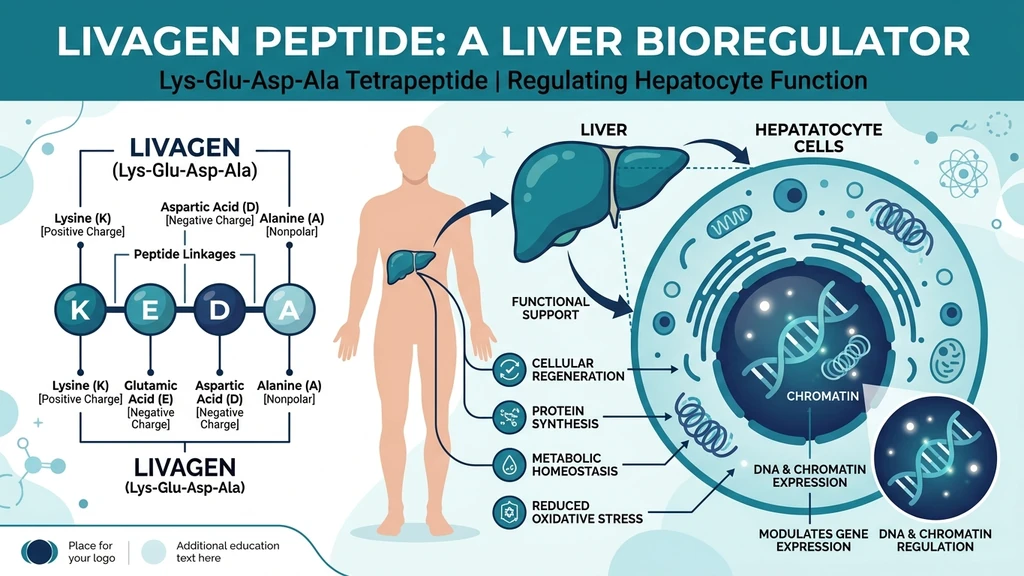
You found a vial labeled "Livagen" in a research-chemical catalog, filed next to Epitalon and Pinealon, with a product page that promises liver support and almost no data underneath. You search for a clinical trial and hit a wall of Russian abstracts. Here is the honest answer. Livagen is a synthetic four-amino-acid peptide (Lys-Glu-Asp-Ala, written KEDA) from the Khavinson "peptide bioregulator" program in Saint Petersburg, studied as a liver and gastrointestinal "cytogen." Researchers report that it influences gene activity in liver cells and digestive-enzyme function in the gut. The evidence is almost entirely Russian, almost entirely preclinical, run in cell cultures and animals, with no large human trials. It is not FDA-approved and is sold for research use only. This guide walks through what Livagen is supposed to do, what the data actually shows, and how research protocols report dosing it.
| Quick Reference | Detail |
|---|---|
| Sequence | Lys-Glu-Asp-Ala (KEDA, a tetrapeptide) |
| Class | Russian short-peptide bioregulator (cytogen) |
| Target tissue | Liver and gastrointestinal tract |
| Proposed effects | Liver-cell support, digestive-enzyme activity, aging modulation |
| Typical research dose | Microgram to low-milligram, injectable, in short cycles |
| Route | Subcutaneous or intramuscular (research) |
| Regulatory status (US) | Not FDA-approved, research use only |
| Evidence base | Russian in vitro and animal studies, no human RCTs |
The Khavinson lab treats short peptides as "bioregulators," each one cut like a key for one lock and addressed to a specific tissue. Livagen is the one addressed to the liver. The mechanism reads well on paper. The human evidence is thin in practice. Treat what follows as a map of the territory, not a prescription, and talk to a qualified physician before you experiment with any research peptide. For the wider family and how the class is supposed to work, start with our bioregulator peptides guide.
Get your custom peptide protocol:
- Tailored to your body and goals
- Precise dosing and cycle length
- Safe stacking combinations
- Backed by peer-reviewed studies
- Ready in under 2 minutes
What Is Livagen and Where Did It Come From?
You are probably trying to decode the name and the letters on the vial. Livagen is a synthetic four-amino-acid peptide: lysine, glutamic acid, aspartic acid, and alanine. The literature writes the sequence as Lys-Glu-Asp-Ala and shortens it to KEDA. The "liv" in the name points to the liver, the organ this peptide was designed to address.
Russian researchers at the Saint Petersburg Institute of Bioregulation and Gerontology developed it, the same group behind a whole family of short peptides aimed at specific organs. The lead scientist was Professor Vladimir Khavinson, a gerontologist who argued for decades that short peptides can "tune up" the tissue they are addressed to. His group placed Livagen in the "cytogen" line, the synthetic peptides built to mirror natural tissue-specific regulators.
The same lab built peptides for other organs. One for the brain, one for the heart, one for the pineal gland. Pinealon is the brain-targeted member and Cardiogen is the heart-targeted one, and both share Livagen's design logic and its evidence problem. For the brain sibling, see Pinealon peptide benefits, and for the heart sibling, see Cardiogen peptide benefits.
Regulatory status is worth pinning down before you spend money. In the United States, Livagen has no FDA approval for any medical use, and vials are sold strictly for laboratory research. It is not a prescribed drug and not a dietary supplement. If you are new to this category entirely, read getting started with peptides before you buy anything.
The Proposed Mechanism: How Livagen Is Supposed to Work
Picture a control room inside each liver cell, with switches that decide which genes run and how tightly the DNA is packed. The bioregulator theory says short peptides act like a technician who reaches specific switches and flips them back toward a younger setting. Livagen is supposed to be the technician assigned to hepatocytes, the liver's working cells.
That picture rests on a few specific claims, and you should weigh each one.
Claim one: it loosens chromatin and changes gene expression. The Russian model says KEDA enters the cell, reaches the nucleus, and interacts with DNA in a way that decondenses chromatin, making dormant genes readable again. A systematic review of this research line catalogs Livagen among peptides reported to bind DNA and modulate transcription in target tissues (Molecules, 2021).
Claim two: it is tissue-specific. The whole cytogen concept holds that each peptide acts mainly on the organ it was designed for. Livagen is framed as liver-and-gut-directed rather than a general metabolic agent. Work on this peptide family reports tissue-specific effects, with a given short peptide stimulating protein synthesis in its target tissue and not others (Bull Exp Biol Med, 2001).
Claim three: tiny doses, short cycles. Because the peptide is described as a signal rather than a drug substitute, research protocols use small amounts for a couple of weeks, then stop. The logic is that once the gene-expression pattern is nudged, you let the tissue run on the new setting.
Here is the catch. A peptide this small usually breaks apart in blood within minutes and struggles to enter cells, let alone reach the nucleus and find a specific DNA sequence. Western pharmacologists look at the chromatin-binding claim and ask for extraordinary proof. Russian labs report the results. Independent groups outside that network have not reproduced them with modern genomic tools. For the family-wide version of this same debate, see the bioregulator peptides guide.
What the Research Actually Shows
If you are deciding whether to spend money on this peptide, the most useful thing you can know is what the studies measured and where they were done. Almost every result below comes from Russian in vitro and animal work. Read the list as "here is what the literature reports," not "here is what science has proven."
Effects in liver-cell culture. The most direct Livagen study grew liver tissue in an organotypic culture and exposed it to the peptide, reporting changes in the structure and activity of the cultured hepatocytes (Adv Gerontol, 2002). This is a dish of liver cells, not a living liver, and the finding describes cell morphology rather than a treated disease.
Digestive-enzyme activity in the gut. A second study looked past the liver into the gastrointestinal tract, reporting that Livagen influenced the activity of digestive enzymes along the digestive system (Adv Gerontol, 2005). This places the peptide's proposed reach in the wider gut, consistent with its liver-and-GI framing.
KEDA and liver complexes in whole-organism aging work. Later work compared a polypeptide liver complex with the synthetic KEDA tetrapeptide and examined effects on physiological function in the whole organism (Adv Gerontol, 2020). It is animal-level research probing whether the synthetic peptide can stand in for a natural tissue extract.
Replication outside the original network. Almost none. The Livagen-specific literature is dominated by Saint Petersburg. In mainstream pharmacology, a mechanism only one network of labs can demonstrate is treated as provisional, no matter how interesting it reads.
That is the entire honest footprint. Two direct Livagen studies, a comparison study, plus the mechanism reviews. There is no Phase II or Phase III dataset because none has been published. The rodent and cell-culture findings may or may not translate to a person.
Reported vs Proven Benefits
You probably want a plain list of what this peptide is supposed to do, separated from what the data can actually support. Keep the two columns apart in your head, because the marketing merges them.
Reported: liver-cell support. Suppliers and the culture study frame Livagen as "supporting" hepatocytes, based on the morphology changes seen when liver tissue met the peptide in a dish. What is proven is a cell-culture observation, not improvement in any liver disease or blood marker in a human.
Reported: better digestion. The digestive-enzyme study is used to claim Livagen aids digestion. What is proven is a measured change in enzyme activity in an animal model, with no human trial showing better nutrient absorption, less bloating, or any clinical digestive outcome.
Reported: anti-aging and gene "reactivation." The chromatin-decondensation idea gets sold as reversing cellular aging in the liver. What is proven is a proposed molecular mechanism described mostly by one research group, flagged as unreplicated by independent labs in the review literature (Molecules, 2021).
What Livagen is not. It is not a proven treatment for fatty liver, hepatitis, cirrhosis, or any diagnosed liver condition. No approved indication exists. If you carry a liver diagnosis, your prescribed care stays put, and Livagen is at best an experimental question you raise with your physician, covered more fully in the peptide safety guide.
Dosage and Administration Context
Now you are looking at the vial and trying to figure out how it has been dosed. Important caveat first, and it is not boilerplate. No regulator has validated a Livagen dose for any human use, no human trial has established a safe or effective amount, and the vial is sold for research only. What follows is what research and suppliers report, not a protocol to follow.
Form. Livagen is a "cytogen," the injectable synthetic class, and ships as a lyophilized powder you would reconstitute before use. It is not designed as an oral capsule, unlike the natural "cytamin" liver extracts sold in Russia.
Commonly reported research pattern: - Dose: microgram to low-milligram amounts per administration in reported animal and exploratory work - Route: subcutaneous or intramuscular injection - Frequency: once daily - Duration: roughly 10 to 20 consecutive days per cycle, spaced months apart, following the bioregulator cycling logic
Reconstitution. Because the reported amounts are small, mixing the powder correctly matters more than usual. A misread on the syringe can swing your actual dose several-fold. Run the numbers with the peptide reconstitution calculator, and if you have never mixed a lyophilized peptide, read how to reconstitute a peptide first.
Why the cycles? The bioregulator model argues that once gene expression is nudged, continuous dosing is unnecessary and may dull the response. That is the opposite of how most drugs work, where you hold blood levels steady. Whether the cycling logic is correct depends entirely on whether the underlying mechanism story is correct, and that has not been independently confirmed.
Treat every number here as uncertain. You are extrapolating an animal-study amount to a human body with no clinical bridge, which is exactly the gap a physician exists to help you weigh.
Liver Safety and the Unknowns
You are about to consider a peptide that acts, in theory, on one of your most metabolically active organs, and the FDA has never reviewed it. This section is where caution earns its keep.
The liver is a high-stakes target. The liver clears drugs, filters toxins, and shows damage late, often after significant harm is already done. A compound proposed to change gene expression in hepatocytes deserves more caution than a peripheral peptide, not less, precisely because the reported mechanism reaches into cell regulation.
What the safety data actually covers. Reported adverse effects in the small Livagen studies are minimal, but that signal sits on a tiny animal database with short follow-up and essentially no human exposure. Absence of reported harm in a handful of animal studies is not evidence of human safety. Interaction studies with prescription medications do not exist.
If you have any liver condition, do not self-treat. Fatty liver disease, hepatitis, elevated liver enzymes, cirrhosis, or a transplant history all place you outside any scenario where self-experimentation is reasonable. Work with a hepatologist or physician who can monitor your liver function, not a supplier's product page.
Who should avoid Livagen entirely: - Pregnant or breastfeeding people: no safety data - People with active cancer: the proposed gene-regulation mechanism is a theoretical concern - Anyone with liver or biliary disease not cleared by a physician - Anyone under 18: no safety data
The single most practical risk is product identity. Because Livagen sells through research-chemical channels with little third-party testing, the vial may not contain what the label claims. New symptoms during use, such as abdominal pain, yellowing skin, dark urine, or unusual fatigue, are stop signals that warrant a physician, and the wider handling risks are covered in the peptide safety guide.
How Livagen Fits the Bioregulator Family
If you are weighing Livagen against its neighbors, seeing the family map helps. None of these peptides is FDA-approved, and every one shares the same thin, Russian-dominated evidence base. What differs is the target organ.
Livagen vs Pinealon. Pinealon (Glu-Asp-Arg) is the brain-targeted member, studied for neuron survival under stress. Same lab, same cycling logic, same evidence problem, different organ. See Pinealon peptide benefits.
Livagen vs Cardiogen. Cardiogen is the heart-directed peptide from the same cytogen line. Comparing the two side by side is the clearest way to see how the "one peptide per tissue" model is supposed to work. See Cardiogen peptide benefits.
Livagen vs Epitalon. Epitalon (Ala-Glu-Asp-Gly) is the pineal peptide from the same program, studied mostly for telomere and aging endpoints rather than a single organ. It is the most-discussed member of the family and a useful reference point for the whole class. See the Epitalon profile.
Livagen vs proven liver care. This is not a real comparison. For diagnosed liver disease, validated treatment, weight management, alcohol reduction, and metabolic control carry far more evidence than any research peptide. Livagen, if you use it, is an experiment layered on top of that foundation, never a replacement for it. Not sure where you sit in the peptide landscape? Our quiz points you toward the topics worth reading first.
Frequently Asked Questions
What is Livagen used for?
In Russian preclinical research, Livagen (Lys-Glu-Asp-Ala) is studied as a liver and gastrointestinal bioregulator, with reported effects on liver-cell structure and digestive-enzyme activity in cultures and animals. There is no approved human use. For the family it belongs to, see the bioregulator peptides guide.
Is Livagen FDA approved?
No. The FDA has not approved Livagen for any use, and no large human trial supports it. In the US it moves through research-chemical channels and is sold for laboratory use only, not as a drug or supplement. Before buying any research peptide, read the peptide safety guide.
Can Livagen support liver health?
Livagen is marketed for liver support based on cell-culture and animal studies, but no human trial shows it improves liver function, enzymes, or any liver disease. If you have a liver condition, work with a physician rather than self-treating, as explained in the peptide safety guide.
Is there human evidence for Livagen?
Essentially none. The Livagen literature is a small set of Russian preclinical studies in liver cultures and animals, with no large randomized human trials published. The wider peptide family shares this gap, detailed in the bioregulator peptides guide.
How is Livagen dosed?
Research reports use microgram to low-milligram amounts by injection, once daily, in 10 to 20 day cycles. These are not clinically validated human doses, since no regulator has established one. Calculate exact syringe units with the peptide reconstitution calculator before drawing anything.
Is Livagen safe?
Reported adverse effects in the few animal studies are minimal, but human exposure and interaction data are absent, and the liver is a high-stakes organ. Avoid use in pregnancy, active cancer, liver disease, and under age 18. Learn how to reconstitute and handle it safely in how to reconstitute a peptide.
How does Livagen compare to Pinealon and Cardiogen?
All three come from the same Khavinson cytogen program and share the cycling logic and thin evidence base, differing only in target organ: Livagen for the liver, Pinealon for the brain, Cardiogen for the heart. Compare them via Pinealon peptide benefits and Cardiogen peptide benefits.
Where does Livagen fit if I'm new to peptides?
Livagen is an experimental, unapproved research peptide, not a starting point for a beginner. If you are new, build the fundamentals of sourcing, reconstitution, and safety first through getting started with peptides before considering any obscure bioregulator.
The Bottom Line
Livagen sits in a category mainstream Western medicine does not yet know how to handle. A Russian liver-targeted tetrapeptide with an unusual proposed mechanism, a handful of preclinical studies on liver cells and digestive enzymes, and a safety signal that looks quiet only because almost no one has been dosed. The honest summary is that Livagen may act on hepatocytes and gut enzymes in cell and animal models, but no human trial supports its use, and the whole evidence base traces back to a single research network.
The liver raises the stakes. If you have any liver condition, self-treating with an unapproved peptide is the wrong move, and a physician who can monitor your liver function is the right one. If you are a curious researcher working with realistic expectations, dose by careful math, reconstitute correctly, and treat any result as uncertain rather than proof.
For peptides in the same research tradition, start with the bioregulator peptides guide, Pinealon peptide benefits, Cardiogen peptide benefits, and the Epitalon profile. For handling and dosing, use the peptide reconstitution calculator and how to reconstitute a peptide.
This is educational content. Livagen is not FDA-approved; consult a healthcare provider. Explore more peptide research and tools at https://peptidesexplorer.com.
References
- 1.Functional morphology of an organotypic liver culture exposed to the peptide livagen. Adv Gerontol, 2002. PMID 12577697
- 2.Effect of peptide Livagen on activity of digestive enzymes in gastrointestinal tract. Adv Gerontol, 2005. PMID 16075683
- 3.The influence of polypeptide liver complex and tetrapeptide KEDA on organism physiological function. Adv Gerontol, 2020. PMID 32362099
- 4.Tissue-specific effects of peptides. Bull Exp Biol Med, 2001. PMID 11713572
- 5.Peptide Regulation of Gene Expression: A Systematic Review. Molecules, 2021. PMID 34834147
Helpful Tools
Related Articles
Vilon Peptide: Benefits, Research, and Dosage
Vilon (Lys-Glu) is a Russian immune bioregulator dipeptide. Review the mechanism, research evidence, dosage context, and an honest look at the limits.
Vesugen Peptide: Vascular Bioregulator Research
Vesugen (Lys-Glu-Asp / KED) is a Russian vascular bioregulator studied for endothelial and vascular aging. Review the mechanism, dosing context, and evidence.
Pinealon Peptide: Benefits & Dosage
Pinealon (Glu-Asp-Arg) is a Russian bioregulator tripeptide studied for neuroprotection. Review the mechanism, benefits, dosing, and honest evidence quality.
Bioregulator Peptides: The Complete Khavinson Guide
Bioregulator peptides (Khavinson short peptides) are studied for tissue-specific gene regulation. Review the families, honest evidence, and safety gaps.