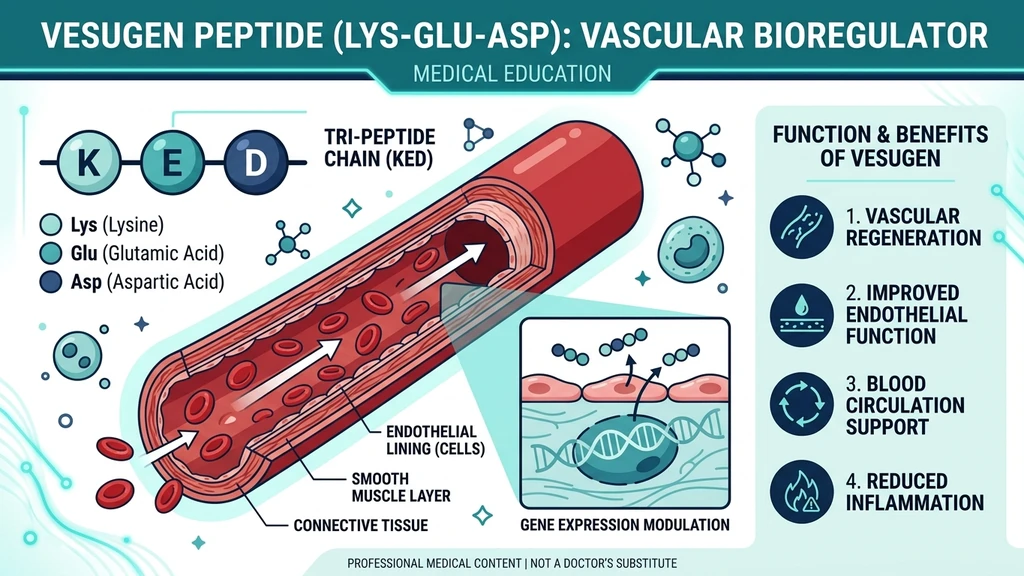
You found a vial labeled "Vesugen" in a research-chemical catalog, filed under "vascular support," with a product page that promises healthy arteries and slower vascular aging and almost nothing underneath to back it up. You search for trials and hit a wall of Russian abstracts. Here is the honest answer. Vesugen is a synthetic tripeptide (Lys-Glu-Asp, written KED) from the Khavinson "peptide bioregulator" program in Saint Petersburg, marketed as a vascular or endothelial "cytogen." Researchers report that it supports the cells lining blood vessels, slows changes tied to atherosclerosis, and helps vessels age more slowly. The evidence is almost entirely from one Russian group, largely preclinical, with only small non-replicated human data. It is not FDA-approved and is sold for research use only. This guide walks through what Vesugen is supposed to do, what the data actually shows, and how research and suppliers report dosing it.
| Quick Reference | Detail |
|---|---|
| Sequence | Lys-Glu-Asp (KED, a tripeptide) |
| Class | Russian short-peptide bioregulator (cytogen) |
| Target tissue | Vascular endothelium (blood vessel lining) |
| Proposed effects | Endothelial support, anti-atherosclerotic, slower vascular aging |
| Reported research dose | Roughly 1 to 10 mg, subcutaneous, in 10 to 20 day cycles |
| Route | Subcutaneous injection (research); oral capsule sold by some suppliers |
| Regulatory status (US) | Not FDA-approved, research use only |
| Evidence base | Russian in vitro and animal studies, limited human data, no Western RCTs |
The Khavinson lab treats short peptides as "bioregulators," each one cut like a key for a single lock. Every peptide is supposed to be addressed to a specific tissue, enter the cell, and switch certain genes on or off. Vesugen is the one addressed to the vascular wall. The mechanism reads well on paper. The human evidence is thin in practice, and blood vessel disease is not a low-stakes place to experiment. Treat what follows as a map of the territory, not a prescription, and work with a qualified physician before touching any research peptide. For the family overview, start with our bioregulator peptides guide.
Get your custom peptide protocol:
- Tailored to your body and goals
- Precise dosing and cycle length
- Safe stacking combinations
- Backed by peer-reviewed studies
- Ready in under 2 minutes
What Is Vesugen and How Is It Supposed to Work?
You are probably trying to decode the name and the letters on the vial. Vesugen is a synthetic three-amino-acid peptide: lysine, glutamic acid, and aspartic acid. The literature writes the sequence as Lys-Glu-Asp and shortens it to KED. The name points at "vessels," because the molecule was designed to target the vascular wall rather than a single organ.
Russian researchers at the Saint Petersburg Institute of Bioregulation and Gerontology developed it, the same group behind a family of short peptides aimed at specific tissues. The lead scientist was Professor Vladimir Khavinson, a gerontologist who argued for decades that short peptides can regulate the tissue they are addressed to by changing gene expression. A 2021 systematic review of that work catalogs KED among the short peptides reported to influence gene activity (Molecules, 2021).
Picture the inside of a blood vessel as a garden hose lined with a single sheet of living cells, the endothelium. That sheet controls how the vessel relaxes, how it repairs, and how easily plaque takes hold. The bioregulator theory says KED acts like a technician who tells that lining to keep dividing and renewing instead of aging out. In cell studies, KED was reported to influence genes tied to endothelial cell renewal during aging (Adv Gerontol, 2014).
Here is the catch worth holding onto. A peptide this small usually breaks apart in blood within minutes and struggles to get inside cells, let alone reach the nucleus and find a specific stretch of DNA. Western pharmacologists look at that gene-regulation claim and ask for extraordinary proof. Russian labs report the results; independent labs outside that network have not reproduced them with modern genomic tools. For the heart-targeted sibling built on the same logic, see Cardiogen peptide benefits, and for the brain-targeted one, see Pinealon peptide benefits.
What the Research Actually Shows
If you are deciding whether to spend money on this peptide, the most useful thing you can know is what the data really contains. Almost every finding below comes from the Khavinson group and a few allied Russian labs. Read the list as "here is what the literature reports," not "here is what science has proven."
Endothelial cell renewal during aging. The headline preclinical finding is that KED supports the cells lining vessels. In cultured human vascular cells, researchers reported that the peptide influenced the expression of genes governing endothelial proliferation, framing it as a way to counter age-related decline in the vessel wall (Adv Gerontol, 2014). This is in vitro work, not a human outcome.
Anti-atherosclerotic signaling. A second line of work looked at plaque biology. Short peptides including KED were reported to shift the molecular signals involved in atherosclerosis, such as markers of vascular inflammation and smooth-muscle behavior (Bull Exp Biol Med, 2014). Follow-up work examined KED specifically as a "vasoprotective" peptide in models of atherosclerosis and restenosis, the re-narrowing of a treated artery (Adv Gerontol, 2016).
The lower-limb human study. The one piece of human data most often cited is a study of peptide bioregulators in chronic arterial insufficiency of the legs, a condition where narrowed arteries starve the lower limbs of blood (Adv Gerontol, 2014). The authors reported improvement in the treated group. It is small, it comes from the originating research network, and it has not been replicated by independent Western trials, so treat it as a signal to investigate, not a settled result.
The pattern across all of it is consistent. The mechanism papers are cell and molecular studies, the human evidence is thin and single-source, and no large randomized placebo-controlled trial exists. For how this evidence problem repeats across the whole family, see the bioregulator peptides guide.
Reported Benefits vs What Is Actually Proven
You probably want a plain line between marketing and evidence. Suppliers describe Vesugen as a fix for arterial aging, blood pressure, and circulation. The published research supports a much narrower and softer set of claims, all preclinical or small-scale.
Reported by suppliers and enthusiasts. Slower vascular aging, better circulation, healthier blood pressure, protection against atherosclerosis, and support for recovery after vascular procedures. These are the claims driving sales pages.
Actually shown in studies. Changes in endothelial gene expression in cell culture (Adv Gerontol, 2014), shifts in atherosclerosis-related molecular markers in models (Bull Exp Biol Med, 2014), and one small human report in lower-limb arterial insufficiency (Adv Gerontol, 2014). That is the honest ceiling of the evidence.
What Vesugen is not. It is not a proven treatment for heart disease, high blood pressure, stroke prevention, or any diagnosed vascular condition. No approved drug indication exists anywhere in the West. If you have a cardiovascular diagnosis, your prescribed care stays exactly where it is, and Vesugen is at most an experimental add-on you clear with a physician first. For a broader safety frame before you consider any of this, read the peptide safety guide.
Dosage and Administration Context
Now you are looking at the vial and trying to figure out how it has been dosed. Important caveat first. What follows is what research protocols and suppliers report, not a clinically established human dose. No regulator has validated a Vesugen dose for any use, and the vial is sold for research only.
Commonly reported injectable protocol: - Dose: roughly 1 to 10 mg per administration in reported cytogen protocols - Frequency: once daily - Duration: 10 to 20 consecutive days per cycle - Repetition: cycles spaced months apart, following the bioregulator cycling logic
Oral capsules. Some suppliers sell Vesugen as an oral capsule rather than an injectable, on the theory that these short peptides survive digestion enough to signal. Oral bioavailability of a tripeptide is a real open question, and the capsule route has even less published support than the injectable one.
Reconstitution. Injectable Vesugen ships as a lyophilized powder you mix with bacteriostatic water before subcutaneous use. Getting the concentration right matters, so run the numbers with the peptide reconstitution calculator and read how to reconstitute a peptide before you draw anything into a syringe. If you are new to injectable peptides entirely, start with getting started with peptides.
Why the cycles? The bioregulator model argues that once gene expression is nudged, continuous dosing is unnecessary. That is the opposite of how most cardiovascular drugs work, where you hold a steady blood level day after day. Whether the cycling logic is correct depends on whether the underlying mechanism story is correct, and that has not been independently confirmed.
Cardiovascular Safety and the Unknowns
You are about to consider something the FDA has never reviewed, aimed at the one organ system where guessing wrong carries the highest cost. Blood vessels and the heart are high-stakes territory. The reported safety signal in the small studies is mild, but the gaps are large, and you should see them clearly.
What the studies report. Serious adverse events attributed to KED are not described in the small published work, and the reported tolerability looks mild. That signal sits on a tiny database with short follow-up and almost no human exposure, so do not read it as proof of long-term cardiovascular safety.
The interaction problem. Many people interested in a "vascular" peptide already take blood pressure medication, statins, or blood thinners. There is no interaction data for Vesugen against any of these. Layering an unstudied compound onto a real cardiovascular drug regimen is exactly the scenario where a physician needs to be in the loop.
Who should not use Vesugen at all: - Pregnant or breastfeeding people: no safety data - People with active cancer: theoretical concern, because the proposed mechanism touches gene regulation and cell proliferation - Anyone under 18: no safety data - Anyone with diagnosed heart or vascular disease who has not cleared it with their physician
The single most important rule. Cardiovascular disease is managed with treatments that have decades of trial evidence: blood pressure control, statins, antiplatelet therapy, and lifestyle change. Vesugen has one small human study. If you have chest pain, leg pain on walking, breathlessness, or any new vascular symptom, that is a doctor's visit, not a peptide experiment. Do not substitute Vesugen for prescribed care, and talk to a physician before adding it to anything. The general framework lives in the peptide safety guide.
How Vesugen Fits the Bioregulator Family
If you are weighing Vesugen against its neighbors, it helps to see the whole set. The Khavinson program built a short peptide for many major tissues, each one following the same "one key, one lock" logic and sharing the same thin, Russian-dominated evidence base.
Vesugen vs Cardiogen. Cardiogen is the heart-muscle member of the family, while Vesugen targets the vessel lining. They are often discussed together for cardiovascular aging, and they share the identical evidence problem: strong theory, mostly preclinical data, one lab network. See Cardiogen peptide benefits.
Vesugen vs Pinealon. Pinealon (Glu-Asp-Arg) is the brain-targeted tripeptide from the same program, studied for neuroprotection rather than vascular health. Same cycling logic, same replication gap, different target tissue. See Pinealon peptide benefits.
Vesugen vs Epitalon. Epitalon is the best-known peptide from the same lab, studied mostly for telomere and pineal aging endpoints, and it is often cycled alongside the tissue-specific bioregulators in anti-aging discussions. See the Epitalon profile.
Vesugen vs proven vascular care. This is not a fair comparison. For diagnosed vascular disease, validated treatments and lifestyle factors carry vastly more evidence than any research peptide. Vesugen, if you use it, is an experiment layered on top of that foundation, never a replacement for it. If you are still deciding where to start, the peptide quiz can point you toward better-evidenced options.
Frequently Asked Questions
What is Vesugen used for?
Vesugen (Lys-Glu-Asp, or KED) is a Russian bioregulator peptide studied as a vascular "cytogen," meaning it is aimed at the endothelial cells lining blood vessels. Researchers report effects on endothelial renewal and atherosclerosis markers, but these are preclinical. For the wider family, see the bioregulator peptides guide.
Is Vesugen FDA approved?
No. The FDA has not approved Vesugen for any use, and no large randomized human trial supports it. In the US it moves through research-chemical channels and is sold for laboratory use only, not as a drug or supplement. Before considering any research peptide, read the peptide safety guide.
Can Vesugen help heart or vascular health?
The evidence is one small human study in lower-limb arterial insufficiency plus preclinical work, so no confident cardiovascular benefit is established. Blood vessel disease is high-stakes, and Vesugen is not a substitute for validated treatment. Discuss any vascular concern with a physician and review the peptide safety guide first.
Is there human evidence for Vesugen?
Only limited data. The main human report studied peptide bioregulators in chronic arterial insufficiency of the legs and described improvement, but it is small, single-source, and unreplicated by Western trials. Most other findings are cell and animal studies. See how this repeats across the bioregulator peptides guide.
How is Vesugen dosed?
Reported research protocols use roughly 1 to 10 mg subcutaneously, once daily, in 10 to 20 day cycles, with some suppliers selling oral capsules. These are not validated human doses. Calculate exact syringe units with the peptide reconstitution calculator before drawing anything.
How do I reconstitute injectable Vesugen?
Injectable Vesugen arrives as a lyophilized powder you mix with bacteriostatic water before subcutaneous use, and precision matters because the doses are small. Follow how to reconstitute a peptide for the technique, then confirm your numbers with the peptide reconstitution calculator.
Is Vesugen safe?
Reported side effects in the small studies are mild, with no serious event clearly tied to the peptide, but the database is tiny and there is no interaction data with blood pressure medication, statins, or blood thinners. Avoid use in pregnancy, active cancer, and under age 18, and see the peptide safety guide.
How does Vesugen compare to Cardiogen or Pinealon?
All three are Khavinson tripeptides with the same cycling logic and the same thin evidence base, differing only in target tissue: Vesugen for vessels, Cardiogen for heart muscle, Pinealon for the brain. Compare them directly in Cardiogen peptide benefits and Pinealon peptide benefits.
The Bottom Line
Vesugen sits in a category mainstream Western medicine has not evaluated. A Russian vessel-targeted tripeptide with a plausible-on-paper mechanism, a body of preclinical endothelial and anti-atherosclerotic data, and one small human study in lower-limb arterial insufficiency. The honest summary is that it may influence the vascular wall in cell and animal models, but no large human trial supports broad use, and the whole evidence base traces back to a single research network.
Blood vessels are the wrong place to gamble. If you have a cardiovascular diagnosis, your foundation stays the same: validated treatment, blood pressure and lipid control, and lifestyle. Vesugen at best is an experimental add-on you clear with a physician, never a replacement for prescribed care. If you are a curious researcher working with realistic expectations, dose by careful math, handle the vial correctly, and treat any result as uncertain rather than proof.
For the peptides in the same research tradition, start with the bioregulator peptides guide, Cardiogen peptide benefits, and Pinealon peptide benefits. For handling and dosing, use the peptide reconstitution calculator and how to reconstitute a peptide.
This is educational content. Vesugen is not FDA-approved; consult a healthcare provider. Explore more peptide research and tools at https://peptidesexplorer.com.
References
- 1.Epigenetic aspects of peptidergic regulation of vascular endothelial cell proliferation during aging. Adv Gerontol, 2014. PMID 25051766
- 2.Molecular aspects of anti-atherosclerotic effects of short peptides. Bull Exp Biol Med, 2014. PMID 25408528
- 3.Molecular aspects of vasoprotective peptide KED activity during atherosclerosis and restenosis. Adv Gerontol, 2016. PMID 28539025
- 4.The efficacy of peptide bioregulators of vessels in lower limbs chronic arterial insufficiency. Adv Gerontol, 2014. PMID 25051774
- 5.Peptide Regulation of Gene Expression: A Systematic Review. Molecules, 2021. PMID 34834147
Helpful Tools
Related Articles
Vilon Peptide: Benefits, Research, and Dosage
Vilon (Lys-Glu) is a Russian immune bioregulator dipeptide. Review the mechanism, research evidence, dosage context, and an honest look at the limits.
Livagen Peptide: Liver Bioregulator Research
Livagen (Lys-Glu-Asp-Ala) is a Russian liver bioregulator tetrapeptide. Review the mechanism, research, dosage context, and honest evidence quality.
Pinealon Peptide: Benefits & Dosage
Pinealon (Glu-Asp-Arg) is a Russian bioregulator tripeptide studied for neuroprotection. Review the mechanism, benefits, dosing, and honest evidence quality.
Bioregulator Peptides: The Complete Khavinson Guide
Bioregulator peptides (Khavinson short peptides) are studied for tissue-specific gene regulation. Review the families, honest evidence, and safety gaps.