Your grandfather hands you a small white box with Cyrillic letters across the front. The pharmacy in Saint Petersburg sold it to him after his last cardiology visit. You search "Cardiogen" online and find almost nothing in English: a few Russian trial abstracts, a forum thread calling it a miracle peptide, and not much in between. The truth sits in the middle. Cardiogen is a tiny 4-amino-acid peptide (Ala-Glu-Asp-Pro, often shortened to AEDP) that Russian researchers claim acts like a tissue-specific signal flare for the heart. It is sold over the counter in Russia for aging-related cardiac support, dosed at 2 to 4 mg per day in short 10 to 20 day cycles. It is not FDA-approved, the human trials are small and almost entirely Russian, and Western cardiologists treat the whole bioregulator class with deep skepticism until somebody outside Saint Petersburg can replicate the results. This guide walks you through what Cardiogen is supposed to do, what the data actually shows, and how Russian clinicians dose it.
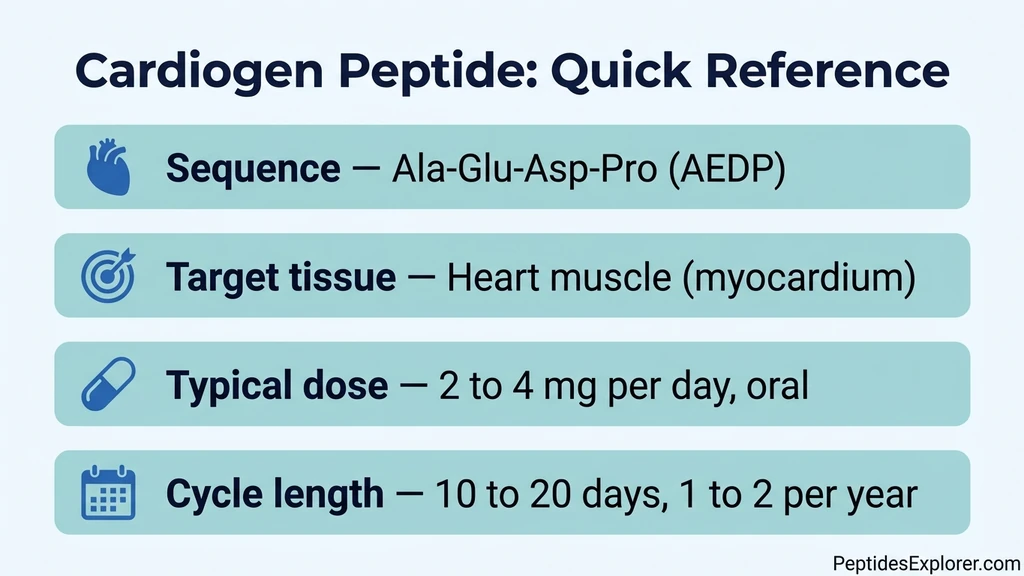
| Quick Reference | Detail |
|---|---|
| Sequence | Ala-Glu-Asp-Pro (AEDP, often shortened to AED) |
| Class | Russian short-peptide bioregulator |
| Target tissue | Myocardium (heart muscle) |
| Typical dose | 2 to 4 mg/day oral capsule |
| Cycle length | 10 to 20 days, 1 to 2 cycles/year |
| Route | Oral (capsule) or sublingual (liquid) |
| Regulatory status (US) | Not FDA-approved, not a prescribed drug |
| Evidence base | Russian animal and human studies, limited Western replication |
The Russian researchers behind it claim that very short peptides act as "bioregulators." Think of bioregulators as tiny postal codes: each peptide is supposed to be addressed to a specific organ, walk into the cell, and tell certain genes to switch on. Cardiogen is the one addressed to the heart. The mechanism is interesting on paper. The human evidence is thin in practice. Treat what follows as a map of the territory, not a prescription. Talk to a qualified cardiologist before you try any cardiovascular peptide, and read our peptide safety guide before you experiment with any research compound.
Get your custom peptide protocol:
- Tailored to your body and goals
- Precise dosing and cycle length
- Safe stacking combinations
- Backed by peer-reviewed studies
- Ready in under 2 minutes
What Is Cardiogen and Where Did It Come From?
You are probably looking at the box and trying to decode the abbreviations. Cardiogen is a synthetic four-amino-acid peptide: alanine, glutamic acid, aspartic acid, and proline. The literature uses two shorthand codes for it. AEDP comes from the four-letter sequence. AED is the older three-letter version. Both names point to the same molecule, and the same molecule sits inside commercial preparations like Cardiogen-VL and Chelochin.
Russian researchers at the Saint Petersburg Institute of Bioregulation and Gerontology built it in the late 1990s and early 2000s. The lead scientist was Professor Vladimir Khavinson, a gerontologist who spent his career arguing that you can purify short peptides from animal tissues and use them to "tune up" the same tissue in humans. Cardiogen came out of the cardiac-tissue side of that program (Khavinson, 2002).
The same lab built peptides for other organs too: one for the pineal gland, one for the thymus, one for the prostate. Cardiogen is the heart one. The lab's claim is that each peptide nudges its target organ back toward a younger gene-expression pattern. That claim has been demonstrated in their own cell cultures and in their own aged-rat studies, but no Western lab has independently reproduced the work using modern tools.
Regulatory status is worth pinning down before you spend money. In Russia, Cardiogen is registered as a "biologically active additive," which is roughly equivalent to a dietary supplement category in the US. You can buy it over the counter in Russian pharmacies. In the United States it has no FDA approval for any medical use, and it sits in a gray zone under research-chemical channels. For the broader picture on legality, see are peptides legal.
The Proposed Mechanism: How Bioregulators Are Supposed to Work
Picture a factory floor with thousands of switches on the wall. Each switch turns on a different machine. The bioregulator theory says short peptides are tiny technicians who walk around the factory and flip the right switches. Cardiogen is supposed to be the technician assigned to the heart.
That picture rests on three specific claims, and you should understand each one before you decide what to think.
Claim one: each peptide hits a specific tissue. The Russian model says short peptides slip into cells, walk into the nucleus, and bind to specific stretches of DNA near gene switches. Different peptide sequences bind to different switches. Cardiogen is supposed to bind switches near genes that build heart-muscle proteins. Khavinson's lab reported that AEDP preferred cardiac DNA fragments over liver or kidney fragments in their binding experiments (Khavinson & Malinin, 2005).
Claim two: aging tissue forgets its job, and the peptide reminds it. A young heart runs a specific recipe of contractile proteins and energy machinery. An aging heart drifts away from that recipe. The Russian claim is that Cardiogen pushes aged heart cells back toward the young recipe by waking up gene switches that have gone quiet.
Claim three: tiny doses, short cycles. Because the peptide is described as a signal rather than a drug substitute, you only need milligrams, and you only need them for a couple of weeks at a time. Once the gene-switch pattern is reset, you stop dosing and let the heart run on the new pattern for months.
Here is the catch. Most peptides this small fall apart in your blood within minutes. They have a hard time getting into cells, let alone reaching the nucleus and finding a specific DNA sequence. Western pharmacologists look at the proposed mechanism and say "extraordinary claims need extraordinary proof." Russian labs report the results. Western labs have not reproduced them with modern genomic tools.
That does not mean Cardiogen does nothing. It might work through a completely different route, like an anti-inflammatory metabolite or a placebo response in elderly patients who feel reassured by a doctor's care. Good research would tease those possibilities apart. That research has not been done.
Reported Benefits of Cardiogen
You probably want a list of what this peptide is supposed to do. Almost all of these claims come from Russian and Eastern European studies. The trials are small, often single-center, and rarely blinded to Western standards. Read the list as "here is what the literature says it does," not as "here is what science has proven."
Easier exercise and fewer angina episodes in older patients. Russian trials in patients over 60 with early cardiac dysfunction reported better walking tolerance, fewer chest pain episodes, and small improvements in echo measures like ejection fraction after a 10 to 20 day course. The reported benefit lasted 4 to 6 months before fading.
Cleaner-looking ECGs. Some studies reported reduced ST-segment abnormalities and better T-wave shape in patients with stable ischemic heart disease. The authors attributed this to better oxygen delivery and metabolism inside the heart muscle.
Steadier blood pressure day to day. In elderly patients with swingy blood pressure, Cardiogen was reported to flatten the day-to-day spikes without dropping the baseline. The proposed reason is better baroreceptor sensitivity, which is the reflex that keeps blood pressure stable when you stand up.
Quicker recovery after heart events. Russian cardiology protocols sometimes add Cardiogen to the standard rehabilitation plan after a heart attack or cardiac surgery. The intent is to help the heart muscle remodel and reduce scar burden. No randomized controlled trial that Western regulators would accept supports this use.
Used as part of an anti-aging stack. Russian clinicians often pair Cardiogen with a thymic peptide for immune support during the same cycle. The reasoning is that cardiovascular and immune aging move together and should be addressed together. For a thymic peptide with stronger Western evidence, see thymosin alpha-1 benefits.
What Cardiogen is not. It does not replace a single proven cardiovascular medication. Statins, beta blockers, ACE inhibitors, and anticoagulants have decades of randomized trial data behind them. Cardiogen has small open-label studies. If you have an established heart diagnosis, your prescribed regimen stays put. Cardiogen is at best an add-on you discuss with your physician.
Evidence Quality: An Honest Assessment
If you are deciding whether to spend money on this peptide, the most useful thing you can know is the quality of the evidence. Treat this section like a credit report on the data.
Cell and animal studies. Moderate volume. Khavinson's group and a handful of other Russian labs have published in vitro and in vivo experiments showing AEDP effects on heart cells, aged rat hearts, and rabbit ischemia models. They report higher contractile protein expression, better mitochondrial function, and less cell death after blood flow is cut off. Some of these papers sit in PubMed-indexed journals.
Human clinical trials. Low volume, low quality by Western standards. Most trials enroll fewer than 100 patients, lack a true placebo arm, and use open-label or single-blind designs. The endpoints are usually subjective, like symptom scores, rather than hard outcomes like death or rehospitalization. The trials cluster in three or four Russian research centers. Independent replication in Germany, Japan, or the US is essentially absent.
Replication outside the original network. Almost none. A few Chinese and Ukrainian labs have published related work on short peptide bioregulators, but the Cardiogen-specific literature is dominated by the Saint Petersburg institute. In mainstream pharmacology, a mechanism that only one network of labs can demonstrate is treated as provisional, no matter how interesting it sounds.
Mechanistic plausibility. Mixed. The proposed DNA-binding mechanism would rewrite parts of peptide pharmacology if true. Simpler explanations like an anti-inflammatory effect, a metabolite signal, or a placebo response have not been systematically tested.
Funding and publication bias. Most Cardiogen research is paid for by Russian state programs or by the same institute that sells the peptide. That is normal for a young compound, but it means the literature is not a disinterested source.
Here is what this means for you. The Russian trial claims may or may not translate to a person living in Toronto or Phoenix. Cardiogen may work. It may work through a different mechanism than its developers claim. It may not work at all in populations the Russian studies never enrolled. Some practitioners look at the low harm signal and the low cost and treat it as a low-stakes personal experiment. That is a defensible decision if you make it with clear eyes. It is not evidence-based medicine. For peptides with stronger Western backing, see BPC-157 vs TB-500 and what does TB-500 do.
Dosing Protocols Used in Russian Practice
Now you are looking at the box and trying to figure out how to actually take it. Russian cardiology protocols use Cardiogen in short bursts rather than as a daily long-term medication. The standard regimens come from the package inserts of commercial preparations like Cardiogen-VL and Chelochin and from the Khavinson group's papers.
Standard oral course: - Dose: 2 to 4 mg per day, taken as one morning capsule or split between morning and midday - Duration: 10 to 20 consecutive days per course - Repetition: 1 to 2 courses per year, usually spaced 4 to 6 months apart - Timing: 10 to 15 minutes before breakfast, on an empty stomach
Intensive course (used after a heart event): - Dose: 4 mg per day - Duration: 20 days - Repetition: Followed by a 4-month washout, then a maintenance course of 2 mg for 10 days
Sublingual liquid protocols (less common, used in some private clinics): - 100 to 200 mcg per drop, 2 to 4 drops under the tongue, hold for 60 seconds before you swallow - Same 10 to 20 day cycle structure
Reconstitution. Most commercial Cardiogen comes as pre-filled capsules. A smaller share comes as lyophilized powder you mix with bacteriostatic water for oral or sublingual use. For the basics on mixing peptides, see how to reconstitute peptide and the peptide reconstitution calculator.
Injectable Cardiogen exists in a handful of Russian research preparations, but you almost never see it used in routine practice. The oral form is reported to absorb well enough for the proposed mechanism, and injection adds work without obvious benefit in the published protocols.
Why the cycles? The bioregulator model argues that once gene expression is reset, you do not need to keep dosing, and continuous dosing might even dull the response over time. That logic is the opposite of how most drugs work, where you keep blood levels steady. Whether the cycling logic is correct depends on whether the underlying mechanism story is correct. For a more general dosing framework that covers mainstream peptides, see the peptide dosage chart.
Cardiogen vs Other Cardiovascular Peptides
If you are weighing Cardiogen against other options, a side-by-side helps. None of these peptides is FDA-approved for cardiac use, and the evidence quality varies a lot.
Cardiogen vs TB-500 (thymosin beta-4). TB-500 is a much longer peptide (43 amino acids) with substantial Western research on heart repair after ischemia, including animal data on heart-cell migration and new blood vessel growth (Bock-Marquette et al., 2004). TB-500 has a stronger mechanistic evidence base than Cardiogen, but it has the same regulatory status: no FDA approval for cardiac indications. See what does TB-500 do for a full profile.
Cardiogen vs BPC-157. BPC-157 is mainly a gut and musculoskeletal repair peptide, but a handful of rat studies suggest cardioprotective effects in arrhythmia models. Its evidence base is similar in size to Cardiogen's, but it is concentrated in Croatian rather than Russian labs. BPC-157 is currently attracting more replication interest in Western labs. See BPC-157 vs TB-500.
Cardiogen vs thymosin alpha-1. Thymosin alpha-1 is an immune peptide with some evidence in viral cardiomyopathy. It is not primarily a cardiac compound. The two peptides come from different classes and Russian clinicians sometimes stack them. See thymosin alpha-1 benefits.
Cardiogen vs conventional cardiac drugs. This is not a real comparison. Statins, beta blockers, ACE inhibitors, and dual antiplatelet therapy have decades of randomized trial evidence with hundreds of thousands of participants behind them. Cardiogen has a few hundred patients in small open-label studies. If you have known coronary disease, you do not substitute Cardiogen for the proven drug. You add it on top, with your cardiologist's input, or you skip it.
Where Cardiogen fits in a stack (if you decide to use it). Russian protocols use it alongside conventional medication for aging-related cardiac support, not as a replacement. It is sometimes cycled with peptides aimed at the pineal gland and the thymus on the theory that all three systems age together. These stacks do not have randomized trial evidence and you should treat them as experiments. For checking interactions before stacking, see the peptide interaction checker.
Safety, Side Effects, and Red Flags
You are about to put something into your body that the FDA has never reviewed. The safety record is reportedly good in the Russian trial population, but you should know exactly where the gaps are.
What Russian trials report. Side effects are rare. Patients occasionally describe mild stomach upset, brief headache, or mild sleep disturbance. No serious adverse event has been clearly attributed to Cardiogen in the published literature. That signal is reassuring, but it sits on a small database with short follow-up, so do not read it as proof of long-term safety.
Who should not take Cardiogen at all. - Pregnant or breastfeeding patients: never used, no safety data - Patients with active cancer: theoretical risk because the proposed mechanism touches gene regulation - Children under 18: never used, no safety data - Severe liver or kidney impairment: no dedicated pharmacokinetic studies - Anyone with a known allergy to peptide preparations or to the capsule excipients
Drug interactions. No rigorous interaction studies exist. Possible concerns that nobody has tested directly: - Additive effects with anticoagulants - Possible interference with beta blockers or calcium channel blockers - Unknown interactions with immunosuppressants if you stack it with a thymic peptide
In practice, because the dose is small and the cycle is short, the practical interaction risk is believed to be low. "Believed to be" is doing a lot of work in that sentence. Nobody has run the studies that would let you say "is."
Symptoms that should make you stop and call a cardiologist. Any new chest pain, palpitations, new shortness of breath, fainting, or sudden swelling during a Cardiogen cycle is a stop signal. Do not assume the new symptom is benign just because the peptide is described as gentle. The patients who take this peptide are usually older and often have known heart disease. The background rate of cardiac events in that group is high, and you cannot tell on your own whether a new symptom comes from the peptide or from the underlying disease.
Storage and handling. Capsules go in a cool dry place. If you have the powder form and you reconstitute it, refrigerate the liquid and use it within 2 to 4 weeks. For the broader storage framework, see how to store peptides.
The biggest practical risk: counterfeit product. Because Cardiogen is not FDA-regulated and most of the supply enters Western markets through gray channels, the box you bought may contain something different from what it claims. Third-party purity testing is rare in this category. For a general framework on peptide safety and sourcing, see the peptide safety guide.
Practical Takeaways for Readers Considering Cardiogen
If you have read this far, you are trying to decide what to do with the box on your kitchen counter. Here is the compressed answer.
Cardiogen is plausible, not proven. The mechanism story is interesting, the Russian clinical data is suggestive, and the safety signal looks reassuring. None of that meets the evidence bar Western regulators require. Good researchers treat Cardiogen as an open question.
It is not a substitute for proven cardiac drugs. If you have diagnosed coronary artery disease, heart failure, atrial fibrillation, or any other cardiac condition, your foundation is evidence-based medication and lifestyle change. Cardiogen at best is an add-on.
Risk is low, but not zero. Reported side effects are rare and mild. Unknown risks exist because the database is small. Counterfeit product is a real concern.
Cost is also low. A 20-day course of Cardiogen capsules runs roughly 30 to 80 dollars in Russian pharmacies and somewhat more through Western gray-market vendors. That makes it a low-cost personal experiment for people who want to try it with realistic expectations.
If you decide to try it, do this: 1. Tell your cardiologist before you start. If they push back, hear out the reasons. 2. Do not change or stop any prescribed medication. 3. Source from a vendor with third-party purity testing if you can find one. 4. Run a standard cycle: 2 to 4 mg per day for 10 to 20 days. 5. Track what you can measure. Blood pressure, resting heart rate, exercise tolerance, symptom frequency. Compare to your pre-cycle baseline. 6. Do not extrapolate from one cycle to broad claims about your health.
If you decide not to try it, that is equally reasonable. Cardiovascular aging is real, but the proven strategies (blood pressure control, lipid management, exercise, sleep, smoking cessation) have vastly more evidence behind them than any peptide intervention. For recovery-oriented peptide protocols with more Western research support, see peptides for recovery.
Frequently Asked Questions
What is Cardiogen peptide made of?
Cardiogen is a synthetic four-amino-acid peptide: alanine, glutamic acid, aspartic acid, and proline (Ala-Glu-Asp-Pro). You will see it abbreviated AEDP or AED in the literature. Russian researchers built it in the late 1990s as a heart-targeted bioregulator, part of a wider family of short peptides aimed at specific organs. For a peptide in the same broad family with stronger Western evidence, see thymosin alpha-1 benefits.
Is Cardiogen FDA-approved?
No. The FDA has not approved Cardiogen for any use. In Russia it is registered as a biologically active additive, which is roughly equivalent to a dietary supplement category, and you can buy it over the counter. In the US it moves through research-chemical and gray-market channels. For the legal landscape on peptides, see are peptides legal.
How is Cardiogen dosed?
The standard Russian protocol is 2 to 4 mg per day taken orally for 10 to 20 days in a row, repeated once or twice per year. You take the capsule in the morning on an empty stomach, 10 to 15 minutes before breakfast. Sublingual liquid versions exist at 100 to 200 mcg per drop. For mixing powder preparations, see the peptide reconstitution calculator.
What are the benefits of Cardiogen?
Russian clinical trials report better exercise tolerance, fewer angina episodes, cleaner ECG patterns, and small improvements in echocardiogram measures of left ventricular function in aging patients. These results come from small, mostly unblinded studies and have not been replicated in Western trials. Treat the benefits as provisional rather than proven. For dosing context across peptides, see the peptide dosage chart.
Is Cardiogen safe?
Reported safety in Russian trials is good. Mild side effects (brief headache, stomach upset, sleep disturbance) show up rarely, and no serious adverse event has been clearly tied to the peptide. The database is small, follow-up is short, and drug interaction studies are missing. Avoid use during pregnancy, in active cancer, or in children. For the broader framework, see the peptide safety guide.
How does Cardiogen compare to TB-500 or BPC-157 for cardiac repair?
TB-500 (thymosin beta-4) has more mechanistic evidence for heart repair in Western labs, including data on heart-cell migration and new blood vessel growth. BPC-157 has some cardioprotective data in rat arrhythmia models. Cardiogen has a different proposed mechanism (gene regulation) and a Russian-dominated evidence base. None has FDA approval for heart use. See BPC-157 vs TB-500 for a side-by-side.
Can I take Cardiogen with my blood pressure or heart medication?
No rigorous interaction studies exist for Cardiogen with beta blockers, ACE inhibitors, calcium channel blockers, anticoagulants, or statins. Because the dose is low and the cycle is short, real-world interaction risk is believed to be low, but no one has proven that. Never change or stop a prescribed cardiac medication to try Cardiogen. Talk to your cardiologist first. See how to store peptides for handling guidance.
Why is Cardiogen controversial in Western medicine?
Three reasons. The proposed mechanism (tiny peptides entering cells and binding DNA switches) would rewrite peptide pharmacology and has not been independently replicated outside Saint Petersburg. The clinical trials are small, often unblinded, and clustered in a handful of Russian centers. Funding and publication bias is high because most studies come from the institute that built and sells the peptide. None of this proves Cardiogen does not work. It means the evidence does not yet meet Western regulatory standards. For peptides with stronger evidence, see peptides for recovery.
The Bottom Line
Cardiogen sits in a category that mainstream Western medicine does not know how to handle. A Russian heart-targeted peptide with an unusual proposed mechanism, a suggestive but limited clinical database, and a safety profile that looks reassuring without being stress-tested. The honest summary is that it may help some aging-related cardiac complaints in some patients, probably through a mechanism simpler than the one its developers describe, but the evidence does not yet support broad clinical use.
If you have an established cardiac diagnosis, your foundation stays the same: proven medication, blood pressure control, lipid management, exercise, and sleep. Cardiogen at best is an add-on that does not change the basics. If you have mild aging-related symptoms and a curiosity about low-cost peptide experiments, Cardiogen is one of the lower-risk options in its class, but track your outcomes honestly and treat the results as uncertain.
The broader lesson reaches past Cardiogen. The whole short-peptide bioregulator class is interesting enough to deserve serious Western replication, and it has not received it. Until somebody outside Saint Petersburg runs the work with modern tools, decisions about these compounds are personal rather than clinical. Reasonable people can read the same data and reach different conclusions. For peptides with more Western validation, start with thymosin alpha-1 benefits, what does TB-500 do, or BPC-157 vs TB-500. For general peptide protocols and safety, see the peptide dosage chart, peptide safety guide, and how to store peptides.
Related Articles: - Thymosin Alpha-1 Benefits - What Does TB-500 Do - BPC-157 vs TB-500 - Peptides for Recovery - Peptide Safety Guide - Are Peptides Legal
Related Articles
Vilon Peptide: Benefits, Research, and Dosage
Vilon (Lys-Glu) is a Russian immune bioregulator dipeptide. Review the mechanism, research evidence, dosage context, and an honest look at the limits.
Vesugen Peptide: Vascular Bioregulator Research
Vesugen (Lys-Glu-Asp / KED) is a Russian vascular bioregulator studied for endothelial and vascular aging. Review the mechanism, dosing context, and evidence.
Livagen Peptide: Liver Bioregulator Research
Livagen (Lys-Glu-Asp-Ala) is a Russian liver bioregulator tetrapeptide. Review the mechanism, research, dosage context, and honest evidence quality.
Pinealon Peptide: Benefits & Dosage
Pinealon (Glu-Asp-Arg) is a Russian bioregulator tripeptide studied for neuroprotection. Review the mechanism, benefits, dosing, and honest evidence quality.