You found a vial labeled "Thymalin" in a research-chemical catalog, shelved next to Vilon and Epitalon, with a product blurb promising immune restoration and healthier aging. You go looking for a clinical trial and hit a wall of decades-old Russian abstracts. Here is the honest answer. Thymalin is a peptide preparation extracted from the thymus gland, developed by the Khavinson group in Saint Petersburg as an immune-targeted bioregulator. It is a polypeptide fraction, not a single defined sequence. Russian clinical work reports that it restores immune markers in older and immunocompromised patients, and it is the most human-observed member of that whole peptide family. The evidence is still single-network, largely from older Russian journals, with no independent Western randomized trials. It is not FDA-approved and is sold for research use only. This guide covers what Thymalin is, what the human data actually shows, and how research protocols report dosing it.
| Quick Reference | Detail |
|---|---|
| Class | Thymus-derived polypeptide preparation (a fraction, not one sequence) |
| Origin | Khavinson bioregulator program, Saint Petersburg |
| Target tissue | Thymus and immune system |
| Proposed effects | Immune restoration, T-cell support, geroprotection |
| Typical research dose | ~10 mg total per course, intramuscular, in short cycles |
| Route | Injection (research use) |
| Regulatory status (US) | Not FDA-approved, research use only |
| Evidence base | Russian clinical reports plus preclinical work, older studies |
The Khavinson lab treats these preparations as bioregulators, each one addressed to a specific tissue. Thymalin is the one aimed at the thymus, the small gland behind the breastbone that trains immune cells and shrinks steadily with age. Of every peptide in this program, Thymalin has the most human observation behind it, which makes it worth reading carefully and still worth reading skeptically. For the wider family this belongs to, start with the bioregulator peptides guide.
Get your custom peptide protocol:
- Tailored to your body and goals
- Precise dosing and cycle length
- Safe stacking combinations
- Backed by peer-reviewed studies
- Ready in under 2 minutes
What Thymalin Is and Where It Came From
You are probably trying to work out whether this is a defined drug or something looser. Thymalin is a preparation extracted from calf or cattle thymus tissue, then processed into a mix of small polypeptides. It is not a single molecule with one amino-acid sequence. That distinction matters, because a fraction is harder to standardize and harder to reproduce than a synthetic peptide with a fixed formula.
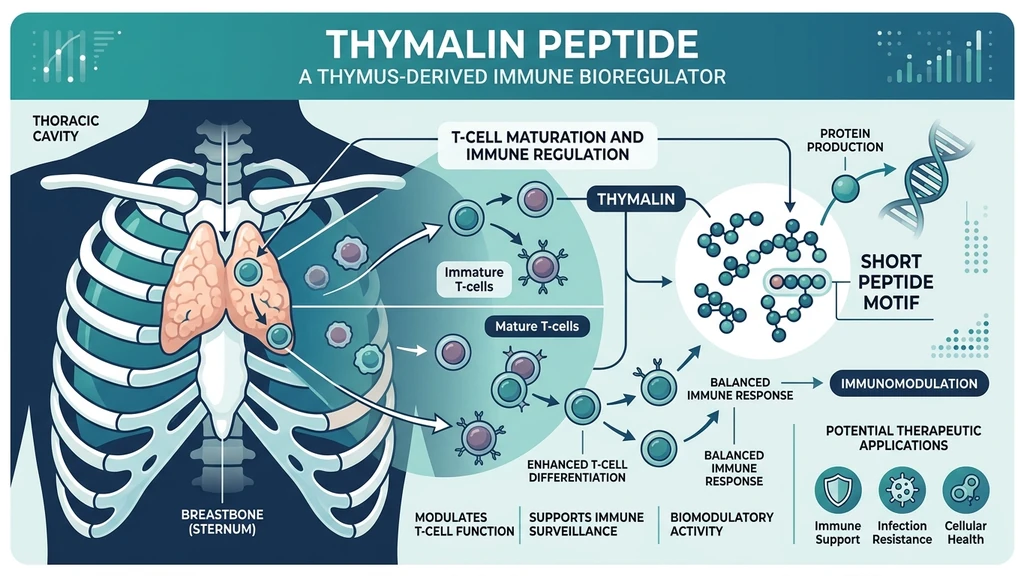
The thymus is where immature T-cells go to mature into functioning immune cells. It is largest in childhood, then shrinks across adult life in a process called thymic involution, which is one reason immune defense weakens with age. Thymalin was built on the idea that a thymus-derived signal could push aging or damaged immune tissue back toward a younger pattern of behavior.
Russian researchers at the Saint Petersburg Institute of Bioregulation and Gerontology developed it, the same group behind a family of tissue-targeted peptides. The lead scientist was Professor Vladimir Khavinson, a gerontologist who spent decades arguing that short peptides can tune the tissue they are addressed to. Thymalin was one of the earliest and most studied products of that program, with clinical reports going back to the early 1980s (Voen Med Zh, 1982).
Thymalin sits close to Vilon, a later synthetic dipeptide from the same lab that was framed as a defined stand-in for this kind of thymic signal. Regulatory status is worth pinning down before you spend money. In the United States, Thymalin has no FDA approval for any medical use, and vials move strictly through research channels. It is neither a prescribed drug nor a dietary supplement. Before you handle any research peptide, read the peptide safety guide.
The Proposed Mechanism: How Thymalin Is Supposed to Work
Picture the thymus as a training academy for immune cells. Raw recruits arrive, get taught to tell friend from foe, and graduate as T-cells that patrol the body. As the academy ages, it shrinks and graduates fewer well-trained cells. The bioregulator theory says Thymalin acts like a set of training materials sent back into that fading academy to restore its output.
That picture rests on one central claim. Thymalin is supposed to supply thymus-derived peptide signals that help immune precursor cells mature and organize. In the group's own laboratory work, Thymalin was reported to activate the differentiation of human hematopoietic stem cells, the master cells that give rise to blood and immune lineages (Bull Exp Biol Med, 2020). The proposed reading is that Thymalin nudges these early cells toward becoming functional immune cells.
The broader Khavinson model goes further and argues that peptides like this reach the cell and influence gene expression, shifting the activity of genes tied to immune function and aging (Neuro Endocrinol Lett, 2002). In that framework, restoring immune output is one arm of a wider geroprotective effect, meaning a slowing of some age-related decline.
Here is the catch. Because Thymalin is a tissue extract rather than one defined molecule, pinning the effect to a specific mechanism is harder than for a single synthetic peptide. Independent groups outside the originating network have not reproduced the gene-level and stem-cell findings with modern tools. The mechanism reads coherently on paper. It has not been independently confirmed in the way Western pharmacology expects.
What the Research Actually Shows
If you are deciding whether to spend money on this peptide, the most useful thing you can know is the quality of the data. Treat this section like a credit report on the evidence. Thymalin scores higher than its siblings on one axis and still fails the Western standard on another.
The human observation is the real distinction. Thymalin is the most human-observed peptide in the entire Khavinson family. Early Russian clinical work described giving it to immunocompromised patients and tracking recovery of immune parameters (Voen Med Zh, 1982). Later reports positioned it as a geroprotector, describing improved immune and physiological markers in older people over extended follow-up (Adv Gerontol, 2002).
The preclinical anchor. The most concrete recent mechanistic finding is that Thymalin activated differentiation of human hematopoietic stem cells in laboratory work (Bull Exp Biol Med, 2020). That gives the immune-restoration story a plausible cellular route, at least in vitro.
Replication outside the original network. Almost none. The Thymalin literature is dominated by Saint Petersburg and allied labs, and much of it is older, published in Russian-language journals. In mainstream pharmacology, a finding that only one network can produce is treated as provisional, no matter how many patients it describes.
Modern Western randomized trials. Absent. There is no large, placebo-controlled, independently run trial of Thymalin. You cannot point to a Phase II or Phase III dataset, because none has been published outside that tradition.
Here is what this means for you. The immune findings may translate reliably, or the effect may be smaller, less durable, or route through mechanisms the developers did not describe. The human record is genuinely larger than for Vilon or the other siblings, and it is still not the kind of evidence a regulator accepts. For an immune peptide with stronger Western backing, see thymosin alpha-1 benefits.
Reported Benefits vs Proven Benefits
You probably want a plain list of what this peptide is supposed to do. Almost every claim below comes from Russian clinical and preclinical work. Read the list as "here is what the literature reports," not "here is what science has proven."
Immune restoration. The headline claim is that Thymalin rebuilds a weakened immune response, especially where the thymus has aged or been suppressed. Early clinical reports described recovery of immune parameters in immunocompromised patients (Voen Med Zh, 1982). This is observational clinical work, not a validated immune therapy.
Geroprotection and healthier aging. The most-cited later work framed Thymalin as a geroprotector, reporting improved markers and outcomes in older patients over long follow-up (Adv Gerontol, 2002). This positions Thymalin inside a broader aging framework, which is a theory of use rather than a demonstrated outcome.
T-cell and stem-cell support. The proposed cellular basis is that Thymalin helps immune precursor cells mature, supported by the stem-cell differentiation finding (Bull Exp Biol Med, 2020). This is preclinical evidence for a plausible route, not proof of clinical benefit.
What Thymalin is not. It is not a proven treatment for immune deficiency, infection, cancer, or any diagnosed disease. No approved indication exists anywhere the FDA governs. If you have a diagnosed condition, your prescribed care stays put, and Thymalin is at best an experimental add-on you discuss with a physician. If you are new to this class, the getting started with peptides guide sets realistic expectations before you buy anything.
Dosage and Administration Context
Now you are looking at the vial and trying to work out how it has been dosed. Important caveat first. These are commonly reported research protocols, not clinically established Western human doses. No US regulator has validated a Thymalin dose for any use, and the vial is sold for research only.
Commonly reported injection protocol: - Dose: roughly 5 to 20 mg per treatment course, often cited around 10 mg total - Frequency: once daily - Duration: short cycles of about 5 to 10 days - Repetition: courses spaced months apart, following the bioregulator cycling logic - Route: intramuscular injection in the original clinical protocols
Reconstitution. Thymalin ships as a lyophilized powder you mix with bacteriostatic water before use. Getting the concentration right matters, because a small misread on the syringe swings the dose several-fold. A vial reconstituted to 10 mg in 2 mL delivers 5 mg per mL, so 10 mg is a full 2 mL draw. Read how to reconstitute a peptide first, then run your numbers through the peptide reconstitution calculator so you know how many syringe units equal your intended dose.
Why the short cycles? The bioregulator model argues that once the thymic signal is delivered, continuous dosing is unnecessary and may dull the response. That logic runs opposite to most drugs, where you hold blood levels steady. Whether the cycling logic is correct depends on whether the underlying mechanism story is correct, and that has not been independently confirmed (Neuro Endocrinol Lett, 2002). Not sure this peptide fits your goal at all? The peptide quiz is a faster starting point than guessing at a protocol.
Safety and the Unknowns
You are about to handle something the FDA has never reviewed. The reported safety signal across the Russian clinical work is mild, and the gaps around it are still real. You should know exactly where they are.
What the studies report. Across the clinical reports, Thymalin is described as well tolerated, with side effects rare and mild and no serious adverse event clearly attributed to the preparation. That signal comes from more human exposure than any sibling peptide can claim. It still rests on older studies, run by one network, without the long-term controlled follow-up a Western regulator would demand.
The extract problem. Because Thymalin is an animal-tissue fraction rather than a defined synthetic peptide, batch-to-batch consistency and purity are harder to guarantee. A biological extract also carries a theoretical risk of allergic or immune reaction to contaminating proteins, which a single-molecule peptide does not.
Who should avoid Thymalin entirely. - Pregnant or breastfeeding people: no safety data - People with active cancer: theoretical concern, since the proposed mechanism touches immune and gene regulation - People with autoimmune disease: modulating immune activity cuts both ways and deserves a physician conversation first - Anyone under 18: no safety data
The biggest practical risk: counterfeit or impure product. Because Thymalin moves through research-chemical channels with little third-party testing, the vial may not contain what the label claims, at the purity it claims, and an extract is especially hard to verify by eye. The full framework for vetting a source and handling risk sits in the peptide safety guide. Any new or unexpected symptom during use is a stop signal that warrants a physician.
Thymalin vs Thymosin Alpha-1 vs Vilon
If you are weighing Thymalin against its neighbors, a side-by-side helps. None of these is FDA-approved in the United States, and the evidence quality varies sharply between them.
Thymalin vs thymosin alpha-1. This is the most useful contrast. Thymosin alpha-1 is a single, defined synthetic peptide with a specific 28-amino-acid sequence, a far larger Western clinical literature, and real regulatory use in some countries. Thymalin is an undefined thymus fraction with a mostly Russian evidence base. If your interest is evidenced immune support built on a reproducible molecule, thymosin alpha-1 benefits is where the stronger data lives.
Thymalin vs Vilon. Same lab, same thymic target, different form. Thymalin is the older extract with the most human observation of any Khavinson peptide. Vilon is a synthetic dipeptide framed as a defined, reproducible stand-in for that thymic signal, which makes it cleaner on paper but backed by even less human data than Thymalin.
Thymalin vs Pinealon and Epitalon. Same program, same cycling logic, same single-network evidence problem, different target tissue. Pinealon is aimed at brain neurons and Epitalon at the pineal gland and aging endpoints. Thymalin is the immune-and-thymus member and the one with the deepest clinical paper trail.
Thymalin vs proven care. This is not a real comparison. For a diagnosed immune problem, validated treatment has vastly more evidence than any thymus extract. Thymalin, if you use it, is an experiment layered on top of that foundation, never a replacement for it.
Frequently Asked Questions
What is Thymalin used for?
In Russian research, Thymalin is studied as a thymus and immune bioregulator, with clinical reports describing restored immune markers in older and immunocompromised patients. These are single-network clinical and preclinical findings, not an FDA-approved use. For an immune peptide with stronger Western data, see thymosin alpha-1 benefits.
Is Thymalin FDA approved?
No. The FDA has not approved Thymalin for any use, and there is no independent Western randomized trial behind it. In the US it moves through research-chemical channels and is sold for laboratory use only, not as a drug or supplement. Before handling any research peptide, read the peptide safety guide.
Is there human evidence for Thymalin?
More than for any other Khavinson peptide, but still limited. Russian clinical reports describe restored immune parameters in patients and geroprotective effects over long follow-up (Adv Gerontol, 2002). None of it is a modern independent randomized trial. The wider family is covered in the bioregulator peptides guide.
How is Thymalin dosed in research?
Reported research protocols use roughly 5 to 20 mg total per course, often around 10 mg, injected intramuscularly once daily over short 5 to 10 day cycles. These are not clinically established Western human doses, since no US regulator has validated one. Calculate your exact syringe units with the peptide reconstitution calculator before drawing.
Is Thymalin safe?
Reported side effects across the Russian clinical work are rare and mild, with more human exposure than its siblings, but the studies are older and single-network. Because it is an animal-tissue extract, purity and allergic risk are concerns, and people with autoimmune disease, active cancer, or pregnancy should avoid it. The full vetting framework is in the peptide safety guide.
How does Thymalin compare to thymosin alpha-1?
Thymosin alpha-1 is a single defined synthetic peptide with a fixed 28-amino-acid sequence and far more Western clinical evidence. Thymalin is an undefined thymus fraction with a mostly Russian, older evidence base. If you want evidenced immune support on a reproducible molecule, start with thymosin alpha-1 benefits.
How does Thymalin relate to other Khavinson peptides?
Thymalin is the thymus-targeted member of the same short-peptide program that produced Vilon for immunity, Pinealon for the brain, and Epitalon for the pineal gland. It has the most human data of the group, though all share the same single-network evidence problem. Compare the Vilon peptide guide and the Pinealon peptide guide.
How do I reconstitute and inject Thymalin?
Thymalin arrives as a powder you mix with bacteriostatic water, then inject in measured doses, so precision matters. Walk through how to reconstitute a peptide for technique, and if you are new to the whole process, the getting started with peptides guide covers the basics first.
The Bottom Line
Thymalin sits in a category mainstream Western medicine does not yet know how to handle. A thymus-derived polypeptide preparation from the Khavinson program, with the most human observation of any peptide in that family, a set of Russian clinical reports on immune restoration and geroprotection, and a modern preclinical finding on stem-cell differentiation. The honest summary is that it may restore immune markers in aging and immunocompromised people, and the entire evidence base still traces back to one research network, in older studies, with no independent randomized trial.
If you have an immune condition, your foundation stays the same: validated treatment and a physician who knows your history. Thymalin at best is an experimental add-on you clear with that physician first, never a substitute for care. If you are a curious researcher working with realistic expectations, dose by careful math, vet your source, and treat any result as uncertain rather than proof.
For the wider family, start with the bioregulator peptides guide, the Vilon peptide guide, and the Epitalon profile. For a better-evidenced immune option, see thymosin alpha-1 benefits, and for handling, use how to reconstitute a peptide and the peptide reconstitution calculator.
This is educational content. Thymalin is not FDA-approved; consult a healthcare provider. Explore more peptide research and tools at https://peptidesexplorer.com.
References
- 1.Thymalin: Activation of Differentiation of Human Hematopoietic Stem Cells. Bull Exp Biol Med, 2020. PMID 33237528
- 2.Geroprotective effect of thymalin and epithalamin. Adv Gerontol, 2002. PMID 12577695
- 3.Peptides and Ageing. Neuro Endocrinol Lett, 2002. PMID 12374906
- 4.Experimental and clinical study of a new immunoregulator preparation thymalin. Voen Med Zh, 1982. PMID 7048731
Helpful Tools
Related Articles
Vilon Peptide: Benefits, Research, and Dosage
Vilon (Lys-Glu) is a Russian immune bioregulator dipeptide. Review the mechanism, research evidence, dosage context, and an honest look at the limits.
Vesugen Peptide: Vascular Bioregulator Research
Vesugen (Lys-Glu-Asp / KED) is a Russian vascular bioregulator studied for endothelial and vascular aging. Review the mechanism, dosing context, and evidence.
Livagen Peptide: Liver Bioregulator Research
Livagen (Lys-Glu-Asp-Ala) is a Russian liver bioregulator tetrapeptide. Review the mechanism, research, dosage context, and honest evidence quality.
Pinealon Peptide: Benefits & Dosage
Pinealon (Glu-Asp-Arg) is a Russian bioregulator tripeptide studied for neuroprotection. Review the mechanism, benefits, dosing, and honest evidence quality.