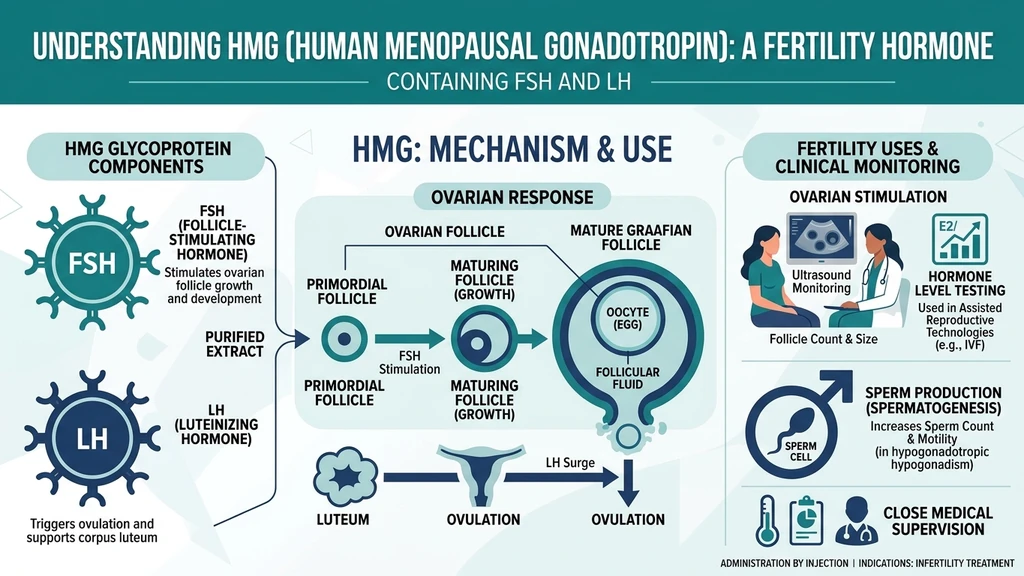
You found HMG on a peptide vendor's list, filed between HCG and a dozen research peptides, tagged as a "fertility peptide." The label is misleading, and the difference matters for how you understand what is in the vial. HMG (human menopausal gonadotropin, generic name menotropins) is a purified glycoprotein hormone preparation that carries both FSH and LH activity, extracted and purified from the urine of postmenopausal women. It is not a peptide in the strict biochemical sense. It is a real, FDA-approved prescription fertility medicine used to stimulate the ovaries in women during IVF and to restart sperm production in men with hypogonadotropic hypogonadism. This guide separates the biochemistry from the marketing and shows what the clinical evidence actually supports.
| Quick Reference | Detail |
|---|---|
| What it is | Purified gonadotropin with FSH + LH activity |
| Molecule type | Glycoprotein hormone, not a true peptide |
| Source | Postmenopausal urine, highly purified |
| Generic name | Menotropins |
| Female use | Ovarian stimulation for IVF and assisted reproduction |
| Male use | Spermatogenesis in hypogonadotropic hypogonadism |
| Route | Subcutaneous or intramuscular injection |
| Regulatory status (US) | FDA-approved prescription medicine |
HMG sits in the same conversation as HCG on bodybuilding and TRT forums, usually in threads about restarting fertility after a cycle. That community framing is where the "peptide" label comes from. The medicine itself is prescription-only, physician-directed, and monitored with bloodwork and ultrasound. For the closely related hormone it is often paired with, start with the HCG peptide guide, and talk to a physician before you consider any of this.
Get your custom peptide protocol:
- Tailored to your body and goals
- Precise dosing and cycle length
- Safe stacking combinations
- Backed by peer-reviewed studies
- Ready in under 2 minutes
Is HMG a Peptide? An Honest Answer
You want to know whether the vendor category is accurate. It is not, and the distinction is not pedantic. A peptide is a short chain of amino acids, usually under 50, with no attached sugars. HMG is a pair of glycoprotein hormones, each built from two protein subunits with carbohydrate chains bolted on. It is far larger and structurally more complex than anything the word peptide describes.
The two hormones inside menotropins are follicle-stimulating hormone (FSH) and luteinizing hormone (LH). These are the same gonadotropins your pituitary gland releases to run the reproductive system. A vial of HMG delivers them as a purified extract rather than asking your body to make its own.
Community usage lumps HMG with peptides because it ships as an injectable lyophilized powder and appears alongside HCG and true peptides in the same catalogs. The packaging is similar. The molecule is not. Calling HMG a peptide is a shorthand that survives because it is convenient, not because it is correct. For the broader landscape of what men actually use these compounds for, see peptides for men.
What HMG Does: FSH and LH in One Vial
Think of the reproductive system as a workshop with two tools. FSH is the tool that grows the raw material: egg-containing follicles in women, sperm-producing machinery in men. LH is the tool that finishes the job: triggering ovulation and driving testosterone production. HMG puts both tools in a single injection.
That dual activity is the defining feature of menotropins. Older HMG preparations carried roughly equal FSH and LH activity, and the LH component is supplied largely by added HCG, which acts on the same receptor. The literal point is simple: one dose of HMG stimulates follicle or sperm development and the hormonal signaling around it at the same time.
Your pituitary normally releases these hormones in a tightly controlled rhythm. When that signal is missing or when a fertility clinic needs to override it, HMG substitutes for the pituitary output directly. This is why it works in people whose own gonadotropin production has failed, a situation where drugs that only prod the pituitary have nothing to prod.
HMG in Female Fertility and IVF
The largest and best-evidenced use of HMG is controlled ovarian stimulation. In an IVF cycle, the goal is to grow multiple mature follicles at once instead of the single egg a natural cycle produces. HMG supplies the FSH that drives that growth, with LH activity supporting estrogen production and follicle maturation.
The evidence here is genuinely strong. A large randomized, assessor-blinded trial comparing a highly purified menotropin preparation for ovarian stimulation reported clinical outcomes competitive with recombinant alternatives (Fertil Steril, 2020). This is Phase III-grade evidence, not the thin preclinical data that surrounds most vendor peptides.
Route of administration has also been studied directly. A trial of subcutaneous HMG for controlled ovarian stimulation found it a practical and effective delivery method, moving patients away from painful intramuscular dosing (Am J Obstet Gynecol, 2000). A 2025 Cochrane network meta-analysis of ovarian stimulation protocols placed HMG among the standard, evidence-backed gonadotropin options rather than a fringe choice (Cochrane Database Syst Rev, 2025). This is regulated reproductive medicine, delivered inside a monitored clinic.
HMG in Men: Restarting Sperm Production
The male use is narrower but real. In hypogonadotropic hypogonadism, the pituitary fails to send FSH and LH signals, so the testes never receive the instruction to make sperm or testosterone. HMG supplies the missing FSH activity directly, and it is typically paired with HCG, which covers the LH side and drives testosterone.
The standard protocol restarts spermatogenesis in two stages. HCG comes first to raise intratesticular testosterone, then HMG is added to supply the FSH needed for full sperm production. The two hormones together reproduce the signal a healthy pituitary would send, which is why neither alone is usually enough for a man with no gonadotropin output.
This is also where the bodybuilding crossover appears. Men who suppressed their natural hormone axis with anabolic steroids or long-term testosterone sometimes use an HCG-and-HMG restart to recover fertility, a process discussed alongside the best peptides for testosterone. That use is off-label, individual, and should be run by a physician who orders semen analysis and hormone panels. For the wider context of why suppression happens, peptides vs steroids covers the underlying mechanism.
HMG vs HCG vs rFSH: An Honest Comparison
These three get confused constantly because they overlap in what they stimulate. The differences are specific and worth pinning down before any conversation with a prescriber.
HMG carries both FSH and LH activity in one preparation, purified from urine. It is the versatile option when a patient needs both signals, which is why it dominates ovarian stimulation and male fertility restarts.
HCG mimics LH almost exclusively. It drives testosterone and triggers ovulation but does little for the FSH-dependent side of follicle growth or sperm production. It is the LH stand-in, not an FSH substitute, which is why the HCG peptide guide treats it as a different tool.
Recombinant FSH (rFSH) is pure FSH made in a lab with no LH activity and no urinary sourcing. A study comparing recombinant FSH to urinary human menopausal gonadotropin examined their relative performance in stimulation cycles, and both remain accepted options (J Endocrinol Invest, 2015). The practical takeaway: rFSH gives clean FSH alone, while HMG gives FSH plus LH from a purified natural source.
Dosage Context: Why This Is Not Self-Administered
You are looking at the vial and wondering about numbers. The honest answer is that there is no safe generic HMG dose, because the correct dose depends entirely on the individual and the monitoring around it. Menotropins are dosed in international units, titrated against blood tests and ultrasound findings, and adjusted mid-cycle.
In ovarian stimulation, a clinic starts at an FSH dose chosen from a woman's age, ovarian reserve, and prior response, then adjusts based on follicle counts and estradiol levels measured every few days. The margin between too little and too much is narrow, and the consequences of guessing are physical, not theoretical.
In male fertility protocols, HMG is dosed alongside HCG over months, with semen analysis tracking whether sperm production is recovering. This is slow, monitored, and individualized. HMG is a prescription medicine for a reason. Self-administering it without ultrasound and hormone monitoring removes the exact safeguards that make it work. Before considering any injectable, read the peptide safety guide and route the decision through a physician.
Safety and Side Effects: OHSS Is the Big One
The serious risk with HMG in women has a name: ovarian hyperstimulation syndrome (OHSS). When the ovaries respond too strongly, they swell, fluid shifts out of the bloodstream, and in severe cases this produces abdominal pain, rapid weight gain, blood clots, and hospital-level illness. OHSS is precisely why HMG cycles are monitored so closely, so a clinic can cut or cancel dosing before it escalates.
Multiple pregnancy is the second major consideration. Because HMG can mature several follicles at once, it raises the odds of twins or higher-order pregnancies, which carry their own risks. Local injection-site reactions, bloating, and headaches are the more common and milder complaints.
In men, side effects are usually limited to injection-site reactions, breast tenderness, and mood changes tied to shifting hormone levels. The through-line for both sexes is the same: HMG is powerful enough to override the body's own reproductive signaling, and that power is exactly why it belongs under medical supervision. If you are trying to figure out whether any of this fits your goals, the peptide quiz is a faster starting point than guessing, and getting started with peptides sets realistic expectations first.
Frequently Asked Questions
Is HMG a peptide?
No. HMG (human menopausal gonadotropin) is a purified glycoprotein hormone preparation carrying FSH and LH activity, not a short amino-acid chain. It is grouped with peptides in community catalogs because it ships as an injectable powder next to HCG. See peptides for men for how these compounds get categorized.
What is HMG used for?
HMG is an FDA-approved fertility medicine. In women it stimulates the ovaries to grow multiple follicles for IVF, supported by strong trial data (Fertil Steril, 2020). In men it helps restart sperm production in hypogonadotropic hypogonadism. Compare it to LH-mimicking HCG in the HCG peptide guide.
What is the difference between HMG and HCG?
HMG carries both FSH and LH activity, while HCG mimics LH almost exclusively. HCG drives testosterone and triggers ovulation but does little for FSH-dependent follicle or sperm growth. For fertility restarts, the two are often used together. The HCG peptide guide covers the LH side in detail.
Is HMG the same as menotropins?
Yes. Menotropins is the generic name for human menopausal gonadotropin. Both refer to the same purified preparation of FSH and LH activity extracted from postmenopausal urine. A study comparing it to recombinant FSH used this exact terminology (J Endocrinol Invest, 2015). Learn broader vetting in the peptide safety guide.
Can men use HMG for fertility?
Yes, but for a specific condition. Men with hypogonadotropic hypogonadism use HMG, usually with HCG, to supply the FSH needed for sperm production. This is a physician-monitored protocol tracked with semen analysis. Men recovering fertility after steroid use also discuss it, as covered in best peptides for testosterone.
What is the main risk of HMG?
In women, the serious risk is ovarian hyperstimulation syndrome (OHSS), where the ovaries swell and fluid shifts out of the bloodstream, sometimes requiring hospitalization. Multiple pregnancy is the second concern. This is why HMG cycles require ultrasound and hormone monitoring. Read the peptide safety guide before considering any injectable.
How is HMG different from steroids?
Steroids suppress the body's own gonadotropin signaling, while HMG supplies FSH and LH to restore or override it. This is why some men use HMG to recover fertility after a steroid cycle. The mechanism behind that suppression is explained in peptides vs steroids.
Can I buy HMG without a prescription?
HMG is an FDA-approved prescription medicine, and using it safely requires the ultrasound and bloodwork monitoring that only a clinic provides. Research-channel vials remove those safeguards and carry purity risks. If you are exploring your options, start with the peptide quiz and getting started with peptides.
The Bottom Line
HMG (human menopausal gonadotropin, generic name menotropins) is a purified glycoprotein hormone carrying FSH and LH activity, not a peptide in the biochemical sense. It is a real, FDA-approved fertility medicine with strong trial evidence behind its use in ovarian stimulation and a defined role in restarting sperm production in men with hypogonadotropic hypogonadism.
The vendor label that files it as a "fertility peptide" gets the biology wrong and hides the most important fact: this is prescription medicine that works because it is monitored. Dosing is titrated against ultrasound and bloodwork, and the serious risk of OHSS in women is managed by exactly that supervision. HMG is not a research-chemical experiment. It is a clinical tool that belongs in a clinician's hands.
If fertility or hormone recovery is your goal, the right next step is a physician, not a vendor. For the closely related hormone it pairs with, read the HCG peptide guide, and for realistic expectations across this whole category, start with getting started with peptides.
This is educational content and not medical advice. HMG is a prescription medicine; consult a healthcare provider. Explore more peptide research and tools at https://peptidesexplorer.com.
References
- 1.Randomized, assessor-blinded trial comparing highly purified human menotropin for ovarian stimulation. Fertil Steril, 2020. PMID 32416978
- 2.Human recombinant follicle stimulating hormone (rFSH) compared to urinary human menopausal gonadotropin. J Endocrinol Invest, 2015. PMID 25480425
- 3.Subcutaneous human menopausal gonadotropin administration for controlled ovarian stimulation. Am J Obstet Gynecol, 2000. PMID 10871458
- 4.Controlled ovarian stimulation protocols for assisted reproduction: a network meta-analysis. Cochrane Database Syst Rev, 2025. PMID 40590303
Related Articles
Best Time to Take MOTS-c: Morning, Fasted or Night?
Best time to take MOTS-c: morning, fasted, 30 to 60 minutes before cardio. The eating window after the shot, daily vs 3x a week, night dosing, missed doses.
What Size Needle for Peptide Injections? Gauge
What size needle for peptide injections: 29 to 31 gauge, 5/16 inch (8 mm), U-100 insulin syringe. Gauge chart, length by body fat, draw vs inject needles.
How Long Does KPV Take to Work? Timeline
How long does KPV take to work: gut symptoms in 1 to 2 weeks, skin in 2 to 4, systemic inflammation in 2 to 6. Half-life, onset by route, and when to stop.
Where to Inject KPV: Best Sites and Technique
Where to inject KPV: belly fat, outer thigh, arm or flank with a 29 to 31G insulin needle. Why the site barely matters, rotation grid and step-by-step.