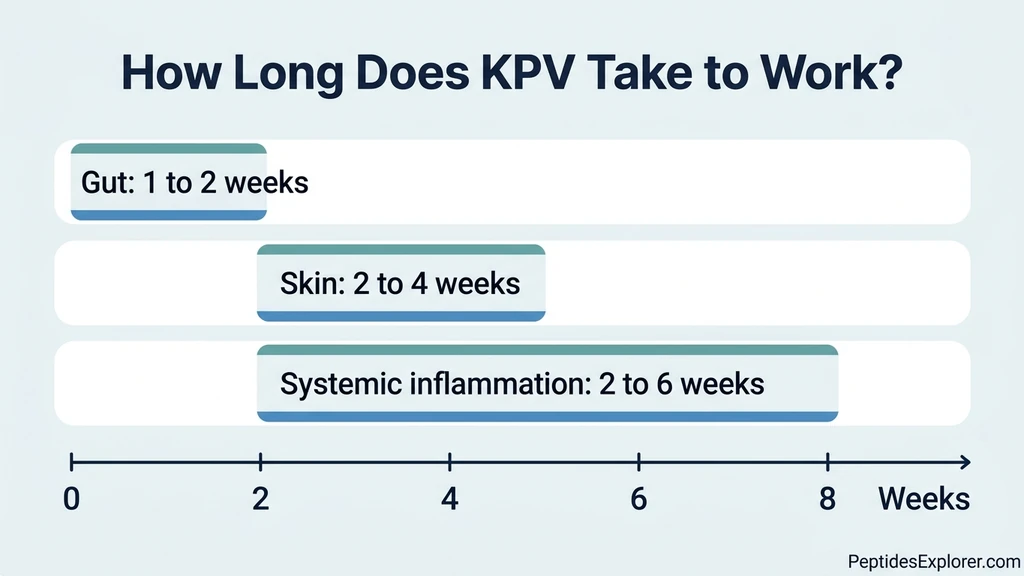
Day nine of oral KPV, the capsule bottle is a third empty, and your gut feels about the way it did on day one. Here is the answer: KPV starts changing gut symptoms in 1 to 2 weeks when taken orally, skin redness in 2 to 4 weeks when applied topically, and joint or whole-body inflammation in 2 to 6 weeks when injected. Mucosal repair in colitis takes 4 to 8 weeks. The molecule acts within hours; the tissue that has to heal sets the calendar.
| Condition and route | First change | Clear improvement | Decide by |
|---|---|---|---|
| Colitis, IBD flare, gut pain (oral or enteric capsule) | 3 to 7 days | 2 to 4 weeks | Week 6 |
| Bloating, loose stools, post-antibiotic gut (oral) | 5 to 10 days | 2 to 3 weeks | Week 4 |
| Eczema, psoriasis, rosacea (topical) | 1 to 2 weeks | 4 to 8 weeks | Week 8 |
| Joint or systemic inflammation (subcutaneous) | 1 to 3 weeks | 4 to 6 weeks | Week 6 |
| Lingering post-infection inflammation (subcutaneous or nasal) | 1 to 2 weeks | 3 to 4 weeks | Week 4 |
Every number above is extrapolated from mouse colitis studies and from reports of people using KPV as a research compound. No human clinical trial of KPV has been published, and the compound is not FDA-approved for any use. Dose by route lives in the KPV dosage guide, the KPV dosage chart by condition handles the microgram math, and KPV morning or night settles the timing question. This page covers one thing: how long it takes, and when to stop waiting.
Get your custom peptide protocol:
- Tailored to your body and goals
- Precise dosing and cycle length
- Safe stacking combinations
- Backed by peer-reviewed studies
- Ready in under 2 minutes
Why KPV Acts in Hours but Shows in Weeks
Think of a dripping tap over a flooded kitchen floor. Closing the tap takes two seconds. The floor still needs a day to dry, and the warped cabinet under the sink needs a carpenter. KPV closes the tap.
Literally stated: KPV is the last three amino acids of alpha-MSH (lysine, proline, valine), and at nanomolar concentrations it blocks activation of NF-kB and MAP kinase signaling in intestinal epithelial and immune cells, which cuts pro-inflammatory cytokine output (Dalmasso et al., Gastroenterology, 2008, PMID 18061177). That switch flips within hours of the peptide reaching the cell. What you feel is the floor drying: fewer cytokines today means less swelling tomorrow and less pain by the end of the week.
The repair phase runs on its own clock. Gut lining replaces itself every 3 to 5 days, the epidermis in about 4 weeks, and an inflamed joint remodels over months, which is why one compound gives a 1-week gut answer and a 6-week joint answer. KPV keeps the parent hormone's anti-inflammatory record without its tanning effect (Brzoska et al., Endocr Rev, 2008, PMID 18612139); the evidence ranked claim by claim is in KPV peptide benefits.
Gut: Colitis, IBD and Gut Symptoms (Oral and Enteric)
Oral is the route the evidence was built on, and the fastest. KPV enters gut lining cells through PepT1, the transporter that pulls tripeptides out of digested food. PepT1 is scarce in a healthy colon and upregulated in inflammatory bowel disease, and KPV's effect vanished in mice lacking it (Viennois et al., Cell Mol Gastroenterol Hepatol, 2016, PMID 27458604). The drug finds the fire.
The mouse timeline is short. In DSS colitis, KPV produced earlier recovery, stronger regain of body weight, fewer inflammatory cells in the colon wall and lower myeloperoxidase, a marker of neutrophil infiltration (Kannengiesser et al., Inflamm Bowel Dis, 2008, PMID 18092346). Those mice were scored over days, and plain KPV in drinking water reduced both DSS and TNBS colitis (PMID 18061177). Scaled to a human flare, the first measurable change is stool frequency and cramping inside the first week.
Delivery form changes speed at the lower end of the gut. Colon-targeted nanoparticles matched free KPV at a concentration 12,000-fold lower (Laroui et al., Gastroenterology, 2010, PMID 19909746), which says most of a plain capsule is absorbed in the small intestine before it reaches the colon. Free KPV still worked in those mice, so an enteric capsule is a refinement, not a requirement; expect it to bring colitis-type symptoms forward by a few days.
What 'Working' Looks Like for Gut Conditions
Days 3 to 7: fewer urgent bathroom trips and less cramping after meals. This is cytokine output falling, before any tissue has been rebuilt.
Weeks 2 to 3: stool firms up, bloating shrinks, appetite returns. The epithelium has turned over two or three times under a lower cytokine load.
Weeks 4 to 8: symptom-free days become the norm. Deeper ulcerations re-epithelialize last, which is why people who stop at week 3 often flare again by week 5. Many run KPV alongside BPC-157 for this phase; its gut timeline is in how long BPC-157 takes to work. PepT1's role in colitis-associated tumors is covered in KPV and cancer.
Skin: Eczema, Psoriasis and Rosacea (Topical)
Topical KPV is slower than oral KPV for gut, because skin turns over in roughly 28 days and a plaque needs at least one full cycle to look different. Itch and redness move first, in 1 to 2 weeks; thickness and scaling take 4 to 8 weeks.
The cellular case is direct. In human keratinocytes, KPV triggered rapid intracellular calcium signaling at concentrations from 10^-15 to 10^-7 M, without the cyclic AMP rise that drives pigmentation (Elliott et al., J Invest Dermatol, 2004, PMID 15102092). Skin cells answer the tripeptide, and they do not tan in response. The parent hormone reduced inflammation in irritant and allergic contact dermatitis models (PMID 18612139), and most of alpha-MSH's anti-inflammatory activity is attributed to its KPV tail (Luger et al., Ann Rheum Dis, 2007, PMID 17934097).
No human trial of topical KPV in eczema, psoriasis or rosacea has been published; the 4-to-8-week window comes from skin biology and user reports and assumes twice-daily application. Comparisons with other compounds are in peptides for eczema, peptides for psoriasis and what peptides do for skin.
Joint and Systemic Inflammation (Subcutaneous and Nasal)
Injection puts KPV into blood, where free tripeptides clear in minutes to hours, so the systemic response builds from daily hits rather than a standing level. Expect morning stiffness and visible swelling to ease in 1 to 3 weeks, and a stable lower baseline by week 4 to 6.
The evidence here is thinner. Alpha-MSH has been validated in animal arthritis and vasculitis models (PMID 18612139) and KPV carries most of that activity (PMID 17934097), but no published study has injected KPV for joint disease in any species. Treat a joint protocol as the least certain timeline on this page, and the one most likely to need the full 6 weeks.
Nasal KPV is a community route with no study behind it. Small peptides cross the nasal mucosa, so judge it on the injection timeline with an unknown fraction of the dose delivered. Where KPV ranks among anti-inflammatory compounds is in peptides for inflammation.
After an Infection: Lingering Inflammation and Gut Recovery
A gut that was flattened by a course of antibiotics, or a body still inflamed three weeks after a virus has cleared, is the third common reason people reach for KPV. The first change is usually appetite and energy in 1 to 2 weeks, with bowel habits settling by week 3 to 4.
KPV does not appear to blunt infection defense. In vitro, alpha-MSH and its KPV tail inhibited Staphylococcus aureus colony formation and reduced Candida albicans viability down to picomolar concentrations, and enhanced rather than reduced neutrophil killing of both (Cutuli et al., J Leukoc Biol, 2000, PMID 10670585). That is a test-tube finding. An active infection still needs diagnosis first, and a gut inflamed because Clostridioides difficile is still present will not respond to KPV on any timeline.
Week-by-Week Expectations: Oral KPV for Gut Inflammation
This timeline assumes 500 mcg of oral KPV per day, a moderate flare rather than a hospital-grade one, and an adult with no stricture, infection or untreated celiac disease.
| Week | What you notice | What is happening in the tissue |
|---|---|---|
| 1 | Fewer urgent bowel movements, less post-meal cramping | NF-kB output falling in epithelial and immune cells, cytokine mRNA dropping |
| 2 | Stool consistency improves, bloating eases | Neutrophil infiltration (myeloperoxidase) declining, first epithelial turnover under lower cytokine load |
| 3 | Appetite and energy return, weight stabilizes | Crypts regenerating, tight junctions re-forming |
| 4 | Most days are normal days | Mucosal barrier largely restored in a mild flare |
| 5 to 6 | An occasional bad day with no pattern | Deeper ulcerations re-epithelializing |
| 7 to 8 | Baseline, or a clear plateau | Repair complete for this flare; decide whether to maintain, taper or stop |
The week-2 verdict. Most people decide at week 2, in both directions. The ones who feel better stop, and the ones who feel the same quit. Both are early. Week 2 is cytokine output, and the lining that keeps the next flare away is still being laid down through week 6.
Half-Life: How Long KPV Stays in Your System
No human pharmacokinetic study of KPV exists. Its parent hormone alpha-MSH has a plasma half-life of only a few minutes (Wang et al., Appl Microbiol Biotechnol, 2016, PMID 26816094), and a free three-amino-acid fragment is an easy target for the same plasma peptidases. The working assumption on this site is a plasma half-life under 4 hours by any route. A dose injected at breakfast is gone from blood by dinner.
So the plain answer to "how long does KPV stay in your system" is one day, with a wide margin. Run your own schedule through the peptide half-life tracker.
| What clears | How fast | What persists | How long |
|---|---|---|---|
| KPV in plasma | Minutes to a few hours | KPV taken into cells via PepT1 | Hours (intracellular action) |
| Peak drug level | Same day | Reduced NF-kB target gene output | 1 to 3 days per dose |
| Lower cytokine load in tissue | Days, stacking with daily dosing | ||
| Repaired epithelium or skin | Weeks to months |
Effects outlast the molecule for three reasons. PepT1 carries KPV inside the cell, where it acts on signaling, so blood level is the wrong gauge (PMID 18061177). The cytokines NF-kB switches on, TNF-alpha and IL-6 among them, persist for hours to days, so blocking transcription today lowers tomorrow's load. And repaired tissue does not un-repair when the drug clears.
Why KPV Does Not Seem to Be Working, and How Long to Trial
Four problems explain most "it did nothing" reports, and only one of them is the peptide.
1. Route mismatch. The transporter that concentrates KPV in colon cells faces the gut lumen, not the bloodstream; injecting 500 mcg for a colitis flare asks a blood-side dose to reach a lumen-side target, and in the mouse work the drug was swallowed (PMID 18061177). The reverse error, oral capsules for a knee, relies on an unknown and probably small fraction escaping the gut wall. Fix: oral for gut, subcutaneous for joints, topical for skin.
2. Dose too low or product degraded. 200 mcg per day is the floor; 500 mcg is where most gut reports land. Reconstituted KPV left at room temperature, or run through three freeze-thaw cycles, delivers an unknown fraction of its label; storage rules are in how to store peptides.
3. The wrong diagnosis. A stricture, a fistula, undiagnosed celiac disease or a persistent infection does not respond to lower inflammatory signaling. Symptoms unchanged at week 4 on the correct route and dose argue for a scope, a stool test or a biopsy, not a higher dose.
4. The week-2 quit. The lining is still under construction.
| Condition | Minimum fair trial | Zero change by then means |
|---|---|---|
| Gut inflammation, oral | 4 weeks (6 for a documented flare) | Reassess diagnosis and route |
| Skin, topical | 8 weeks | Switch compound or add a prescription |
| Joint or systemic, injected | 6 weeks | Stop; evidence for this use is weakest |
| Post-infection recovery | 4 weeks | Rule out ongoing infection |
If a protocol already contains an immune-modulating drug, run the combination through the peptide interaction checker first and tell your prescriber.
Frequently Asked Questions
How long does KPV take to work for gut inflammation?
Oral KPV typically changes stool frequency and cramping within 3 to 7 days, with clear improvement in bloating and consistency by week 2 to 4. Mucosal repair in a colitis-type flare takes 4 to 8 weeks. In mouse colitis, KPV produced earlier recovery and lower neutrophil activity (PMID 18092346). The KPV profile covers the mechanism.
How long does KPV take to work for eczema or psoriasis?
Topical KPV eases itch and redness in 1 to 2 weeks, but a plaque or patch needs 4 to 8 weeks to change texture because skin turns over in about 28 days. Human keratinocytes respond to KPV at picomolar to nanomolar concentrations (PMID 15102092). No human trial exists; see peptides for psoriasis for the comparison.
When does KPV start working after an injection?
Signaling changes begin within hours of a subcutaneous dose, but perceptible relief in a joint or systemic inflammation takes 1 to 3 weeks of daily dosing, with a stable lower baseline by week 4 to 6. No study has injected KPV for joint disease in any species, so this is the least certain timeline. Context is in peptides for inflammation.
How long does KPV stay in your system?
About one day, with a wide margin. No human pharmacokinetic data exist for KPV, but its parent hormone alpha-MSH has a plasma half-life of only a few minutes (PMID 26816094), and this site assumes under 4 hours for the tripeptide. A breakfast dose is gone from blood by dinner. Model your own schedule in the peptide half-life tracker.
What is the half-life of KPV?
Unmeasured in humans. Alpha-MSH, the 13-amino-acid hormone KPV is cut from, clears from plasma in minutes, and a free tripeptide is at least as exposed to peptidases. A working estimate is under 4 hours. The effect lasts longer because PepT1 moves KPV inside cells (PMID 18061177); the mechanism is in the KPV profile.
Why is KPV not working after 3 weeks?
The usual causes are route mismatch (injected for gut, swallowed for a joint), a dose under 200 mcg per day, a degraded vial, or a condition that is not inflammatory signaling at all, such as a stricture or an infection. Colon-targeted delivery matched free KPV at a 12,000-fold lower concentration (PMID 19909746), so form matters. Storage rules are in how to store peptides.
How long should you take KPV before deciding it does not work?
Four weeks for gut symptoms (six for a documented flare), eight for skin, six for joint or systemic use, and four for post-infection recovery. Zero change at those marks on the correct route and dose means reassess, not increase. The evidence behind each use, ranked from strong to weak, is in KPV peptide benefits.
The Bottom Line
KPV takes 1 to 2 weeks to change gut symptoms by mouth, 2 to 4 weeks to change skin by cream, and 2 to 6 weeks to change joint or systemic inflammation by injection. Mucosal repair in colitis runs 4 to 8 weeks, and the week-2 feeling, good or bad, is cytokine output rather than healed tissue.
The principle: the peptide clears from blood within hours, but it acts inside cells and the tissue it protects repairs on its own schedule. Judge KPV by the tissue's clock, give it the full trial for its route, and stop at the deadline if nothing has moved.
KPV is a research compound with no FDA approval and no published human trial; every timeline here is extrapolated from mouse colitis data and user reports. Map your dosing against clearance in the peptide half-life tracker and find the rest of the KPV cluster at PeptidesExplorer. Educational content, not medical advice.
Helpful Tools
Related Articles
KPV Peptide Benefits: What the Evidence Shows
KPV peptide benefits ranked by evidence: strong preclinical colitis data, plausible skin effects, weak systemic claims. No registered human trial exists.
Peptides for Gut Health: 5 Best
BPC-157, KPV, LL-37, collagen peptides, and larazotide for gut healing. Condition-specific protocols for IBS, leaky gut, Crohn's, and bloating.
Where to Inject KPV: Best Sites and Technique
Where to inject KPV: belly fat, outer thigh, arm or flank with a 29 to 31G insulin needle. Why the site barely matters, rotation grid and step-by-step.
MOTS-c Half-Life: How Long It Stays in Your System
MOTS-c half-life: no human PK study exists. Exercise-raised plasma MOTS-c clears within 4 hours, yet gene effects last days. Washout, detectability, drug tests.