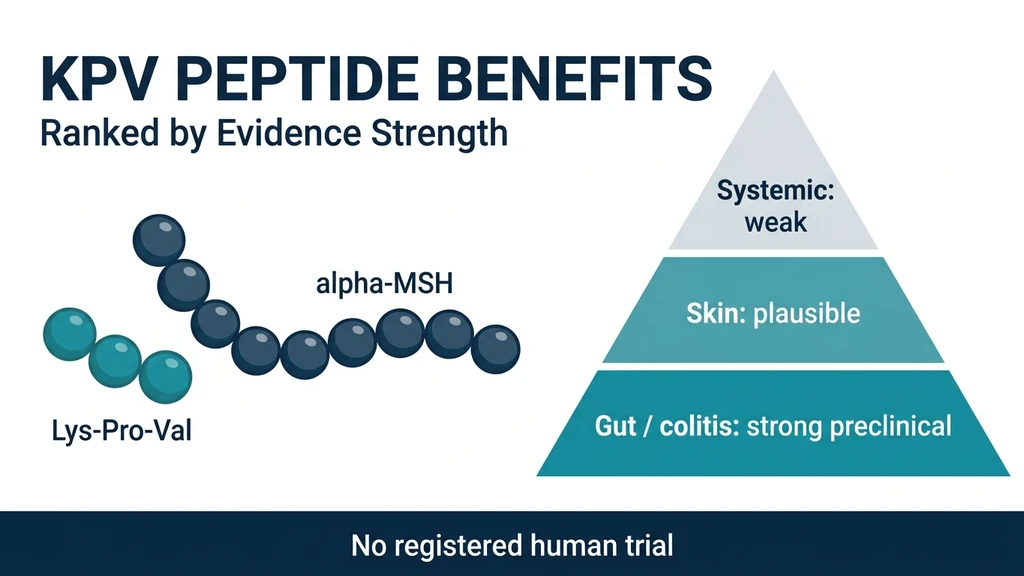
You are on a vendor page that says KPV calms gut inflammation, clears eczema, and lowers whole-body inflammation. Only one of those has real support. KPV's anti-inflammatory effect is well characterised in cell culture and rodent models, and the colitis data is the strongest of it. Skin effects are plausible. Broad systemic claims rest on almost nothing. No human clinical trial of KPV is registered.
| Claimed benefit | Evidence level | What it rests on |
|---|---|---|
| Reduces intestinal inflammation | Strongest (still preclinical) | Two independent mouse colitis papers, human cell lines |
| Suppresses NF-kB and TNF-a/IL-6 output | Strong mechanistic | Human intestinal epithelial and T cell assays |
| Calms inflammatory skin conditions | Plausible, thin | Rodent dermatitis models; no controlled human data |
| Antimicrobial (S. aureus, C. albicans) | Narrow, in vitro | Culture-plate colony counts |
| Systemic anti-inflammatory "reset" | Weakest | Extrapolation from the above |
| Human clinical benefit at any dose | None established | Zero registered Phase 1 or Phase 2 trials |
KPV is the C-terminal tripeptide of alpha-melanocyte-stimulating hormone: lysine, proline, valine, positions 11 to 13 of the parent hormone. Each benefit below is graded by how much weight its underlying data can actually carry. Doses live separately in the KPV peptide dosage guide. This is educational, not medical advice.
Get your custom peptide protocol:
- Tailored to your body and goals
- Precise dosing and cycle length
- Safe stacking combinations
- Backed by peer-reviewed studies
- Ready in under 2 minutes
Why a Three-Amino-Acid Fragment Keeps the Anti-Inflammatory Job
Alpha-MSH is thirteen amino acids long and does two very different things. It darkens skin by acting on melanocytes, and it quiets inflammation. Those are separable jobs, and KPV is the reason we know that.
Think of alpha-MSH as a keyring. One key opens the pigment cabinet. A second key throws the inflammation breaker. The last three residues sit at one end of the chain, and snapping that end off leaves you holding the breaker key alone. The pigment key stays behind on the ring.
The literal version: KPV is alpha-MSH(11-13). It reduces NF-kB activation and pro-inflammatory cytokine output without triggering melanogenesis. Getting and colleagues showed KPV still suppressed leukocyte migration in mice lacking a functional MC1 receptor, and unlike alpha-MSH it did not raise cAMP (Getting et al., J Pharmacol Exp Ther, 2003).
That single finding is why the analogy holds. KPV's anti-inflammatory action does not run through the classic melanocortin receptor and cAMP route that drives pigmentation. The two functions come apart cleanly, which is the entire pharmacological argument for using the fragment instead of the hormone.
It also means KPV is a poor fit for anyone reasoning by analogy to tanning peptides. If you arrived here from melanotan 1 vs melanotan 2, KPV is the branch of the melanocortin family that went the other way.
Benefit Tier 1: Intestinal Inflammation (Strongest Preclinical Support)
The gut is where KPV has its deepest bench. Two independent groups, using different colitis models, reported the same direction of effect within the same year.
Dalmasso and colleagues showed that KPV enters colonic epithelial cells through PepT1, a di/tripeptide transporter that is upregulated in inflamed colon. Oral KPV at 100 micromolar in drinking water cut myeloperoxidase activity by roughly half and reduced IL-6 and IL-12 mRNA in DSS-treated mice (Dalmasso et al., Gastroenterology, 2008).
In human intestinal epithelial cells, 10 nanomolar KPV was enough to be transported by hPepT1, and co-incubation blunted the roughly six-fold NF-kB reporter activation triggered by IL-1 beta. The mechanism is not hand-waving. It has a named transporter and a measured readout.
A second team reproduced the anti-inflammatory effect in two separate murine IBD models, DSS colitis and CD45RB-high transfer colitis, with reduced colonic damage and lower inflammatory cytokine levels (Kannengiesser et al., Inflamm Bowel Dis, 2008).
Both papers are mice. Neither establishes a human dose, a human response rate, or a human safety margin. "Strongest evidence for KPV" and "proven in people" are separated by a gap nobody has crossed. For the wider context, see peptides for gut health and peptides for inflammation.
Benefit Tier 2: Skin and Barrier Conditions (Plausible, Thinly Supported)
Skin is the second-most-cited KPV benefit and the most oversold. The rationale is solid. Eczema and psoriasis are inflammatory diseases, KPV suppresses inflammatory signalling, and alpha-MSH is produced in skin. The supporting data is another matter.
Rodent contact-hypersensitivity and dermatitis models show KPV reducing ear swelling and inflammatory infiltrate. There is no controlled human trial in atopic dermatitis, psoriasis, or any other dermatologic indication. The claim is a mechanism plus a mouse, presented as a treatment.
Delivery is the harder problem. In dermatomed human skin, passive diffusion of KPV was below the limit of detection. Microneedle poration raised permeation to 4.4 micrograms per square centimetre per hour, and iontophoresis combined with microneedles increased that rate 35-fold over microneedles alone (Pawar et al., J Pharm Sci, 2017).
Read that number again. A KPV serum rubbed onto intact skin delivers an amount the assay could not measure. Any topical benefit depends entirely on a delivery method the product does not include. Compare with what peptides do for skin and the barrier-repair case for GHK-Cu in GHK-Cu benefits.
If you came here for a skin condition specifically, peptides for eczema and peptides for psoriasis lay out where KPV sits alongside standard dermatologic care, which it does not replace.
Benefit Tier 3: Antimicrobial Activity (Real, Narrow, In Vitro)
KPV kills things on a plate. Alpha-MSH peptides including KPV inhibited Staphylococcus aureus colony formation and reduced viability and germ-tube formation in Candida albicans, with effects extending down into picomolar concentrations (Cutuli et al., J Leukoc Biol, 2000).
This is a genuine, reproducible finding. It is also a culture-plate finding, and colony counts on agar do not forecast what happens in an infected human tissue with blood flow, proteases, and an immune system already at work.
Vendors sometimes fuse this with the anti-inflammatory data into a single "fights infection and inflammation" bullet. The honest version: one antimicrobial paper, in vitro, from 2000, with no follow-through into human infection. Antimicrobial peptides with far more data, like LL-37, are covered in LL-37 peptide benefits.
Benefit Tier 4: Systemic Anti-Inflammatory Claims (Weakest)
The claims that sell best have the least behind them. Lowering whole-body inflammation, improving joint pain, speeding recovery, sharpening immune function: none of these has a KPV study attached. They are inferences drawn from colitis mice.
The inference is not absurd. NF-kB is a shared node across inflammatory disease, so a compound that suppresses it in the colon might do so elsewhere. Might. The distance from "suppresses NF-kB in an intestinal epithelial cell line" to "reduces your knee pain" is several unfunded studies wide.
Systemic exposure is also unresolved. KPV's gut effect in Dalmasso's work depended on PepT1, a transporter concentrated in intestinal epithelium and upregulated by inflammation. A mechanism keyed to gut transporters is a poor foundation for whole-body claims.
Where the evidence for a systemic effect matters most, other peptides have more of it. See thymosin alpha-1 benefits for immune modulation, peptides for joint pain for musculoskeletal claims, and BPC-157 benefits for tissue repair. KPV's cancer-adjacent claims get their own treatment in KPV peptide and cancer.
Two Ways This Goes Wrong, With Numbers
Scenario 1: Swapping maintenance IBD therapy for a KPV capsule. Someone with ulcerative colitis reads that KPV halved myeloperoxidase activity in colitic mice and stops their prescribed maintenance drug. The mouse figure is real: roughly a 50 percent reduction, at 100 micromolar delivered continuously in drinking water. It was measured in a chemically induced colitis that runs for about a week. Human ulcerative colitis runs for decades, and no published study reports a human KPV dose, a remission rate, or a relapse rate. Stopping a monitored regimen for an unmeasured one converts controlled disease into an uncontrolled flare with no fallback data. The fix: KPV is an addition to a physician-managed plan, never a substitution, and dosing questions belong in the KPV peptide dosage guide with a clinician reading over your shoulder.
Scenario 2: Copying a nanoparticle dose onto an oral capsule. Xiao and colleagues delivered 16 micrograms per kilogram per day of KPV orally to colitic mice, packaged in hyaluronic-acid-functionalised nanoparticles. Non-functionalised nanoparticles matched free KPV solution at a 12,000-fold lower KPV concentration (Xiao et al., Mol Ther, 2017). Scale 16 micrograms per kilogram to a 70 kg adult and you get 1.12 mg, a number that circulates on forums as "the mouse dose." That 1.12 mg figure describes encapsulated peptide. Naked KPV in the same study needed roughly 12,000 times more to reach the same endpoint. Anyone anchoring a capsule dose to the nanoparticle paper is off by roughly four orders of magnitude in the direction of doing nothing. The fix: read the delivery vehicle before you read the number, and check KPV peptide dosage chart for how the ranges people actually use were derived.
Scenario 3: Paying for a topical that delivers nothing. Passive KPV permeation across human skin was undetectable in the Pawar study. Microneedling brought it to 4.4 micrograms per square centimetre per hour. A cream applied to intact skin sits at the undetectable end of that range, so the money buys a mechanism you never receive. The fix: if a topical KPV claim matters to you, ask what carries it through the stratum corneum, and read GHK-Cu microneedling for how badly broken-skin delivery can misfire.
The Skill: Reading the Evidence Tier on Any Peptide Benefit Claim
Every peptide benefit claim you will ever read can be graded in about ninety seconds. Nobody teaches this, so vendors get away with citing a cell-culture paper as though it were a trial. Five questions, in order.
1. What species, and how many of them? Human randomised trial, human uncontrolled series, live rodent, human cell line, or a computer model. Each step down that list costs an order of magnitude of certainty. KPV's best gut paper is live rodent.
2. What was the delivery vehicle? Intraperitoneal injection is not subcutaneous. Nanoparticle-encapsulated oral is not a capsule. Drinking-water exposure is continuous, not once daily. A dose without its vehicle is a meaningless number, which is exactly how the 12,000-fold error above happens.
3. Was the endpoint a symptom or a surrogate? Myeloperoxidase activity, cytokine mRNA, and NF-kB reporter luminescence are surrogates. Remission, pain score, and lesion clearance are outcomes. Surrogates move all the time in compounds that later fail.
4. How long did the model run? Seven days of DSS colitis in a mouse is an acute chemical injury. Crohn's disease is a lifelong relapsing condition. A drug that works on the first says close to nothing about the second.
5. Search ClinicalTrials.gov for the peptide's name. Thirty seconds. If nothing returns, no regulator has ever seen a dose-finding protocol for it. For KPV, nothing returns.
Now assign the tier. Tier 1: controlled human trial. Tier 2: uncontrolled human data or human ex vivo tissue. Tier 3: live animal, disease model. Tier 4: cell culture. Tier 5: mechanism, structural similarity, or vibes.
KPV tops out at Tier 3 for gut inflammation, Tier 4 for skin, and Tier 2 only for one thing that is not a benefit at all: the ex vivo human skin permeation study, which measured delivery rather than effect. Run this on the next peptide you research, whether that is BPC-157 or something you found in a Telegram group, and see getting started with peptides for the broader framework.
KPV Benefits by Evidence Tier: The Reference Table
One row per claim. The last column is the one that matters, because it names what the study cannot tell you.
| Claimed benefit | Best available evidence | Model | Tier | What it does not show |
|---|---|---|---|---|
| Reduces colonic inflammation | Dalmasso 2008; Kannengiesser 2008 | DSS and TNBS/transfer colitis, mice | 3 | Any human dose, response rate, or duration of effect |
| Suppresses NF-kB activation | Dalmasso 2008 | Human intestinal epithelial cells, 10 nM | 4 | That gut-cell suppression happens anywhere else in the body |
| Lowers IL-6 and IL-12 | Dalmasso 2008 | Mouse colon, mRNA | 3 | Change in any clinical symptom |
| Enters cells via PepT1 | Dalmasso 2008 | Human cell line, radiolabelled tracer | 4 | Systemic bioavailability after oral dosing in people |
| Acts independently of MC1R | Getting 2003 | MC1R-mutant mice, peritonitis | 3 | Efficacy in any chronic disease |
| Reduces skin inflammation | Rodent dermatitis models | Mouse ear swelling | 3 | Benefit in human eczema or psoriasis |
| Crosses skin topically | Pawar 2017 | Ex vivo human skin | 2 | Any therapeutic effect; passive flux was undetectable |
| Inhibits S. aureus and C. albicans | Cutuli 2000 | Agar culture | 4 | Clearance of an infection in a living host |
| Nanoparticle oral delivery works | Xiao 2017 | DSS colitis, mice, 16 mcg/kg/day | 3 | That unencapsulated oral KPV does the same thing |
| Lowers systemic inflammation | None specific to KPV | Inference | 5 | Anything |
| Improves joint pain, energy, immunity | None | Marketing | 5 | Anything |
Nothing on this list reaches Tier 1. Every benefit attributed to KPV, including its best one, is currently an animal or a cell-culture result. KPV is not FDA-approved for any indication, and its regulatory position for compounding has moved before, which is covered in the FDA peptide crackdown and are peptides legal.
Common Mistakes People Make With KPV Benefits
Mistake 1: Treating "strong preclinical evidence" as "proven." KPV's colitis data is unusually good for a research peptide, with two independent groups and a named transport mechanism. It remains mouse data. Compounds with better preclinical packages than this fail human trials routinely. The fix: describe KPV to yourself as promising and untested in people, because that is what it is.
Mistake 2: Importing the gut evidence into every other organ. The PepT1 mechanism that makes oral KPV work in colon is a gut-specific mechanism. Nothing licenses moving that result to skin, joints, or systemic inflammation. The fix: judge each claimed benefit against its own study, using the five questions above. For systemic goals, peptides for recovery and peptides for immune system survey compounds with more relevant data.
Mistake 3: Stacking KPV on top of five other compounds and attributing the result to KPV. If inflammation drops while you are running KPV, BPC-157, and a diet change simultaneously, you have learned nothing about KPV. The fix: change one variable, and screen combinations with the peptide interaction checker before you build anything. See peptide stacking guide.
Mistake 4: Ignoring the sourcing and handling problem. A peptide with no approved manufacturer has no guaranteed purity, and reconstituted tripeptides degrade. Benefits measured on pure synthetic KPV in a lab tell you nothing about a grey-market vial of unknown content. The fix: read where to buy peptides, how to store peptides, and the peptide safety guide before benefits are even a relevant question.
Frequently Asked Questions
What are the proven benefits of KPV peptide?
None are proven in humans. The strongest benefit is reduced intestinal inflammation, shown in two independent mouse colitis studies and human intestinal cell lines, where 10 nanomolar KPV blunted NF-kB activation. Zero Phase 1 or Phase 2 human trials of KPV are registered. See peptides for gut health for the wider picture.
How does KPV reduce inflammation?
KPV is the C-terminal tripeptide of alpha-MSH. It enters cells through the PepT1 transporter, suppresses NF-kB activation, and lowers TNF-alpha, IL-6, and IL-12 output. Getting 2003 showed it works in mice lacking a functional MC1 receptor, so the effect bypasses the melanocortin route that causes pigmentation. More at peptides for inflammation.
How much KPV should I take?
No human dose has been established in any published trial. The commonly quoted mouse figure of 16 micrograms per kilogram per day describes nanoparticle-encapsulated KPV, not a capsule, so copying it across formulations is an error of roughly four orders of magnitude. Full derivations: KPV peptide dosage guide and KPV peptide dosage chart.
Should I take KPV in the morning or at night?
Timing arguments for KPV rest on meal interaction and PepT1 activity rather than any circadian trial, and they change depending on whether you are using an oral or injectable route. The full breakdown, including how food affects absorption, lives in KPV peptide morning or night. Pair it with the KPV peptide dosage guide.
Does KPV work for eczema or psoriasis?
Rodent dermatitis models show reduced skin inflammation, but no controlled human trial exists for either condition. Delivery is the bigger obstacle: passive KPV permeation across human skin was undetectable, rising to only 4.4 micrograms per square centimetre per hour with microneedling. See peptides for eczema and peptides for psoriasis.
Is KPV safe?
No human safety data exists at any dose, because no registered clinical trial has generated it. Rodent studies report no obvious toxicity, which is not the same finding. Purity and sourcing add a second layer of risk with unapproved compounds. Read the peptide safety guide and peptide therapy side effects.
Can KPV replace my IBD medication?
No. KPV cut myeloperoxidase activity by roughly half in mice with seven-day chemically induced colitis. That is a surrogate marker in an acute animal model, not remission in chronic human disease. Substituting it for a monitored regimen trades measured control for an unstudied compound. Discuss any addition with your gastroenterologist. See peptides for gut health.
Is KPV better than BPC-157 for gut problems?
They act differently. KPV suppresses inflammatory signalling through NF-kB, while BPC-157 is studied for mucosal repair and angiogenesis. Both are preclinical, and neither has a human trial establishing superiority. Comparing them on evidence tier rather than marketing is the useful exercise. See BPC-157 benefits and the peptide stacking guide.
The Bottom Line
KPV's benefits sort cleanly by evidence. Intestinal inflammation has the strongest case, built on two independent mouse colitis studies, a named transporter, and NF-kB suppression in human cell lines. Skin benefits are plausible and poorly delivered. Systemic anti-inflammatory claims have no KPV study behind them at all.
The principle generalises past this peptide. A benefit is worth exactly as much as the species, vehicle, endpoint, and duration of the study behind it, and the five-question tier check takes ninety seconds to run on anything.
For doses, timing, and protocols, the KPV peptide dosage guide and KPV peptide dosage chart carry the numbers. Screen combinations with the peptide interaction checker, price a course with the peptide cost calculator, and browse the full KPV profile at PeptidesExplorer.com. Work with a clinician before adding any research peptide to a treatment plan.
Helpful Tools
Related Articles
Peptides for Psoriasis: The Evidence
Peptides for psoriasis: the honest evidence on KPV, GHK-Cu, BPC-157, and why LL-37 drives the disease rather than treating it. See a dermatologist.
Peptides for Eczema: What Helps?
Peptides for eczema: which ones support skin barrier repair and inflammation, the evidence behind GHK-Cu and KPV, safety cautions, and what they cannot replace.
KPV Peptide Dosage Chart by Condition
KPV peptide dosage chart by condition: gut/IBD, skin, and inflammation doses with oral vs subcutaneous routes, reconstitution math, and common mistakes.
VIP Peptide: Benefits, Evidence, and Real Risks
VIP peptide (vasoactive intestinal peptide): real physiology, the CIRS nasal spray protocol, what the trials actually found, doses used, and side effects.