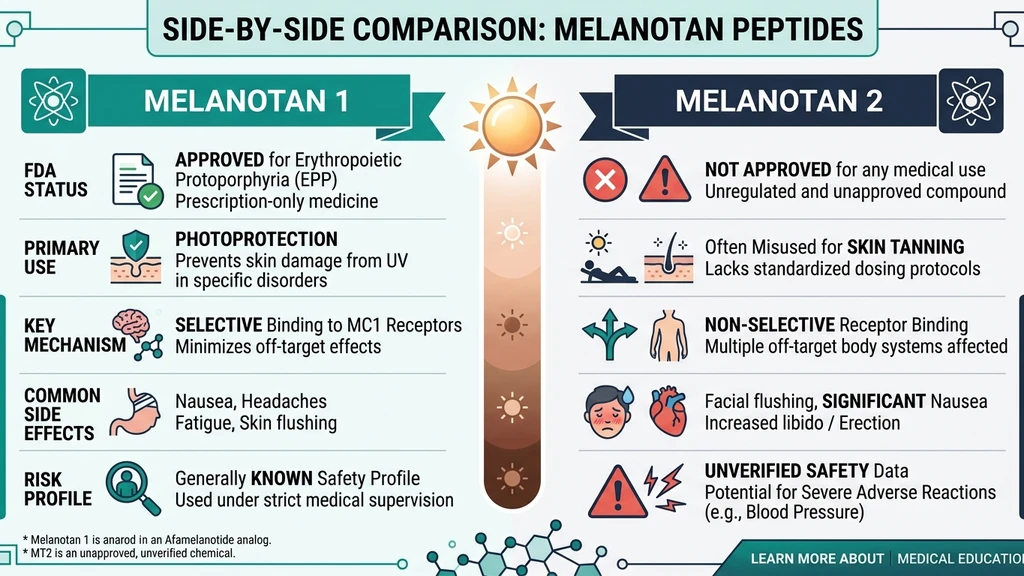
You bought a vial labeled "melanotan," read a dosage guide for "Melanotan 1," and now you are not sure which molecule is actually in your hand. Melanotan 1 (afamelanotide) is an MC1R-selective peptide approved by the FDA as the Scenesse implant for a rare light-sensitivity disorder, producing slow and even tanning with few side effects, while Melanotan 2 is an unapproved, broadly-acting melanocortin peptide that tans faster but triggers nausea, spontaneous erections, appetite loss, and mole darkening, with case reports linking it to melanoma.
They are two different molecules. Most people who self-inject for a tan are using Melanotan 2, even when they call it "melanotan," and only Melanotan 1 has an approved medical form.
| Attribute | Melanotan 1 (Afamelanotide) | Melanotan 2 (MT-2) |
|---|---|---|
| Full name | Afamelanotide | Melanotan II |
| Peptide structure | Linear tridecapeptide (13 aa) | Cyclic, truncated melanocortin analog |
| Receptor target | MC1R-selective | MC1R, MC3R, MC4R, MC5R (broad) |
| FDA status | Approved (Scenesse implant) | Not approved; grey-market |
| Approved use | Erythropoietic protoporphyria (EPP) | None |
| Approved form | 16 mg subcutaneous implant | None (sold as research powder) |
| Tan onset | Slow (2 to 4 weeks) | Fast (1 to 2 weeks) |
| Tan quality | Even, uniform | Faster but patchy; darkens moles |
| Libido / erections | Minimal | Common (MC4R); risk of priapism |
| Nausea | Rare | Common, dose-dependent |
| Appetite effect | Minimal | Suppression common |
| Mole / nevi changes | Low risk | Darkening, new and dysplastic nevi |
| Melanoma case reports | Not associated | Multiple published case reports |
| How it is obtained | Prescription / clinic implant | Self-injection, grey market |
| Cost signal | High (medical implant) | Low (research vials) |
Both peptides mimic alpha-MSH, the hormone that tells your skin to make pigment. The single difference that drives everything below is how many receptors each one hits. This is educational content, not medical advice.
Get your custom peptide protocol:
- Tailored to your body and goals
- Precise dosing and cycle length
- Safe stacking combinations
- Backed by peer-reviewed studies
- Ready in under 2 minutes
What Is Melanotan 1 (Afamelanotide)?
Melanotan 1 is a synthetic linear tridecapeptide, a 13-amino-acid analog of alpha-melanocyte-stimulating hormone (alpha-MSH). It binds selectively to the melanocortin-1 receptor (MC1R), the switch that drives pigment production in skin cells.
It is marketed as Scenesse and was approved by the FDA on October 8, 2019, the first treatment cleared for erythropoietic protoporphyria (EPP), a rare disorder that makes sunlight painful (FDA NDA review, accessdata.fda.gov). The approved form is a 16 mg controlled-release implant placed under the skin roughly every two months by a clinician.
Afamelanotide raises eumelanin, the dark protective pigment, largely independent of UV exposure. In the pivotal EPP trials, patients gained pain-free time in sunlight and tolerated the implant well across repeated dosing (Langendonk et al., N Engl J Med, 2015). The approved indication is EPP only. It is not sold or approved as a cosmetic tanning drug.
What Is Melanotan 2 (MT-2)?
Melanotan 2 is a synthetic, cyclic and truncated melanocortin analog. Unlike its MC1R-selective cousin, it activates several melanocortin receptors at once: MC1R, MC3R, MC4R, and MC5R.
It was never submitted for FDA approval and has no approved medical use. It circulates on the grey market as a "research chemical" powder that buyers reconstitute and self-inject. People use it off-label for tanning and for libido, since MC4R activation drives sexual response.
Because it is unregulated, grey-market vials carry no guarantee of identity, purity, or actual peptide mass. If you are looking at a deeper protocol for the molecule most self-injectors actually hold, see the Melanotan 2 dosage protocol. MT-2 is also one of several peptides for libido that act on melanocortin receptors.
Mechanism and Receptor Selectivity
One mechanistic fact explains the entire gap between these two peptides: how many receptors each one switches on.
MC1R Selectivity vs Broad Melanocortin Activity
Think of the melanocortin system as a panel of light switches. Melanotan 1 flips one switch, MC1R, which controls pigment. Melanotan 2 flips the whole panel at once.
MC1R drives melanin production. MC3R and MC4R sit in the brain and influence appetite and sexual function. MC5R affects exocrine glands. Afamelanotide stays narrow on MC1R, so its action is mostly limited to pigment, which is consistent with its clean trial-grade safety profile (chronic MC1R activation review, PMC11664455).
Melanotan 2 reaches all four. That broad activation is why it darkens skin and also drives nausea, appetite loss, and erections. The side-effect gap between the two is not random. It maps directly onto how many switches each peptide touches.
Why Potency Differs
Melanotan 2 usually produces a visible tan within 1 to 2 weeks. Melanotan 1 takes 2 to 4 weeks to express the same darkening.
Faster is not safer. The speed comes from the same broad receptor activation that produces the nausea, the appetite suppression, and the priapism risk. You cannot separate the quick tan from the side effects, because they share a cause.
Both peptides still need some UV exposure in most users to fully express the tan. They prime the pigment machinery; sunlight or a bed pulls the color through.
Tanning Effect Compared
Both peptides upregulate tyrosinase, the enzyme that builds melanin inside pigment cells. The difference is how evenly that pigment lands.
Melanotan 1 produces slow, uniform darkening because MC1R activation spreads across the skin's melanocytes in a controlled way. The result is an even tan over two to four weeks.
Melanotan 2 tans faster but more unevenly. It darkens existing moles and freckles along with the surrounding skin, so pigment concentrates in spots rather than spreading smoothly. That mole-darkening effect is cosmetically uneven and clinically important, since changes in pigmented lesions are exactly what dermatologists watch for. For the broader picture of how pigment-active peptides interact with skin, see what peptides do for skin.
Side Effects and Safety
The safety story splits cleanly along the receptor line. Melanotan 1 is narrow and well-characterized in trials. Melanotan 2 is broad, unregulated, and carries a documented signal toward dangerous skin changes.
Melanotan 2 Side Effects
Melanotan 2's broad receptor activity produces a consistent cluster of effects. The most common are nausea, facial flushing, appetite suppression, and spontaneous or prolonged erections. Reported nausea is dose-dependent, and one early pilot study described severe nausea in a minority of subjects even at controlled doses, though that figure comes from a small trial and should be read with caution.
Prolonged erections matter beyond inconvenience. MC4R activation can drive priapism, an erection lasting hours that is a urological emergency. Blood pressure shifts have also been reported.
The pigment-specific effects are the larger concern: existing moles darken, freckles deepen, and new nevi can appear. PT-141, another melanocortin peptide, shares the libido mechanism but is used episodically rather than for chronic tanning.
The Melanoma Concern
Melanotan 2 has been documented in multiple published case reports preceding melanoma. A British Journal of Dermatology report described melanoma developing in a melanotan user (Cousen et al., Br J Dermatol, 2009), and a separate case documented eruptive dysplastic nevi following melanotan use (Actas Dermo-Sifiliograficas).
Dysplastic nevi are atypical moles and recognized melanoma precursors, so their sudden eruption is not a cosmetic footnote. MC1R signaling itself is also studied as a marker in melanoma biology (PMC10543287).
State the limit honestly: no controlled study proves Melanotan 2 causes melanoma. What exists is a consistent signal across independent case reports, which is enough reason to treat any new or changing pigmented lesion during use as a dermatologist visit, not a tolerable side effect.
Melanotan 1 Safety Profile
Melanotan 1 is cleaner precisely because it is MC1R-selective. Without MC3R and MC4R activation, it largely avoids the nausea, appetite suppression, and erection effects that define Melanotan 2.
Its safety is also trial-grade. Afamelanotide was studied in controlled EPP trials and tolerated across repeated two-month implant cycles (Langendonk et al., N Engl J Med, 2015).
It is still not a consumer tanning drug. The approved use is EPP, the form is a prescription implant, and it is not legally sold for cosmetic tanning. For general injectable-peptide safety practices, see the peptide safety guide.
Legal and Regulatory Status
Melanotan 1 exists in one legal form: the Scenesse implant, a prescription product approved only for erythropoietic protoporphyria and administered in a clinic. It is not available for cosmetic tanning.
Melanotan 2 has no FDA approval at all. It is sold on the grey market as a research chemical, and regulators including the UK MHRA have issued public safety warnings against buying and injecting it. Possessing or using it sits in a regulatory grey zone that varies by country.
For where injectable peptides stand legally in 2026, see are peptides legal, and for the enforcement trend, the FDA peptide crackdown covers how agencies are treating unapproved injectables.
Dosing Patterns (Informational, Not Instructions)
The dosing structures are not comparable, because one is a clinic product and the other is self-injected.
Melanotan 1's approved form is a single 16 mg controlled-release implant placed subcutaneously roughly every two months by a clinician (FDA NDA review, accessdata.fda.gov). There is no consumer dosing decision; the implant releases over weeks on its own.
Melanotan 2 in grey-market use follows a self-administered pattern of a loading phase followed by smaller maintenance injections. The detail belongs on a dedicated page rather than here, so for the full breakdown see the Melanotan 2 dosage protocol. If you reach the point of handling any injectable peptide, the mechanics in how to inject peptides cover sterile technique.
Why People Choose Each
The two peptides attract different users for different reasons, and availability shapes the choice as much as preference.
People who get Melanotan 1 almost always get it through medical necessity. It treats EPP, it is prescription-only, and the implant is administered in a clinic. Someone who simply wants an even tan with minimal side effects would prefer it on paper, but cannot buy it for that purpose. Availability is the wall.
People choose Melanotan 2 because it is easy to obtain, tans fast, and produces a libido effect. The tradeoff is accepting an unapproved molecule, no dose verification, and the documented pigment and melanoma signal. The decision is usually access versus risk, not one peptide being objectively better.
Quantified Danger Scenario
Picture a typical grey-market routine. A user runs a Melanotan 2 loading protocol of roughly 0.5 mg daily for two weeks, then moves to maintenance injections. The vial carries no certificate of identity or dose, so the actual amount per injection is unknown.
Nausea hits early, which the pilot-study literature describes as a common, dose-dependent effect of Melanotan 2. Over the following weeks, two existing moles darken and a new pigmented spot appears on the back.
This is the decision point that matters. Because Melanotan 2 is documented in multiple case reports to precede melanoma and eruptive dysplastic nevi (Cousen et al., Br J Dermatol, 2009), any darkening, growth, or new lesion calls for a dermatologist, not a higher dose. Melanotan 1 avoids most of this because it acts only on MC1R, but it is prescription-only and not legally sold for cosmetic tanning.
Frequently Asked Questions
What is the difference between Melanotan 1 and Melanotan 2?
Melanotan 1 (afamelanotide) targets only the MC1R receptor and produces an even tan with few side effects. Melanotan 2 acts on several melanocortin receptors, tanning faster but causing nausea, erections, appetite loss, and mole darkening. They are different molecules. See the Melanotan 2 dosage protocol for the molecule most self-injectors actually hold.
Is Melanotan 1 or Melanotan 2 safer?
Melanotan 1 has the cleaner profile because it is MC1R-selective and exists in an FDA-approved medical form with trial-grade safety data. Melanotan 2 is unapproved and linked in case reports to dysplastic nevi and melanoma. For broader injectable-peptide safety practices, see the peptide safety guide.
Is Melanotan 1 FDA approved?
Yes, as the Scenesse implant, approved on October 8, 2019, but only to treat erythropoietic protoporphyria, a rare light-sensitivity disorder. It is not approved or sold for cosmetic tanning. For where injectable peptides stand legally, see are peptides legal.
Is Melanotan 2 legal?
Melanotan 2 has no FDA approval and is sold on the grey market as a research chemical. Regulators including the UK MHRA have issued safety warnings against using it. The enforcement climate is tightening, which the FDA peptide crackdown covers in detail.
Which Melanotan tans faster?
Melanotan 2 usually produces a visible tan within 1 to 2 weeks, versus 2 to 4 weeks for Melanotan 1. The faster onset comes from broad melanocortin activation, which also drives the heavier side-effect load. For how pigment-active peptides affect skin generally, see what peptides do for skin.
Does Melanotan 2 cause cancer?
No controlled study proves causation, but multiple case reports describe melanoma and dysplastic nevi developing in Melanotan 2 users (Cousen et al., Br J Dermatol, 2009). Any mole darkening or new pigmented lesion during use should be checked by a dermatologist, not treated as a normal side effect.
Why do my moles get darker on Melanotan 2?
Melanotan 2 broadly stimulates melanocytes, so existing moles and freckles darken along with the skin, and new nevi can appear. This is why dermatologist monitoring is advised during use. The same melanocortin mechanism is shared by peptides for libido such as PT-141, which act on MC4R rather than pigment.
Can you buy Melanotan 1 like Melanotan 2?
No. Melanotan 1 in its approved form is a prescription Scenesse implant administered in a clinic for EPP, while Melanotan 2 is widely sold as an injectable research powder. If you do handle any injectable peptide, the mechanics are covered in how to inject peptides.
The Bottom Line
Melanotan 1 (afamelanotide) is an MC1R-selective, FDA-approved implant for EPP that tans slowly and evenly with few side effects. Melanotan 2 is an unapproved, broadly-acting peptide that tans faster but drives nausea, erections, appetite loss, mole darkening, and a melanoma signal across case reports.
The principle is receptor selectivity. One peptide flips a single switch and stays narrow; the other flips the whole panel and inherits every downstream effect. The faster tan and the heavier risk come from the same broad activation, so they cannot be separated.
If the vial in your hand is the self-injected kind, it is almost certainly Melanotan 2, so read the Melanotan 2 dosage protocol and treat any new or changing mole as a dermatologist visit. Learn more at peptidesexplorer.com.
This is educational content, not medical advice. Consult a healthcare provider before using any peptide.
Related Articles: - Melanotan 2 Dosage Protocol - Peptides for Libido - Are Peptides Legal - FDA Peptide Crackdown 2026 - Peptide Safety Guide - What Peptides Do for Skin - How to Inject Peptides
Related Articles
Ipamorelin vs Sermorelin: Mechanism, Safety, Cost
Ipamorelin vs sermorelin: ghrelin-receptor agonist vs GHRH analog, 2-hour vs 4-minute half-life, cortisol selectivity, FDA history, cost, and who picks which.
GHRP-2 vs GHRP-6: Potency vs Hunger Compared
GHRP-2 vs GHRP-6: GH release potency, hunger effects, cortisol and prolactin impact, 100-300 mcg dosing, and which peptide fits each research goal.
SARMs vs Peptides: Differences and Which Is Riskier
SARMs and peptides are different compound classes. Compare mechanism, legality, evidence, and safety, and see why SARMs carry a clearer documented harm profile.
HGH or Peptides: Key Differences and Risks
HGH or peptides? Somatropin floods growth hormone directly; GH peptides work upstream and preserve pulsatility. Mechanisms, FDA status, US law, and IGF-1.