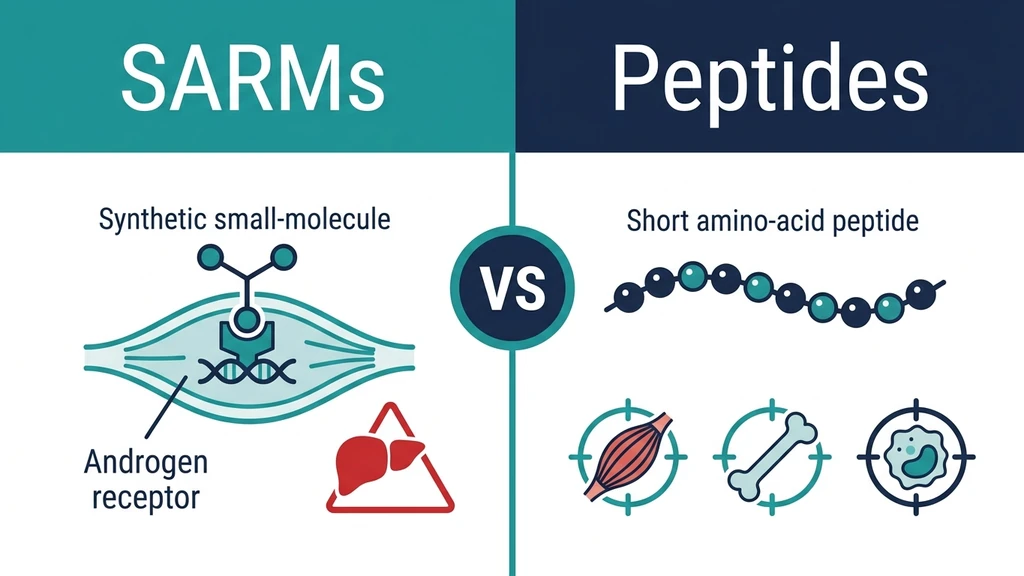
You are staring at two tabs. One sells RAD-140 capsules promising lean mass, the other sells peptide vials promising recovery, and a forum thread swears both are "safer than steroids." Here is the honest answer. SARMs and peptides are different classes of compounds. SARMs are synthetic small molecules that bind the androgen receptor to build muscle. Peptides are short amino-acid chains with varied targets. Neither is FDA-approved for bodybuilding. SARMs carry a clearer, documented harm profile, including drug-induced liver injury, cholesterol and cardiovascular shifts, and testosterone suppression. Peptide safety depends entirely on the specific compound. This guide compares mechanism, legality, evidence, and real safety data, and answers whether peptides are actually safer than SARMs.
| Quick Reference | SARMs | Peptides |
|---|---|---|
| What they are | Synthetic androgen-receptor small molecules | Short chains of amino acids |
| Common examples | RAD-140, ostarine, LGD-4033 | BPC-157, semaglutide, thymosin alpha-1 |
| Primary action | Bind the androgen receptor to build muscle | Varied targets, class depends on the peptide |
| FDA approval | None approved; no marketed SARM | Some approved (GLP-1 drugs), many research-only |
| Documented harm profile | Liver injury, lipid and cardiovascular change, testosterone suppression | Compound-dependent, ranges from approved-drug to unknown |
| Testosterone suppression | Yes, consistently reported | Not a general feature of the class |
| Legal status (US) | Not legal dietary supplements; grey-market sale | Varies; some prescription drugs, many grey-market |
Both sit outside the approved-drug lane for the uses people actually want, and both move through channels with weak quality control. That shared grey-market reality matters as much as the biology. Before comparing risks, it helps to see how the two classes are built, because the differences in structure drive the differences in danger. For the closely related steroid question, start with peptides vs steroids.
Get your custom peptide protocol:
- Tailored to your body and goals
- Precise dosing and cycle length
- Safe stacking combinations
- Backed by peer-reviewed studies
- Ready in under 2 minutes
What SARMs Are and How They Work
SARMs stands for selective androgen receptor modulators. They are synthetic small molecules designed to bind the same receptor that testosterone binds, the androgen receptor, which sits inside muscle and bone cells. The "selective" part is the marketing promise: hit muscle and bone, spare the prostate and other tissues.
Picture the androgen receptor as a lock on a muscle cell's control room. Testosterone is the master key. A SARM is a machined copy shaped to fit that same lock and turn on the genes that drive muscle growth. The literal point is simple. SARMs activate androgen signaling to build lean mass, which is why athletes and bodybuilders seek them (Am J Sports Med, 2025).
The most common compounds have code names before they ever earn a drug name. RAD-140 (testolone), ostarine (MK-2866, enobosarm), and LGD-4033 (ligandrol) lead the market. Several were developed by pharmaceutical companies for muscle-wasting conditions, then abandoned or stalled in trials, and none is an approved medicine you can be prescribed for building muscle.
Here is the label trick worth knowing. SARMs are frequently sold as "dietary supplements" or "research chemicals," yet they are neither dietary ingredients nor approved drugs. The FDA has warned that SARMs are not legal dietary supplements, which is the same grey-market status covered in are peptides legal.
What Peptides Are and How They Work
Peptides are short chains of amino acids, the same building blocks that make proteins, just far smaller. A peptide might be 2 amino acids or 40. That size lets them act like signaling molecules, telling cells to do a specific job rather than forcing a single receptor open.
This is the key difference from SARMs. Peptides are not one mechanism. Each peptide has its own target and its own effect, so "peptides" is a category the way "vehicles" is a category, spanning bicycles and freight trucks. Some peptides prompt growth hormone release, some support tissue repair, some regulate appetite and blood sugar.
That heterogeneity extends to legal status. Semaglutide and tirzepatide are FDA-approved GLP-1 medicines. Thymosin alpha-1 is an approved immune drug in some countries. Meanwhile compounds like BPC-157 and many growth-hormone secretagogues remain research-only, sold through the same channels as SARMs and covered in the getting started with peptides guide.
For muscle, the peptides people reach for are usually growth-hormone secretagogues, not androgen agonists, which is a different biological path than SARMs take. The realistic ceiling on those results is smaller than the forums suggest, laid out in peptides for muscle growth and peptides for bodybuilding.
Head-to-Head: Mechanism, Legality, Evidence, Safety
You want the comparison in one place. The table below sets SARMs and peptides side by side on the four questions that decide risk. Read it as a map of where each class stands, then read the safety sections that follow for the detail behind it.
| Dimension | SARMs | Peptides |
|---|---|---|
| Mechanism | One shared pathway: androgen-receptor activation | Many pathways, target depends on the peptide |
| Legality (US) | Not legal supplements; no approved SARM for muscle | Mixed: some approved drugs, many research-only |
| Human evidence | Early trials plus a large body of adverse-event reports | Ranges from major trials (GLP-1) to almost none |
| Documented harm | Liver injury, lipid change, testosterone suppression | Compound-specific, from well-characterized to unknown |
| Reversibility | Suppression often recovers; liver injury can be serious | Varies by compound |
The single biggest structural difference is uniformity. Every SARM funnels through the same androgen pathway, so the class shares a predictable set of side effects. Peptides scatter across dozens of mechanisms, so a blanket safety verdict on "peptides" is meaningless without naming the exact compound.
Evidence quality splits the same way. SARMs carry a growing library of published harm, because their popularity produced real clinical cases. A physician conversation matters for both, and the peptide safety guide is the framework to bring to it.
The SARMs Safety Record, Honestly
SARMs are often sold as a gentler alternative to anabolic steroids. The published record does not support treating them as safe. A comparative safety review of SARMs against anabolic androgenic steroids found overlapping toxicity concerns rather than a clean safety advantage (Expert Opin Drug Saf, 2015).
The clearest documented danger is the liver. SARMs have been described in the hepatology literature as an emerging liver toxin, with cases of drug-induced liver injury tied to their use (J Clin Transl Hepatol, 2023). Consider the concrete case. A young man taking RAD-140 for muscle developed drug-induced liver injury, presenting with the jaundice and elevated liver enzymes that signal a stressed liver (Ochsner J, 2022).
Liver injury is not the only signal. A pharmacovigilance analysis of SARM use documented a range of related adverse events beyond the liver, spanning cardiovascular and metabolic effects (Eur J Clin Pharmacol, 2024). A systematic review of SARM abuse in athletes catalogued lipid changes, including drops in protective HDL cholesterol, alongside the liver and hormonal findings (Am J Sports Med, 2025).
Then there is your own hormone system. SARMs suppress natural testosterone production, because the body reads the synthetic androgen signal and dials back its own output. That suppression is a consistent finding across the athlete literature (Am J Sports Med, 2025), and it is why people seek recovery protocols after a cycle. For the hormone-support angle specifically, see best peptides for testosterone.
Are Peptides Safer Than SARMs?
This is the question that brought you here, and the honest answer has a condition attached. It depends on the specific peptide. SARMs have a clearer, better-documented harm profile than most peptides, especially the liver injury and testosterone suppression above.
Compare the extremes to see why the question needs a compound name. An FDA-approved GLP-1 peptide like semaglutide has been through large human trials with a known side-effect profile a physician can monitor. That is a different safety universe than a SARM sold as a supplement, and a different universe again from a research-only peptide with almost no human data.
Now compare fairly at the risky end. A research-only peptide bought from a grey-market vendor, with no trials and no purity guarantee, is not automatically safe just because it is a peptide. Its risk is unknown rather than documented, and unknown is not the same as low. The difference is that SARMs have earned specific, published warnings, chiefly around the liver (J Clin Transl Hepatol, 2023).
Here is the practical read. If someone is choosing between a SARM and a peptide for muscle, the SARM carries a harm profile that is both serious and well characterized, while the peptide answer swings entirely on which peptide. Neither choice replaces medical supervision, and the honest starting move is the peptides vs steroids comparison plus a physician who knows your bloodwork.
The Legal and Quality-Control Reality
Biology is only half the risk. The other half is what is actually inside the bottle or vial, and here SARMs and research peptides share the same problem. Both move through grey-market channels with little independent testing.
The mislabeling is documented. Analyses of products sold as SARMs have repeatedly found that the contents do not match the label, sometimes containing unapproved drugs, sometimes the wrong compound, sometimes nothing active at all. When you buy a SARM sold as a "supplement," you are trusting a supply chain the FDA has flagged as noncompliant, the same legal grey zone described in are peptides legal.
Research peptides face a parallel gap. A vial sold "for research use only" carries no guarantee of purity, dose accuracy, or sterility, and contamination is a real risk when the product never passed pharmaceutical manufacturing standards. The vetting framework for that problem lives in the peptide safety guide.
The takeaway is blunt. For both classes, you are often gambling on an unverified product on top of gambling on the compound itself. That double uncertainty is a reason to involve a physician before use, not a footnote, and to be honest with yourself about what you cannot confirm. If you are still mapping which compound even fits your goal, the peptide quiz is a faster starting point than a forum thread.
Frequently Asked Questions
What is the difference between SARMs and peptides?
SARMs are synthetic small molecules that bind the androgen receptor to build muscle, so the whole class shares one pathway. Peptides are short amino-acid chains with many different targets, so their effects vary by compound. Neither is FDA-approved for bodybuilding. See peptides for bodybuilding for the muscle-specific picture.
Are peptides safer than SARMs?
It depends on the specific peptide. SARMs have a clearer documented harm profile, including drug-induced liver injury and testosterone suppression (J Clin Transl Hepatol, 2023). An approved GLP-1 peptide is well studied, while a research-only peptide is largely unknown. Compare classes in peptides vs steroids.
Do SARMs damage the liver?
SARMs have been described in the hepatology literature as an emerging liver toxin, with published cases of drug-induced liver injury, including a RAD-140 case presenting with jaundice (Ochsner J, 2022). This is one of the strongest documented risks. Read the peptide safety guide before considering any research compound.
Do SARMs suppress testosterone?
Yes. SARMs consistently suppress natural testosterone production because the body reads the synthetic androgen signal and reduces its own output, a finding repeated across the athlete literature (Am J Sports Med, 2025). Recovery is common but not guaranteed. For hormone-support peptides, see best peptides for testosterone.
Are SARMs or peptides legal to buy?
SARMs are not legal dietary supplements, and no SARM is FDA-approved for muscle building. Peptides are mixed: some are approved drugs, many are sold research-only. Both often move through grey-market channels with weak quality control. The full legal picture is in are peptides legal.
Can you build muscle with peptides instead of SARMs?
Peptides used for muscle are usually growth-hormone secretagogues, a different pathway than SARMs, and the realistic gains are smaller than forums claim. They avoid direct androgen-receptor activation but are not magic. Set expectations with peptides for muscle growth and peptides for bodybuilding.
Are SARMs the same as steroids?
No, but they are related. Both act on androgen signaling, and a comparative safety review found overlapping toxicity rather than a clean safety gap (Expert Opin Drug Saf, 2015). SARMs are not the safe alternative they are marketed as. The full breakdown is in peptides vs steroids.
How do I know if a SARM or peptide product is real?
Often you cannot without lab testing. Products sold as SARMs are frequently mislabeled, and research peptides carry no purity or sterility guarantee. This double uncertainty is a core risk. Vet any source using the peptide safety guide, and if you are unsure what fits your goal, try the peptide quiz.
The Bottom Line
SARMs and peptides are different classes of compounds, and the safety question does not resolve into a slogan. SARMs are synthetic androgen-receptor small molecules with a clear, documented harm profile: drug-induced liver injury, lipid and cardiovascular change, and testosterone suppression. Peptides span from approved GLP-1 medicines to research-only vials with almost no human data, so their safety depends entirely on the exact compound.
If you are choosing between the two for muscle, the honest read is that SARMs carry serious, well-characterized risks that are not offset by their "supplement" marketing, while the peptide answer swings on which peptide. Neither is FDA-approved for bodybuilding, and both often reach you through grey-market channels you cannot fully verify. That makes a physician conversation the real starting point, not an afterthought.
This is educational content, not medical advice. SARMs are not legal dietary supplements, and many peptides are not FDA-approved; consult a healthcare provider before use. To go deeper, compare peptides vs steroids, read the peptide safety guide, and explore more research and tools at https://peptidesexplorer.com.
References
- 1.Selective androgen receptor modulator use and related adverse events. Eur J Clin Pharmacol, 2024. PMID 38059982
- 2.Athlete Selective Androgen Receptor Modulators Abuse: A Systematic Review. Am J Sports Med, 2025. PMID 39755947
- 3.Selective Androgen Receptor Modulators: An Emerging Liver Toxin. J Clin Transl Hepatol, 2023. PMID 36479151
- 4.RAD-140 Drug-Induced Liver Injury. Ochsner J, 2022. PMID 36561105
- 5.Comparative safety evaluation of selective androgen receptor modulators and anabolic androgenic steroids. Expert Opin Drug Saf, 2015. PMID 26401842
Related Articles
KPV Topical vs Oral vs Injection: Which Route
KPV topical vs oral vs injection vs nasal: how each route reaches its target, what the PepT1 and keratinocyte evidence shows, and a condition-by-route table.
Retatrutide vs Semaglutide: Results, Risks, Cost
Retatrutide vs semaglutide (Ozempic, Wegovy): 24.2% vs 14.9% trial weight loss, side effects, heart rate, dosing cadence, cost, FDA status, and how to switch.
Ipamorelin vs Sermorelin: Mechanism, Safety, Cost
Ipamorelin vs sermorelin: ghrelin-receptor agonist vs GHRH analog, 2-hour vs 4-minute half-life, cortisol selectivity, FDA history, cost, and who picks which.
GHRP-2 vs GHRP-6: Potency vs Hunger Compared
GHRP-2 vs GHRP-6: GH release potency, hunger effects, cortisol and prolactin impact, 100-300 mcg dosing, and which peptide fits each research goal.