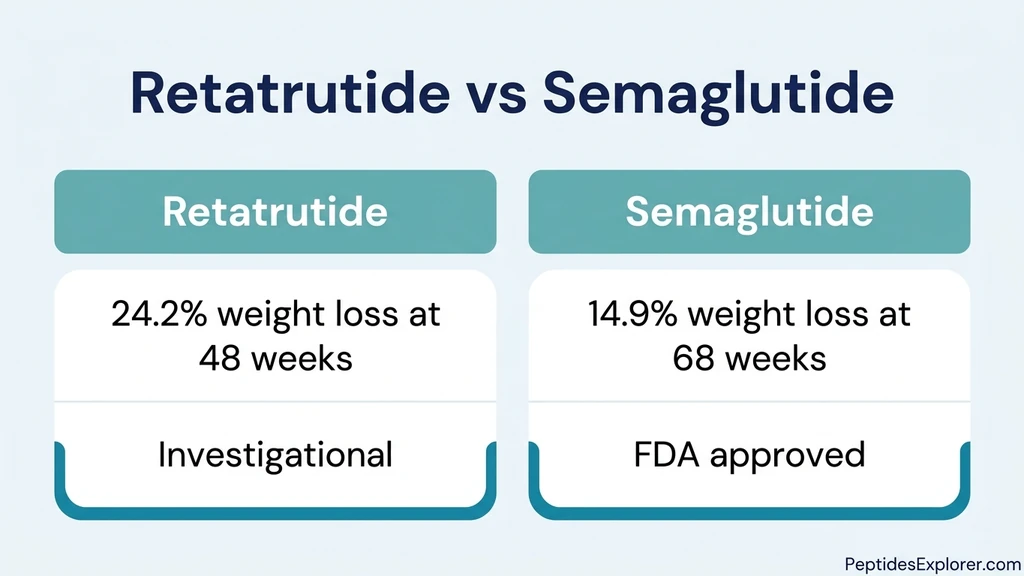
You are on 2.4 mg of semaglutide, the scale has not moved in six weeks, and a forum thread says retatrutide nearly doubles the result. Here is the answer: retatrutide produced 24.2% mean weight loss at 48 weeks in its phase 2 trial, against 14.9% for semaglutide at 68 weeks in STEP 1, but semaglutide is FDA-approved as Ozempic, Wegovy and Rybelsus while retatrutide is still investigational, with no approved product, no label and no outcomes data. One drug wins on paper. The other is the only one you can legally be prescribed.
| Question | Retatrutide | Semaglutide |
|---|---|---|
| Receptors | GIP + GLP-1 + glucagon (triple) | GLP-1 only |
| Trial weight loss | 24.2% at 48 weeks (12 mg, phase 2) | 14.9% at 68 weeks (2.4 mg, STEP 1) |
| Lost 15% or more | 83% of the 12 mg group | 50.5% of the 2.4 mg group |
| FDA status | Investigational, phase 3 TRIUMPH ongoing | Approved (Ozempic 2017, Wegovy 2021) |
| Heart-rate signal | Dose-dependent rise, peaked at week 24 | Mean rise of 1 to 4 bpm on the label |
| Heart outcomes | No data yet | 20% fewer major cardiac events (SELECT) |
| Weekly dose range | 2 mg to 12 mg | 0.25 mg to 2.4 mg |
| Monthly cost | $100 to $300 research-grade, no approved price | $1,349 list, $349 self-pay, $149+ compounded |
The tirzepatide matchup lives in retatrutide vs tirzepatide, the branded version in retatrutide vs Zepbound, and the milligram-by-milligram escalation in the retatrutide dosage guide. This page answers the semaglutide question only: mechanism, trial numbers at matched time points, side effects, dosing cadence, legal status, cost, and how a switch works.
Get your custom peptide protocol:
- Tailored to your body and goals
- Precise dosing and cycle length
- Safe stacking combinations
- Backed by peer-reviewed studies
- Ready in under 2 minutes
The Verdict: Retatrutide Wins on Trial Data, Semaglutide Wins on Approval
Retatrutide posted the largest weight loss of any obesity drug in a completed trial. Semaglutide is the drug a pharmacist can hand you this afternoon with a prescription, a label, a missed-dose rule and four years of outcomes data behind it.
| Factor | Retatrutide | Semaglutide (Ozempic, Wegovy) |
|---|---|---|
| Mechanism | Triple agonist: GIP, GLP-1, glucagon | Single GLP-1 receptor agonist |
| Best trial result | 24.2% at 48 weeks, 12 mg | 14.9% at 68 weeks, 2.4 mg |
| Trial size | 338 adults, phase 2 | 1,961 adults, phase 3 |
| Approval | None, TRIUMPH phase 3 ongoing | Ozempic, Wegovy, Rybelsus |
| Half-life | About 6 days | About 1 week |
| Titration to full dose | 2 to 12 mg in 4-week steps, about 12 weeks | 0.25 to 2.4 mg in 4-week steps, 16 weeks |
| Main side effects | GI, dose-related, mostly mild to moderate | GI, nausea 44%, diarrhea 32% |
| Heart | Heart rate rose, peaked at 24 weeks | 1 to 4 bpm rise; 20% MACE reduction |
| Legal source | Research-use-only vials, no label | Prescription, pharmacy or compounder |
If you want the biggest number, retatrutide leads by roughly 9 percentage points in cross-trial terms. If you want a regulated drug with proven heart protection you can start under a prescriber this month, semaglutide is the only one of the two that qualifies. The rest of this page shows where those numbers come from and where they break down.
Mechanism: Three Receptors vs One
Think of a bathtub. Semaglutide turns the tap down, so fewer calories come in. Retatrutide turns the tap down and also pulls the plug, so calories drain faster at the same time.
Literally stated: semaglutide is a GLP-1 receptor agonist. It slows gastric emptying, blunts appetite and improves insulin release after meals; its weight effect comes from eating less. Retatrutide activates three receptors, GIP, GLP-1 and glucagon, and in preclinical models the glucagon component raised energy expenditure on top of the appetite effect (Coskun et al., Cell Metab, 2022, PMID 35985340).
The glucagon receptor also acts on the liver. In a 48-week substudy of people with fatty liver disease, retatrutide cut liver fat by more than 80% on average at the 8 mg and 12 mg doses by week 24, with most participants reaching a normal liver-fat level (Sanyal et al., Nat Med, 2024, PMID 38858523). Semaglutide reduces liver fat too, through weight loss, but without a direct glucagon signal.
The third receptor explains the gap in the trial results. It also explains why retatrutide carries signals semaglutide does not: glucagon raises heart rate and blood glucose in the short term, which is why the phase 2 trial watched both closely.
Weight Loss: Trial Data at Matched Time Points
The headline numbers come from different trials, so the fair comparison lines them up by week rather than by press release.
| Time point | Retatrutide 12 mg | Retatrutide 8 mg | Semaglutide 2.4 mg | Placebo (each trial) |
|---|---|---|---|---|
| Week 20 to 24 | 17.5% | 17.3% | 10.6% at week 20 | 1.6% (retatrutide trial) |
| Week 48 | 24.2% | 22.8% | Not reported | 2.1% |
| Week 68 | 28.7% (TRIUMPH-4, company report) | Not reported | 14.9% | 2.4% (STEP 1) |
| Lost 15% or more | 83% at week 48 | 75% at week 48 | 50.5% at week 68 | 2% vs 4.9% |
In the phase 2 trial, 338 adults with obesity took retatrutide or placebo once weekly for 48 weeks. Mean weight change at 24 weeks was 17.5% on 12 mg, 17.3% on 8 mg and 12.9% on 4 mg; at 48 weeks it was 24.2%, 22.8% and 17.1%, against 2.1% on placebo. At 48 weeks, 100% of the 12 mg group had lost at least 5% and 83% had lost at least 15% (Jastreboff et al., N Engl J Med, 2023, PMID 37366315).
STEP 1 enrolled 1,961 adults without diabetes and ran 68 weeks. Mean weight change was 14.9% on semaglutide 2.4 mg against 2.4% on placebo; 86.4% lost at least 5%, 69.1% at least 10% and 50.5% at least 15% (Wilding et al., N Engl J Med, 2021, PMID 33567185). The week-20 figure of 10.6% comes from the STEP 4 run-in, where 902 adults were titrated to 2.4 mg before randomization (Rubino et al., JAMA, 2021, PMID 33755728).
Read side by side: at roughly five months, retatrutide 12 mg was ahead by about 7 percentage points. At the end of each trial it was ahead by about 9, and retatrutide had not plateaued at week 48. The week-by-week shape of the semaglutide curve is in semaglutide results week by week; the retatrutide shape in how long retatrutide takes to work.
Reading the numbers carefully
Three things limit the comparison.
- Phase 2 versus phase 3. Retatrutide's 24.2% comes from 338 people; semaglutide's 14.9% from 1,961. Smaller trials run hotter, and phase 3 results usually land lower. Lilly's first phase 3 readout, TRIUMPH-4, reported 28.7% at 68 weeks in December 2025, but that is a company announcement, not yet a peer-reviewed paper; when will retatrutide be available tracks the program.
- Different populations. Both trials excluded diabetes and both enrolled a BMI of 30 or above, or 27 with a weight-related condition. That makes this one of the cleaner cross-trial matchups in the class.
- Different doses of effort. STEP 1 paired the drug with a lifestyle program. The retatrutide trial used a lifestyle intervention too, so neither number is drug-alone.
The honest read: retatrutide is stronger by a margin no amount of trial noise erases, and it has not yet passed the full phase 3 and regulatory test semaglutide passed in 2021.
Side Effects Side by Side
Both drugs share one dominant problem: the gut. The difference is that semaglutide's numbers come from thousands of patients and a label, while retatrutide's come from one phase 2 trial and a company phase 3 announcement.
| Side effect | Retatrutide (phase 2, 48 weeks) | Semaglutide 2.4 mg (STEP 1, 68 weeks) |
|---|---|---|
| Nausea | Most common event, dose-related | 44% vs 17% placebo |
| Diarrhea | Common, dose-related | 32% vs 16% placebo |
| Vomiting | Dose-related | 25% vs 7% placebo |
| Constipation | Reported | 23% vs 10% placebo |
| Severity | Mostly mild to moderate | Mostly mild to moderate, transient |
| Quit because of GI events | Lower with a 2 mg start | 4.5% vs 0.8% placebo |
| Heart rate | Dose-dependent rise, peaked week 24, then fell | Mean rise 1 to 4 bpm |
| Thyroid boxed warning | No label; same class concern | Yes, rodent C-cell tumors |
In the retatrutide trial, gastrointestinal events were the most common adverse events, were dose-related, were mostly mild to moderate, and were partially mitigated by starting at 2 mg rather than 4 mg (Jastreboff et al., N Engl J Med, 2023, PMID 37366315). In STEP 1, nausea and diarrhea were the most common events, typically transient, and 4.5% of the semaglutide group stopped treatment because of them, against 0.8% on placebo (Wilding et al., N Engl J Med, 2021, PMID 33567185).
The timing is the same for both. Across the pooled STEP trials, GI events clustered during and just after each dose escalation and faded with time (Wharton et al., Diabetes Obes Metab, 2022, PMID 34514682). Hour-by-hour management is in the retatrutide nausea guide and how to relieve nausea from semaglutide; the class-wide rates are in GLP-1 side effect statistics.
Heart rate and cardiovascular outcomes
This is where the two drugs separate most sharply, and where semaglutide holds an advantage no trial number for retatrutide can offset yet.
Retatrutide's glucagon activity raised heart rate in a dose-dependent way; the rise peaked at 24 weeks and declined afterward (Jastreboff et al., N Engl J Med, 2023, PMID 37366315). The Wegovy label reports a mean resting heart-rate increase of 1 to 4 beats per minute (FDA, Wegovy prescribing information, 2021, label PDF).
Semaglutide also has hard outcomes. In SELECT, 17,604 adults with cardiovascular disease and obesity but no diabetes took semaglutide 2.4 mg or placebo for a mean of 40 months. A major cardiac event occurred in 6.5% on semaglutide versus 8.0% on placebo, a hazard ratio of 0.80, with 16.6% stopping the drug for adverse events against 8.2% on placebo (Lincoff et al., N Engl J Med, 2023, PMID 37952131). Retatrutide has no outcomes trial completed. If you have heart disease, that gap matters more than 9 points of weight.
Dosing and Titration Cadence
Both are once-weekly subcutaneous injections climbing in 4-week steps. Semaglutide takes 16 weeks to reach its ceiling; retatrutide, in the trial protocol, took about 12.
| Week | Semaglutide (Wegovy label) | Retatrutide (phase 2, 12 mg arm) |
|---|---|---|
| 1 to 4 | 0.25 mg | 2 mg |
| 5 to 8 | 0.5 mg | 4 mg |
| 9 to 12 | 1.0 mg | 8 mg |
| 13 to 16 | 1.7 mg | 12 mg |
| 17 onward | 2.4 mg | 12 mg |
| Missed dose | Inject if the next dose is more than 2 days away | No label; research convention is 3 days |
| Form | Prefilled pen or compounded vial | Lyophilized powder, reconstituted |
The milligram numbers are not comparable across drugs; 12 mg of retatrutide is not "five times" 2.4 mg of semaglutide, because the two molecules bind different receptors at different potencies. The semaglutide steps are laid out in the semaglutide titration schedule and converted to pen clicks or units in the semaglutide dosage calculator.
Retatrutide adds a step semaglutide users never face: the vial arrives as powder. Mixing and storage are in how to reconstitute retatrutide, and the retatrutide dosage calculator turns milligrams into syringe units at your concentration. The 2 mg start is the single most protective choice available; the phase 2 groups that started at 4 mg had more GI events than those that started at 2 mg and climbed.
Half-lives are close. Retatrutide's is about 6 days (Urva et al., Lancet, 2022, PMID 36354040); semaglutide's clearance and volume of distribution put it at roughly 1 week (Overgaard et al., Diabetes Ther, 2019, PMID 30788808). Both forgive a few hours of drift and punish a doubled dose. Injection timing is covered in best time to take retatrutide.
Availability, Legal Status and Cost
Semaglutide has three FDA-approved products and a published price. Retatrutide has a trial program and a grey market.
| Retatrutide | Semaglutide | |
|---|---|---|
| FDA approval | None as of October 2026 | Ozempic (diabetes, 2017), Wegovy (weight, 2021), Rybelsus (oral, 2019) |
| Phase 3 status | TRIUMPH program, eight trials, readouts through 2026 | Complete |
| Legal ways to obtain | Clinical trial enrollment only | Prescription: brand, or compounded during shortages and by 503A/503B pharmacies |
| What is sold online | Research-use-only vials, no human-use clearance | Compounded vials, telehealth prescriptions |
| Brand list price | None | Wegovy $1,349/month, Ozempic about $1,028/month |
| Self-pay program | None | NovoCare $349/month for Wegovy |
| Compounded | Not applicable | From about $149/month |
| Research-grade | $150 to $400 per vial, $100 to $300/month at common doses | Not applicable |
| Expected branded price | $1,000 to $1,300/month by analogy to Zepbound | Already known |
The research-grade price is the trap. A $200 vial of retatrutide looks cheaper than a $349 Wegovy fill, but you are comparing a regulated drug with a certificate of analysis you have to request from a vendor, no sterility guarantee and no prescriber. Where that money goes and what it buys is broken down in retatrutide cost; the full GLP-1 price landscape, including the coming Novo price cuts, is in GLP-1 cost statistics.
Timeline: the TRIUMPH phase 3 program covers eight trials and more than 5,800 patients, and approval cannot come before the main obesity trials read out and the FDA reviews the file. Current estimates are tracked in when will retatrutide be available.
Who Should Pick Which
Choose on what you can obtain legally and what your body needs, in that order.
Semaglutide is the right choice if you:
- Need an approved drug with a prescriber, a label and a missed-dose rule
- Have cardiovascular disease, where SELECT showed a 20% reduction in major events
- Want the longest safety record in the class and the option of an oral form
- Have insurance coverage, or can use the $349 self-pay program
- Are early in treatment and have not yet reached 2.4 mg or given it 68 weeks
Retatrutide is worth watching if you:
- Lost less than 10% on 2.4 mg of semaglutide after a full titration and 6 months at the top dose
- Have significant liver fat, where the glucagon signal adds a direct effect
- Are willing to wait for approval or qualify for a TRIUMPH trial site
- Understand that any vial sold today is unapproved research material with no human-use clearance
A plateau on semaglutide is common and usually has fixable causes before you need a stronger drug; not losing weight on semaglutide walks through them. Do not treat 12 mg of retatrutide as the next rung on a ladder you can climb at will. It is a trial drug with a heart-rate signal and no outcomes data.
Switching from Semaglutide to Retatrutide
No trial has studied this switch. What follows is pharmacology plus the convention the research community borrowed from switching from tirzepatide to retatrutide.
- 1.Take your last semaglutide dose on your usual day. Do not taper it; a weekly drug tapers itself.
- 2.Wait the normal 7 days. The first retatrutide injection goes in on the day the next semaglutide dose would have been due.
- 3.Start at 2 mg regardless of your semaglutide dose. There is no conversion table, and the 2 mg start was the most protective arm in the phase 2 trial.
- 4.Hold each step 4 weeks. 2, 4, 8, then 12 mg if needed.
- 5.Expect a soft week 1 to 2. Semaglutide is still 50% present a week after the last dose; appetite suppression carries over, so the first retatrutide weeks feel like a continuation, not a restart.
Scenario 1, the stack. You inject your last 2.4 mg on Friday, read about retatrutide on Sunday, and inject 4 mg on Monday. With a roughly 1-week half-life, about 75% of the semaglutide is still circulating. Two gut-slowing agonists now overlap at the dose level where retatrutide's phase 2 participants had the most GI events. Expect vomiting and a missed week of work. Fix: the first retatrutide dose waits for the next Friday, and it is 2 mg.
Scenario 2, the "equivalent" dose. You reason that 2.4 mg is semaglutide's top dose, so retatrutide should start at its top dose, 12 mg. The trial reached 12 mg only after 12 weeks of stepping through 2, 4 and 8 mg; no one started there. A cold 12 mg is a four-step jump, the kind that produces the vomiting and dehydration that end up in emergency rooms. Fix: 2 mg, and use the retatrutide dosage calculator to draw it accurately.
Scenario 3, the long washout. You stop semaglutide for 6 weeks "to clear it." Semaglutide is essentially gone after 5 weeks, which is the problem: in STEP 4, participants switched from 2.4 mg to placebo regained 6.9% of body weight over 48 weeks while those who continued lost a further 7.9% (Rubino et al., JAMA, 2021, PMID 33755728). Appetite returns within 2 to 3 weeks of the last dose. Fix: a 7-day gap, not a washout. How long the drug lingers is in how long semaglutide stays in your system.
Retatrutide is investigational and not FDA-approved. Switching to it means leaving a regulated drug for research material, and that decision belongs with a prescriber who knows your history.
Frequently Asked Questions
Is retatrutide better than semaglutide for weight loss?
On trial numbers, yes. Retatrutide 12 mg produced 24.2% mean weight loss at 48 weeks (PMID 37366315) against 14.9% for semaglutide 2.4 mg at 68 weeks (PMID 33567185). Semaglutide is FDA-approved with heart-outcome data; retatrutide is not. The mechanism behind the gap is in the retatrutide profile.
How much more weight do you lose on retatrutide vs semaglutide?
About 9 percentage points at trial end and about 7 at five months. At week 24, retatrutide 12 mg had delivered 17.5%; semaglutide reached 10.6% at week 20 in the STEP 4 run-in (PMID 33755728). The curves are drawn in semaglutide results week by week.
Is retatrutide the same as Ozempic or Wegovy?
No. Ozempic and Wegovy are brand names for semaglutide, a single GLP-1 receptor agonist made by Novo Nordisk. Retatrutide is an Eli Lilly triple agonist hitting GIP, GLP-1 and glucagon receptors, still in phase 3 trials. The semaglutide molecule, doses and forms are covered in the semaglutide profile.
Can you switch from semaglutide to retatrutide?
Not through an approved prescription, because retatrutide is investigational. The research convention is a 7-day gap after the last semaglutide dose, then retatrutide at 2 mg with 4-week steps, never a dose "matched" to 2.4 mg. The same logic, with the overlap math, is in switching from tirzepatide to retatrutide.
Which has worse side effects, retatrutide or semaglutide?
Both are dominated by nausea, diarrhea and vomiting during dose escalation. Semaglutide 2.4 mg produced nausea in 44% and GI-related discontinuation in 4.5% (PMID 33567185). Retatrutide adds a dose-dependent heart-rate rise that peaked at week 24 (PMID 37366315). Day-by-day management is in the retatrutide nausea guide.
Is retatrutide FDA-approved like semaglutide?
No. Semaglutide has three approvals: Ozempic (2017), Rybelsus (2019) and Wegovy (2021). Retatrutide is in Eli Lilly’s phase 3 TRIUMPH program, eight trials and more than 5,800 patients, with no approval as of October 2026. The expected timeline is tracked in when will retatrutide be available.
Which costs more, retatrutide or semaglutide?
Semaglutide has real prices: Wegovy lists at $1,349 a month, the NovoCare self-pay program is $349, and compounded versions start near $149. Retatrutide has no approved price; research-grade vials run $150 to $400 and carry no human-use clearance. The breakdown is in retatrutide cost.
Does retatrutide raise heart rate more than semaglutide?
Retatrutide produced a dose-dependent heart-rate increase that peaked at 24 weeks and then declined (PMID 37366315), a glucagon effect semaglutide lacks; the Wegovy label reports a 1 to 4 bpm rise. Semaglutide also cut major cardiac events by 20% in SELECT (PMID 37952131). Class-wide figures are in GLP-1 side effect statistics.
The Bottom Line
Retatrutide beat semaglutide on every efficacy number: 24.2% versus 14.9% at trial end, 83% versus 50.5% reaching a 15% loss, and a liver-fat effect semaglutide reaches only through weight. Semaglutide beats retatrutide on everything that lets you take a drug safely today: FDA approval, a label, a 20% cut in major cardiac events, and a price you can look up.
The principle: a third receptor buys more weight loss and a heart-rate signal at the same time, and only one of the two drugs has finished proving that trade is safe. If semaglutide has stalled, check the fixable causes first; if you still want retatrutide, the legal route is a trial site, and the research route means a 7-day gap and a 2 mg start.
Retatrutide is investigational and not FDA-approved for any use. Model either drug's dose in the retatrutide dosage calculator or the semaglutide dosage calculator, and find the rest of the GLP-1 cluster at PeptidesExplorer. Educational content, not medical advice.
Related Articles
Retatrutide vs Tirzepatide Compared
Retatrutide vs tirzepatide compared: 28.7% vs 22.5% weight loss, triple vs dual agonist mechanism, side effects, dosing, cost, and FDA status.
Not Losing Weight on Semaglutide?
Not losing weight on semaglutide? 5-10% of users are non-responders. Learn 8 fixable reasons, STEP trial data, and a 4-week troubleshooting plan.
Retatrutide vs Zepbound: Which Is Better?
Retatrutide vs Zepbound compared: weight loss data, mechanism, FDA status, cost, and side effects. See which GLP-1 drug wins and which you can get today.
Does Semaglutide Cause Heartburn?
Does semaglutide cause heartburn? Yes, in 1.9-5% of users. Delayed gastric emptying mechanism, GERD differences, and 7 ways to manage it.