You want to know what a GLP-1 actually costs, not the scary sticker number a headline quotes. The verified 2026 figures: brand-name weight-loss GLP-1s list at roughly $1,000 to $1,349 per month, but most cash patients now pay far less through manufacturer programs. Zepbound vials run $299 to $449 on LillyDirect, Wegovy self-pay runs $349 on NovoCare, and compounded versions start near $149. Americans still pay about 5x more than peer nations for the same drug.
The trap in GLP-1 pricing is mixing up four different numbers: the list price, the manufacturer self-pay cash price, the net price after rebates, and the with-insurance copay. They differ by more than a thousand dollars. This page keeps them separate and labels every figure.
Sources are manufacturer press releases, CMS, KFF, RAND, and a peer-reviewed discontinuation study. We update this resource quarterly, most recently in June 2026.
Get your custom peptide protocol:
- Tailored to your body and goals
- Precise dosing and cycle length
- Safe stacking combinations
- Backed by peer-reviewed studies
- Ready in under 2 minutes
Key Takeaways
The cost statistics cited most often from this resource:
- $1,349/month: Wegovy list price (WAC), the most-quoted GLP-1 sticker number (Novo Nordisk, 2026)
- $299-$449/month: Zepbound single-dose vials through LillyDirect self-pay (Eli Lilly, Dec 2025)
- $349/month: Wegovy self-pay through NovoCare for cash patients (NovoCare, 2026)
- ~$149/month: Floor for compounded semaglutide through telehealth (regulatory caveats apply)
- 5x+: How much more the US pays for Ozempic versus peer nations like Japan, the next highest (KFF, 2023)
- 47.6%: Of people who stopped a GLP-1, the share who cited financial reasons (Gasoyan et al., Obesity, 2025)
- $50/month: Copay under the new Medicare GLP-1 Bridge demonstration, running July 2026 through December 2027 (CMS)
How Much Do GLP-1 Drugs Cost Without Insurance?
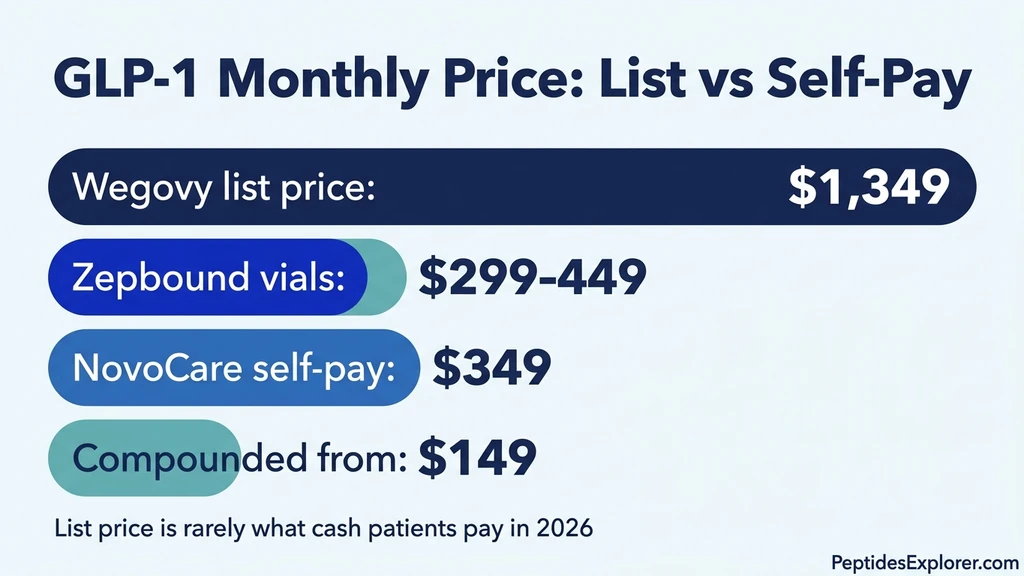
The list price (wholesale acquisition cost) is the number on the headline. It is also the number almost nobody actually pays in 2026.
| Drug (Brand) | List Price (Cash) | Indication |
|---|---|---|
| Wegovy (semaglutide) | $1,349/month | Obesity |
| Ozempic (semaglutide) | ~$1,028/month | Type 2 diabetes |
| Zepbound (tirzepatide) | $1,086/month | Obesity |
| Mounjaro (tirzepatide) | ~$1,023/month | Type 2 diabetes |
| Rybelsus (oral semaglutide) | ~$998/month | Type 2 diabetes |
| Saxenda (liraglutide) | $1,349/month | Obesity |
Sources: Novo Nordisk and Eli Lilly pricing pages, GoodRx, 2026.
These are the figures behind every "weight-loss drugs cost $1,000+ a month" headline. They are accurate as list prices. They are misleading as what a typical cash patient pays, because manufacturer self-pay programs now sit far below them. For a detailed breakdown on one drug, see how much is semaglutide.
Manufacturer Self-Pay Changed the Math
In 2025 both makers launched direct-to-consumer cash programs that undercut their own list prices by more than half.
| Program | Drug | Self-Pay Price |
|---|---|---|
| LillyDirect | Zepbound vial 2.5 mg | $299/month |
| LillyDirect | Zepbound vial 5 mg | $399/month |
| LillyDirect | Zepbound vials 7.5-15 mg | $449/month |
| NovoCare | Wegovy (injectable doses) | $349/month |
| NovoCare | Wegovy intro offer (new patients) | $199/month, first 2 fills |
Sources: Eli Lilly investor release, 2025; NovoCare, 2026.
LillyDirect's reduced prices require a refill within 45 days. These programs are why the real cash cost of a brand GLP-1 in 2026 is closer to $300-$450 than to $1,300.
Compounded GLP-1s Cost Less, With Caveats
Compounded semaglutide and tirzepatide through telehealth platforms are the cheapest route, but the most lightly sourced and the most legally fragile.
Compounded semaglutide typically runs about $149 to $200 per month. Compounded tirzepatide runs roughly $125 to $400. These figures come from telehealth aggregators, not manufacturers, so treat them as ranges, not fixed prices.
The legal ground shifted in 2025. After the FDA removed semaglutide and tirzepatide from its shortage list, the basis for mass compounding narrowed, and the agency issued warning letters to more than 30 compounders. Some platforms, including Hims, exited compounding and now sell brand Wegovy. For whether the compounded product works, see does compounded tirzepatide work and is compound tirzepatide safe.
What Do GLP-1s Cost With Insurance?
With commercial insurance and a manufacturer savings card, out-of-pocket cost drops sharply, but coverage is inconsistent.
| Scenario | Typical Out-of-Pocket |
|---|---|
| Commercial insurance + savings card (eligible) | As low as $25/month |
| Typical commercial-insurance copay | $150-$300/month |
| High-deductible plan, before coverage kicks in | Full list price until deductible met |
The $25 savings-card figure is well-corroborated by Lilly and Novo. The $150-$300 range comes from clinic and industry estimates, so treat it as indicative rather than precise. The catch is the deductible: on a high-deductible plan, you can face the full list price for months before coverage starts.
Many employer plans exclude weight-loss indications entirely while covering the diabetes versions, which is why some patients and prescribers navigate between Ozempic and Wegovy. For the insured-cost picture on one drug, see tirzepatide cost with insurance.
Medicare, Medicaid, and the 2027 Price Cuts
Public coverage is shifting fast, and two dated changes matter.
Medicare Part D statutorily excludes drugs used for weight loss, so standard Medicare does not cover Wegovy or Zepbound for obesity alone. The exception is the new Medicare GLP-1 Bridge, a demonstration running July 1, 2026 through December 31, 2027, with a $50 monthly copay and a negotiated manufacturer price of $245 per 30-day supply (CMS and KFF, 2026).
On the commercial side, Novo Nordisk announced in February 2026 that it will cut the list price of Wegovy, Ozempic, and Rybelsus to $675 per month effective January 1, 2027, a roughly 50% reduction for Wegovy. Note the date: that cut is not yet in effect, and it does not change the self-pay cash prices already in market.
Medicaid spending shows the scale of adoption: gross GLP-1 spending rose from about $1 billion in 2019 to roughly $9 billion in 2024, at about $1,000 gross per prescription (KFF, 2026).
Why Americans Pay So Much More
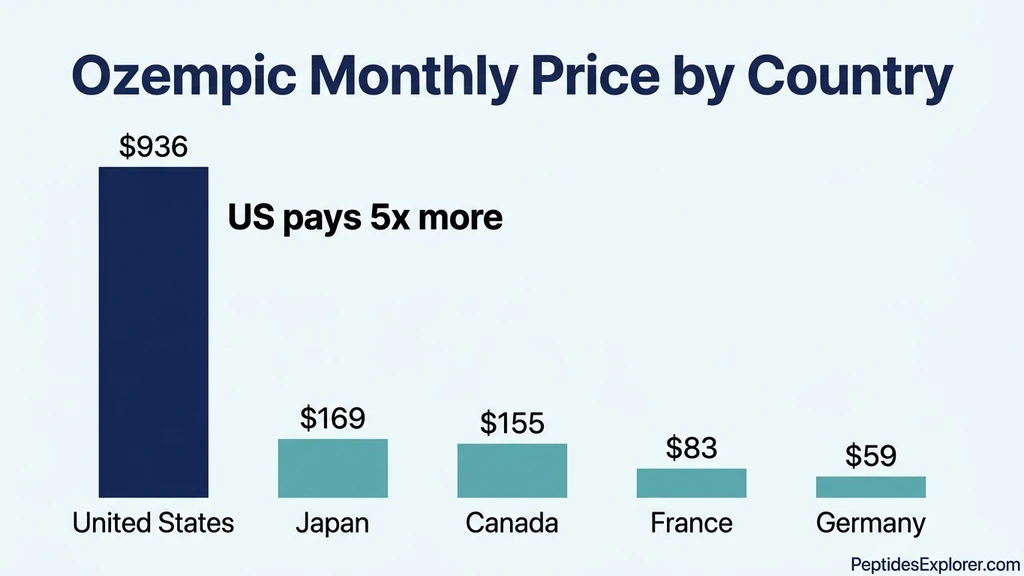
The international gap is the single most-cited GLP-1 cost statistic, and it holds up.
| Country | Ozempic Monthly Price |
|---|---|
| United States | ~$936 (list) |
| Japan | ~$169 |
| Canada | ~$155 |
| France | ~$83 |
| Germany | ~$59 |
Source: KFF analysis, 2023.
The US pays more than 5x the price of Japan, the next-highest country, for the same Ozempic. Across all brand-name drugs, RAND found US prices run 4.22x higher than in 33 comparison nations (RAND, 2024). The KFF country figures are from 2023, so treat the exact numbers as a snapshot, but the multiple is consistent across analyses. Ignore the sensational "1,300% more" outliers; the defensible figure is roughly 5x.
The Cost of Quitting
Cost is not just a barrier to starting a GLP-1. It is the leading reason people stop.
Among adults who discontinued a GLP-1 within a year, 47.6% cited financial reasons, versus 28.2% who cited side effects (Gasoyan et al., Obesity, 2025). That study is peer-reviewed and population-based, which makes it the gold-standard source on why GLP-1 courses end.
The broader spending picture explains the pressure on insurers and employers. US GLP-1 class spending reached roughly $132 billion in 2025, about 14% of all US prescription drug spending (ASHP, 2026). Medicare Part D gross GLP-1 spending alone hit $27.5 billion in 2024, five times the 2019 figure (KFF, 2025). When a drug class costs the system this much, coverage decisions tighten, and patients feel it at the pharmacy counter. Estimate your own scenario with the peptide cost calculator.
Methodology
Every price on this page is labeled by type, because conflating them is the most common error in GLP-1 cost coverage:
- List price (WAC): the wholesale sticker price, from manufacturer pricing pages and GoodRx
- Self-pay cash price: LillyDirect and NovoCare direct-to-consumer programs
- Net price: after confidential rebates, reported only as estimates
- With-insurance copay: savings-card and commercial-plan out-of-pocket ranges
High-credibility figures (manufacturer releases, CMS, KFF, RAND, the peer-reviewed Gasoyan study) are stated as fact. Compounded pricing and clinic-sourced copay averages are the weakest data and are presented as ranges. Net prices are never stated as exact, because rebates are confidential. Time-sensitive figures (the 2027 Novo list-price cut, the July 2026 Medicare Bridge) are date-stamped so they do not read as already in effect.
Frequently Asked Questions
How much does Ozempic cost per month without insurance?
Ozempic's list price is about $1,028 per month without insurance. As a diabetes-labeled drug, it lacks the broad obesity self-pay program that Wegovy and Zepbound offer, though savings cards can lower the cost for eligible commercially insured patients. See how much is semaglutide for the full breakdown.
How much is Wegovy without insurance in 2026?
Wegovy lists at $1,349 per month, but cash patients can use the NovoCare self-pay program at $349 per month, with a $199 intro offer for the first two fills for new patients. The list price is scheduled to drop to $675 per month on January 1, 2027. Compare doses with our semaglutide dosage calculator.
How much does Zepbound cost on LillyDirect?
Zepbound single-dose vials through LillyDirect self-pay run $299 per month for the 2.5 mg dose, $399 for 5 mg, and $449 for 7.5 mg and above. Reduced pricing requires a refill within 45 days. This is far below Zepbound's $1,086 list price.
Why is Ozempic so much more expensive in the US than other countries?
The US paid about $936 per month for Ozempic versus roughly $169 in Japan, the next-highest country, more than a 5x gap (KFF, 2023). Across all brand drugs, US prices run 4.22x higher than 33 peer nations (RAND, 2024). The gap reflects US drug-pricing structure, not a different product.
Does Medicare cover GLP-1s for weight loss?
Standard Medicare Part D excludes weight-loss drugs, so it does not cover Wegovy or Zepbound for obesity alone. The new Medicare GLP-1 Bridge demonstration, running July 2026 through December 2027, offers a $50 monthly copay with a $245 negotiated price. Diabetes indications remain covered outside the Bridge.
How much does compounded semaglutide cost through telehealth?
Compounded semaglutide typically runs $149 to $200 per month, and compounded tirzepatide $125 to $400, through telehealth platforms. These are aggregator estimates, not fixed prices. The legal basis narrowed in 2025 after shortages ended. See is compound tirzepatide safe.
Will GLP-1 prices go down in 2027?
Yes for Novo's semaglutide drugs. The company will cut Wegovy, Ozempic, and Rybelsus list prices to $675 per month on January 1, 2027, roughly a 50% reduction for Wegovy. Separately, Medicare negotiated a semaglutide price effective 2027. Self-pay cash prices are already below the current list.
How much can you save with a GLP-1 savings card?
With commercial insurance and an eligible manufacturer savings card, out-of-pocket cost can fall to as low as $25 per month for Zepbound or Wegovy. Without insurance, savings cards generally do not apply, and the self-pay manufacturer programs ($299-$449) are the better route.
The Bottom Line
The real cost of a GLP-1 in 2026 depends entirely on which price you are quoting. The $1,349 Wegovy list price is accurate but rarely paid. The numbers most patients actually face are the $299-$449 LillyDirect vials, the $349 NovoCare self-pay, or a $25-$300 insured copay. Compounded routes go lower, with legal caveats.
The international gap is real and large: Americans pay roughly 5x peer nations for the same drug. And cost, not side effects, is the leading reason people stop, ending nearly half of all discontinued courses.
Keep exploring the data:
- GLP-1 Side Effects Statistics: the trial numbers, separated from real-world data
- Ozempic Statistics 2026: market size, prescriptions, and adoption
- Peptide Statistics 2026: 60+ verified facts across the industry
- Take our peptide quiz: a personalized protocol in 2 minutes
References
- 1.Novo Nordisk (2026). US list price reduction for Wegovy, Ozempic, and Rybelsus. Link
- 2.Eli Lilly (2025). Lilly lowers price of Zepbound single-dose vials. Link
- 3.KFF (2023). How do US weight-loss drug prices compare to peer nations? Link
- 4.RAND (2024). US prescription drug prices 2.78x to 4.22x peer nations. Link
- 5.CMS (2026). Medicare GLP-1 Bridge. Link
- 6.Gasoyan H et al. (2025). Reasons for discontinuation of GLP-1 medications. *Obesity*. Link
*Educational content only. Not medical or financial advice. Prices reflect 2026 figures and change frequently. Verify current pricing with the manufacturer or pharmacy before making decisions.*
Helpful Tools
Related Articles
GLP-1 Side Effects Statistics (2026)
GLP-1 side effects by the numbers: 44% nausea on semaglutide, 4-7% quit in trials vs up to 64.8% within a year. Cited STEP/SURMOUNT trial data.
Ozempic Statistics 2026: Market, Sales & Usage Data
Ozempic and GLP-1 statistics for 2026: 1 in 8 US adults take a GLP-1, Ozempic made ~$18B in 2025, Lilly overtook Novo. Verified earnings, survey, and FDA data.
Peptide Statistics 2026: 60+ Verified Facts
60+ peptide statistics for 2026: $52.6B market, 1 in 8 US adults on GLP-1s, search +652%, retatrutide 28.7% weight loss. Cited sources, updated quarterly.
FDA Peptide Crackdown 2026
Timeline of FDA actions against peptide vendors in 2025-2026. Why Peptide Sciences shut down, which peptides are banned, and what options remain.