You want a GLP-1 side effect number that survives fact-checking, not a vague "may cause stomach upset." The verified pivotal-trial figures: 44.2% of people on semaglutide 2.4 mg had nausea versus 17.4% on placebo (STEP 1), tirzepatide nausea ran 25-33% across doses (SURMOUNT-1), and only 4-7% of trial participants quit because of side effects. In the real world, the story shifts: up to 64.8% of obesity patients stopped their GLP-1 within a year (a 125,474-patient cohort, 2024).
Every figure on this page cites its primary source: the STEP and SURMOUNT trials published in the New England Journal of Medicine, FDA labels, JAMA meta-analyses, and peer-reviewed real-world cohorts. Where evidence is mixed or a number is contested, this page says so rather than picking the scariest figure.
The gap between trial side effects and real-world discontinuation is the single most misreported part of this topic. We separate the two below. We update this resource quarterly, most recently in June 2026.
Get your custom peptide protocol:
- Tailored to your body and goals
- Precise dosing and cycle length
- Safe stacking combinations
- Backed by peer-reviewed studies
- Ready in under 2 minutes
Key Takeaways
The statistics cited most often from this resource:
- 44.2%: Nausea rate on semaglutide 2.4 mg in STEP 1, versus 17.4% on placebo (Wilding et al., NEJM 2021)
- 25-33%: Nausea range for tirzepatide across 5-15 mg doses in SURMOUNT-1 (Jastreboff et al., NEJM 2022)
- 4-7%: Share of trial participants who discontinued due to adverse events
- 64.8%: Obesity patients (without diabetes) who stopped their GLP-1 within one year in real-world data (125,474-patient cohort, 2024)
- 47.6%: Of people who quit, the share citing cost (not side effects) as the reason (Gasoyan et al., Obesity, 2025)
- 1.37: Relative risk of gallbladder or biliary disease across GLP-1 drugs (76 trials, JAMA Internal Medicine, 2022)
- Improving: One-year persistence rose from 33.2% (2021 starters) to 60.9% (2024 starters) as shortages eased and titration improved
How Common Are GLP-1 Side Effects?
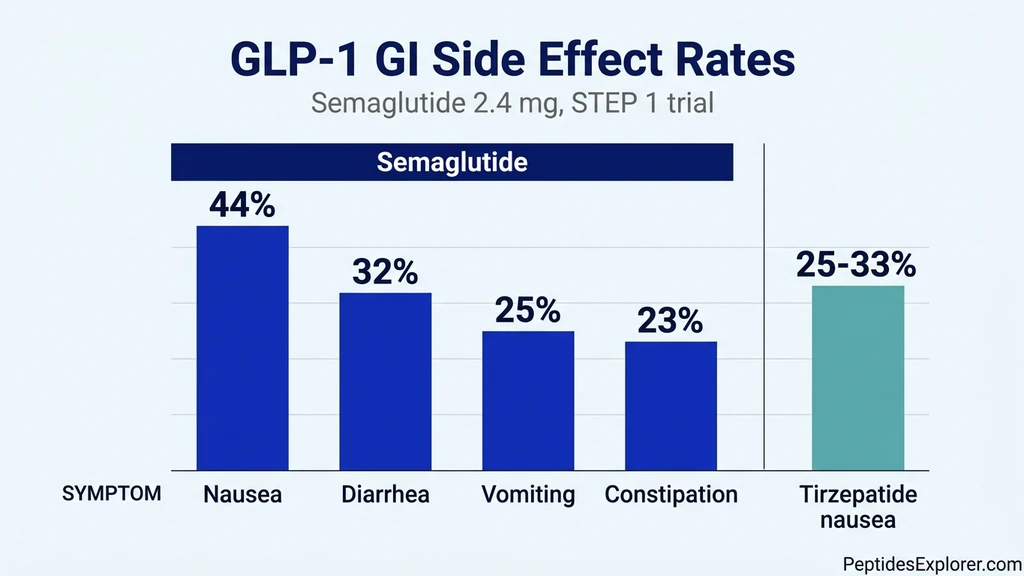
Gastrointestinal effects are the defining side effect of the GLP-1 class. They cluster during the dose-escalation phase, when the body adjusts to slowed gastric emptying, and they are usually mild to moderate.
Nausea leads every trial. In STEP 1, the pivotal semaglutide weight-loss trial, 44.2% of participants reported nausea against 17.4% on placebo. Diarrhea hit 31.5%, vomiting 24.8%, and constipation 23.4%.
These are real, common, and temporary for most people. They are also the reason titration matters: starting low and increasing slowly is the single biggest lever for tolerating a GLP-1. For practical management, see how to relieve nausea from semaglutide.
Semaglutide Side Effect Rates (STEP 1)
These rates come from STEP 1, semaglutide 2.4 mg weekly over 68 weeks in roughly 1,961 adults with overweight or obesity (Wilding et al., NEJM 2021).
| Side Effect | Semaglutide 2.4 mg | Placebo |
|---|---|---|
| Nausea | 44.2% | 17.4% |
| Diarrhea | 31.5% | 15.9% |
| Vomiting | 24.8% | 6.6% |
| Constipation | 23.4% | n/a |
Source: Wilding et al., NEJM 2021 (STEP 1).
Nausea is the headline number at 44.2%, and it remains the most defensible single statistic about GLP-1 tolerability. For symptom-specific detail, see does semaglutide cause nausea and how long do semaglutide side effects last.
Tirzepatide Side Effect Rates (SURMOUNT-1)
Tirzepatide rates come from SURMOUNT-1, 72 weeks in roughly 2,539 adults with obesity (Jastreboff et al., NEJM 2022).
| Side Effect | 5 mg | 10 mg | 15 mg |
|---|---|---|---|
| Nausea | 24.6% | 33.3% | 31.0% |
| Diarrhea | 18.7% | 21.2% | 23.0% |
| Constipation | 16.8% | 17.1% | 11.7% |
| Vomiting | 8.3% | 10.7% | 12.2% |
Source: Jastreboff et al., NEJM 2022 (SURMOUNT-1).
One counterintuitive finding: tirzepatide nausea does not climb steadily with dose. The 10 mg arm reported more nausea than the 15 mg arm. The drugs were studied in separate trials, so the tirzepatide and semaglutide numbers are not a head-to-head comparison. For symptom-specific pages, see does tirzepatide cause diarrhea and does tirzepatide cause constipation.
Discontinuation: Trial Data vs Real World
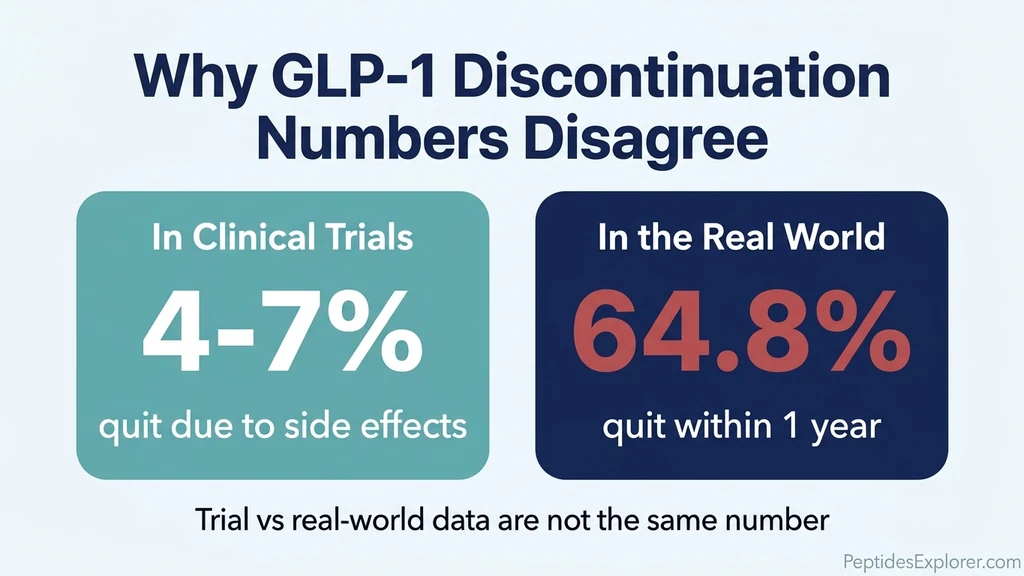
This is where most articles go wrong. Two completely different numbers describe "how many people quit," and they are not interchangeable.
In the controlled trials, discontinuation due to adverse events was low. STEP 1 saw 4.5% stop for GI events versus 0.8% on placebo. SURMOUNT-1 ranged from 4.3% (5 mg) to 7.1% (10 mg).
In the real world, discontinuation is far higher, because real patients face cost, access gaps, and life outside a monitored study. A cohort of 125,474 patients found 64.8% of those without diabetes stopped within one year, versus 46.5% of those with diabetes (2024).
The reasons matter. Among people who quit, 47.6% cited financial reasons and 28.2% cited side effects (Gasoyan et al., Obesity, 2025). Side effects are real, but cost ends more GLP-1 courses than nausea does. For the price side of that equation, see our GLP-1 cost statistics.
Persistence Is Improving
The high discontinuation figures come from early data. Persistence has climbed sharply as the shortage resolved and prescribers got better at slow titration.
One-year persistence rose from 33.2% among 2021 starters to 60.9% among first-half 2024 starters. Pharmacy-claims analysis of Wegovy and Zepbound showed 63% of 2024 starters still on therapy at one year, up from 40% of 2023 starters.
Pairing the scary "64.8% quit" headline with this improving trend is the honest way to present the data. The number is real, but it describes an earlier, harder period of access.
Serious Adverse Events: What the Data Does and Does Not Show
Beyond GI effects, GLP-1 labels carry warnings for several serious conditions. The evidence quality varies, and precision matters here more than anywhere.
Gallbladder and Biliary Disease (Quantified)
This is the best-quantified serious risk. A meta-analysis of 76 randomized trials covering 103,371 patients found a relative risk of 1.37 for gallbladder or biliary disease across GLP-1 drugs (He et al., JAMA Internal Medicine, 2022).
| Condition | Relative Risk | Source |
|---|---|---|
| Gallbladder or biliary disease (overall) | 1.37 | JAMA Intern Med, 2022 |
| Cholelithiasis (gallstones) | 1.27 | JAMA Intern Med, 2022 |
| Cholecystitis | 1.36 | JAMA Intern Med, 2022 |
| Biliary disease | 1.55 | JAMA Intern Med, 2022 |
Source: He et al., JAMA Internal Medicine, 2022. Risk was higher with weight-loss indications, higher doses, and longer use.
Pancreatitis and Thyroid Tumors (Warnings, Not Rates)
Pancreatitis appears on every GLP-1 label as a precaution. But pivotal-trial and meta-analytic data do not show a robust, statistically significant increase in pancreatitis incidence. STEP 1 logged three pancreatitis cases in the semaglutide group, two of them with concurrent gallstones. There is no clean "X% pancreatitis rate" to cite, and anyone publishing one is guessing.
The thyroid C-cell tumor boxed warning rests on rodent studies, not human cases. Rodent thyroid C-cells carry far more GLP-1 receptors than human cells, and large datasets covering more than 14,000 patients show no statistically significant increase in medullary thyroid carcinoma. The warning is real and the contraindication is firm (personal or family history of medullary thyroid carcinoma or MEN 2), but as of 2026 there is no confirmed human causation. Source: FDA Ozempic label, 2025. The same boxed warning applies to tirzepatide.
Emerging Signals: Vision and Muscle Mass
Two newer signals draw attention but lack settled evidence.
A 2024 case series in JAMA Ophthalmology described nine patients with vision problems on semaglutide or tirzepatide, most with non-arteritic anterior ischemic optic neuropathy (NAION). Follow-up studies conflict, and the American Academy of Ophthalmology advises awareness rather than stopping treatment. This is an association, not an established cause.
On muscle, roughly 25-40% of total weight lost on a GLP-1 shows up as lean mass on DXA scans. That figure is genuinely contested, because "lean mass" on DXA includes water, glycogen, and organs, not just skeletal muscle. The range is defensible; a single precise muscle-loss number is not. See does tirzepatide cause muscle loss for the resistance-training and protein strategies that limit it.
Methodology
Every statistic on this page is sourced to one of the following, in descending order of weight:
- Peer-reviewed pivotal trials (STEP, SURMOUNT) published in the New England Journal of Medicine
- FDA prescribing labels for boxed warnings and contraindications
- Meta-analyses in JAMA Internal Medicine and equivalent journals
- Peer-reviewed real-world cohorts for discontinuation and persistence
We deliberately do not publish a composite "X% of users have at least one side effect" figure, because we could not trace one to a primary source. We do not cite litigation case counts as incidence, because legal filings measure lawsuits, not biology. Where sources conflict (vision risk, lean-mass fraction), we present the range and say so. Trial discontinuation and real-world discontinuation are reported as separate numbers, never merged.
Frequently Asked Questions
What are the most common side effects of Ozempic and Wegovy?
Gastrointestinal effects dominate. In the STEP 1 trial, semaglutide 2.4 mg caused nausea in 44.2% of users, diarrhea in 31.5%, vomiting in 24.8%, and constipation in 23.4%, all versus much lower placebo rates. Most are mild to moderate and concentrated during dose escalation. See does semaglutide cause nausea for management.
How long do GLP-1 side effects last?
For most people, GI side effects peak during the dose-escalation phase and ease as the body adapts, typically over the first several weeks at each new dose. They are usually mild to moderate and transient. The detailed timeline is in how long do semaglutide side effects last.
What percentage of people stop taking GLP-1 medications?
Two very different numbers apply. In clinical trials, only 4-7% quit due to side effects. In the real world, up to 64.8% of obesity patients without diabetes stopped within a year (2024 cohort). Of those who quit, 47.6% cited cost, not side effects. Persistence is improving year over year. See our GLP-1 cost statistics.
Does Mounjaro or Zepbound cause fewer side effects than Ozempic?
In their respective trials, tirzepatide nausea ran 25-33% (SURMOUNT-1) versus 44.2% for semaglutide 2.4 mg (STEP 1). The drugs were not tested head-to-head, so this is not a direct comparison. Both share the same GI profile and the same boxed thyroid warning. Compare protocols with our tirzepatide dosage calculator.
Can GLP-1 drugs cause pancreatitis or gallbladder problems?
Gallbladder and biliary disease carry a quantified relative risk of 1.37 across GLP-1 trials (JAMA Internal Medicine, 2022). Pancreatitis is a labeled precaution, but trial and meta-analytic data do not show a robust increase in incidence, so no reliable percentage exists. Risk rises with higher doses and longer use. See peptide therapy side effects.
Why do GLP-1 medications have a thyroid cancer warning?
The boxed warning comes from rodent studies showing thyroid C-cell tumors, not from human cases. Rodent C-cells have far more GLP-1 receptors than human cells, and large human datasets show no statistically significant increase in medullary thyroid carcinoma. It is contraindicated if you have a personal or family history of medullary thyroid carcinoma or MEN 2.
Do GLP-1 drugs cause muscle loss?
Roughly 25-40% of weight lost on a GLP-1 appears as lean mass on DXA scans, though that measure includes water and glycogen, not just muscle, so the real skeletal-muscle loss is lower. Resistance training and high protein intake limit it. Full detail is in does tirzepatide cause muscle loss.
Are there vision risks with semaglutide?
A 2024 JAMA Ophthalmology case series linked semaglutide and tirzepatide to nine cases of vision problems, mostly NAION. Follow-up evidence conflicts, and ophthalmology bodies advise awareness rather than stopping treatment. As of 2026 this is an unresolved association, not an established cause.
The Bottom Line
The honest summary of GLP-1 side effects: gastrointestinal effects are common but usually mild and temporary, with nausea affecting 44.2% of semaglutide users in STEP 1. Only 4-7% of trial participants quit because of them. The serious risks are mostly labeled precautions rather than quantified rates, with gallbladder disease (relative risk 1.37) the clearest exception.
The real-world discontinuation figures are higher, but cost drives more of them than side effects, and persistence is improving every year. Read the trial numbers and the real-world numbers as two separate things, because they are.
Keep exploring the data:
- GLP-1 Cost Statistics: why nearly half of people who quit cite price
- Ozempic Statistics 2026: market size, prescriptions, and who is taking GLP-1s
- Peptide Statistics 2026: 60+ verified facts across the industry
- Take our peptide quiz: a personalized protocol in 2 minutes
References
- 1.Wilding JPH et al. (2021). Once-Weekly Semaglutide in Adults with Overweight or Obesity (STEP 1). *NEJM*, 384:989-1002. Link
- 2.Jastreboff AM et al. (2022). Tirzepatide Once Weekly for the Treatment of Obesity (SURMOUNT-1). *NEJM*, 387:205-216. Link
- 3.He L et al. (2022). Association of GLP-1 Receptor Agonists with Gallbladder and Biliary Diseases. *JAMA Intern Med*, 182(5):513-519. Link
- 4.Gasoyan H et al. (2025). Reasons for discontinuation of GLP-1 medications. *Obesity*. Link
- 5.FDA Ozempic Prescribing Information (2025). Link
*Educational content only. Not medical advice. Side effect rates come from clinical trials and may differ from individual experience. Consult a qualified healthcare provider before starting or stopping any medication.*
Helpful Tools
Related Articles
Ozempic Statistics 2026: Market, Sales & Usage Data
Ozempic and GLP-1 statistics for 2026: 1 in 8 US adults take a GLP-1, Ozempic made ~$18B in 2025, Lilly overtook Novo. Verified earnings, survey, and FDA data.
GLP-1 Cost Statistics 2026: Real Prices, Verified
How much GLP-1 drugs really cost in 2026: Wegovy lists at $1,349/mo but self-pay runs $349, Zepbound vials $299-449, compounded from $149. Verified prices.
Peptide Statistics 2026: 60+ Verified Facts
60+ peptide statistics for 2026: $52.6B market, 1 in 8 US adults on GLP-1s, search +652%, retatrutide 28.7% weight loss. Cited sources, updated quarterly.
FDA Peptide Crackdown 2026
Timeline of FDA actions against peptide vendors in 2025-2026. Why Peptide Sciences shut down, which peptides are banned, and what options remain.