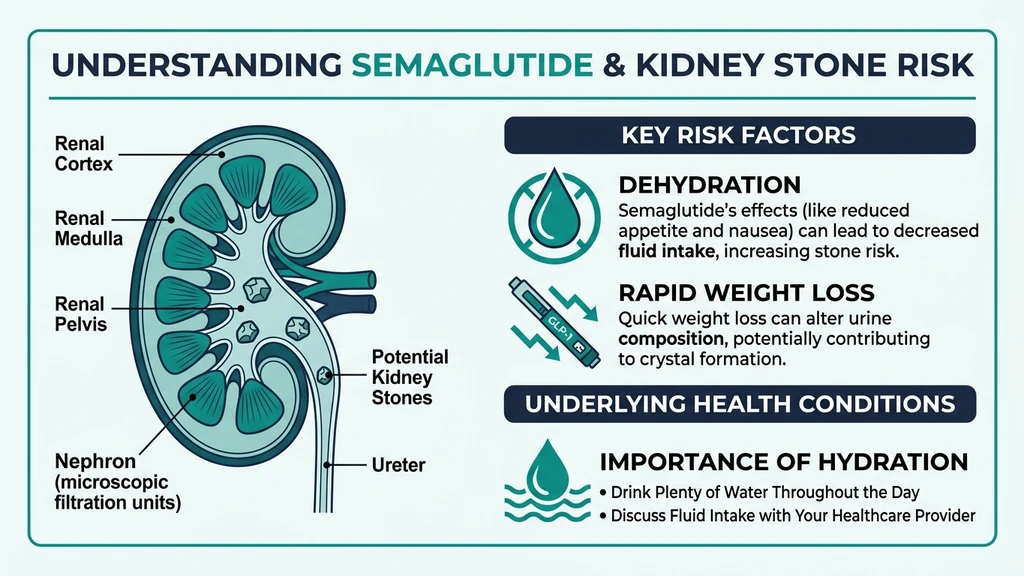
You felt a sharp ache in your lower back a few weeks into your semaglutide dose, and now you are searching whether the drug is forming stones in your kidney. Semaglutide has not been shown to directly cause kidney stones. No clinical trial, FDA label warning, or established pharmacological mechanism links the drug to stone formation, and the largest real-world datasets actually point the other way, associating GLP-1 use with the same or lower stone risk. Any added risk is indirect: nausea, vomiting, and diarrhea can dehydrate you, and very rapid weight loss can shift urine chemistry, both of which favor stones only when fluid intake stays low.
The risk that exists is conditional and manageable. The table below maps each indirect risk factor to its mechanism and the fix.
| Risk Factor | Mechanism | How to Mitigate |
|---|---|---|
| Dehydration from nausea, vomiting, diarrhea | Concentrated urine raises stone-salt saturation | Hit your fluid target, treat GI effects early, titrate slowly |
| Reduced fluid intake from appetite suppression | Lower urine volume concentrates minerals | Schedule water, track to pale-yellow urine |
| Very rapid weight loss | Higher uric acid load, shifted urine chemistry | Target 0.5 to 1% body weight per week, not crash loss |
| Personal or family stone history | About 50% recurrence within 5 to 10 years | Baseline counseling, 24-hour urine test if recurrent |
| Low citrate, high oxalate diet | Less stone inhibitor, more substrate | Citrus, balanced calcium with meals, moderate oxalate |
| High sodium and animal protein | Raises urinary calcium and uric acid | Keep sodium under 2,300 mg/day, moderate protein |
| Co-medications (topiramate, acetazolamide, high-dose vitamin C) | Independently raise stone risk | Review meds with your prescriber |
| Hot climate or heavy sweating | Fluid loss concentrates urine | Add fluids in heat and during exercise |
What follows is the mechanism, the named evidence, and a quantified prevention protocol you can run from your first injection.
Get your custom peptide protocol:
- Tailored to your body and goals
- Precise dosing and cycle length
- Safe stacking combinations
- Backed by peer-reviewed studies
- Ready in under 2 minutes
The Short Answer
Semaglutide is not a known direct cause of kidney stones. The STEP and SUSTAIN trial programs and the FDA label list gastrointestinal effects and rare acute kidney injury from volume depletion, not nephrolithiasis (FDA prescribing information for semaglutide, 2024, https://www.accessdata.fda.gov/scripts/cder/daf/).
The largest cohort data leans neutral-to-protective. A 716,406-adult analysis found GLP-1 use carried no excess stone risk, with newer SGLT2 inhibitors lower still (Paik et al., Mass General Brigham, 2024, https://www.massgeneralbrigham.org/en/about/newsroom/articles/diabetes-medication-class-tied-to-lower-risk-of-kidney-stones).
The plausible risk is indirect and conditional. Dehydration and very rapid weight loss can favor stones, but only when fluid intake stays low. Direct evidence for causation is limited and does not support it, so the honest reading is reassuring with a hydration caveat.
What the Evidence Actually Shows
Direct data on semaglutide and stones is limited, and what exists points away from causation. Three lines of evidence carry the weight here: trial labeling, large real-world cohorts, and urine chemistry.
No Direct Causal Link in Trials or Labeling
No phase 3 semaglutide trial flagged a kidney stone signal. The renal events in the label are acute kidney injury tied to dehydration from severe vomiting or diarrhea, not stone formation (FDA prescribing information for semaglutide, 2024, https://www.accessdata.fda.gov/scripts/cder/daf/).
That distinction matters. The kidney harm documented in trials is a fluid problem, the same fluid problem you can prevent with hydration. It is not the drug etching stones into your urinary tract.
Real-World Data Leans Protective
The strongest dataset is large and consistent. Among 716,406 adults, GLP-1 receptor agonist use was not tied to higher kidney stone risk, and the protective signal held across sex, race, prior chronic kidney disease, and obesity status (Paik et al., Mass General Brigham, 2024, https://www.massgeneralbrigham.org/en/about/newsroom/articles/diabetes-medication-class-tied-to-lower-risk-of-kidney-stones).
Real-world urology cohorts agree. A Journal of Urology analysis reported GLP-1 receptor agonists reduced stone events in obese patients (Journal of Urology real-world cohort, 2025, https://www.auajournals.org/doi/10.1097/01.JU.0001191328.95269.a6.11), and a WCET 2025 real-world analysis found the same directional benefit in obesity (WCET 2025, https://www.urotoday.com/conference-highlights/wcet-2025/163036-wcet-2025-the-impact-of-glp-1-receptor-agonists-on-nephrolithiasis-amongst-patients-with-obesity-insights-from-a-real-world-data-analysis.html).
Read this honestly: the data is observational, so it shows association, not proof. The signal is neutral-to-protective, which is the opposite of the scare framing thinner pages lead with.
Urine Chemistry Does Not Turn Pro-Stone
The most direct mechanistic test looked at what actually happens in urine. In 44 obese stone-formers on GLP-1 therapy for about 1.1 years, urinary oxalate fell from 40 to 32 mg/day (P=0.002), and sulfate and ammonium dropped as well (Changes in 24-Hour Urine Chemistry during Weight Loss with GLP-1 Therapies, 2025, https://pmc.ncbi.nlm.nih.gov/articles/PMC12282619/).
Calcium, citrate, uric acid, pH, and urine volume stayed unchanged. No prolithogenic shift appeared, unlike the oxalate spike seen after bariatric surgery or with orlistat (same study, 2025, https://pmc.ncbi.nlm.nih.gov/articles/PMC12282619/).
Lower oxalate means less stone substrate. The chemistry moved in the protective direction, which is the cleanest refutation of the idea that semaglutide pushes urine toward stones.
How Semaglutide Could Indirectly Raise Risk
Every real risk here runs through fluid, not pharmacology. Three pathways can concentrate urine enough to favor stones, and each is something you control.
Dehydration From GI Side Effects
Gastrointestinal effects are the main pathway. When semaglutide and nausea hit together, or you have a bout of diarrhea on semaglutide, you lose fluid out and take less fluid in.
Concentrated urine raises the saturation of calcium, oxalate, and uric acid. That is the chemistry that lets a stone seed and grow. These effects are usually worst during dose increases and fade with time, which the side effect timeline covers in detail.
Appetite Suppression and Low Fluid Intake
Semaglutide blunts appetite, and that often blunts thirst. Many users simply drink less without noticing, which lowers urine volume on its own.
Add the fatigue that some users report. When fatigue from semaglutide keeps you on the couch, it is easy to skip the water you would normally drink moving through your day.
Very Rapid Weight Loss
Fast fat breakdown raises the uric acid load your kidneys clear. Crash-style loss without matching hydration favors uric acid and calcium oxalate stones, which is the same mechanism that makes aggressive bariatric procedures a known stone risk (Changes in 24-Hour Urine Chemistry during Weight Loss with GLP-1 Therapies, 2025, https://pmc.ncbi.nlm.nih.gov/articles/PMC12282619/).
Gradual loss does not carry this penalty. Steady loss at 0.5 to 1% of body weight per week is protective against the metabolic drivers of stones, not harmful. The danger is the crash, not the drug.
Semaglutide vs Other GLP-1s and Weight-Loss Methods
Neither leading GLP-1 shows a consistent kidney stone signal. A FAERS disproportionality study covering January 2022 to September 2025 found renal reports dominated by acute kidney injury from dehydration, not stones, with AKI in about 1.07% of semaglutide reports versus about 0.47% of tirzepatide reports (Comparative Renal Safety of Tirzepatide and Semaglutide, 2025, https://www.ncbi.nlm.nih.gov/pmc/articles/PMC12610529/).
Kidney stones were not a flagged disproportionate signal for either drug. The renal story for both molecules is a hydration story, which is exactly why the fix is fluid.
The real stone-raisers are older interventions. Bariatric surgery, orlistat, and topiramate increase urinary oxalate or otherwise shift urine toward stones; GLP-1s do the opposite to oxalate (UAB Heersink explainer on GLP-1 medications and kidney stone risk, 2025, https://www.uab.edu/medicine/news/urology/understanding-the-connection-between-glp-1-medications-and-kidney-stone-risk). If you have used those methods before, the stone history they left behind matters more than your current semaglutide dose.
How to Prevent Kidney Stones on Semaglutide
Prevention here is mostly hydration with a few diet and dosing levers. The goal is a urine output target, not a vague "drink more water."
1. Hydrate to a urine-output target. Anyone with prior stones should produce 2.5 to 3 liters of urine per day, which takes roughly 3 to 3.5 liters of total fluid intake (Houston Methodist kidney stone prevention guidance, 2023, https://www.houstonmethodist.org/blog/articles/2023/jan/kidney-stone-prevention-how-much-water-should-you-drink/). Gauge it by pale-yellow urine, carry water, and front-load fluids during nausea windows.
2. Manage GI side effects fast. Slow titration, an antiemetic if prescribed, and bland low-fat meals keep fluid losses down. The titration schedule reduces GI severity, and these steps to relieve semaglutide nausea help you keep fluids in. Persistent vomiting or diarrhea is the real stone risk, not the molecule.
3. Lose weight gradually. Hold loss to 0.5 to 1% of body weight per week. Avoid crash dieting stacked on top of appetite suppression, which is the combination that raises uric acid load. If your loss has stalled, the reasons weight loss stalls on semaglutide are a safer thing to troubleshoot than starving the pace faster.
4. Eat stone-smart. Keep adequate dietary calcium with meals, moderate oxalate, limit sodium under 2,300 mg/day, and ease off excess animal protein. Add citrate from lemon water, since citrate is a natural stone inhibitor (Dietary weight loss strategies for kidney stone patients, 2023, https://pmc.ncbi.nlm.nih.gov/articles/PMC10188387/).
5. Review your medications. Topiramate, acetazolamide, and high-dose vitamin C independently raise stone risk and can stack on top of any dehydration. Flag them with your prescriber (MedlinePlus kidney stones self-care, 2024, https://medlineplus.gov/ency/patientinstructions/000135.htm).
6. Monitor if high-risk. Prior stones, a solitary kidney, or recurrence warrant a 24-hour urine study and urology input. Recurrence runs near 50% within 5 to 10 years for past stone formers, so baseline counseling pays off. The broader peptide safety guide covers monitoring principles across GLP-1 therapy.
When to See a Doctor
Some symptoms need same-day evaluation. Seek care for flank or back pain that radiates to the groin, blood in the urine, painful urination, fever, or a clear drop in urine output.
Nausea unrelated to your dosing schedule also warrants a look, since it can signal an obstructing stone rather than a drug effect. The broader symptom picture and how it overlaps with ordinary semaglutide side effects is worth reviewing so you can tell them apart.
Certain people should escalate faster. A solitary kidney, pregnancy, or a history of prior stones raises the urgency of any of the symptoms above. When in doubt, call your prescriber rather than waiting it out.
Frequently Asked Questions
Does semaglutide directly cause kidney stones?
No. No clinical trial, FDA warning, or known mechanism links semaglutide to stone formation. A 716,406-adult dataset associated GLP-1 use with neutral-to-lower stone risk. The renal events in the label are dehydration-driven, which the semaglutide side effect overview explains in more depth.
How could semaglutide indirectly raise my risk?
Through dehydration. Nausea, vomiting, and diarrhea reduce body fluid, and appetite loss can cut your water intake, concentrating urine and favoring stones. Managing semaglutide and nausea early keeps fluid losses down and removes the main pathway to stones.
Does rapid weight loss on semaglutide cause stones?
Very fast weight loss can raise uric acid and shift urine chemistry, but only when paired with poor hydration. Gradual loss of 0.5 to 1% of body weight per week is considered stone-safe. If your pace stalls, troubleshoot it with the weight loss plateau guide rather than crash dieting.
How much water should I drink on semaglutide?
Enough to produce 2.5 to 3 liters of urine per day, roughly 3 to 3.5 liters of total fluid. Pale-yellow urine signals adequate hydration. Front-load fluids during nausea windows, and use these steps to relieve semaglutide nausea so you can keep water down when GI effects peak.
Is tirzepatide safer than semaglutide for kidney stones?
Neither shows a consistent kidney stone signal. FAERS renal reports for both are dominated by dehydration-driven acute kidney injury, not stones, at about 1.07% for semaglutide versus 0.47% for tirzepatide. Both follow the same hydration rules covered in the peptide safety guide.
Can semaglutide actually protect against kidney stones?
Some evidence points that way. A 716,406-adult study found no excess risk, and a 44-patient urine study showed urinary oxalate fell from 40 to 32 mg/day with no pro-stone changes. The benefit tracks with gradual weight loss, which the titration schedule supports by easing GI effects.
Could fatigue on semaglutide raise my stone risk?
Indirectly, yes. When fatigue from semaglutide keeps you sedentary, you tend to drink less and lower your urine volume. The fix is the same hydration target of 2.5 to 3 liters of urine per day, met by scheduling water rather than relying on thirst.
When should I see a doctor about kidney stones?
Seek care for flank or back pain spreading to the groin, blood in the urine, painful urination, fever, or reduced urine output. Prior stones, a solitary kidney, or pregnancy raise the urgency. Separating these from routine GI effects is easier once you know the side effect timeline.
The Bottom Line
Semaglutide has not been shown to cause kidney stones. No trial, label warning, or mechanism supports causation, and the largest cohort data, plus a urine-chemistry study showing oxalate falling from 40 to 32 mg/day, leans neutral-to-protective.
The principle is simple: the only real risk runs through fluid, not the drug. Dehydration from GI side effects and crash-style weight loss can concentrate urine, so hydrate to 2.5 to 3 liters of urine per day, lose weight at 0.5 to 1% per week, and treat nausea and diarrhea early.
Run the prevention protocol from your first dose, and review your full risk picture in the peptide safety guide. Learn more at peptidesexplorer.com.
This is educational content, not medical advice. Consult a healthcare provider about kidney stone risk before or during semaglutide use.
Related Articles: - Does Semaglutide Cause Nausea - Can Semaglutide Cause Diarrhea - Does Semaglutide Cause Fatigue - How Long Do Semaglutide Side Effects Last - How to Relieve Nausea From Semaglutide - Semaglutide Titration Schedule - Peptide Safety Guide
Related Articles
How Long Does Retatrutide Diarrhea Last? Timeline & Fixes
Retatrutide diarrhea lasts 3 to 5 days per wave, clusters after each dose increase, and fades by week 3 to 4 at a stable dose. Timeline, fixes and red flags.
Can You Drink Alcohol on Peptides?
Can you drink on peptides? Class-by-class safety: GLP-1 hypoglycemia, GH pulse suppression, healing peptides. Risk levels and harm-reduction rules.
Tirzepatide and Pregnancy: Safety & Risks
Tirzepatide is not recommended in pregnancy. Stopping window, the oral birth control interaction, breastfeeding, and what to do if you conceive on it.
MOTS-c Peptide Side Effects: Full Guide
MOTS-c peptide side effects explained: injection reactions, fatigue, GI issues, who should avoid it, dosing safety, and how to minimize risks. Evidence-based.