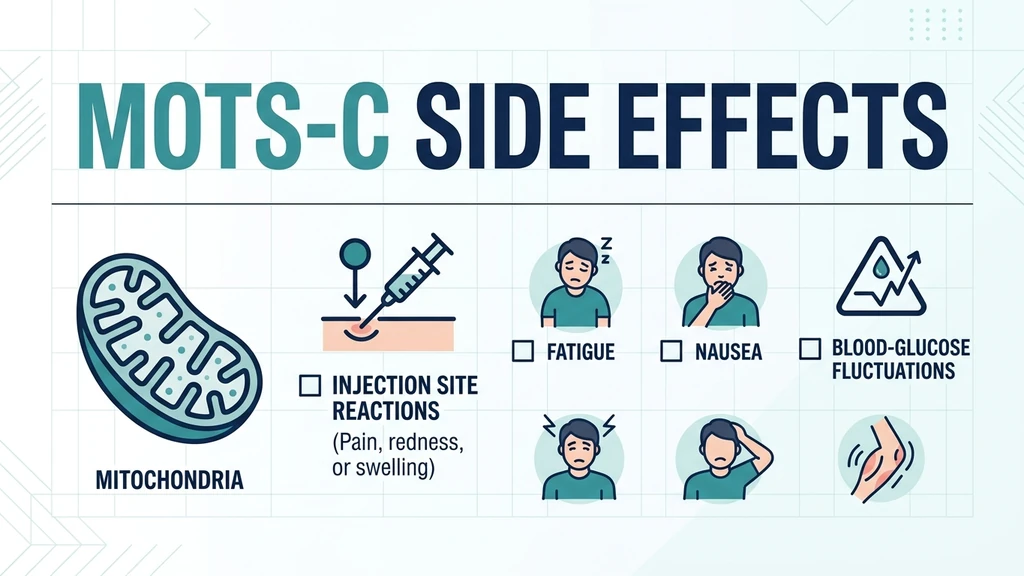
You are considering MOTS-c or already using it, and you want to know what can go wrong before it does. MOTS-c is a mitochondrial-derived peptide studied for metabolism, insulin sensitivity, and exercise capacity. Reported side effects are generally mild and uncommon: injection-site reactions, transient fatigue, occasional GI upset, and rare flushing. There is no large human safety database, so the cautious approach is essential.
| Quick Reference | Details |
|---|---|
| Most common effect | Injection-site redness or soreness |
| Other reported effects | Fatigue, mild nausea, flushing, headache |
| Serious effects | None well-documented; data is limited |
| Human safety data | Sparse; mostly preclinical research |
| Higher-risk groups | Diabetics on glucose-lowering drugs, pregnancy |
| FDA status | Not approved for human use |
| Key principle | Start low; monitor; data is incomplete |
MOTS-c is not FDA-approved and human research is limited. The absence of reported severe effects is not the same as proven safety. This guide summarizes what is known and where the gaps are. Always consult a licensed provider before use.
For dosing, see our MOTS-c peptide dosage guide and the broader peptide safety guide.
Get your custom peptide protocol:
- Tailored to your body and goals
- Precise dosing and cycle length
- Safe stacking combinations
- Backed by peer-reviewed studies
- Ready in under 2 minutes
MOTS-c Side Effects: Quick Reference
Most reported MOTS-c side effects are mild, localized, and transient. The list below reflects user reports and the limited research available, not a controlled safety trial.
| Side Effect | Frequency | Severity | Typical Duration |
|---|---|---|---|
| Injection-site redness/soreness | Common | Mild | Hours to 1-2 days |
| Fatigue or low energy | Occasional | Mild | First few days |
| Mild nausea | Occasional | Mild | First few days |
| Flushing/warmth | Uncommon | Mild | Minutes to hours |
| Headache | Uncommon | Mild | Hours |
| Dizziness | Rare | Mild | Transient |
The pattern resembles many research peptides: a brief adjustment period dominated by local injection effects and mild systemic symptoms that fade as the body adapts. Severe or lasting adverse events are not well-documented, but that reflects the small amount of human data as much as genuine safety.
Because MOTS-c influences metabolism and glucose handling, the most important caution is for people on glucose-lowering medication, covered below. Use the peptide interaction checker before combining it with anything.
Why MOTS-c Causes Side Effects
MOTS-c is a mitochondrial-derived peptide, meaning it is encoded within mitochondrial DNA and acts as a signaling molecule for cellular energy metabolism. It influences how cells handle glucose and respond to metabolic stress (Lee et al., Cell Metab, 2015).
Think of MOTS-c like a dispatcher for your cells' power plants. It tells mitochondria to ramp up energy production and improve how the body uses glucose. When you introduce an external signal that nudges metabolism, the body sometimes responds with temporary symptoms while it recalibrates, which is why early fatigue or mild GI changes show up.
The injection-site effects are mechanical and immunological rather than related to the peptide's metabolic action. Any subcutaneous injection can cause local redness, soreness, or a small bump, especially with improper technique or unbuffered solutions.
The metabolic effects are where real caution lies. By improving insulin sensitivity and glucose uptake, MOTS-c could theoretically lower blood sugar, which matters enormously if you also take insulin or other glucose-lowering drugs. Its exercise and metabolic benefits are documented in animal models (Reynolds et al., Nat Commun, 2021), but human dosing safety is not established.
Injection-Site Reactions
The most common MOTS-c side effect is also the most manageable. Local reactions at the injection site affect many subcutaneous peptide users.
What it looks like: Redness, mild swelling, soreness, itching, or a small temporary bump at the injection site. It usually appears soon after injection and resolves within a day or two.
Why it happens: Needle trauma, the solution's pH, injection of cold liquid, or repeated injection in the same spot. Poor sterile technique can turn a minor reaction into an infection.
How to minimize it: - Rotate injection sites rather than reusing the same spot - Let reconstituted solution reach room temperature before injecting - Use proper sterile technique with alcohol swabs and fresh needles - Inject slowly into subcutaneous fat, not muscle
Quantified guidance: a small red mark lasting under 48 hours is normal. Spreading redness, warmth, pus, or fever suggests infection and needs medical attention. See how to inject peptides and where to inject GHK-Cu for injection technique that applies to subcutaneous peptides generally.
Systemic Side Effects: Fatigue, GI, and Flushing
Beyond the injection site, MOTS-c can cause mild whole-body symptoms, usually during the first few days as the body adjusts.
Fatigue. Some users report low energy or sluggishness early on. This is somewhat paradoxical given MOTS-c is studied for improving exercise capacity, and it typically fades. If fatigue is persistent, reassess your dose and rule out other causes.
Mild nausea or GI upset. Occasional and usually short-lived. Taking it consistently and staying hydrated helps.
Flushing or warmth. Some people feel a brief flush after injection. It is generally harmless and passes within minutes to hours.
Headache. Uncommon and mild, often linked to dehydration or dosing changes.
These effects share a pattern: mild, early, and self-resolving. They rarely require stopping the peptide. The exception is if any symptom is severe, escalating, or accompanied by signs of low blood sugar (shakiness, sweating, confusion), which warrants stopping and seeking care. Compare this profile with GHK-Cu side effects and TB-500 side effects for context on how research peptides typically present.
Who Should Avoid or Be Cautious With MOTS-c
MOTS-c is not for everyone, and certain groups face meaningfully higher risk. The metabolic action that makes it interesting is also what creates the cautions.
Diabetics and those on glucose-lowering drugs. MOTS-c may improve insulin sensitivity and lower blood sugar. Combined with insulin, metformin, or sulfonylureas, this could risk hypoglycemia. This is the single most important caution. Coordinate closely with a physician.
Pregnant or breastfeeding individuals. No safety data exists. Avoid.
People with serious medical conditions. Anyone with cardiovascular, liver, kidney, or endocrine disease should not use research peptides without medical supervision.
Those on multiple medications. Interaction potential is poorly mapped. Check before combining.
Anyone seeking a quick fix. MOTS-c is a research compound, not a proven therapy. The risk-benefit math is unfavorable for casual experimentation.
The honest summary: MOTS-c sits in a low-data zone. The lack of documented severe effects is reassuring but not conclusive. People with metabolic conditions or on glucose-affecting medication carry the most real-world risk. Use the peptide interaction checker and read our peptide safety guide before starting.
How to Minimize MOTS-c Side Effects
Most side effects can be reduced or avoided with sensible practices. The principles mirror responsible use of any research peptide.
Start at a low dose. Begin below your target and assess tolerance before escalating. This limits the intensity of any early adjustment symptoms. See our MOTS-c peptide dosage guide.
Reconstitute and store correctly. Use bacteriostatic water, keep reconstituted peptide refrigerated, and discard degraded product. See how long do reconstituted peptides last.
Rotate injection sites. Prevents cumulative local irritation.
Do not run it continuously. Side effects accumulate on open-ended use, and taking a break between runs is the simplest way to reset tolerance. See MOTS-c cycle length for how long to stay on and when to break.
Monitor blood sugar if relevant. If you have any glucose concern or take glucose-lowering drugs, monitor closely and involve your physician.
Stay hydrated and consistent. Reduces headaches and GI upset.
Track your response. Keep a simple log of dose, timing, and any symptoms so you can spot patterns and adjust.
Stop if anything is severe. Escalating or alarming symptoms always override a protocol. Seek medical care for signs of hypoglycemia, infection, or allergic reaction.
Common Mistakes That Worsen Side Effects
Mistake 1: Starting at a high dose. Jumping in aggressively amplifies early adjustment symptoms. The fix: start low and titrate slowly.
Mistake 2: Ignoring blood-sugar interactions. Combining MOTS-c with glucose-lowering drugs without monitoring risks hypoglycemia. The fix: involve a physician and monitor closely.
Mistake 3: Reusing injection sites and needles. This drives local reactions and infection risk. The fix: rotate sites and use fresh sterile supplies.
Mistake 4: Injecting cold solution. Cold liquid stings and worsens local reactions. The fix: let it reach room temperature first.
Mistake 5: Pushing through severe symptoms. Treating a research peptide as something to tough out is dangerous. The fix: stop for any escalating or alarming symptom and seek care. See peptide therapy side effects for the general framework.
Frequently Asked Questions
What are the side effects of MOTS-c peptide?
The most common is injection-site redness or soreness. Others include mild fatigue, occasional nausea, brief flushing, and uncommon headaches, usually during the first few days. Severe effects are not well-documented, though human safety data is limited. The main caution is potential blood-sugar lowering. See our MOTS-c peptide dosage guide.
Is MOTS-c safe?
MOTS-c is not FDA-approved and human safety data is sparse, so it cannot be called proven-safe. Reported side effects are mild, but the absence of documented severe effects partly reflects limited research. People on glucose-lowering medication and those who are pregnant should avoid it. Always consult a licensed provider and review our peptide safety guide.
Does MOTS-c cause fatigue?
Some users report mild fatigue or low energy in the first few days, which usually fades as the body adjusts. This is somewhat paradoxical since MOTS-c is studied for improving exercise capacity. Persistent fatigue warrants reassessing your dose and ruling out other causes. Staying hydrated and consistent helps.
Can MOTS-c lower blood sugar?
Potentially, yes. MOTS-c may improve insulin sensitivity and glucose uptake, so it could lower blood sugar. This is the most important safety concern for people taking insulin, metformin, or sulfonylureas, where it could risk hypoglycemia. Monitor blood sugar closely and coordinate with a physician. Use our peptide interaction checker.
Who should not use MOTS-c?
Avoid MOTS-c if you are pregnant or breastfeeding, and use extreme caution if you take glucose-lowering medication or have diabetes, cardiovascular, liver, kidney, or endocrine disease. Those on multiple medications should check interactions first. It is a research compound, not a proven therapy, so casual use is discouraged. See our peptide safety guide.
How do I reduce MOTS-c injection-site reactions?
Rotate injection sites, let the reconstituted solution reach room temperature before injecting, use fresh sterile needles and alcohol swabs, and inject slowly into subcutaneous fat. A small red mark under 48 hours is normal, but spreading redness, warmth, or pus suggests infection and needs medical attention. See how to inject peptides.
How long do MOTS-c side effects last?
Most are short-lived. Injection-site reactions resolve within one to two days, while mild systemic effects like fatigue or nausea typically fade within the first few days as the body adjusts. Anything that persists, escalates, or is severe should prompt stopping and a medical consult. See how long do reconstituted peptides last for storage safety.
The Bottom Line
MOTS-c side effects are generally mild and uncommon: injection-site redness, transient fatigue, occasional nausea, and rare flushing or headache. Severe adverse events are not well-documented, but that reflects how little human data exists, not proven safety. Treat the gaps in the evidence as a reason for caution, not confidence.
The most important real-world risk is metabolic. Because MOTS-c may lower blood sugar, anyone on insulin or other glucose-lowering drugs needs close monitoring and physician involvement. Pregnant individuals and those with serious medical conditions should avoid it entirely.
You can minimize most issues by starting low, reconstituting and storing correctly, rotating injection sites, and tracking your response. Stop for any severe or escalating symptom. Plan your dose with our MOTS-c peptide dosage guide, check combinations with the peptide interaction checker, and always consult a licensed healthcare provider before use.
Helpful Tools
Related Articles
How Long Does Retatrutide Diarrhea Last? Timeline & Fixes
Retatrutide diarrhea lasts 3 to 5 days per wave, clusters after each dose increase, and fades by week 3 to 4 at a stable dose. Timeline, fixes and red flags.
Alcohol on Tirzepatide: Risks
Alcohol and tirzepatide: no absolute contraindication, but risks include hypoglycemia, prolonged intoxication, and stalled weight loss.
What Happens If You Use Expired Semaglutide?
Expired semaglutide usually means a weaker dose, not a dangerous one. Real risks by timeframe: 1 week, 1 month, 3 months past expiry and signs.
MOTS-c Before and After: Results & Timeline
See realistic MOTS-c before and after results, a week-by-week timeline, what the research shows, and the factors that decide whether you respond.