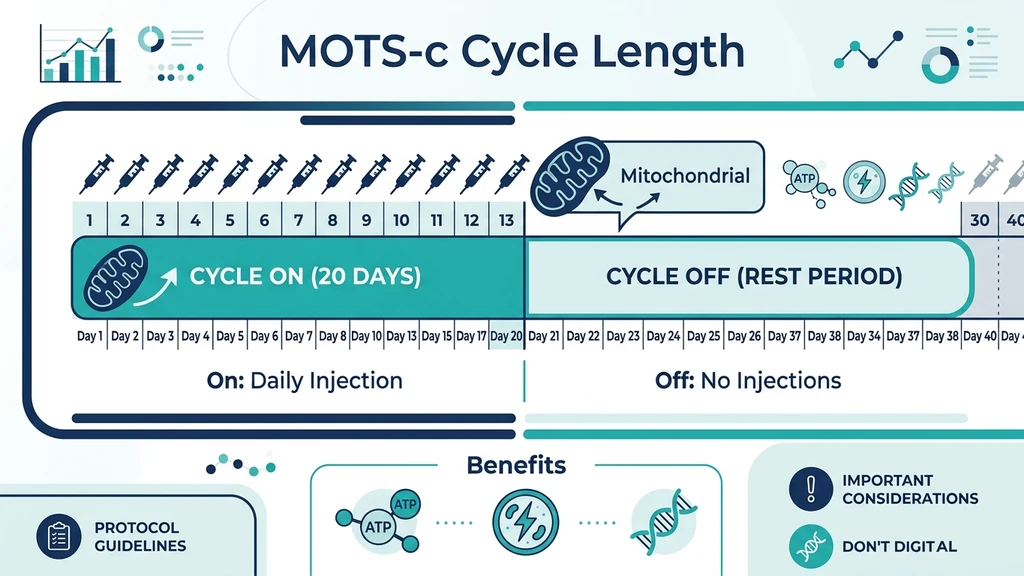
A typical MOTS-c cycle runs 4 to 6 weeks, with most short protocols using 4 injections spread over roughly 20 days. Longer maintenance cycles extend to 8 weeks. MOTS-c is almost always cycled rather than run continuously, followed by an off period of equal or greater length. Beginners stop at the shorter end and reassess before repeating.
This guide covers common cycle lengths, why MOTS-c is dosed on and off, how to adjust cycle length by goal, rest periods between cycles, and the mistakes that flatten results. For exact milligram amounts, see the MOTS-c dosage guide.
MOTS-c is a research peptide and is not FDA-approved. Consult a healthcare provider before starting any protocol.
Get your custom peptide protocol:
- Tailored to your body and goals
- Precise dosing and cycle length
- Safe stacking combinations
- Backed by peer-reviewed studies
- Ready in under 2 minutes
How Long Does a Typical MOTS-c Cycle Run?
Most MOTS-c cycles last 4 to 6 weeks. The peptide is run in defined blocks, not indefinitely, because its benefits come from intermittently activating a metabolic pathway rather than saturating it.
Three cycle templates dominate community and practitioner use. Each pairs a duration with a dosing frequency.
| Cycle type | Length | Dosing pattern | Typical goal |
|---|---|---|---|
| Short pulse | ~20 days | 4 injections (every ~5 days) | Metabolic reset, first trial |
| Standard | 4-6 weeks | 1-2 injections/week | Fat loss, recomposition |
| Maintenance | 8 weeks | 1 injection/week | Longevity, general metabolic support |
The short pulse protocol, 4 injections over about 20 days, is popular as an introductory block. It limits total exposure while still delivering a metabolic stimulus. The standard 4-to-6-week cycle is the workhorse for body composition goals, long enough for AMPK-driven changes to show in the mirror and on training performance.
Cycle length is not the same as dosing frequency. A 6-week cycle might mean six weekly injections or twelve twice-weekly ones, but the cycle is still 6 weeks. Decide the block length first, then set how many doses fit inside it.
MOTS-c clears the body quickly, so cycle length is driven by the duration of pathway stimulation you want, not by accumulation. There is no loading phase and no taper. Track dosing days and clearance windows with the Peptide Half-Life Tracker.
Why MOTS-c Is Cycled Instead of Run Continuously
MOTS-c works by activating AMPK, the same energy-sensing pathway that exercise switches on. Continuous activation of a stress-response pathway tends to lose effect over time, which is why intermittent dosing is the standard approach.
Lee et al. (2015) first described MOTS-c as a mitochondrial-derived peptide that promotes metabolic homeostasis and regulates insulin sensitivity through AMPK signaling. The peptide acts as a stress-responsive regulator, meaning the body adapts when the signal is constant.
Reynolds et al. (2021) showed that endogenous MOTS-c rises sharply with exercise, increasing nearly 12-fold in muscle after activity and then declining during rest. This natural pulse-and-recover pattern is the physiological model that on/off cycling imitates.
Running MOTS-c continuously risks blunting AMPK responsiveness, the same way constant stimulation dulls any adaptive signal. Cycling preserves sensitivity so each block produces a fresh response. The fasting-mimetic and exercise-mimetic framing only holds if the signal comes and goes, as it does with real fasting and training.
This is why cycle length is capped rather than open-ended. The benefit lives in the contrast between an active block and a recovered baseline. Remove the recovery and you remove the contrast, which is the part that drives the metabolic effect.
Cycle Length by Goal
Match the cycle length to what you want from MOTS-c. A metabolic reset is short. Fat loss and recomposition need longer blocks. Longevity support uses the longest, lowest-intensity cycles.
Metabolic Reset (about 20 days)
A reset uses the short pulse: 4 injections over roughly 20 days. The aim is a brief metabolic stimulus to improve insulin sensitivity and energy, not a sustained body-composition change.
This is the most common first cycle. It gives you a controlled trial of tolerance and response before committing to a longer block. Many users repeat a short reset 2 to 3 times per year rather than running long cycles.
Fat Loss and Recomposition (4-6 weeks)
Fat loss goals use a 4-to-6-week cycle, typically 1 to 2 doses per week. The longer window gives AMPK-driven changes in fat oxidation and metabolic rate time to compound alongside diet and training.
Dosing 30 to 60 minutes before exercise pairs the peptide's signal with training-induced AMPK activation. Pushing past 6 weeks rarely adds benefit and starts to risk pathway tolerance. See the MOTS-c before and after guide for realistic timelines on what a cycle of this length produces.
Longevity and Metabolic Health (up to 8 weeks)
Longevity-focused protocols run the longest, up to 8 weeks, but at the lowest frequency: usually 1 injection per week. The goal is gentle, sustained mitochondrial support rather than aggressive recomposition.
These cycles are repeated 2 to 3 times per year with long rest periods between them. The low weekly dose keeps cumulative pathway stimulation modest across an extended block. Confirm injection technique in the MOTS-c injection site guide.
On/Off Scheduling and Rest Between Cycles
The standard rule is to rest at least as long as your cycle ran, and often longer. A 4-week cycle is followed by 4 or more weeks off. An 8-week cycle is followed by 8 weeks or more.
The off period lets AMPK responsiveness recover, so the next cycle starts from a sensitized baseline. Skipping rest is the fastest way to flatten results. Because MOTS-c has a short half-life and does not accumulate, the off period is about pathway recovery, not waiting for the peptide to clear.
| Cycle length | Minimum rest | Cycles per year |
|---|---|---|
| ~20 days (short pulse) | 3-4 weeks | 3-4 |
| 4-6 weeks (standard) | 4-6 weeks | 3-4 |
| 8 weeks (maintenance) | 8+ weeks | 2-3 |
Most users run 2 to 4 cycles per year. Reconstitution and storage matter across these gaps, since vials sit between blocks; review the MOTS-c reconstitution steps before storing a partially used vial. A downloadable schedule template is in the MOTS-c dosage protocol PDF.
Signs to Stop or Extend a Cycle
Stop a cycle early if side effects appear and do not settle. The most common are injection-site irritation, transient fatigue, dizziness, or digestive upset. Persistent or worsening symptoms are a reason to end the block and consult a healthcare provider.
Diminishing returns are the signal to stop on schedule rather than extend. If energy, performance, or body-composition changes plateau in weeks 4 to 6, pushing longer usually adds exposure without benefit. That plateau is the pathway adapting, which an off period resolves.
You might extend a cycle toward the longer end of its range only when response is still building and tolerance is clean. Even then, 8 weeks is a practical ceiling for a single block. For a full breakdown of what to watch for, see the MOTS-c side effects guide and the general peptide safety guide.
Common MOTS-c Cycling Mistakes
The biggest mistake is running MOTS-c continuously with no off period. This blunts AMPK responsiveness and quietly erases the benefit you started the cycle for. Almost every "MOTS-c stopped working" report traces back to skipped rest.
Other frequent errors:
- Stacking cycle on cycle. Starting a new block the moment one ends defeats the recovery purpose. Honor the minimum rest window.
- Chasing length over dose discipline. A longer cycle does not beat a well-timed one. Past 6 to 8 weeks, you mostly add risk.
- Ignoring goal alignment. Running an 8-week maintenance block for fat loss, or a 20-day pulse for longevity, mismatches duration to outcome.
- No baseline trial. Jumping to a long cycle before a short reset means you have not confirmed tolerance.
Spacing injections correctly inside the cycle also matters. See the MOTS-c dosage guide for frequency, and the peptide dosage chart for how MOTS-c cycling compares to other peptides.
Reynolds et al. (2021) confirmed MOTS-c is naturally an intermittent, exercise-triggered signal. Treating it like a daily supplement works against its own biology.
Frequently Asked Questions
How long should a MOTS-c cycle be?
Most MOTS-c cycles run 4 to 6 weeks. Short introductory pulses use 4 injections over about 20 days, while maintenance cycles extend to 8 weeks at a lower weekly dose. Match the length to your goal using the MOTS-c dosage guide.
Do I need to cycle MOTS-c on and off?
Yes. MOTS-c activates AMPK, a pathway that loses responsiveness under continuous stimulation, so on/off cycling preserves the effect. Rest at least as long as your cycle ran. See the MOTS-c peptide profile for the mechanism behind this.
How long should I rest between MOTS-c cycles?
Rest at least as long as the cycle you just finished, and longer for maintenance blocks. A 4-week cycle needs 4 or more weeks off; an 8-week cycle needs 8 or more. The MOTS-c dosage protocol PDF includes a schedule template.
Can I run MOTS-c continuously?
Running MOTS-c continuously is the most common mistake. Constant AMPK stimulation blunts the response and erases benefits, which is why intermittent dosing is standard. Use the Peptide Half-Life Tracker to plan dosing days and off periods.
How many MOTS-c cycles can I run per year?
Most users run 2 to 4 cycles per year, depending on length. Short 20-day pulses can repeat 3 to 4 times; 8-week maintenance blocks are limited to 2 to 3. Review the peptide safety guide before stacking multiple cycles annually.
When should I stop a MOTS-c cycle early?
Stop early if side effects like persistent injection-site irritation, fatigue, or digestive upset do not settle, and consult a healthcare provider. A clear results plateau is also a reason to end on schedule. See the MOTS-c side effects guide.
Does MOTS-c cycle length depend on my goal?
Yes. Metabolic resets run about 20 days, fat loss and recomposition use 4 to 6 weeks, and longevity protocols extend to 8 weeks at low frequency. The MOTS-c before and after guide shows what each duration realistically produces.
The Bottom Line
MOTS-c cycle length comes down to a simple rule: run it in defined 4-to-6-week blocks (or a 20-day pulse, or an 8-week maintenance cycle), then rest at least as long before repeating. The on/off pattern is not optional. It mirrors how MOTS-c works naturally as an exercise-triggered signal, and skipping the off period is what makes the peptide stop delivering.
Pick a length that matches your goal, hold the rest window, and watch for the plateau that tells you the block is done. Confirm dosing details before you start in the MOTS-c dosage guide, and verify your injection technique in the where to inject MOTS-c guide.
This article is for research and education only and is not medical advice. Consult a healthcare provider before starting MOTS-c. For more evidence-based peptide guides and free dosing tools, visit https://peptidesexplorer.com.
Helpful Tools
Related Articles
MOTS-c Dosage Protocol (Printable Chart)
A complete MOTS-c dosage protocol you can print or save: phase, dose in mg, frequency, injection days, timing, and full cycle week-by-week chart.
Ipamorelin Dosage: Protocols, Timing & Units
Ipamorelin dosage: 200-300 mcg subcutaneous, 1-3x daily, bedtime fasted. Charts by goal and weight, saturation dose, reconstitution units, safety data.
Epitalon Dosage: Khavinson Protocol, Cycles & Unit Math
Epitalon dosage: 5-10 mg/day subcutaneous for 10-20 days, 1-2 courses per year. Khavinson protocol, reconstitution units for 10-50 mg vials, evidence review.
HGH Fragment 176-191 Dosage: What Research Supports
HGH Fragment 176-191 dosage: 250-500 mcg/day subcutaneous, fasted, 8-12 week cycles. Unit math for 2 mg and 5 mg vials, rodent vs human evidence, safety.