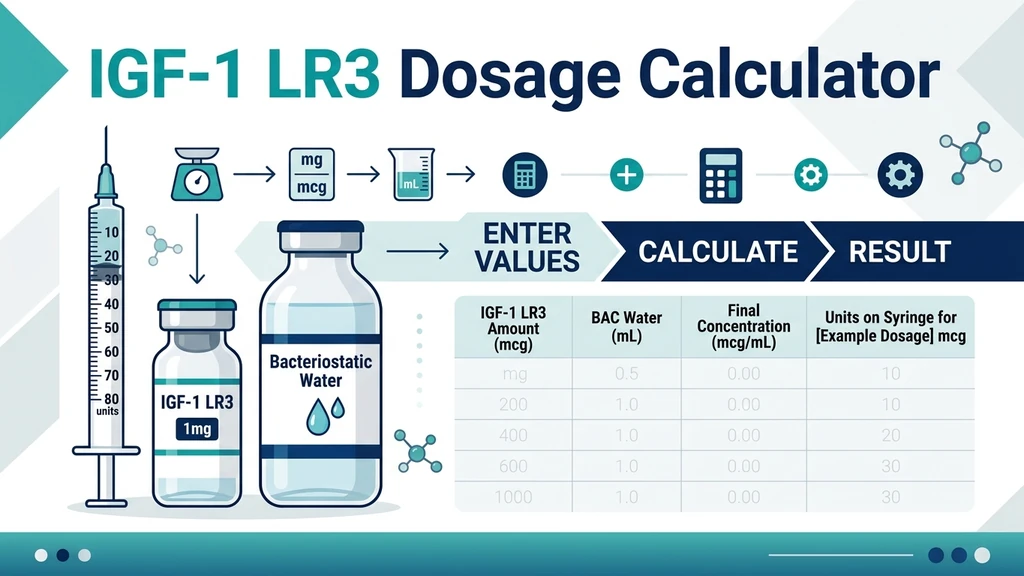
You hold a 1 mg vial of IGF-1 LR3, a bottle of bacteriostatic water, and an insulin syringe, and you need to know how many units pull a 30 mcg research dose. The answer comes from three numbers: the mg in the vial, the mL of water you add, and your target mcg. Reconstitute 1 mg with 1 mL of bacteriostatic water and you get 1000 mcg/mL, which means 30 mcg sits at the 3-unit mark on a U-100 insulin syringe.
Want the answer instantly? Use our interactive IGF-1 LR3 dosage calculator to get your daily dose and exact syringe units in one click. This guide shows the same math by hand so you can check every number yourself. It walks through the exact concentration math, gives reconstitution and dose-by-goal reference tables, and works through full examples so you can compute your own per-injection volume. IGF-1 LR3 is a research chemical and is not approved for human use. Treat every number here as research education and consult a healthcare provider before acting on it.
For the full mechanism, structure, and safety profile, see the IGF-1 LR3 peptide profile. For dose figures across every compound, see the peptide dosage chart.
Get your custom peptide protocol:
- Tailored to your body and goals
- Precise dosing and cycle length
- Safe stacking combinations
- Backed by peer-reviewed studies
- Ready in under 2 minutes
How to Calculate Your IGF-1 LR3 Dose
Every IGF-1 LR3 dose calculation reduces to one equation. Your concentration is the vial amount in mcg divided by the water you add in mL. Your injection volume is your target dose in mcg divided by that concentration.
Concentration (mcg/mL) = total mcg in vial ÷ mL of bacteriostatic water added
Injection volume (mL) = target dose (mcg) ÷ concentration (mcg/mL)
The only conversion to memorize is that 1 mg equals 1000 mcg. A 1 mg vial holds 1000 mcg of peptide. The third number you need is how a U-100 insulin syringe reads, because that is what you actually measure with.
Reading the Insulin Syringe (Units vs mL)
A U-100 insulin syringe is marked in "units," not milliliters. On a U-100 scale, 100 units equals 1 mL, so 1 unit equals 0.01 mL. The entire barrel of a 1 mL syringe runs from 0 to 100 units.
This is the single most useful fact for dosing. Convert your injection volume to units by multiplying mL by 100:
Syringe units = injection volume (mL) × 100
So 0.03 mL draws to the 3-unit line. 0.05 mL draws to 5 units. You never have to eyeball a partial milliliter.
Worked Example: 1 mg Vial, 1 mL Water, 30 mcg Dose
Reconstitute a 1 mg vial with 1 mL of bacteriostatic water.
- Concentration = 1000 mcg ÷ 1 mL = 1000 mcg/mL
- Injection volume for 30 mcg = 30 ÷ 1000 = 0.03 mL
- Syringe units = 0.03 × 100 = 3 units
A 30 mcg dose is 3 units on a U-100 syringe. The vial holds 1000 ÷ 30 = 33 full doses.
Write these three figures on the vial label after you reconstitute: the concentration (1000 mcg/mL), the units for your standard dose (3 units), and the reconstitution date. That label removes the need to redo the math at every injection and prevents the most common cause of overdose, which is recalculating from memory under poor lighting.
Worked Example: 1 mg Vial, 2 mL Water, 50 mcg Dose
Add more water and the same dose moves to a different mark. Reconstitute a 1 mg vial with 2 mL instead.
- Concentration = 1000 mcg ÷ 2 mL = 500 mcg/mL
- Injection volume for 50 mcg = 50 ÷ 500 = 0.10 mL
- Syringe units = 0.10 × 100 = 10 units
More water makes each dose a larger, easier-to-measure volume. The trade-off is the same total peptide spread across a bigger liquid, so the vial still holds 1000 ÷ 50 = 20 doses. To skip the arithmetic, run your numbers through the peptide reconstitution calculator or the peptide unit converter.
Reconstitution and Concentration Reference Table
Reconstitution sets your concentration before you ever calculate a dose. Use bacteriostatic water, not sterile water, because the benzyl alcohol preservative lets a reconstituted vial last in the refrigerator for weeks rather than one use. See bacteriostatic water vs sterile water for why the preservative matters.
This table shows the concentration produced by common 1 mg vial and water combinations, plus the syringe units for a reference 40 mcg dose.
| Vial size | Bac water added | Concentration | 40 mcg dose = |
|---|---|---|---|
| 1 mg | 1 mL | 1000 mcg/mL | 4 units (0.04 mL) |
| 1 mg | 2 mL | 500 mcg/mL | 8 units (0.08 mL) |
| 1 mg | 3 mL | 333 mcg/mL | 12 units (0.12 mL) |
| 0.1 mg | 1 mL | 100 mcg/mL | 40 units (0.40 mL) |
Aim the water stream down the inside wall of the vial, not directly onto the powder, then swirl gently until clear. Do not shake. For step-by-step reconstitution technique, see how to reconstitute peptides. Reconstituted IGF-1 LR3 holds potency in the refrigerator for roughly 2 to 4 weeks; details in how long reconstituted peptides last.
IGF-1 LR3 Dosage by Goal and Experience
Common research-context protocols run 20 to 120 mcg per day, with cycle lengths held to 4 to 6 weeks because of receptor downregulation concerns. IGF-1 LR3 carries an extended biological half-life of roughly 20 to 30 hours, compared with about 12 to 15 hours for native IGF-1, because the Arg3 substitution and N-terminal extension cut its binding to IGF binding proteins by over 100-fold and keep it circulating in the active free form (Buckway et al., 2001, Journal of Clinical Endocrinology & Metabolism). That long half-life is why daily single doses are typical rather than multiple injections.
| Experience | Daily dose | Units at 1000 mcg/mL | Cycle length |
|---|---|---|---|
| Beginner | 20-40 mcg | 2-4 units | 4 weeks |
| Intermediate | 40-80 mcg | 4-8 units | 4-6 weeks |
| Advanced | 80-120 mcg | 8-12 units | 4-6 weeks |
Start at the low end and hold it for at least the first week. IGF-1 is the primary mediator of growth hormone's anabolic signal, driving skeletal muscle protein synthesis through the PI3K/Akt/mTOR pathway and stimulating satellite cell proliferation (Florini et al.; Velloso, 2008, British Journal of Pharmacology), so higher doses do not linearly produce better outcomes and raise hypoglycemia risk.
Cycle length matters as much as daily dose. Most research-context protocols cap a run at 4 to 6 weeks rather than running continuously, on the reasoning that sustained IGF-1 receptor stimulation can blunt receptor sensitivity over time. A common pattern is 4 weeks on followed by an equal or longer break before any subsequent cycle. Track your starting dose, daily units, and cycle dates so you can reproduce or adjust the protocol on a later run instead of guessing. For how IGF-1 LR3 fits a broader training stack, see peptides for bodybuilding, and for outcome expectations see IGF-1 LR3 results.
Localized vs Systemic Dosing
Two injection strategies exist, and they change where you place the needle, not the calculation. Systemic dosing puts the full daily dose into a single subcutaneous site, usually the abdomen, to raise circulating IGF-1 LR3 throughout the body. Localized dosing splits the dose into the specific muscles trained that day, based on the unproven theory that local concentration favors growth in those fibers.
For localized work, divide the daily dose across target muscles. A 40 mcg daily dose split bilaterally across biceps becomes 20 mcg (2 units) per arm. Localized injection is intramuscular into the worked muscle belly rather than subcutaneous.
The evidence for site-specific hypertrophy from localized IGF-1 LR3 in humans is anecdotal. Systemic IGF-1 still reaches local muscle and activates satellite cells through the IGF-1 receptor (Velloso, 2008, British Journal of Pharmacology). Whichever route you choose, review sterile injection technique in how to inject peptides.
Timing: Post-Workout and Bilateral Splits
The most common timing places the dose immediately after training, within 15 to 30 minutes of finishing. The rationale is that exercise increases blood flow and IGF-1 receptor sensitivity in the worked tissue, so a post-workout injection meets a primed receptor environment.
On rest days, users running systemic protocols typically dose at a fixed morning or pre-meal time to keep daily exposure consistent. Because the half-life spans 20 to 30 hours, a single daily injection maintains steady levels without splitting the dose across the day.
For bilateral muscles trained the same session, split the localized dose evenly left and right. A 30 mcg post-workout dose for a leg day becomes 15 mcg (1.5 units at 1000 mcg/mL) into each quad. Keep injection sites rotated to avoid local tissue irritation.
Common Dosing and Measurement Mistakes
Most IGF-1 LR3 dosing errors are measurement errors, not protocol errors. A single misread of the syringe can deliver ten times the intended dose.
Confusing units with mcg. A syringe "unit" is a volume mark, not a microgram. At 1000 mcg/mL, 1 unit equals 10 mcg, but at 500 mcg/mL, 1 unit equals 5 mcg. Always recompute units against your actual concentration after every reconstitution.
Ignoring the syringe scale. A U-40 insulin syringe is not a U-100. On a U-40 syringe, 40 units equals 1 mL, so the same volume reads at a different number. Verify your syringe is U-100 before applying any unit figure in this guide.
Decimal-point overdoses. Reading 0.30 mL as 30 units instead of 0.03 mL as 3 units is a tenfold error. Because IGF-1 LR3 lowers blood glucose, a tenfold overdose carries real hypoglycemia risk: shakiness, sweating, confusion, and in severe cases loss of consciousness. Keep fast-acting carbohydrate on hand.
Reusing stale math. When you change vial size or water volume, your entire unit table changes. Recalculate from scratch. A 1 mg vial in 1 mL gives 10 mcg per unit, but the same vial in 2 mL gives 5 mcg per unit, so an old 3-unit habit silently halves or doubles your dose.
Skipping the syringe-volume check. Some insulin syringes hold only 0.3 mL (30 units) or 0.5 mL (50 units) total. If your calculated dose exceeds the barrel capacity, you cannot draw it in one pull. Confirm the barrel size covers your largest planned dose before you reconstitute. General precautions are covered in the peptide safety guide.
Frequently Asked Questions
How many units of IGF-1 LR3 is 40 mcg?
It depends on concentration. With a 1 mg vial reconstituted in 1 mL of bacteriostatic water (1000 mcg/mL), 40 mcg equals 0.04 mL, which is 4 units on a U-100 insulin syringe. Add 2 mL instead and 40 mcg becomes 8 units. See the peptide unit converter.
How do I reconstitute a 1 mg IGF-1 LR3 vial?
Add 1 mL of bacteriostatic water down the inside wall of the vial, then swirl gently until clear, producing a 1000 mcg/mL solution. Do not shake. Store refrigerated. Full technique is in how to reconstitute peptides.
What is a beginner IGF-1 LR3 dose?
Research-context beginner protocols use 20 to 40 mcg per day for a 4-week cycle, which is 2 to 4 units at 1000 mcg/mL. Hold the low end for the first week to assess tolerance. IGF-1 LR3 is not approved for human use; consult a healthcare provider. See IGF-1 LR3 results.
Why use bacteriostatic water instead of sterile water?
Bacteriostatic water contains 0.9% benzyl alcohol, a preservative that inhibits bacterial growth and lets a reconstituted vial last 2 to 4 weeks refrigerated. Sterile water has no preservative and is single-use. Compare both in bacteriostatic water vs sterile water.
What is the half-life of IGF-1 LR3?
IGF-1 LR3 has an extended biological half-life of roughly 20 to 30 hours, versus about 12 to 15 hours for native IGF-1, because reduced IGF binding protein affinity keeps it in the active free form (Buckway et al., 2001). This is why once-daily dosing is standard. See the IGF-1 LR3 profile.
How do I avoid an IGF-1 LR3 overdose?
Recompute syringe units after every reconstitution, confirm your syringe is U-100, and never read a decimal volume as a unit count. A tenfold misread risks hypoglycemia. Keep fast-acting carbohydrate available and review the peptide safety guide.
Can I split an IGF-1 LR3 dose into multiple muscles?
Yes. For localized intramuscular protocols, divide the daily dose evenly across worked muscles, such as 20 mcg into each bicep for a 40 mcg bilateral split. Evidence for site-specific growth is anecdotal. Review technique in how to inject peptides.
The Bottom Line
IGF-1 LR3 dosing is arithmetic before it is anything else. Fix your concentration at reconstitution, divide your target mcg by that concentration, multiply by 100 for syringe units, and verify the math every time the vial or water volume changes. A 1 mg vial in 1 mL of bacteriostatic water makes 1000 mcg/mL, so common research doses of 20 to 40 mcg land at 2 to 4 units on a U-100 syringe.
IGF-1 LR3 remains a research chemical with no approval for human use and a real hypoglycemia risk from misdosing. Nothing here is medical advice; consult a qualified healthcare provider before acting. For deeper context, read the IGF-1 LR3 peptide profile and explore the full library of dosage tools and guides at https://peptidesexplorer.com.
Related Articles
Ipamorelin Dosage: Protocols, Timing & Units
Ipamorelin dosage: 200-300 mcg subcutaneous, 1-3x daily, bedtime fasted. Charts by goal and weight, saturation dose, reconstitution units, safety data.
Epitalon Dosage: Khavinson Protocol, Cycles & Unit Math
Epitalon dosage: 5-10 mg/day subcutaneous for 10-20 days, 1-2 courses per year. Khavinson protocol, reconstitution units for 10-50 mg vials, evidence review.
HGH Fragment 176-191 Dosage: What Research Supports
HGH Fragment 176-191 dosage: 250-500 mcg/day subcutaneous, fasted, 8-12 week cycles. Unit math for 2 mg and 5 mg vials, rodent vs human evidence, safety.
Tesamorelin Dosage Chart: Clinical Doses
Full tesamorelin dosage chart: the 2 mg/day clinical dose, research tiers, reconstitution math in syringe units, timing, titration, and cycle length.