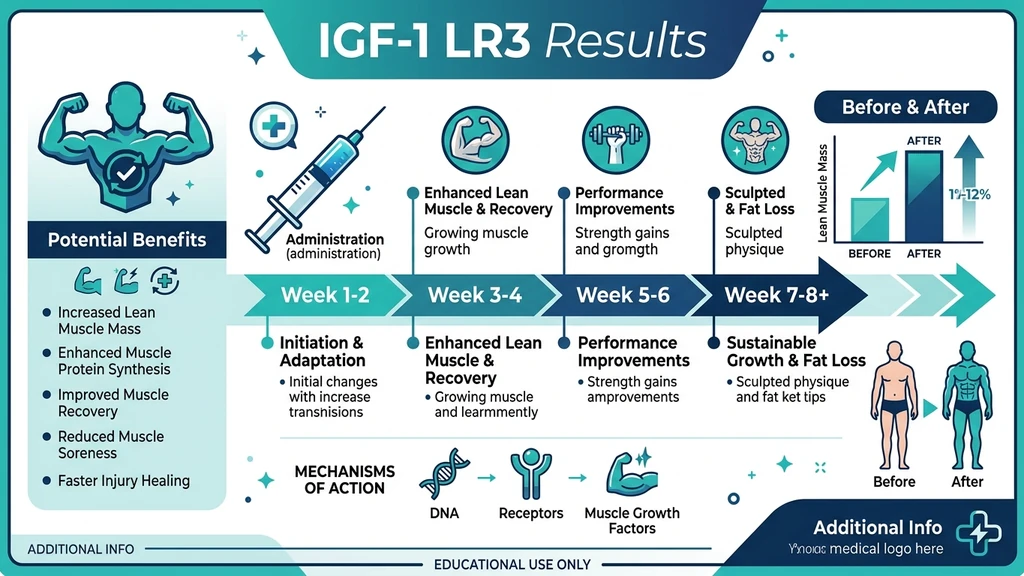
IGF-1 LR3 results follow a predictable order: muscle fullness and pumps in weeks 1 to 2, faster recovery between training sessions in weeks 2 to 4, then small lean mass and strength gains by weeks 4 to 6. Most of what users feel early is glycogen loading and water retention, not new tissue. Genuine fiber changes take longer and stay modest in research-reported use.
IGF-1 LR3 is a research chemical. It is not approved for human use by the FDA or any comparable regulator, and no controlled human bodybuilding trials confirm the gains discussed online. This guide separates documented IGF-1 biology from gym-floor exaggeration so you can set realistic expectations. Consult a healthcare provider before using any peptide.
| Phase | Timeframe | What users typically report | What is actually happening |
|---|---|---|---|
| Early | Weeks 1-2 | Bigger pumps, muscle fullness, vascularity | Glycogen and water shift into muscle; IGF-1R signaling begins |
| Mid | Weeks 2-4 | Faster recovery, less soreness, better sleep | Increased protein synthesis and satellite cell activation |
| Late | Weeks 4-6 | Small lean mass and strength gains, slightly leaner look | Modest hypertrophy plus possible nutrient partitioning |
These outcomes assume consistent training, adequate protein, and a caloric surplus. Without those inputs, IGF-1 LR3 produces little. See the IGF-1 LR3 profile for full pharmacology, and the IGF-1 LR3 dosage calculator for protocol math.
Get your custom peptide protocol:
- Tailored to your body and goals
- Precise dosing and cycle length
- Safe stacking combinations
- Backed by peer-reviewed studies
- Ready in under 2 minutes
IGF-1 LR3 Results Timeline: Week by Week
IGF-1 LR3 does not deliver a single dramatic result. It delivers a sequence of changes that build on each other over a typical 4 to 6 week cycle. Knowing the order prevents the most common error, which is quitting too early or doubling the dose when week-one results feel small.
The earliest signal is almost always a "pump" effect. IGF-1 increases glucose uptake into muscle cells through the PI3K/Akt pathway, which pulls water and glycogen into the tissue. That makes muscles look and feel fuller within days. It is a real physiological effect, but it is volume from fluid, not new muscle fiber.
Recovery improvements arrive next. Lifters commonly report less delayed-onset soreness and the ability to train a body part again sooner. This aligns with IGF-1's documented role in muscle repair and satellite cell recruitment (Adams, J Appl Physiol, 2002).
Weeks 1-2: Pumps and Fullness
In the first two weeks, the dominant effect is muscle fullness and stronger pumps during training. Vascularity often improves because the muscle bellies expand against the skin. Some users notice mild localized swelling at injection sites if they inject into a worked muscle.
This phase is mostly glycogen and water, driven by enhanced glucose uptake. It can disappear within days of stopping. Treat it as a sign the compound is active, not as proof of muscle growth. Compare this pattern to other recovery compounds in the peptides for recovery guide.
Weeks 2-4: Recovery and Work Capacity
Between weeks 2 and 4, recovery becomes the headline result. Soreness fades faster, training sessions feel more productive, and many users add reps or sets without extra fatigue. This improved work capacity is often the real driver of any later gains, because it lets you train harder.
IGF-1 signaling supports this by activating satellite cells, the muscle stem cells that donate new nuclei to growing fibers (Adams, J Appl Physiol, 2002). More training stimulus plus better recovery is a more honest explanation for progress than the compound "building" muscle on its own.
Weeks 4-6: Lean Mass and Strength
By weeks 4 to 6, small but measurable changes can appear: a few pounds of lean mass, modest strength increases, and a slightly leaner look from improved nutrient partitioning. These gains are far smaller than the transformations marketed in vendor before-and-after photos.
Realistic research-context outcomes are roughly 1 to 4 lbs of lean tissue over a 4 to 6 week cycle, heavily dependent on training and diet. Strength tends to rise alongside the added work capacity rather than from any direct neural effect. Track lifts and bodyweight against a baseline using the peptide dosage chart to keep expectations grounded.
How IGF-1 LR3 Works: Mechanism and the Hyperplasia Question
IGF-1 LR3 is a modified version of natural insulin-like growth factor 1. It carries an arginine substitution at position 3 and a 13 amino acid N-terminal extension. Those changes reduce binding to IGF binding proteins by more than 100-fold, which extends its functional half-life from minutes to roughly 20 to 30 hours and keeps it active in free form much longer than native IGF-1.
The compound works by binding the IGF-1 receptor (IGF-1R), a receptor tyrosine kinase found on muscle, bone, and fat cells. Activation triggers two cascades: the PI3K/Akt pathway, which drives protein synthesis and glucose uptake, and the MAPK/ERK pathway, which stimulates cell proliferation (Yoshida & Delafontaine, Cells, 2020).
Hyperplasia vs Hypertrophy: Evidence vs Bro-Science
The most repeated marketing claim is that IGF-1 LR3 causes hyperplasia, meaning new muscle fibers rather than just bigger existing ones. The biology is partly real and partly overstated. IGF-1 does activate satellite cells, and that machinery resembles the processes seen in developmental muscle growth (Adams, J Appl Physiol, 2002).
The overstatement is the leap to large, permanent fiber counts in trained adult humans. Localized IGF-I infusion produced hypertrophy in rat muscle, but human data for injectable IGF-1 LR3 bodybuilding use is essentially absent. Most measurable IGF-I muscle growth in research combines satellite cell activation with increased protein synthesis in existing fibers, not dramatic new-fiber formation. Treat "hyperplasia gains" as unproven in humans. For how this differs from anabolic steroids, see peptides vs steroids.
Realistic Muscle, Recovery, and Fat Results vs the Hype
Honest IGF-1 LR3 results are modest. The compound amplifies an existing training and nutrition signal; it does not manufacture a physique. Set expectations against three outcomes that the biology can plausibly support.
Muscle: small lean mass increases over a 4 to 6 week cycle, driven by improved protein synthesis and recovery rather than mass new-fiber growth. Recovery: faster repair between sessions, which is the most consistently reported benefit and aligns well with IGF-1's documented repair role (Adams, J Appl Physiol, 2002).
Fat: IGF-1 LR3 is not a fat-loss compound. Any leaner appearance usually comes from better nutrient partitioning and fuller muscles, not direct lipolysis. The marketed images of rapid body recomposition are misleading. For a grounded look at how peptide results photograph, see peptides before and after results.
Factors That Change Your Results
Two people running identical IGF-1 LR3 doses can see very different outcomes. The compound is a multiplier on your inputs, so the inputs matter more than the peptide.
Dose, Cycle Length, and Administration Site
Higher doses do not scale linearly into more muscle; they scale into more side-effect risk, especially hypoglycemia. Research-context protocols cluster in the low tens of micrograms per day over 4 to 6 week cycles, with breaks afterward. Run the numbers and unit conversions with the IGF-1 LR3 dosage calculator and the peptide unit converter.
Site selection also shapes the result type. Localized injection into a worked muscle is theorized to favor that muscle's fullness and pump, while systemic effects on overall protein synthesis happen regardless of site. The localized "site growth" claim is popular but weakly supported in humans.
Training and Nutrition
IGF-1 LR3 raises the ceiling on protein synthesis, but you still have to supply the stimulus and the raw materials. Without progressive resistance training, there is little for the signal to act on. Without sufficient protein, roughly 1.6 to 2.2 g/kg/day, and adequate calories, the anabolic signal has nothing to build with.
A caloric surplus generally produces more visible mass results; a deficit shifts the benefit toward recovery and muscle retention. For structuring a full muscle-building protocol around these inputs, see the peptides for bodybuilding guide.
What Before-and-After Photos Really Show
IGF-1 LR3 before-and-after photos are the least reliable evidence in the entire conversation. Most circulate from vendors or anonymous forum posts with no controls, no timeline verification, and no disclosure of other compounds used in the same cycle.
Several factors inflate these images. The early water and glycogen "pump" makes muscles look dramatically fuller within days, which photographs as rapid growth that is mostly fluid. Lighting, pump timing, tan, posing, and dehydration for the "after" shot can manufacture a transformation with no tissue change at all. Many subjects also run anabolic steroids or growth hormone simultaneously, then credit IGF-1 LR3.
Read these photos as marketing, not data. A realistic 4 to 6 week change is subtle: slightly fuller muscles and a few pounds on the scale, not a contest-ready physique. For a calibrated view of what genuine peptide progress looks like, compare against peptides before and after results.
Common Mistakes, Unrealistic Expectations, and Safety
The biggest mistake is expecting steroid-tier transformation. IGF-1 LR3 is a recovery and partitioning amplifier with modest mass effects, and chasing dramatic gains pushes users toward dangerous doses. The second mistake is ignoring the most acute risk: hypoglycemia.
Hypoglycemia and Theoretical Organ Concerns
Because IGF-1 LR3 activates insulin-like signaling and increases glucose uptake, it can lower blood sugar. Symptoms include shakiness, sweating, confusion, and lightheadedness, and severe hypoglycemia is a medical emergency. Eating carbohydrate around dosing and avoiding fasted use are common harm-reduction steps, but they do not eliminate the risk.
The more theoretical concern is that IGF-1R is expressed throughout the body, so chronic systemic signaling could affect non-muscle tissues, including potential organ or gut growth and unknown long-term cancer-promotion risk given IGF-1's role in cell proliferation. None of this is quantified for human bodybuilding use. Review general harm reduction in the peptide safety guide, and consult a healthcare provider before use.
Frequently Asked Questions
How long does it take to see IGF-1 LR3 results?
Pumps and fullness appear within 1 to 2 weeks, recovery improvements by weeks 2 to 4, and small lean mass and strength changes by weeks 4 to 6. Early effects are mostly water and glycogen. See the week-by-week breakdown in this guide and the IGF-1 LR3 profile.
How much muscle can IGF-1 LR3 realistically add?
Research-context expectations are modest, roughly 1 to 4 lbs of lean tissue over a 4 to 6 week cycle, heavily dependent on training and diet. The marketed transformations are exaggerated. Plan a realistic protocol with the peptides for bodybuilding guide.
Does IGF-1 LR3 cause hyperplasia or just hypertrophy?
IGF-1 activates satellite cells, which is the biology behind hyperplasia claims, but large new-fiber growth in trained adult humans is unproven. Most measurable growth combines satellite cell activity with protein synthesis in existing fibers. Compare mechanisms in peptides vs steroids.
Are IGF-1 LR3 before-and-after photos reliable?
No. Most come from vendors or anonymous posts without controls, and water-driven pumps, lighting, posing, and concurrent steroid use inflate them. Read them as marketing, not data. See a calibrated view in peptides before and after results.
What is the main safety risk of IGF-1 LR3?
Hypoglycemia is the most acute risk because IGF-1 LR3 increases glucose uptake and can lower blood sugar quickly. Symptoms include shakiness, sweating, and confusion. There are also theoretical long-term organ-growth and cancer-promotion concerns. Review harm reduction in the peptide safety guide.
Does diet affect IGF-1 LR3 results?
Strongly. IGF-1 LR3 raises the ceiling on protein synthesis but supplies no building materials. Without adequate protein, around 1.6 to 2.2 g/kg/day, and sufficient calories, results stay minimal. Structure intake and dosing using the peptide dosage chart.
Does injection site change where you grow?
Localized injection may favor fullness and pumps in that muscle, but systemic effects on overall protein synthesis happen regardless of site, and the site-specific growth claim is weakly supported in humans. Calculate doses and conversions with the peptide unit converter.
How quickly do IGF-1 LR3 results disappear after stopping?
The water and glycogen fullness can fade within days of stopping, so a portion of the visible change is temporary. Genuine lean tissue gained through training is more durable if you keep training and eating well. Pair with recovery support from the peptides for recovery guide.
The Bottom Line
IGF-1 LR3 results follow a clear arc: pumps and fullness in weeks 1 to 2, faster recovery in weeks 2 to 4, then small lean mass and strength gains by weeks 4 to 6. The early visual change is mostly water and glycogen, and honest mass outcomes are modest, in the range of a few pounds over a cycle when training and nutrition are dialed in. The dramatic before-and-after photos are marketing, not evidence.
IGF-1 LR3 remains a research chemical with no approved human use and no controlled bodybuilding trials, and it carries a real risk of hypoglycemia plus unquantified long-term concerns. Treat any use as experimental and consult a healthcare provider first. To plan responsibly, start with the IGF-1 LR3 profile and the IGF-1 LR3 dosage calculator, then explore evidence-based protocols at PeptidesExplorer.com.
Helpful Tools
Related Articles
When to Take IGF-1 LR3: Best Time & Fed vs Fasted
When to take IGF-1 LR3: post-workout with carbs on training days, morning with breakfast on rest days, never fasted. Half-life, spacing from GH peptides, FAQ.
Peptides for Bodybuilding (2026)
Best peptides for bodybuilding: BPC-157, TB-500, MK-677, CJC-1295/Ipamorelin, HGH Fragment 176-191. Dosages and stacking protocols.
Where to Inject IGF-1 LR3: Sites, SubQ vs IM, Rotation
Where to inject IGF-1 LR3: abdomen, thigh or glute, subcutaneous, 29-31G needle. Why site-specific growth is a myth, a rotation map, and the hypoglycemia rule.
MOTS-c Before and After: Results & Timeline
See realistic MOTS-c before and after results, a week-by-week timeline, what the research shows, and the factors that decide whether you respond.