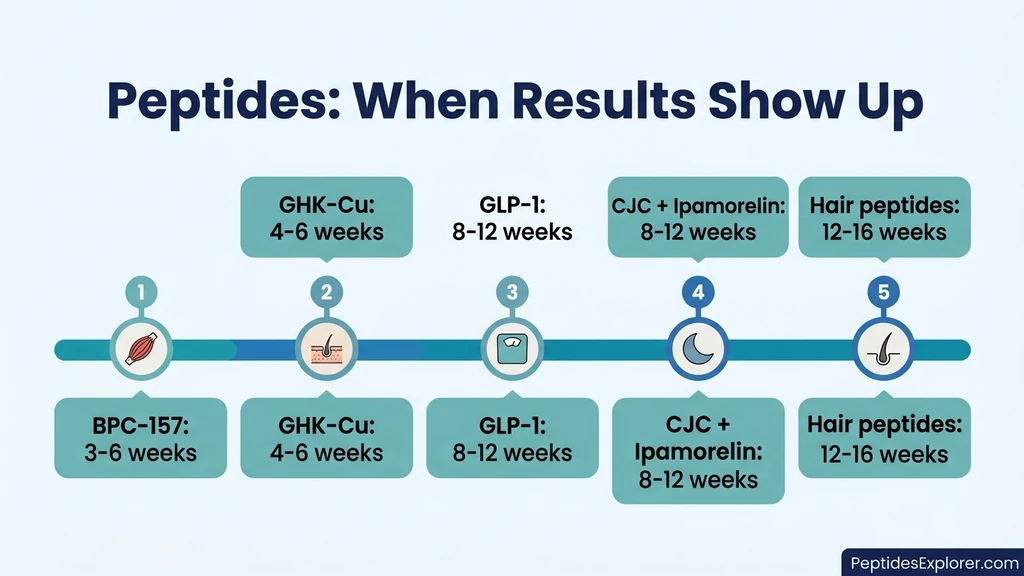
You scroll through a Reddit thread, then an Instagram carousel, then a telehealth brand's landing page, and every "before and after peptides" photo promises something different. A glowing complexion at week two. A 40-pound weight drop in three months. A rotator cuff that feels brand new after a single vial. The truth is that peptide timelines are wildly different depending on the class: GLP-1 weight loss peptides need 6 to 12 months to produce the dramatic torso shots (14 to 22% weight loss in STEP-1 and SURMOUNT-1), BPC-157 and TB-500 show visible injury improvement in 3 to 6 weeks, GHK-Cu skin changes take 8 to 12 weeks of daily topical use, growth hormone secretagogues like CJC-1295 and ipamorelin need 3 to 6 months for body composition shifts, and hair regrowth peptides run 3 to 6 months minimum. There is no universal "peptide before and after." There is a specific timeline for each specific peptide class, and the photos you should expect to see at month 1 are completely different from the ones that show up at month 6.
| Peptide class | First visible change | Peak visible result | Evidence baseline |
|---|---|---|---|
| GLP-1 (tirzepatide, semaglutide) | Week 8-12 (face, waistband) | Week 52-72 (14-22% body weight) | STEP-1, SURMOUNT-1 |
| BPC-157 / TB-500 (healing) | Week 3-6 (injury pain, range of motion) | Week 8-12 (tissue function) | Animal models, small case series |
| GHK-Cu (skin, topical) | Week 4-6 (texture, firmness) | Week 8-12 (wrinkles, tone) | Multiple RCTs, small n |
| CJC-1295 + Ipamorelin | Week 8-12 (sleep, recovery) | Week 20-26 (body comp) | Open-label trials |
| MK-677 (ibutamoren) | Week 4-8 (sleep, appetite, fullness) | Week 24+ (physique, IGF-1 plateau) | Long-term trials |
| 5-Amino-1MQ | Week 4-8 (subtle fat loss) | Week 12-16 (visible waist change) | Preclinical + early human |
| Hair peptides (GHK-Cu, PTD-DBM) | Week 12-16 (shedding slows) | Week 24-36 (density visible) | Small topical trials |
This is educational content. Consult a healthcare provider before starting any peptide protocol. For pricing expectations across classes, use the peptide cost calculator.
Get your custom peptide protocol:
- Tailored to your body and goals
- Precise dosing and cycle length
- Safe stacking combinations
- Backed by peer-reviewed studies
- Ready in under 2 minutes
GLP-1 Weight Loss Peptides: The 6 to 12 Month Before and After
When people search "before and after peptides," they most often mean GLP-1 receptor agonists, because those are the photos that have defined the category in the last two years. Tirzepatide (Zepbound, Mounjaro) and semaglutide (Wegovy, Ozempic) produce the most dramatic physical changes of any peptide class in common use.
SURMOUNT-1 data (tirzepatide, Jastreboff et al., NEJM 2022): - 15 mg weekly, 72 weeks: 20.9% mean weight loss - 10 mg weekly, 72 weeks: 19.5% mean weight loss - 5 mg weekly, 72 weeks: 15.0% mean weight loss - Placebo: 3.1% weight loss - Source: (Jastreboff et al., 2022)
STEP-1 data (semaglutide, Wilding et al., NEJM 2021): - 2.4 mg weekly, 68 weeks: 14.9% mean weight loss - Placebo: 2.4% weight loss - Source: (Wilding et al., 2021)
What photos actually show, month by month: - Month 1 (weeks 1-4): scale drops 3 to 8 lb during titration. Face may look slightly less puffy. No visible body change to outside observers. - Month 3 (weeks 8-12): 12 to 20 lb lost. First "the face looks different" comments from people who see you often. Waistband one belt loop looser. - Month 6 (weeks 20-26): 25 to 45 lb lost. Clothes don't fit. Friends who have not seen you in months notice immediately. Jawline and cheekbones emerging. - Month 9 (weeks 36-40): 40 to 55 lb lost. Pant size down 2 to 3 sizes. Shirts boxy, need replacement. - Month 12 (week 52): 50 to 65 lb lost. Near plateau. This is the "after" photo most people share. - Month 17-18 (week 72, trial endpoint): stable or still losing slowly. Maintenance phase begins.
For the detailed week-by-week semaglutide progression, see semaglutide results week by week. For tirzepatide-specific photo trajectories, see tirzepatide before and after. For male-specific data from the SURMOUNT-1 subgroup, see men before and after tirzepatide. For semaglutide-specific progression, see semaglutide before and after.
What the transformation photos do NOT show: - Loss of lean mass (typically 25 to 35% of total weight lost without resistance training) - Loose skin on abdomen and upper arms (common after 40+ lb loss) - Temporary facial gauntness ("Ozempic face") in the rapid-loss phase - Hair shedding during peak caloric deficit months (telogen effluvium) - Regain if the drug is stopped without behavior change (60 to 80% within 2 years)
These are the realities behind the curated before-and-after grids. The AOD-9604 before and after comparison covers a related fat-loss fragment with much smaller expected effects.
Healing Peptides (BPC-157, TB-500): The 3 to 6 Week Before and After
BPC-157 ("body protection compound") and TB-500 (thymosin beta-4) are the most-used peptides for injury recovery. The before-and-after evidence is very different from GLP-1 photos: there is nothing to photograph in the mirror. The change is functional, and it shows up in range of motion, pain scores, and return-to-activity timelines.
Realistic functional timeline for soft-tissue injury (tendon, ligament, muscle): - Week 1-2: no noticeable change. Baseline pain and swelling. Standard rehab ongoing. - Week 3-4: first subjective reports. Less morning stiffness. Pain at rest lower. Range of motion incrementally better. - Week 5-6: clearer improvement. Activities that hurt 4 weeks ago tolerable at reduced load. - Week 8-12: typical resolution window for mild-to-moderate soft-tissue injuries on BPC-157 protocols.
What the evidence actually supports: - Rat and rodent models consistently show accelerated tendon-to-bone healing, ligament repair, and gut mucosa healing with BPC-157 (review: Sikiric et al., 2018). - Human RCT evidence is limited. Most human data comes from small uncontrolled case series and compounding pharmacy records. - TB-500 has stronger vascular and muscle-repair animal data, with even thinner human trial evidence.
Typical self-reported before-and-after pattern from practitioners using these peptides: - Chronic tendinopathy: 60 to 70% report meaningful pain reduction at 6 to 8 weeks. - Acute ligament sprain: return-to-sport 2 to 4 weeks earlier than typical rehab timeline. - GI healing (IBD, NSAID gastritis): symptomatic relief reported at 2 to 4 weeks.
Photos that exist for healing peptides are usually: - Range-of-motion videos at baseline vs week 6 - Ultrasound or MRI comparison of tendon structure (rare but compelling when available) - Pain log graphs (the most honest "before and after" for this category)
For deeper evidence review, see BPC-157 benefits and BPC-157 vs TB-500. For injection protocols and stacking, see peptide stacking guide. For general peptide dosing, see peptide dosage chart.
What to watch out for in online healing peptide before/afters: - "My shoulder is healed" posts with no baseline imaging - Dramatic bruise-healing videos that are standard bruise healing - Claims of ACL regeneration (not supported by any current evidence)
GHK-Cu and Skin Peptides: The 8 to 12 Week Before and After
GHK-Cu (copper tripeptide-1) is the most evidence-backed skin peptide in common use. Unlike GLP-1s, GHK-Cu before-and-after photos are subtle and require controlled photography to see. The physiological changes are real. The marketing photos are often not.
Realistic topical GHK-Cu timeline: - Week 1-3: no visible change. Skin barrier adapting. Mild acclimation redness in some users. - Week 4-6: first texture change. Skin feels "smoother" under fingertips. Hydration improves. - Week 8-12: visible firmness on photograph comparison. Fine lines around eyes less prominent under matched lighting. - Week 16-24: more consistent tone, some users report reduced sunspot intensity. - Week 24+: plateau of visible change; continued maintenance benefit.
What the clinical evidence supports: - Increased collagen and glycosaminoglycan synthesis in fibroblast studies, demonstrated in early dermal fibroblast work showing GHK-Cu stimulates type I collagen and proteoglycan production (Maquart et al., 1988). - Wound healing acceleration in controlled studies and broader regenerative effects on skin remodeling, antioxidant enzyme expression, and tissue repair pathways (Pickart, 2008). - Small RCTs show reduced wrinkle depth, improved elasticity, and better skin density with 8 to 12 weeks of daily topical use. - Hair regrowth benefit at topical concentrations (discussed in hair section).
Typical honest before-and-after conditions to ask for: - Same lighting, same time of day, same makeup (or none), same distance, same angle. - Photos at 0, 4, 8, and 12 weeks minimum. - Photographed without filters or smoothing. Raw camera output.
For the benefits breakdown, see GHK-Cu benefits. Injected GHK-Cu is used by some but topical has the strongest evidence base for skin changes.
Before-and-after red flags for skin peptides: - Different lighting between photos (warm-to-cool temperature shift alone can create apparent "glow") - Filters or Instagram smoothing on the "after" photo - Camera angle change (downward angle hides jowls; upward angle flattens wrinkles) - 7-day transformation claims (collagen turnover does not work on that timeline) - Stock photography with minor adjustments
Realistic expectation: you will see 10 to 20% improvement in measurable skin parameters at 12 weeks. This reads as "my skin looks better" in the mirror, not as a dramatic transformation. That is a feature, not a bug, of legitimate skin biology.
Growth Hormone Secretagogues (CJC-1295, Ipamorelin, MK-677)
This is the category with the widest gap between expectation and outcome. CJC-1295 and ipamorelin (often stacked), and MK-677 (ibutamoren) orally, increase pulsatile GH release and subsequently IGF-1 levels. The before-and-after timelines are measured in quarters, not weeks.
CJC-1295 + Ipamorelin (injectable stack) timeline: - Week 2-4: improved sleep depth is usually the earliest reported change. Dream recall returns. - Week 6-8: subjective recovery from workouts faster. Soreness windows shorter. - Week 12: IGF-1 levels typically 20 to 40% above baseline. Skin feels thicker. - Week 16-20: body composition beginning to shift if training and nutrition support it. Subtle fat loss, subtle muscle gain. - Week 24-26: most common "before and after" timepoint. 2 to 4% body fat reduction, 2 to 4 lb lean mass increase, noticeable but not dramatic.
MK-677 (oral, long half-life) timeline: - Week 2-4: appetite surge (MK-677 raises ghrelin). Weight gain starts, primarily from water and glycogen. - Week 4-8: sleep depth increases. IGF-1 rising. Some users report 5 to 10 lb weight gain from fluid retention alone. - Week 8-12: skin thickness changes, nail growth, hair density feels different. - Week 24+: physique changes settling in, dependent on training and nutrition. IGF-1 typically plateaus at ~50 to 100% above baseline.
What the photos usually show at 6 months: - Slightly fuller muscle bellies (water and glycogen effect is real) - Subtle abdominal leanness if diet was consistent - Thicker-looking skin texture in macro photos - Unchanged face and overall silhouette to casual observers
What the photos should NOT show but sometimes do: - 20 lb of lean mass gain in 3 months (unrealistic without concurrent anabolic use) - "Steroid-like" transformations (GH secretagogues are not anabolic in that league) - Shredding to single-digit body fat (these peptides do not drive fat loss that aggressively)
For the stack overview, see CJC-1295 ipamorelin benefits. For MK-677 specifically, see peptides for bodybuilding.
Honest expectations: A 6-month before-and-after on a well-dosed CJC-1295 and ipamorelin stack, combined with solid training and nutrition, produces roughly the physique improvement a disciplined 6-month training block alone would produce, plus slightly better sleep and recovery. If the photo shows more than that, the athlete likely ran additional compounds.
5-Amino-1MQ and Other Fat-Loss Peptides: 4 to 12 Week Timeline
5-Amino-1MQ is a small molecule (technically not a peptide, but widely marketed alongside peptides) that inhibits NNMT, an enzyme that limits fat cell oxidation. It is one of the few "fat loss peptides" with modest but real human-adjacent data.
Typical 5-amino-1MQ before-and-after timeline: - Week 1-3: no visible change. Possible slightly increased energy. - Week 4-6: first waist circumference changes (0.5 to 1 inch in responders). - Week 8-12: 2 to 5 lb fat loss typical in untrained users with no dietary change. - Week 12-16: 4 to 8 lb fat loss reported with mild caloric deficit.
Realistic positioning: 5-amino-1MQ is a fat-loss augment, not a fat-loss driver. The before-and-after photos look like disciplined-diet photos plus 10 to 20% acceleration. Anyone claiming 30 pounds off with no dietary change is misrepresenting the compound.
Other niche fat-loss peptides: - AOD-9604: a fragment of HGH marketed for fat loss. Evidence is weak. See AOD-9604 before and after for a realistic timeline. - Tesofensine: stimulant weight-loss agent, approved in Mexico as Tesomet. Not a peptide. - Retatrutide: GLP-1/GIP/glucagon triple agonist, in late-stage trials. Expected to produce 24%+ weight loss, on par with or exceeding tirzepatide.
What to expect from "fat loss peptide" before and after photos: - GLP-1 class: dramatic, covered above. - Everything else: modest, 2 to 8% body fat reduction over 3 to 6 months.
For broader context on peptide fat loss mechanisms, see peptides for bodybuilding and peptide stacking guide.
Hair Regrowth Peptides: The 3 to 6 Month Before and After
Hair peptides are a niche but growing category. GHK-Cu, PTD-DBM, and thymosin beta-4 fragments are the most studied. Timelines mirror minoxidil: nothing fast, everything slow.
Realistic hair peptide timeline (topical GHK-Cu daily): - Week 1-6: possible shed phase (telogen hairs exiting to make room for new growth) - Week 8-12: shedding stabilizes. Scalp feels healthier, less oily or less irritated. - Week 12-16: first visible vellus (baby) hairs at hairline or crown. - Week 16-24: terminal hair density starts to rise in responders. - Week 24-36: noticeable improvement on parted-hair photography.
What the evidence supports: - Small topical trials with copper peptide formulations show density improvements at 6 months. - The effect size is modest compared to FDA-approved treatments (minoxidil, finasteride). - Best used as an adjunct, not a replacement, for established regimens.
Before-and-after photo honesty checklist for hair: - Same lighting, same part location, same photo distance. - Wet-hair photos show scalp more honestly than dry-hair photos. - Top-down photos more honest than front-facing (hairline angles are easily manipulated). - Minimum 4 to 6 months between comparison photos.
Hair peptides are not a miracle cure. A realistic 24-week before-and-after shows moderate density improvement in responders, no change in a meaningful fraction, and worse-than-expected outcomes in a small minority.
How to Photograph Your Own Before and After (And Evaluate Others')
Most before-and-after photos online are useless because photography conditions vary more than the actual physiological change. If you are running a peptide protocol and want to honestly track your own results, controlling variables matters more than the camera.
The non-negotiables: 1. Same time of day. Morning fasted vs evening fed changes body water, face puffiness, abdominal distension by 3 to 8 lb equivalent visual volume. 2. Same lighting. Natural window light, north-facing if possible. Never mix "warm bedroom" before with "cool bathroom" after. 3. Same background, distance, and angle. Mark the floor with tape. Set phone on tripod. Measure distance. 4. Same pose. Relaxed, not flexed. Arms at sides, not behind back. Standing tall without pulling in. 5. Same clothing (or none). Fitted underwear or swimwear gives the most honest silhouette. 6. Same weigh-in conditions. Morning, post-bathroom, pre-food, pre-exercise, same scale, same floor location.
Recommended photography cadence: - Weekly scale and waist measurement - Biweekly photos (front, back, side) - Monthly same-condition evaluation photos for longer comparisons
What to look for in other people's peptide before and after photos online: - Metadata preserved? (Many stolen photos have been scrubbed.) - Same person confirmed? (Tattoos, scars, moles should match.) - Clothing and background tell the story? (Different outfits, different rooms, different years.) - Lighting consistency? (A warm-to-cool shift alone can add "glow.") - AI generation artifacts? (Extra fingers, warped earrings, inconsistent shadows.)
Red flags in telehealth marketing: - Stock photo libraries used as "patient results" (reverse image search catches most) - "Month 1" and "Month 6" photos from entirely different people - Filter or skin-smoothing slider active only on the after - Claims that cannot match the class timeline (e.g., "GLP-1 results in 2 weeks")
For a compound-specific comparison that reveals how marketing hype diverges from trial data, see peptide sciences review and best peptide company reviews. For cost realism alongside timeline realism, use the peptide cost calculator.
Setting Realistic Expectations by Goal
Your before-and-after depends far more on what you are treating than on which peptide you choose within a category.
If your goal is weight loss of 15+ pounds: GLP-1 agonists (tirzepatide, semaglutide) are the only peptides with robust evidence at this scale. Plan for 6 to 12 months for a dramatic photo. Plan for maintenance afterward.
If your goal is injury recovery: BPC-157 and TB-500 have the most supportive evidence. Plan for 3 to 12 weeks of subjective improvement. There will be no dramatic photograph.
If your goal is skin quality: Topical GHK-Cu has the most evidence. Plan for 8 to 24 weeks of controlled-photography improvement. Improvement will be subtle and easily missed without matched conditions.
If your goal is body composition (minor fat loss, minor muscle gain, better sleep): CJC-1295 and ipamorelin are the most common choice. Plan for 6 months to see meaningful change. Training and nutrition are still doing most of the work.
If your goal is appetite suppression and sleep: MK-677 has unique ghrelin-axis effects that some value and others cannot tolerate (water retention, increased hunger). Expect fast subjective changes, slow physique changes.
If your goal is hair regrowth: Topical GHK-Cu (possibly stacked with PTD-DBM) as an adjunct to minoxidil or finasteride. Plan for 6 months minimum before evaluating.
If your goal is "general wellness" with no specific target: Peptides are not good "wellness" supplements. They are targeted tools. If you cannot name a specific, measurable change you want to see, the before-and-after photos will disappoint you regardless of which compound you choose.
For category-specific comparisons, see peptides for bodybuilding, peptides for women, peptides for men, and the comprehensive peptide stacking guide.
Frequently Asked Questions
What peptide gives the most dramatic before and after?
GLP-1 receptor agonists (tirzepatide, semaglutide) produce the most visible transformations because they drive 14 to 22% body weight loss over 12 to 18 months. No other peptide class produces changes at that scale. Healing peptides, skin peptides, and GH secretagogues produce real but subtle changes. See tirzepatide before and after for the highest-scale class.
How long until I see before and after changes from peptides?
It depends entirely on the class. GHK-Cu topical skin changes show up at 8 to 12 weeks. BPC-157 injury improvement at 3 to 6 weeks. GLP-1 weight changes at 8 to 12 weeks for first scale drop, 6+ months for dramatic body photos. CJC-1295/ipamorelin body composition changes at 20+ weeks. Hair regrowth 24+ weeks. See semaglutide results week by week for a granular weight-loss timeline.
Are peptide before and after photos real or photoshopped?
Both exist. Legitimate photos require same lighting, same time of day, same pose, same camera distance, and no filters. Check for metadata, matching moles/tattoos, and consistent backgrounds. Many telehealth marketing photos are stock or from different people. AI-generated composites are now common. For trusted baseline evidence, rely on trial data from publications like STEP-1 and SURMOUNT-1. See semaglutide before and after for trial-backed examples.
How much weight can I realistically lose on peptides?
On GLP-1 peptides at therapeutic dose: 14 to 22% of body weight over 12 to 18 months (STEP-1 and SURMOUNT-1). On 5-amino-1MQ, AOD-9604, or CJC-1295 stacks: 2 to 8% body fat reduction over 3 to 6 months, heavily dependent on training and nutrition. See AOD-9604 before and after and peptides for bodybuilding for realistic class comparisons.
Do healing peptides like BPC-157 produce visible before and after photos?
Not in the mirror. The changes are functional (range of motion, pain scores, return-to-activity time) rather than visual. Honest healing peptide before-and-afters are ultrasound imaging, pain logs, or ROM videos, not physique shots. See BPC-157 benefits for realistic outcome expectations.
Why does my skin look different after GHK-Cu?
GHK-Cu stimulates collagen and glycosaminoglycan synthesis in fibroblasts. At 8 to 12 weeks of daily topical use, measurable skin firmness and elasticity increase in small RCTs. The change is subtle (10 to 20% parameter improvement) but real under matched-condition photography. Dramatic overnight skin changes are usually filter, lighting, or hydration artifacts. See GHK-Cu benefits.
Will I keep my results if I stop peptides?
Class dependent. GLP-1 weight loss: 60 to 80% regain within 2 years after stopping without behavior change. BPC-157 injury healing: permanent (the tissue healed). GHK-Cu skin: reverses over 3 to 6 months after discontinuation. CJC-1295/ipamorelin body composition: slow reversal unless training continues. MK-677: water/glycogen gains reverse in 2 to 4 weeks. See peptide stacking guide for maintenance strategies.
What's the best peptide for a fast before and after?
No peptide produces fast dramatic photos. MK-677 shows subjective changes (sleep, appetite, water retention) at 2 to 4 weeks but these are not photo-worthy. The fastest visible change in the mirror is GLP-1 face thinning at 8 to 12 weeks. Anyone marketing 2-week before-and-afters is misrepresenting the biology. Use the peptide dosage chart and peptide cost calculator to plan a realistic multi-month protocol.
The Bottom Line
Every peptide class has a different before-and-after story. GLP-1 receptor agonists produce the only truly dramatic mirror transformations, and only over 6 to 12 months (STEP-1, SURMOUNT-1). Healing peptides like BPC-157 and TB-500 produce real functional improvements in 3 to 6 weeks but nothing photographable. GHK-Cu delivers subtle but measurable skin changes at 8 to 12 weeks under controlled photography. CJC-1295 and ipamorelin need 6 months to show modest body-composition shifts. MK-677 changes sleep and appetite fast but physique slowly. Hair peptides need 6 months minimum. 5-amino-1MQ and AOD-9604 are accelerators at best.
The before-and-after photos you see online compress this reality. They show the best-responder month-6 GLP-1 photo next to the worst-lit day-one photo, or a stock image labeled as a patient result, or two different people photographed years apart. The honest version looks different: controlled lighting, matched pose, matched time-of-day, and a smaller (but real) change at the class-appropriate timepoint.
If you are planning your own peptide protocol, match your expectation to the class. GLP-1 for 15+ pound weight loss. BPC-157 for specific injuries with clear endpoints. GHK-Cu topical for skin parameter improvement. CJC-1295 and ipamorelin as a training adjunct. Hair peptides as an adjunct to proven regimens. If your goal is "general wellness" with no specific measurable target, peptides will disappoint regardless of compound choice.
For category-specific deep dives, see tirzepatide before and after, semaglutide before and after, men before and after tirzepatide, AOD-9604 before and after, and semaglutide results week by week. For mechanism and dosing, see BPC-157 benefits, GHK-Cu benefits, CJC-1295 ipamorelin benefits, peptide dosage chart, and peptides for bodybuilding. For budget planning, use the peptide cost calculator.
Related Articles: - Tirzepatide Before and After - Semaglutide Before and After - Men Before and After Tirzepatide - AOD-9604 Before and After - Semaglutide Results Week by Week - BPC-157 Benefits - GHK-Cu Benefits - CJC-1295 Ipamorelin Benefits
Related Articles
Tirzepatide Before & After: Real Data
Tirzepatide before and after: 22.5% weight loss at 15mg over 72 weeks (SURMOUNT-1). Week-by-week timeline, real-world data, and what to expect.
Tirzepatide Men Before & After: Data for Males
Tirzepatide before and after for men: SURMOUNT-1 male subgroup data, testosterone impact, muscle loss risk, body composition timeline. Men-specific protocols.
Humanin Peptide: Benefits, Dosing, Safety
Humanin is a 24-amino-acid mitochondrial peptide studied for neuroprotection since 2001. What the research shows, reported protocols, and the safety gaps.
P21 Peptide: What the Research Actually Shows
P21 (P021) is a CNTF-derived peptide that boosted neurogenesis and memory in mouse Alzheimer's models. The research, reported protocols, and safety gaps.