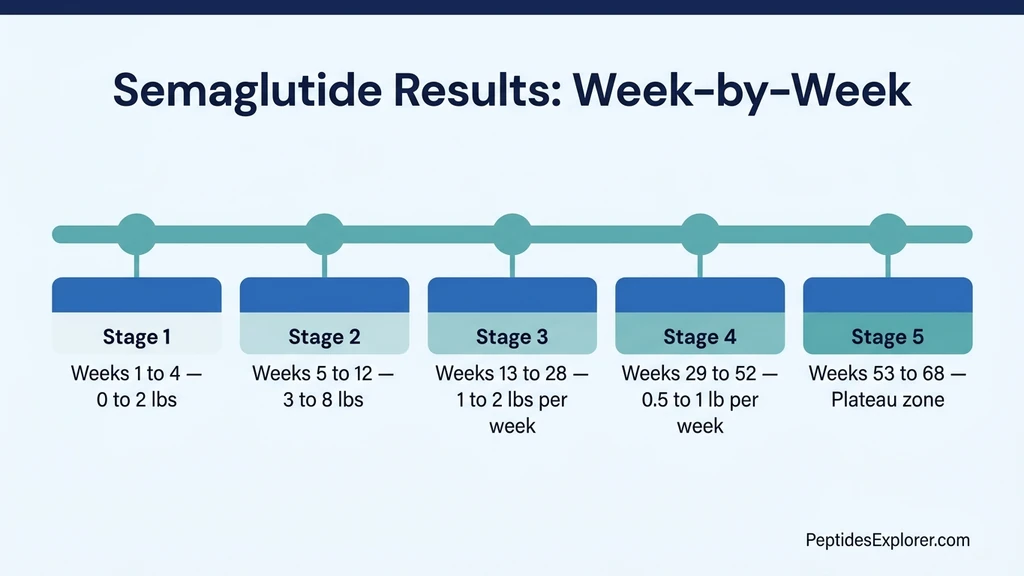
You took your first semaglutide injection, nothing dramatic happened that week, and now you are wondering when the scale will actually move. Expect minimal scale change in weeks 1 to 4 (titration phase), the first clear weight loss in weeks 5 to 12 (often 5 to 8 pounds), steady progress of 1 to 2 pounds per week through weeks 13 to 28, and a deceleration toward the plateau zone from weeks 29 to 68. The average STEP-1 trial participant lost 14.9% of body weight by week 68. Real-world losses are smaller, usually 8 to 12% at 6 months, because of dose interruptions and slower titration. This timeline assumes consistent dosing, adequate protein intake, and at least minimal resistance training. Missing any of these extends the timeline by weeks or months.
| Phase | Weeks | Expected Weight Loss | Key Events |
|---|---|---|---|
| Titration | 1-4 | 0-2 lbs | 0.25 mg starter dose, first side effects, appetite suppression begins |
| Early response | 5-12 | 3-8 lbs | Escalate to 0.5 then 1.0 mg, clear appetite reduction, scale starts moving |
| Peak loss | 13-28 | 1-2 lbs/week | Continue titration to 1.7-2.4 mg, consistent fat loss, body composition changes |
| Deceleration | 29-52 | 0.5-1 lb/week | Fat loss slows, muscle preservation matters most, habits lock in |
| Plateau zone | 53-68 | Minimal scale change | Maintenance dose, body composition optimization, next-phase decision |
The STEP-1 trial enrolled 1,961 adults without diabetes, mean baseline weight 105 kg (231 lbs). At week 68, semaglutide-treated participants lost 14.9% (roughly 34 lbs) versus 2.4% in placebo (Wilding et al., NEJM 2021). The week-by-week curve in this article mirrors that trial data.
This is educational content. Consult a healthcare provider before starting or continuing any medication.
Get your custom peptide protocol:
- Tailored to your body and goals
- Precise dosing and cycle length
- Safe stacking combinations
- Backed by peer-reviewed studies
- Ready in under 2 minutes
Weeks 1 to 4: The Titration Phase (Expect Little Scale Change)
The first four weeks at 0.25 mg weekly are designed to build tolerance to GLP-1 effects, not to produce weight loss. The standard Wegovy titration starts at 0.25 mg for 4 weeks, moves to 0.5 mg for 4 weeks, then 1.0 mg, 1.7 mg, and finally 2.4 mg maintenance.
What to expect in weeks 1 to 4: - 0 to 2 pounds of weight change, mostly from water shifts - Mild appetite suppression starts around day 3 to 5 of the first injection - First side effects (nausea, fullness, fatigue) peak around day 2 to 3 post-injection and fade before the next dose - Subtle changes in food preferences ("food noise" quieting down) - Possible mild GI effects: burping, soft stools, or constipation
What is happening biologically: Semaglutide reaches steady state plasma levels around week 4 to 5 of consistent dosing. During titration, plasma levels are building; effects are real but modest. GLP-1 receptors in your gut, pancreas, and hypothalamus are adapting to chronic signaling.
Common mistakes in weeks 1 to 4: - Weighing daily and panicking when the scale does not move - Increasing dose faster than the titration schedule (provider-ordered dose bumps before week 4 are usually a mistake) - Eating the same portions you did before because appetite suppression feels mild - Skipping the 4-week hold and thinking "I tolerate it well, let me jump to 1.0 mg"
What you should do: - Weigh weekly at the same time, same condition - Start tracking protein intake (target 1.0 to 1.6 g/kg lean body mass) - Begin or maintain 2 to 3 resistance training sessions per week; muscle preservation starts day 1 - Photograph your starting point (front, side, back) for the later phases when photos show what the scale may not
For injection technique, see how to inject peptides and semaglutide mixing chart.
Weeks 5 to 12: The Scale Starts Moving
This is when weight loss becomes visible to you and to others. You should be at 0.5 mg (weeks 5-8) then 1.0 mg (weeks 9-12) per the standard titration. Some providers extend each stage to 5 or 6 weeks.
Expected results by week 12: - STEP-1 trial data at 12 weeks: ~5% weight loss (about 11 lbs from 231-lb baseline) - Real-world data at 12 weeks: 4 to 7 lbs, slower due to lower effective doses - Clear reduction in hunger and craving intensity - Appetite suppression starts to feel more sustained (no longer just day 1-3 of the week) - Subjective energy may dip around week 6-8 as weight loss accelerates (manage with protein and sleep)
Body composition changes: - First 2 to 4 lbs of loss is often water and glycogen depletion - After that, roughly 70% fat / 30% lean tissue loss is typical without resistance training - With resistance training and adequate protein: closer to 85% fat / 15% lean - Waist circumference often drops faster than overall weight
Typical side effect trajectory: - Week 5: bump to 0.5 mg often triggers 2-3 days of nausea - Weeks 6-8: side effects plateau, most people feel "normalized" - Week 9: bump to 1.0 mg triggers another 2-3 days of increased nausea - Weeks 10-12: side effects settle at this new dose
Signs you are on track: - Steady weight loss of 0.5 to 1.5 lbs per week - Noticeable fullness from smaller portions - Less obsessive food thinking - Jeans feeling looser even before scale shows major change
Signs of a problem (call your provider): - No weight change over 4 weeks at 1.0 mg (dose may need to escalate) - Persistent vomiting for more than 48 hours after a dose - Severe upper abdominal pain (rule out pancreatitis) - Rapid weight loss greater than 2% per week (may indicate muscle wasting)
For troubleshooting a stalled start, see not losing weight on semaglutide. For side effect management, see how to relieve nausea from semaglutide and does semaglutide cause nausea.
Weeks 13 to 28: Peak Loss Phase
This phase is when most of your total weight loss happens. You should be moving from 1.0 mg to 1.7 mg (weeks 13-16) to 2.4 mg maintenance (weeks 17+).
Expected results: - STEP-1 trial at week 28: approximately 10% body weight loss (23 lbs from 231-lb baseline) - Real-world data at week 28: 8 to 12% body weight loss - Weekly loss rate: 1 to 2 lbs per week consistently - Cumulative loss from baseline: 15 to 35 lbs depending on starting weight
What changes in this phase: - Visible change in face shape, clothing fit, and posture - Muscle definition becomes visible if you have been training - Cardiovascular fitness improves (lower resting heart rate, easier breathing at activity) - Blood pressure often drops 5-15 mmHg from baseline - HbA1c drops 0.5 to 1.5% if you are diabetic or pre-diabetic
Body composition gets serious: Without intervention, the rate of muscle loss accelerates during rapid weight loss. This phase is where resistance training and protein become critical. - Protein target: 1.6 to 2.0 g/kg lean body mass per day - Resistance training: 3 to 4 sessions per week, progressive overload - Prioritize sleep: 7 to 9 hours; growth hormone release during deep sleep protects muscle
Psychological changes to watch: - "Food noise" reduction is most dramatic here; some patients report surprise at how quiet their thinking becomes - Social eating situations become easier (less temptation) or harder (less reward) - Body dysmorphia risk: seeing progress often reveals new insecurities - For mood effects, see can semaglutide cause depression
Common plateau at week 16-20: Many people experience a 2-3 week scale stall around this point. Causes: - Glycogen repletion (temporary water retention) - Muscle gain from new training (offsets fat loss on scale) - Adaptive thermogenesis (metabolic rate drops 5-10%) - Hidden calorie creep as food tolerance returns
Fixes: increase protein, add 2 more resistance training sessions, audit liquid calories, be patient. Plateaus of 2-3 weeks are normal; real stalls are 4+ weeks.
Weeks 29 to 52: The Long Middle
By now you are at your maintenance dose (typically 2.4 mg weekly) and settled into routine. Results slow but do not stop.
Expected weekly progress: - 0.5 to 1 pound per week (down from 1-2 in the peak phase) - Cumulative: another 10-20 pounds over 24 weeks - At week 52 (1 year): total loss of 13-16% body weight typical in STEP-1
What gets harder: - Motivation drops as results slow - Side effects no longer dramatic, so the drug feels "less active" - Appetite partially returns; you can eat more than in month 3 - Compensatory behaviors increase if not monitored (bigger portions, more snacks)
What gets easier: - Habits are now routine; injection day, meal prep, and training all autopilot - Body composition continues to improve even when scale moves slowly - Cardiovascular markers (lipids, blood pressure, HbA1c) keep improving - Psychological relationship with food stabilizes
Common issues in months 8-12: - Muscle loss becomes obvious. If you have skipped resistance training for weeks, you will see loose skin, reduced strength, and a "skinny-fat" look. - Rebound eating during stressful periods. Job changes, holidays, illness can derail consistency. - Plateaus longer than 4 weeks. See why am I not losing weight on tirzepatide (same framework applies to semaglutide).
Medical check-ins: - Full blood panel (lipids, liver, kidney function, HbA1c) at month 6 and 12 - Weight trend review with provider every 3 months - DEXA scan or similar body composition check at 6 and 12 months if you have access
For long-term outcomes data, see tirzepatide maintenance dose after weight loss (transferable to semaglutide) and how long does semaglutide stay in your system.
Weeks 53 to 68: Plateau and Maintenance Decision
The STEP-1 trial measured weight loss out to week 68. By this point, the average trajectory is flat. Real people often hit their plateau earlier, around weeks 40-52.
Expected status at week 68: - STEP-1 trial: 14.9% total weight loss maintained - Real-world: 10-14% maintained in consistent adherers - Plateau is pronounced; 2-3 week stalls become 6-8 week stalls - Body composition continues to improve if training continues - Most dramatic "after" photos are taken in this window
The three-way decision at week 68:
- 1.Continue on semaglutide indefinitely. Data from post-trial follow-up shows that stopping semaglutide leads to regain of most lost weight within 2 years. Continuing maintains the loss. This is the most common choice for patients with obesity as a chronic disease.
- 1.Switch to a more potent drug (tirzepatide). If weight loss has plateaued and you still have meaningful weight to lose, tirzepatide (22.5% loss in SURMOUNT-1 at 72 weeks) may push further. Semaglutide-to-tirzepatide transitions are common and well-tolerated. See semaglutide to tirzepatide conversion.
- 1.Taper off and maintain with lifestyle. Requires robust protein, resistance training, sleep, and portion control. Highest rebound risk. Works for a minority of patients but is the minority outcome. For cautions around this path, see tirzepatide maintenance dose after weight loss (the pharmacology is analogous).
What most patients get wrong in month 12+: - Treating the plateau as failure. Your body is defending its new setpoint; that is biology, not failure. - Escalating dose beyond 2.4 mg (there is no 3.2 mg clinical benefit) - Restricting calories to push through the plateau; this accelerates muscle loss with minimal additional fat loss - Stopping abruptly without a maintenance plan
For comparison with other long-term weight loss drugs, see retatrutide vs tirzepatide and cagrilintide weight loss dosage.
Why Your Timeline May Differ From the STEP-1 Curve
STEP-1 is the reference trial, but your trajectory may look different. Common reasons:
Slower titration than trial protocol. Real-world providers sometimes extend the 0.25 mg and 0.5 mg phases to 5 or 6 weeks to reduce side effects. This delays the peak-loss phase by 4 to 6 weeks.
Lower maintenance dose. Some patients cannot tolerate 2.4 mg and maintain on 1.0 or 1.7 mg. Lower doses produce proportionally less weight loss, usually 5 to 10% instead of 14.9%.
Interruptions from side effects or supply. Every week off semaglutide slows the timeline by approximately 1 to 1.5 weeks of equivalent progress.
Starting weight matters. Patients with BMI > 40 often lose more absolute pounds but similar percentage. Patients with BMI 27 to 32 have less to lose and plateau sooner.
Age and sex effects. Men typically lose slightly faster than women in the first 12 weeks. Post-menopausal women and older patients often have slower early loss but similar total loss at 68 weeks.
Diabetes status. Diabetic patients lose less weight on semaglutide than non-diabetic patients (roughly 10% vs 15% at 68 weeks). This is consistent across GLP-1 trials.
Lifestyle factors. Resistance training + protein intake produces 20 to 30% more lean-mass preservation and better body composition at the same scale weight.
Compounded vs brand product variability. Compounded semaglutide quality varies. A sub-potent compounded product extends your timeline meaningfully. See is compound tirzepatide safe for compounded product considerations (same logic applies to semaglutide).
For the full trial data, see semaglutide before and after. For maximum-efficacy alternatives, see retatrutide vs tirzepatide.
Frequently Asked Questions
When will I start losing weight on semaglutide?
Typically weeks 5 to 8 based on STEP-1 trial data. Weeks 1 to 4 are titration with minimal scale change. Real weight loss becomes visible at 0.5 mg or 1.0 mg dose (weeks 5 to 12) with 3 to 8 pounds typical. Rapid loss starts in weeks 13 to 28 after titration completes.
How much weight can I lose on semaglutide in 3 months?
STEP-1 trial data shows ~5% body weight loss by week 12 (about 11 lbs from 231-lb baseline). Real-world data is usually 4 to 7 pounds at 12 weeks because of slower titration. By 6 months, expect 8 to 12% of starting body weight. The rate increases as dose increases through weeks 5 to 16.
Why am I not losing weight in the first month on semaglutide?
Because 0.25 mg is a titration dose, not a weight-loss dose. Its job is to build GLP-1 receptor tolerance and minimize side effects before escalation. Expect minimal scale change in weeks 1 to 4. If you are still not losing by week 8 at 0.5 mg, see not losing weight on semaglutide.
When do semaglutide side effects go away?
Initial nausea and fullness usually fade within 2 to 3 days of each injection after the first 4 weeks. Each dose increase (0.25→0.5, 0.5→1.0, etc.) triggers another 2 to 3 days of heightened side effects, then plateaus. Most patients feel stable at a given dose within 4 weeks. See how long does semaglutide side effects last.
How long does it take to reach the maintenance dose?
With standard Wegovy titration: 16 weeks to reach 2.4 mg. 4 weeks each at 0.25, 0.5, 1.0, 1.7, then 2.4 mg from week 17 onward. Some providers extend stages if side effects are heavy. Compounded protocols are sometimes faster or slower. See semaglutide titration schedule.
What is the average weight loss at 6 months on semaglutide?
About 10% of starting body weight in trial data, 8 to 10% in real-world data. For a 250-lb starting weight, expect 20 to 25 lbs at 6 months. Results depend on consistent dosing, adherence, protein intake, and whether you maintain resistance training. For comparison to tirzepatide at the same point, see retatrutide vs tirzepatide.
What should I expect in my first year on semaglutide?
Week 1-4: titration, minimal change. Week 5-12: 5-8 lbs lost. Week 13-28: steady 1-2 lbs/week. Week 29-52: slowing to 0.5-1 lb/week, body comp continues improving. At week 52: typically 13-16% body weight loss. For long-term trajectories, see tirzepatide maintenance dose after weight loss.
When does the plateau happen on semaglutide?
Typically weeks 29 to 52 for most patients, earlier for patients with lower starting BMI. Weekly loss decelerates from 1-2 lbs/week to 0.5 lbs/week, then approaches zero. STEP-1 showed a clear plateau by week 60. Plateaus are biological (body defends new setpoint), not failure. Muscle preservation and resistance training become most important during this phase.
The Bottom Line
Semaglutide results do not follow a straight line. The first 4 weeks are titration (expect little), weeks 5 to 12 show the first real loss (3 to 8 lbs), weeks 13 to 28 are peak-loss territory (1 to 2 lbs per week), and weeks 29 to 68 decelerate toward a plateau around 14 to 16% of starting body weight. The STEP-1 trial curve is the benchmark, and real-world results typically track 20 to 30% lower because of slower titration, dose interruptions, and treatment breaks.
What you do outside the injection matters almost as much as the drug. Resistance training 3 to 4 times per week preserves 20 to 30% more lean mass at the same total weight loss. Protein at 1.6 to 2.0 g/kg lean body mass per day protects muscle during rapid loss. Sleep at 7 to 9 hours supports the growth hormone pulse that limits muscle wasting. Without these, semaglutide produces weight loss but worse body composition.
If your timeline is meaningfully off from the curve above, do not panic. Check: dose at each phase, protein intake, training frequency, sleep quality, and any treatment breaks. For troubleshooting, see not losing weight on semaglutide and why am I not losing weight on tirzepatide (same diagnostic framework). For dose optimization, see semaglutide titration schedule. For graduating to maintenance, see tirzepatide maintenance dose after weight loss.
Related Articles: - Semaglutide Before and After - Semaglutide Titration Schedule - Not Losing Weight on Semaglutide - Semaglutide Mixing Chart - How Long Does Semaglutide Take to Work - Tirzepatide Maintenance Dose After Weight Loss
Related Articles
Can I Split My Semaglutide Dose Twice a Week?
Can you split a semaglutide dose twice a week? PK says yes (7-day half-life supports BIW), but no RCT has tested it. Protocol and risks.
What Color Is Semaglutide? Clear vs Cloudy
What color is semaglutide? Properly reconstituted is clear. Yellow tint is fine, red means added B12, cloudy means discard. Safe-use rules.
Retatrutide vs Semaglutide: Results, Risks, Cost
Retatrutide vs semaglutide (Ozempic, Wegovy): 24.2% vs 14.9% trial weight loss, side effects, heart rate, dosing cadence, cost, FDA status, and how to switch.
How to Travel With Semaglutide: TSA & Cold Chain
How to travel with semaglutide: TSA rules for Ozempic pens, cold chain packing, customs regs, hotel storage, and time zone dosing tips.