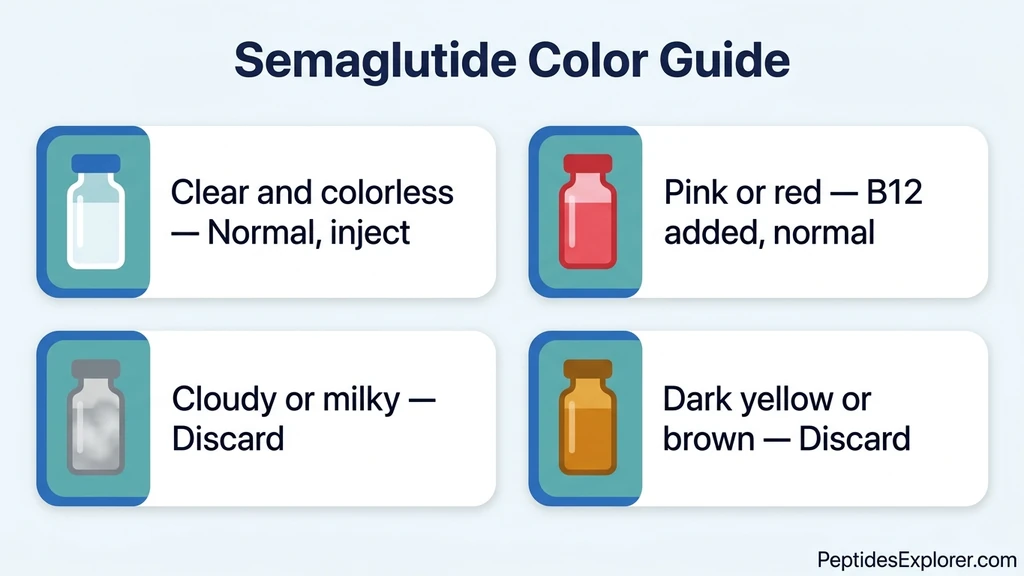
You reconstituted your vial last night, slept on it, and pulled it out of the fridge this morning to draw your dose. The liquid stares back at you and you freeze: *is it supposed to look like this?* Properly reconstituted semaglutide is clear and colorless, sometimes with a very faint pale-yellow or straw tint that is still normal. Brand pens like Ozempic and Wegovy are clear and colorless. Compounded semaglutide mixed with bacteriostatic water should match that. Compounded semaglutide mixed with B12 is red. That is expected, not a defect. Cloudy, milky, dark yellow, or brown semaglutide is not safe to inject and should be discarded. Color is the single cheapest and fastest quality check you can run on a GLP-1 vial, and it tells you more than most injection-day checks.
| Appearance | What it means | Safe to use? |
|---|---|---|
| Clear, colorless | Normal reconstitution with bacteriostatic water | Yes |
| Clear, very pale yellow or straw | Normal (protein absorbs faint blue wavelengths) | Yes |
| Red / pink / rose | Compounded with B12 (cyanocobalamin) | Yes (if intentional) |
| Clear with floating crystals | Cold-storage precipitation | Warm to room temp, swirl, inspect |
| Cloudy or milky | Denaturation, contamination, or over-shaking | No, discard |
| Dark yellow, amber, or brown | Oxidation, degradation, or expiry | No, discard |
| Particles, fibers, or haze | Particulate contamination | No, discard |
The short logic: semaglutide is a 4,113-dalton peptide that is fully soluble in water-based diluents at therapeutic concentrations. Semaglutide was engineered with a C18 fatty diacid moiety attached to lysine 26 via a γGlu-2xOEG linker, plus Aib substitution at position 8 and Arg at position 34, to achieve a ~7-day half-life via albumin binding (Lau et al., 2015). When it is intact and properly mixed, light passes straight through it. When it aggregates, oxidizes, or is contaminated, light scatters, and you see it as cloudiness, haze, or color shift. If you are still learning reconstitution, work through the semaglutide mixing chart first and then come back to this color check as your final verification.
This is educational content. Consult a healthcare provider before starting any peptide.
Get your custom peptide protocol:
- Tailored to your body and goals
- Precise dosing and cycle length
- Safe stacking combinations
- Backed by peer-reviewed studies
- Ready in under 2 minutes
The Default Answer: Clear and Colorless
Brand-name semaglutide pens (Ozempic, Wegovy, and Rybelsus oral tablets set aside) are manufactured as clear, colorless solutions. Novo Nordisk's labeling for Ozempic reads "clear and colorless solution" and instructs patients to discard the pen if they see particles, cloudiness, or discoloration (Novo Nordisk Ozempic label, FDA). That is the reference standard. When a compounded semaglutide vial is described as "clear," it should match the visual clarity of tap water in a clean glass.
Why some "clear" vials look faintly yellow. Semaglutide is a peptide with aromatic amino acids (phenylalanine, tyrosine, tryptophan) and a fatty-acid side chain. Protein solutions absorb very faintly in the violet end of the visible spectrum, which makes concentrated peptide solutions read as a pale straw color. At typical compounded concentrations (2.5 mg/mL or 5 mg/mL), the tint is usually too faint to notice in a clear vial. At 10 mg/mL or higher, a very slight yellow is normal. If you hold the vial against a white sheet of paper and it looks like watered-down champagne, you are fine. If it looks like apple juice or iced tea, you are not.
The bacteriostatic water does not add color. Standard 0.9% benzyl alcohol bacteriostatic water is clear and colorless on its own and stays that way when mixed with intact peptide. If your diluent looked yellow *before* mixing, the water was already contaminated or expired. Throw both the water and the reconstituted vial out and start over with fresh supplies. For diluent selection, see bacteriostatic water vs sterile water.
Clarity matters more than color. A clear pale-yellow vial is safer than a pure white-looking vial that has any haze in it. Cloudiness and particulate contamination are the serious failure modes. A faint tint with perfect clarity is cosmetic, not clinical.
Why Some Compounded Semaglutide Is Red
If your compounded vial came back rose, pink, ruby, or deep red, you did not receive a degraded product. You received a B12 formulation. Many compounding pharmacies mix semaglutide with cyanocobalamin (vitamin B12) as part of their standard protocol. Cyanocobalamin is inherently and intensely red because of the cobalt-containing corrin ring at its center, the same chemistry that makes injectable B12 shots red. Even at micro-gram quantities, B12 turns a clear vial into a noticeable pink or red. Notably, cyanocobalamin is also light-sensitive and degrades to hydroxocobalamin under fluorescent or sunlight exposure, with about 50% degradation in 11-14 days at room light intensity (Ahmad et al., 2014), which is why B12-containing vials should be stored protected from light.
Why compounders add B12. Three reasons come up most often: - Stability marker: B12 gives the solution a visible color, which is a crude but useful tamper/identity check - Nausea claim: some pharmacies claim B12 reduces GLP-1 nausea; the evidence is weak but the side effect profile is near-zero - Energy claim: B12 deficiency is common in caloric restriction, and the addition is sold as an "energy support" feature
The medical reality: the B12 dose in a standard weekly semaglutide injection is small (typically 50 to 1,000 mcg), far below therapeutic supplementation doses, and its effect on nausea in clinical trials is inconsistent. But B12 is water-soluble, renally cleared, and has no realistic toxicity ceiling. For most patients it is harmless ballast.
What a B12-semaglutide should look like. Clear red or rose. Not cloudy. Not streaky. The color should be uniform when you hold the vial up to light. If you see particles floating through a red solution, the issue is contamination, not the B12. For a deeper dive on this specific combo, see why is my semaglutide red and compound semaglutide with B12.
Check your prescription label before panicking. Any legitimate compounder labels B12 formulations as "semaglutide + cyanocobalamin" or "semaglutide/B12." If you ordered plain semaglutide and received a red vial, contact the pharmacy. Either they made a labeling error or they shipped the wrong product.
Other Normal Color Variations
Not every deviation from pure clear-and-colorless is a problem. Several compounding blends produce slight but expected tints.
Semaglutide + niacinamide (vitamin B3). Some compounders add niacinamide for skin or metabolic support. Niacinamide is close to colorless and the final solution should still look clear, maybe with a very faint yellow. Cloudiness or dramatic color shift is not expected.
Semaglutide + glycine or L-carnitine. These amino-acid additives are colorless and should not change the vial's appearance. Solutions should match plain semaglutide visually.
High-concentration semaglutide (10 mg/mL or above). The pale-yellow tint from aromatic amino acids becomes slightly more visible at high concentrations. This is normal for research-grade vials reconstituted to small volumes. Clarity, not color, is the check.
Freshly mixed versus fully dissolved. Right after adding bacteriostatic water to a lyophilized (freeze-dried) semaglutide vial, the solution may look slightly hazy for 2 to 10 minutes while the powder finishes dissolving. Do not shake. Swirl gently or let it sit. Full clarity should emerge within 15 minutes. If it does not, treat the vial as suspect. See how to mix semaglutide for the full reconstitution technique.
Cold-storage crystals. Refrigerated semaglutide sometimes shows thin, thread-like crystals or a faint film on the vial wall. This is usually excipient (mannitol or phosphate buffer) precipitating at low temperature, not peptide degradation. Pull the vial from the fridge, let it warm to room temperature over 15 to 20 minutes, swirl gently, and check clarity. If the crystals dissolve and the solution returns to clear, it is still usable. If they persist, discard. For storage rules, see does semaglutide need to be refrigerated.
The Red Flags: Colors and Textures That Mean Discard
Any of the following appearances in a semaglutide vial means the product is compromised. Do not inject. Contact the pharmacy for replacement if the vial is within its expected shelf life.
Cloudy, milky, or opaque. Cloudiness is the most common failure. It usually means peptide aggregation: the semaglutide molecules have started clumping together, a result of heat exposure, over-vigorous shaking, or denaturation from repeated temperature swings. Aggregated peptide is at best inactive (your dose does nothing) and at worst immunogenic (the aggregates can trigger antibodies that neutralize even future intact doses).
Dark yellow, amber, or brown. Deep color shift beyond a faint straw tint indicates oxidation. The disulfide and peptide bonds have started breaking and side-chain oxidation products absorb more strongly in the visible spectrum. This is the classic appearance of expired or heat-damaged vials. Semaglutide that has been left at room temperature for more than 28 days, or that has been exposed to direct sunlight or a car interior in summer, will show this shift. For shelf-life rules, see does semaglutide expire.
Visible particulates. Any fibers, specks, rubber fragments from the stopper, or dust-like particles mean the vial has been contaminated. Some rubber "coring" (small pieces of stopper knocked loose by needle insertion) is possible with aggressive technique, and the safe move is always to discard. Particulates injected subcutaneously can cause local granulomas or, rarely, systemic reactions.
Streaking or swirls that do not dissolve. If you swirl the vial gently and see oily-looking streaks, protein layers, or a "phase separation" between layers, the peptide has precipitated out of solution. This is most common with vials that were frozen and thawed, or with counterfeit product using the wrong diluent.
Color in a vial labeled as plain semaglutide. If you did not order a B12 formulation and the vial is red, pink, yellow beyond a faint tint, or any unusual color, stop and verify with the pharmacy before injecting. Counterfeit and mislabeled products do exist in the compounded GLP-1 market. For the broader safety picture on compounded GLP-1s, see is compound tirzepatide safe.
How to Inspect a Vial the Right Way
Color inspection is only meaningful if you do it in decent light against a neutral background. Bathroom fluorescents and overhead LED in a yellow kitchen will both skew your perception.
The 30-second vial check: 1. Pull the vial from the fridge and let it sit at room temperature for 15 to 20 minutes (cold liquid scatters light more and can mask or create false cloudiness). 2. Hold the vial up to a white background. A sheet of printer paper works. Look for color and overall clarity. 3. Tilt the vial slowly from side to side under a direct light source (daylight through a window or a bright white LED). Watch for streaks, fibers, or haze that only shows up when light cuts through at an angle. 4. Gently invert the vial once or twice (do not shake). Watch whether small particles settle to the bottom or float. Particles are never normal. 5. Compare the vial to a freshly drawn syringe of bacteriostatic water held next to it. If the semaglutide vial is visibly more cloudy or colored than the reference water, pay attention to the difference.
Do not shake the vial to "test" it. Shaking generates foam and mechanical stress that can denature any peptide, intact or not. Foam is not a failure signal on its own. If you shook a good vial, the foam will disappear over 10 to 30 minutes and the solution will return to clear. If it stays cloudy after the foam clears, there was already a problem.
Check under both warm and cool light. Some subtle brown tints only show up under daylight. Some haze only shows up under angled LED. A vial that looks fine under one light source and suspect under another should be treated as suspect. The cheapest-cost decision is always to discard and reorder.
What to Do If the Color Is Wrong
The reflex when a vial looks off is to inject anyway because the product is expensive and waiting for a new one is annoying. That instinct is the wrong one for GLP-1 medications specifically.
If the vial is cloudy, dark, or contaminated: 1. Do not inject. Cap the syringe if you have already drawn. 2. Photograph the vial next to a white background and next to the lot/expiry label. 3. Contact the pharmacy or supplier within 48 hours. Reputable compounders issue replacements for visibly compromised product. 4. Dispose of the vial properly (sharps container or pharmacy take-back). 5. Check the rest of your supply. If multiple vials from the same lot look wrong, it is a batch problem. Notify the pharmacy for recall tracking.
If the vial has floating crystals but otherwise looks clear: 1. Warm the vial to room temperature for 15 to 20 minutes. 2. Swirl gently; do not shake. 3. Re-inspect. If crystals dissolve and the solution is clear, use it. 4. If crystals persist after warming, discard and replace.
If the color surprises you but matches a B12 or additive formulation: Cross-check the prescription label, the pharmacy shipping manifest, and any intake form you filled out. If "cyanocobalamin" or "B12" appears anywhere, red is expected. For dose adjustment with B12 formulations, see semaglutide titration schedule.
Never try to "rescue" a cloudy vial. Filtering through a sterile syringe filter, re-refrigerating, or adding more bacteriostatic water does not restore a denatured or contaminated product. The peptide is already compromised at the molecular level, and no at-home process reverses aggregation.
Color Changes Over Time in a Normal Vial
Even a perfectly mixed vial changes slightly over its in-use lifespan. Knowing what is normal drift prevents false alarms.
Week 1 (freshly mixed): Crystal clear, essentially colorless. Easy to mistake for plain water.
Weeks 2 to 4 (typical in-use window): Clarity should remain. A very faint yellowing is normal at higher concentrations or with additives, but the vial should still read as clear. If a new tint appears that was not there in week 1, log it and watch.
After week 4 (beyond typical bacteriostatic water shelf life): Potency drop accelerates and visible drift becomes more common. Most compounders and most practitioners discard vials 28 days after reconstitution regardless of remaining volume. For a side-by-side comparison of shelf-life logic, see does semaglutide expire.
Temperature-caused drift. A vial stored in the door of the fridge (which warms and cools every time the door opens) will drift faster than one stored on a back shelf. A vial taken on a flight or left in a hot car is effectively a new expiry calculation. Treat it as if it were recently mixed and watch carefully over the next 7 days.
What timing-of-effect tells you. If you have been injecting consistent dose and your appetite suppression or nausea pattern drops off over a week or two, the peptide may be losing potency before the color changes. Color is lagging indicator; effect is leading indicator. For the standard timeline of what effects to expect, see how long does semaglutide take to work.
Frequently Asked Questions
Is semaglutide supposed to be clear or yellow?
Both are normal. Brand Ozempic and Wegovy are clear and colorless. Compounded semaglutide reconstituted with bacteriostatic water is also clear and colorless, sometimes with a very faint pale-yellow or straw tint at higher concentrations. A light tint without any cloudiness is fine. Deep yellow, amber, or brown is not normal and means discard. For the full reconstitution process, see the semaglutide mixing chart.
Why is my semaglutide red?
Red semaglutide is a compounded formulation that includes vitamin B12 (cyanocobalamin). B12 is inherently red, so even small amounts turn the solution pink, rose, or ruby red. This is expected when the prescription label lists 'semaglutide + B12' or 'semaglutide + cyanocobalamin.' If you did not order a B12 formulation and received a red vial, contact your pharmacy before injecting. See why is my semaglutide red for the full explanation.
Can I inject cloudy semaglutide?
No. Cloudy semaglutide indicates peptide aggregation, denaturation, or contamination. Aggregated semaglutide is at best inactive and at worst immunogenic. It can trigger antibodies that neutralize future doses. Discard any cloudy vial and contact the pharmacy for replacement. Do not try to filter, re-refrigerate, or 'rescue' it. For safe storage rules, see does semaglutide need to be refrigerated.
What does expired semaglutide look like?
Expired or degraded semaglutide typically shifts to dark yellow, amber, or brown, and may develop cloudiness or particulates. Heat damage and oxidation drive the color shift. Most compounded vials should be discarded 28 days after reconstitution regardless of remaining volume, even if they still look clear. For the full expiry logic, see does semaglutide expire.
Can I fix crystals in my semaglutide vial?
Sometimes. Cold-storage crystallization is usually from excipients (mannitol, phosphate buffer) precipitating at refrigerator temperature rather than peptide degradation. Warm the vial to room temperature for 15 to 20 minutes and gently swirl. If the crystals fully dissolve and the solution returns to clear, it is safe to use. If crystals persist or the solution remains cloudy, discard. Never shake vigorously to force dissolution. That causes denaturation. See the peptide reconstitution calculator for correct mixing volumes.
Is compounded semaglutide supposed to look different from Ozempic?
Not really. Plain compounded semaglutide mixed with bacteriostatic water should look very similar to Ozempic pen contents: clear and colorless. The main visual differences come from additives: B12 turns it red, and high concentrations produce a faint yellow tint. If a compounded vial is significantly cloudier or more colored than a reference Ozempic pen, treat that as a quality red flag. For the broader safety comparison, see is compound tirzepatide safe.
Does bacteriostatic water make semaglutide a certain color?
No. Standard 0.9% benzyl alcohol bacteriostatic water is clear and colorless on its own and does not add color to reconstituted semaglutide. If your diluent looked yellow before mixing, the water was already contaminated or expired. Discard both the water and the semaglutide vial and restart with fresh supplies. For diluent differences, see bacteriostatic water vs sterile water.
My vial looks fine but my appetite suppression is fading. Is the color wrong?
Effect usually drops before color does. Peptide potency loss from heat exposure, storage variance, or vial age shows up in your body weeks before it becomes visually obvious. If your consistent dose suddenly feels weaker, check storage history (did the vial spend a day in a hot car?), check days since reconstitution, and consider opening a fresh vial. For expected timelines and dose response, see how long does semaglutide take to work.
The Bottom Line
Semaglutide color tells you most of what you need to know about a vial's quality in about thirty seconds. Clear and colorless (or very pale yellow) is the default for both brand pens and compounded semaglutide mixed with bacteriostatic water. Red means B12 was added. Check your prescription label. Anything cloudy, milky, dark yellow, brown, or particulate is compromised product that should not be injected.
The inspection habit is worth building even if you never encounter a bad vial. It takes less than a minute, it catches shipping damage and storage mistakes that no other check will find, and it costs nothing. Compare each new vial to the one before it, watch for drift over the 28-day in-use window, and throw out anything you are not sure about. The cost of a replacement vial is always less than the cost of injecting a denatured or contaminated peptide.
For the full reconstitution protocol and correct bacteriostatic water volumes, see the semaglutide mixing chart and the peptide reconstitution calculator. For storage rules, see does semaglutide need to be refrigerated and does semaglutide expire. For dose-progression questions once you are confident your vial is good, see semaglutide titration schedule.
Related Articles: - Semaglutide Mixing Chart - Why Is My Semaglutide Red? - Compound Semaglutide with B12 - Does Semaglutide Need to Be Refrigerated? - Semaglutide Titration Schedule
Related Articles
Retatrutide vs Semaglutide: Results, Risks, Cost
Retatrutide vs semaglutide (Ozempic, Wegovy): 24.2% vs 14.9% trial weight loss, side effects, heart rate, dosing cadence, cost, FDA status, and how to switch.
Does Semaglutide Cause Heartburn?
Does semaglutide cause heartburn? Yes, in 1.9-5% of users. Delayed gastric emptying mechanism, GERD differences, and 7 ways to manage it.
Can Semaglutide Cause Depression?
Clinical trials show semaglutide does not increase depression risk. FDA cleared GLP-1 drugs of suicidality concerns in 2025. Evidence and mechanisms.
Can Semaglutide Cause Diarrhea?
Diarrhea affects 8-30% of semaglutide users depending on dose. Learn the GLP-1 mechanism, STEP trial incidence data, timeline, and 6 management strategies.