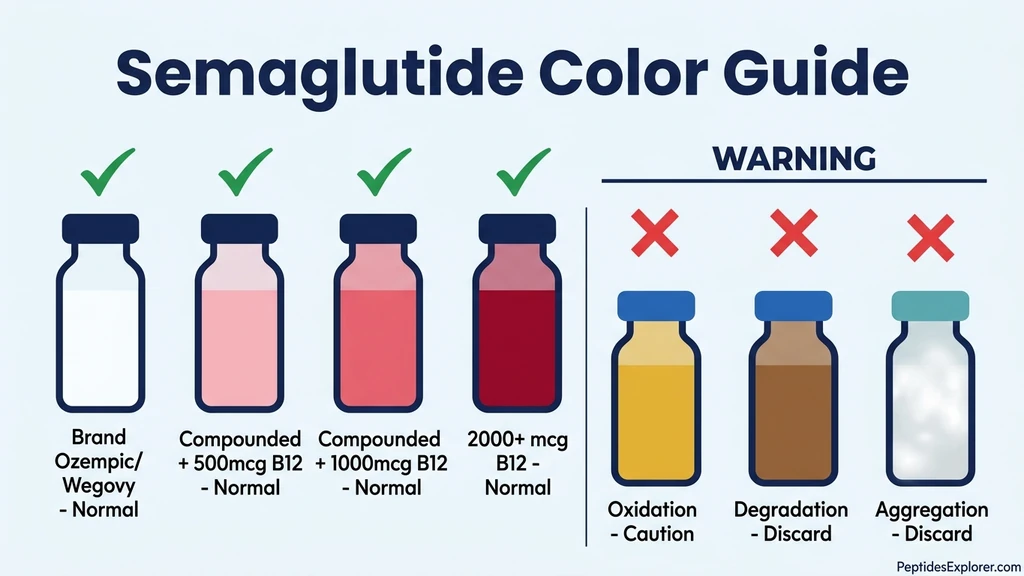
You just pulled your semaglutide vial from the refrigerator and the liquid inside is red. Or pink. Or somewhere between salmon and cherry. You did not expect that. If your semaglutide is red or pink, the most likely explanation is that your compounding pharmacy added vitamin B12 (cyanocobalamin) to the formulation. Cyanocobalamin is a cobalt-containing molecule that produces a deep red color in solution. The higher the B12 concentration, the deeper the red. This is normal, expected, and safe when the vial label lists B12 as an ingredient.
Brand-name Ozempic and Wegovy contain no B12. They are always clear and colorless. If your brand-name pen contains anything other than a clear, colorless liquid, do not inject it.
| Semaglutide Type | Expected Color | Contains B12? | Action If Different |
|---|---|---|---|
| Ozempic pen | Clear, colorless | No | Discard if cloudy, yellow, or any color |
| Wegovy pen | Clear, colorless | No | Discard if cloudy, yellow, or any color |
| Compounded (no B12) | Clear, colorless | No | Discard if cloudy, yellow, or any color |
| Compounded + B12 (500 mcg) | Light pink to salmon | Yes | Normal; discard if cloudy or brown |
| Compounded + B12 (1,000 mcg) | Pink to red | Yes | Normal; discard if cloudy or brown |
| Compounded + B12 (2,000+ mcg) | Deep red to cherry | Yes | Normal; discard if cloudy or brown |
Check your vial label right now. If B12 or cyanocobalamin appears in the ingredient list, the color matches the additive and your medication is fine. If the label does not mention B12 and the liquid is red, contact your pharmacy before injecting. For dose calculations across all concentrations, use the semaglutide dosage calculator.
Get your custom peptide protocol:
- Tailored to your body and goals
- Precise dosing and cycle length
- Safe stacking combinations
- Backed by peer-reviewed studies
- Ready in under 2 minutes
Why Compounding Pharmacies Add B12 to Semaglutide
The red color is not the pharmacy's goal. It is a byproduct. Pharmacies add cyanocobalamin to semaglutide formulations because semaglutide slows gastric emptying by 20-30%, reduces food intake by 30-40%, and both mechanisms impair B12 absorption over time (Blundell et al., Diabetes Obes Metab, 2017). A retrospective analysis found that 12-16% of patients on GLP-1 receptor agonists developed subnormal B12 levels within 12 months of treatment (Aroda et al., J Clin Endocrinol Metab, 2016).
Bundling the two compounds in one vial means one injection covers both needs. The B12 does not enhance semaglutide's weight-loss effect. It prevents a nutritional deficit that would otherwise build over months of treatment. For the full breakdown of this combination, see compounded semaglutide with B12.
Why B12 Turns the Solution Red
Cyanocobalamin's molecular structure contains a cobalt ion at its center, coordinated within a corrin ring. That cobalt-corrin complex absorbs light in the yellow-green spectrum and reflects red wavelengths. Pure cyanocobalamin powder is dark red to purplish-red. Dissolve it in water and it produces a clear red solution.
The color intensity is proportional to concentration. At 500 mcg per mL, the solution looks light pink or salmon. At 1,000 mcg per mL (the most common injectable B12 concentration), the color deepens to a clear pink-red. Above 2,000 mcg per mL, the liquid appears cherry red. Your vial's shade depends entirely on how much B12 the pharmacy added per milliliter.
This is the same reason standalone B12 injections at clinics are bright red. The molecule itself is the pigment.
Common Compounded Semaglutide + B12 Concentrations
Most compounding pharmacies use one of these standard formulations:
| Semaglutide Strength | B12 Amount | Typical Color | Common Providers |
|---|---|---|---|
| 0.25 mg/mL | 500 mcg/mL | Light pink | 503A pharmacies |
| 1.0 mg/mL | 1,000 mcg/mL | Pink-red | 503A and 503B pharmacies |
| 2.5 mg/mL | 1,000 mcg/mL | Pink-red | 503B outsourcing facilities |
| 5.0 mg/mL | 1,000-2,000 mcg/mL | Red to cherry | High-concentration vials |
The semaglutide itself is colorless at all concentrations. Every bit of color you see comes from the B12 component. If your vial is labeled 1,000 mcg/mL cyanocobalamin and the liquid is a clear pink-red, you are looking at exactly what the pharmacy intended.
Semaglutide Color by Formulation Type
Not all semaglutide looks the same. The expected appearance depends entirely on the formulation and manufacturer. Knowing what your specific product should look like is the first step in spotting a problem.
Brand-Name Ozempic and Wegovy
Novo Nordisk manufactures both products as clear, colorless, sterile solutions in pre-filled pens. The formulation contains semaglutide, disodium phosphate dihydrate, propylene glycol, phenol (preservative), and water for injection. None of these excipients produce color.
Every Ozempic and Wegovy pen should contain liquid that looks identical to water when held up to light. If you see any tint (pink, yellow, brown, or anything else) in a brand-name pen, the medication has been compromised. Do not inject it. Contact the pharmacy that dispensed it.
Novo Nordisk's prescribing information is explicit: discard the pen if the solution appears cloudy, colored, or contains particles.
Compounded Semaglutide Without B12
Some compounding pharmacies produce semaglutide without B12. These formulations should also be clear and colorless, identical in appearance to brand-name products (minus the pen delivery system). The semaglutide molecule in solution does not produce visible color at any therapeutic concentration.
If your compounded vial has no B12 on the label and the liquid is anything other than clear and colorless, treat it as potentially degraded. Call the pharmacy. Do not assume a faint tint is normal.
Compounded Semaglutide with B12
This is the formulation that causes the most confusion and the reason most people search "why is my semaglutide red." The liquid should be a clear pink, salmon, or red, depending on B12 concentration. The key word is clear. You should be able to see through the vial with no haze, no floating particles, and no sediment at the bottom.
A helpful test: hold the vial against a white background (a sheet of paper works). The liquid should be uniformly tinted with no cloudy patches, no swirls of different densities, and no specks. If it passes that visual check and the label confirms B12, the color is working as intended.
When Color Change Means Degradation
Color is one of the fastest visual indicators that something has gone wrong with a peptide solution. Semaglutide degrades through oxidation, deamidation, and aggregation. Several of these pathways produce visible changes. For detailed degradation chemistry, see does semaglutide expire.
Yellow or Amber Tint
A yellow or amber color in semaglutide (with or without B12) indicates oxidative degradation. The tryptophan residues in the peptide chain oxidize when exposed to UV light or elevated temperatures, producing chromophores that absorb blue light and appear yellow. This is the same mechanism that causes insulin to yellow when left in the sun.
If your clear semaglutide turns yellow, potency has dropped. If your pink B12-containing semaglutide shifts toward orange or amber, the semaglutide component is degrading even though the B12 color remains. Discard the vial.
Brown or Dark Discoloration
Brown coloring signals advanced degradation. Multiple oxidation products accumulate and cross-link, creating larger chromophore complexes. By the time semaglutide turns brown, potency loss is substantial. In stability studies, brown discoloration correlates with greater than 20% loss of active peptide (ICH Q1A(R2) degradation profiling guidelines).
A B12-containing vial that shifts from clear red to muddy brown has experienced both B12 degradation (cyanocobalamin breaks down under light exposure) and semaglutide degradation. Discard immediately.
Cloudiness and Particles
Cloudiness is the most dangerous visual sign because it often indicates protein aggregation or bacterial contamination. Aggregated semaglutide molecules clump into visible or sub-visible particles. These aggregates are not just inactive; they can trigger immune responses at the injection site, causing redness, swelling, and pain.
Bacterial contamination produces cloudiness through microbial growth. This risk increases with every needle puncture through the vial stopper, which is why reconstituted compounded semaglutide should be discarded after 28 days even if it still looks clear.
Any cloudiness in any semaglutide product is an absolute discard signal. No exceptions. Do not shake the vial to "see if it clears." Protein aggregation is irreversible.
How Temperature Affects Semaglutide Color
Temperature is the primary driver of semaglutide degradation, and color changes are the visible evidence of that damage. Understanding the temperature thresholds helps you assess whether a vial that looks slightly off is still safe.
Think of it like an egg. A raw egg is clear and fluid. Apply gentle heat and it begins to turn opaque. Apply more and it solidifies into white rubber. You cannot reverse the process. Semaglutide is a protein that follows the same principle at a molecular scale: heat unfolds the structure, and the unfolded protein aggregates into visible changes.
Refrigerated Storage (2-8°C): The Safe Zone
At proper refrigeration temperature, semaglutide remains stable for its full labeled shelf life. Brand-name pens stay potent until the printed expiration date (typically 24 months). Compounded vials last for their assigned beyond-use date, usually 28-45 days for liquid formulations. Color should not change during this window.
If your properly refrigerated semaglutide-with-B12 vial looks the same pink or red today as the day you received it, the medication is fine. Consistency of color over time is a good indicator of stability. For complete storage protocols, see does semaglutide need to be refrigerated.
Room Temperature Exposure (15-30°C)
Ozempic pens tolerate room temperature for 56 days after first use. Wegovy pens allow 28 days. Compounded semaglutide vials have no validated room-temperature stability window unless the pharmacy specifically tested for one (most have not).
Brief room-temperature exposure during your injection routine (15-30 minutes) is fine. Leaving a compounded vial on the kitchen counter overnight is a concern. Leaving it in a hot car for an afternoon is a discard event. Degradation rate roughly doubles for every 10°C increase above refrigeration temperature.
You will not necessarily see an immediate color change from a single warm exposure. The damage accumulates. A vial that spent two hours at 35°C and then went back in the fridge may look identical but has lost measurable potency. If your weight loss stalls or appetite suppression weakens, check your storage practices before assuming the dose needs adjustment.
Heat Exposure Above 30°C: Visible Damage Territory
Above 30°C, degradation accelerates sharply. At 40°C (a car dashboard in summer), semaglutide can lose 10-15% potency within hours. Visual signs may include:
- Slight yellowing of clear semaglutide
- Shift from clear pink to slightly hazy in B12 formulations
- Faint cloudiness that was not present before
At 50°C and above, protein denaturation becomes rapid. The solution may turn visibly cloudy within minutes. Any semaglutide exposed to temperatures above 40°C for more than 30 minutes should be discarded regardless of appearance, because potency loss precedes visible change.
Freezing: A Different Kind of Damage
Freezing semaglutide solution causes ice crystal formation that physically shears the peptide's tertiary structure. The freeze-thaw cycle is destructive even if the vial looks clear afterward. Novo Nordisk's prescribing information states explicitly: discard any Ozempic or Wegovy pen that has been frozen, even if thawed.
Compounded liquid semaglutide follows the same rule. Lyophilized (freeze-dried) semaglutide powder can be stored frozen because the water has already been removed. But once reconstituted, the rules change. Never freeze a reconstituted vial.
The 30-Second Visual Inspection Checklist
Before every injection, hold your vial or pen up to a light source and check these five things. The entire process takes 30 seconds and can prevent you from injecting degraded medication.
1. Color match. Does the color match what you expect for your formulation? Clear for brand-name or non-B12 compounded. Pink/red for B12-containing compounded.
2. Clarity. Is the liquid transparent? Can you read text through the vial? Any haze, milkiness, or turbidity means discard.
3. Particles. Tilt the vial slowly. Look for specks, fibers, crystals, or floating material. Any visible particles mean discard.
4. Sediment. Check the bottom of the vial. Settled material that swirls up when you tilt suggests precipitation or contamination.
5. Color consistency. Is the color uniform throughout? Layering, streaks, or patches of different intensity suggest uneven degradation or contamination.
If the vial fails any of these checks, do not inject. Contact your pharmacy for a replacement. The cost of a wasted vial is trivial compared to injecting a contaminated or degraded product.
What to Do If Your Semaglutide Looks Wrong
You have inspected your vial and something is off. The color is unexpected, or cloudiness appeared that was not there before. Follow this decision tree:
Your semaglutide is clear but should be pink/red (B12 formula): The pharmacy may have filled it without B12, or you may have received the wrong product. Do not inject. Call the pharmacy and confirm the formulation.
Your semaglutide is pink/red but should be clear (no B12 on label): Potential contamination or mislabeled product. Do not inject. Contact the pharmacy immediately.
Your semaglutide was pink and is now orange or brownish: Degradation has occurred, likely from heat or light exposure. Discard the vial. Review your storage practices and order a replacement.
Your semaglutide has become cloudy (any formulation): Protein aggregation or bacterial contamination. Discard immediately. Do not shake or attempt to "fix" it.
Your brand-name pen looks yellow: Oxidative degradation from heat or UV light. Discard. If the pen was stored correctly and is within its expiration date, report it to the pharmacy and Novo Nordisk's adverse event line.
For reconstituted peptide storage timelines across all products, see how to store peptides.
Brand-Name vs. Compounded: Why the Color Difference Exists
The color gap between brand-name and compounded semaglutide reflects a fundamental difference in formulation philosophy, not in quality or efficacy of the active ingredient.
Novo Nordisk designs Ozempic and Wegovy as single-active-ingredient products. The formulation contains semaglutide, a buffer system, a preservative (phenol), and water. Nothing else. The clear, colorless appearance is by design: it simplifies quality control, allows visual inspection for degradation, and matches patient expectations for an injectable medication.
Compounding pharmacies operate under different regulatory frameworks (503A or 503B) and have the flexibility to combine active ingredients. Adding B12 addresses a real clinical concern (GLP-1-induced B12 malabsorption) and differentiates their product from competitors. The red color is a side effect of that clinical choice, not a quality defect.
Neither approach is inherently better. Brand-name products have more extensive stability data and FDA oversight. Compounded products cost 70-85% less and can be customized to individual patient needs. The color difference is simply a visible marker of which path your prescription took. For a full comparison and pricing breakdown, see compounded semaglutide with B12.
Common Mistakes with Semaglutide Storage and Appearance
1. Storing the vial in a bathroom medicine cabinet. Bathrooms generate heat and humidity from showers. Both accelerate peptide degradation. Store semaglutide in the main refrigerator compartment, not the door (which fluctuates in temperature) and never in a bathroom.
2. Leaving a compounded vial on the counter during injections. Drawing your dose takes 2-3 minutes. Leaving the vial out for 30 minutes while you eat breakfast or shower adds unnecessary warm exposure. Draw your dose, recap the vial, return it to the fridge.
3. Assuming pink semaglutide has gone bad. This is the most common overreaction. People discard perfectly good compounded semaglutide because they expect it to look like the Ozempic pen they saw online. Check the label for B12 before discarding anything.
4. Ignoring subtle cloudiness. A vial that was crystal-clear last week and now looks slightly hazy has changed. That change is meaningful. Do not rationalize it as "maybe I'm imagining it." Trust your eyes and discard.
5. Shaking the vial to dissolve particles. Semaglutide should never have particles. If you see them, shaking will not help. It may actually accelerate aggregation by introducing air bubbles and mechanical stress to an already unstable solution.
Frequently Asked Questions
Why is my semaglutide red or pink?
Red or pink semaglutide contains vitamin B12 (cyanocobalamin) added by a compounding pharmacy. Cyanocobalamin has a cobalt-corrin complex that produces a red pigment in solution. At 500 mcg/mL the color is light pink; at 1,000 mcg/mL it is pink-red; above 2,000 mcg/mL it appears cherry red. Check your vial label for B12 or cyanocobalamin to confirm.
Should Ozempic or Wegovy be red or pink?
No. Brand-name Ozempic and Wegovy are always clear and colorless. Any color in a brand-name pen indicates contamination or degradation. Discard the pen and contact your pharmacy. Only compounded semaglutide formulations with added B12 should appear red or pink.
What does it mean if my semaglutide turns yellow?
Yellow or amber color indicates oxidative degradation, usually caused by heat or UV light exposure. Tryptophan residues in the peptide chain oxidize and produce yellow chromophores. A yellow tint means measurable potency loss has occurred. Discard the vial or pen and replace it.
Is cloudy semaglutide safe to inject?
No. Cloudiness indicates protein aggregation or bacterial contamination. Aggregated semaglutide is not just inactive; it can trigger immune reactions at the injection site. Discard cloudy semaglutide immediately regardless of formulation type. Do not shake the vial to try to clear it.
Can I use semaglutide that was left out of the fridge overnight?
A single overnight exposure at room temperature (below 25°C / 77°F) is unlikely to cause visible degradation, but it shortens the vial's usable life. Ozempic pens tolerate room temperature for 56 days. Compounded vials have no validated room-temperature window. Return the vial to the fridge and use it promptly. If the room was above 30°C, discard it.
What color should compounded semaglutide be without B12?
Clear and colorless, identical to water. The semaglutide molecule does not produce visible color at any therapeutic concentration. If your non-B12 compounded vial has any tint, cloudiness, or particles, contact the pharmacy before using it.
Does the shade of red matter in B12-containing semaglutide?
The shade corresponds to B12 concentration: light pink at 500 mcg/mL, pink-red at 1,000 mcg/mL, deep red above 2,000 mcg/mL. What matters more than shade is consistency. If the color was pink when you received it and is now darker, lighter, or shifting toward brown, the formulation may be degrading. Contact your pharmacy.
How do I know if my semaglutide has gone bad?
Five visual signs: cloudiness or haziness, yellow or brown discoloration, floating particles or fibers, sediment at the bottom of the vial, and color change from the original appearance. Clinical signs include reduced appetite suppression, return of hunger between doses, and weight loss plateau. If you notice visual changes, discard the vial. For storage best practices, see the semaglutide refrigeration guide.
The Bottom Line
Red or pink semaglutide is almost always compounded semaglutide with vitamin B12. The cyanocobalamin molecule is a red pigment by nature, and its color intensity scales with concentration. This is normal, safe, and intentional.
Brand-name Ozempic and Wegovy are always clear and colorless. Any color in a brand-name pen means do not inject. For compounded vials, match the color to the label: if B12 is listed, pink or red is expected. If B12 is not listed, any color is a red flag.
Store all semaglutide at 2-8°C, inspect before every injection, and discard anything cloudy, yellow, brown, or particle-laden. Use the semaglutide dosage calculator to verify your draw volume, and review how to store peptides if your vials are degrading before you finish them.
Related Articles
Can You Drink on Semaglutide? Risks
Can you drink on semaglutide? No ban, but risks include hypoglycemia, prolonged intoxication, 73% fat-burn suppression, and worse GI side effects.
How Much Is Semaglutide? 2026 Cost Breakdown
Semaglutide costs $149-$1,349/month depending on formulation. Compare Wegovy, Ozempic, compounded, and oral prices with savings strategies.
Semaglutide Refrigeration Guide
Yes, semaglutide must be refrigerated at 2-8°C before first use. Ozempic pens last 56 days at room temp after opening. Compounded vials: 28 days.
How to Travel With Semaglutide: TSA & Cold Chain
How to travel with semaglutide: TSA rules for Ozempic pens, cold chain packing, customs regs, hotel storage, and time zone dosing tips.