You have a flight in 48 hours and a semaglutide pen in the fridge. The questions hit fast: Can you bring needles through airport security? Will your medication survive a 12-hour travel day outside the refrigerator? Yes, you can fly with semaglutide. The TSA exempts injectable medications from the 3-1-1 liquids rule. Ozempic pens tolerate room temperature (up to 30°C / 86°F) for 56 days after first use; Wegovy pens get 28 days. Compounded semaglutide vials must stay cold at 2-8°C throughout the trip. This guide covers every step: TSA screening, cold chain packing, international customs, hotel storage, and time zone dose adjustments.
Semaglutide is a GLP-1 receptor agonist prescribed for type 2 diabetes (Ozempic) and chronic weight management (Wegovy). Millions of patients travel with it every year, and many also travel with the dual GIP/GLP-1 agonist tirzepatide (the same carry-on and cold chain rules apply to both). The semaglutide molecule is more thermally stable than shorter peptides like BPC-157 or GHK-Cu because of its C-18 fatty acid side chain, but it still requires respect for temperature limits. A pen left on the dashboard of a rental car in Phoenix is ruined. A vial packed in checked luggage that freezes at altitude is ruined. This guide prevents those outcomes.
For background on semaglutide storage rules at home, see does semaglutide need to be refrigerated. For shelf life data, see does semaglutide expire.
| Semaglutide Form | Carry-On Required? | Cold Pack Needed? | Max Time at Room Temp | Key Travel Consideration |
|---|---|---|---|---|
| Ozempic pen (in use) | Yes | No, if under 30°C | 56 days | Cap the pen; protect from sunlight |
| Ozempic pen (unopened) | Yes | Yes, keep 2-8°C | Brief excursion OK | Open it on arrival to start the 56-day clock |
| Wegovy pen | Yes | Recommended | 28 days | Single-use; plan injection day around travel |
| Compounded vial (reconstituted) | Yes | Yes, mandatory | Do not leave at room temp | Use insulated case with gel packs |
| Compounded vial (lyophilized) | Yes | No (if sealed) | Stable at room temp | Reconstitute on arrival; bring bacteriostatic water |
Get your custom peptide protocol:
- Tailored to your body and goals
- Precise dosing and cycle length
- Safe stacking combinations
- Backed by peer-reviewed studies
- Ready in under 2 minutes
TSA Rules for Traveling With Semaglutide
The Transportation Security Administration (TSA) classifies semaglutide as a medically necessary liquid. This classification grants a specific set of exemptions that make air travel with injectable medications straightforward, provided you follow the correct declaration procedure.
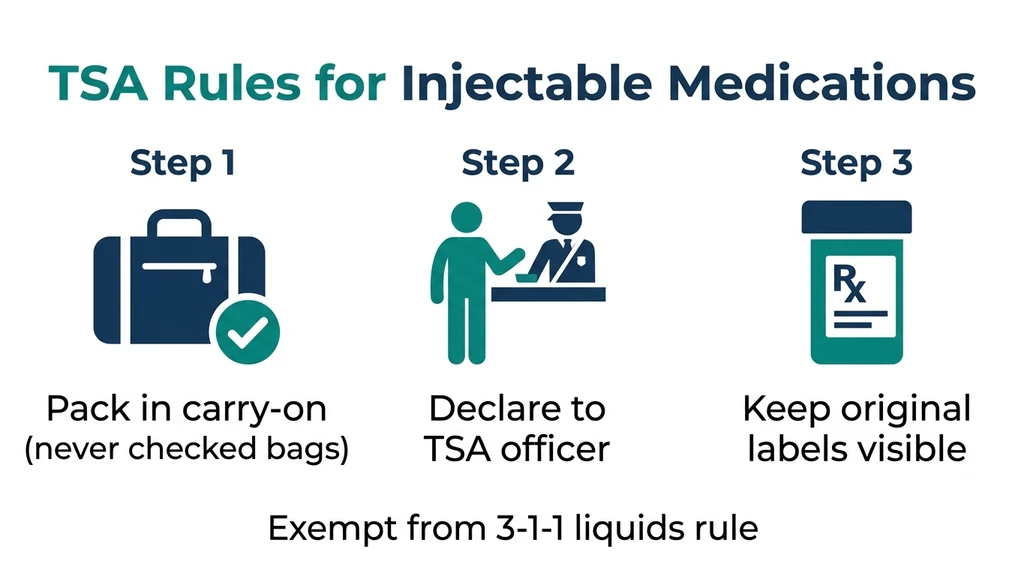
The 3-1-1 Liquids Rule Does Not Apply
The TSA 3-1-1 rule limits carry-on liquids to 3.4 ounces (100 mL) in containers that fit in a single quart-size bag. Injectable medications, including semaglutide pens and vials, are explicitly exempt from this rule. You may carry quantities that exceed 3.4 ounces, and they do not need to go inside the quart-size toiletry bag.
This exemption applies to: - Ozempic pens (1.5 mL or 3 mL solution volumes) - Wegovy pens (all strengths) - Compounded semaglutide vials (any volume) - Bacteriostatic water vials for reconstitution - Insulin syringes, pen needles, and alcohol swabs - Sharps disposal containers
Declaration step: Before your belongings enter the X-ray conveyor, tell the TSA officer that you are carrying medically necessary liquids and sharps. Place the medication in a separate bin or on top of your carry-on so it can be screened independently. The TSA may perform additional inspection, including visual examination and swab testing for explosive residue, but they will not open sealed medication packaging without your consent.
Documentation You Should Carry
The TSA does not legally require a prescription to carry medication through a U.S. airport checkpoint. However, carrying documentation prevents delays and confusion during screening.
Recommended documents: 1. Prescription label or pharmacy label on the original packaging (most important) 2. Letter from your prescribing physician stating the medication name, dosage, and medical necessity 3. Copy of your prescription (digital or physical) 4. Your photo ID matching the name on the prescription
If you use compounded semaglutide, the pharmacy label on the vial serves as proof. If you transfer doses to unlabeled syringes for convenience, also carry the original labeled vial or packaging. A TSA officer who sees an unlabeled syringe without context will reasonably want clarification.
For a complete overview of safe injection technique to review before your trip, see the peptide injection guide.
Needles and Sharps Through Security
Unused syringes and pen needles pass through TSA screening without issue when accompanied by injectable medication. You do not need to declare each needle individually. Pack them with your semaglutide pen or vial so the context is clear.
Sharps containers are allowed in carry-on luggage. If you are traveling for more than a few days, bring a travel-size sharps container (available at any pharmacy for under $5) rather than capping used needles and tossing them in the hotel trash.
Used needles should go directly into the sharps container. Never place loose used needles in your carry-on bag. If the TSA finds an uncontained used needle during screening, it creates a needlestick hazard and will cause a significant delay.
For proper injection technique and needle selection, see the peptide safety guide.
Cold Chain Management: Keeping Semaglutide at the Right Temperature
The term "cold chain" refers to the unbroken series of temperature-controlled environments that keep a medication within its safe range from manufacturer to patient. When you travel, you become the cold chain. Your decisions about packing, transit, and hotel storage determine whether the semaglutide in your pen or vial retains full potency.
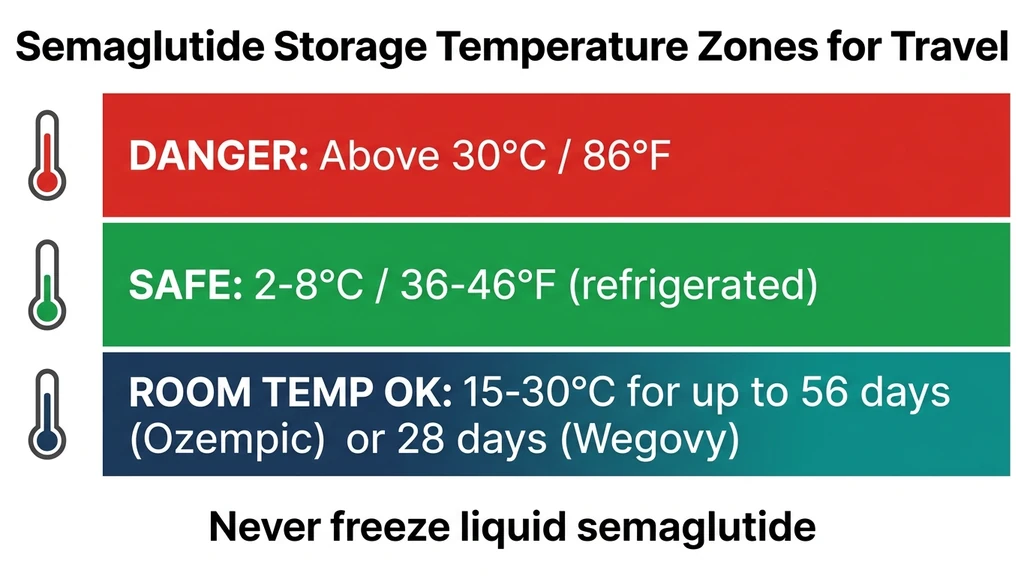
The temperature requirements differ by product form:
| Product | Required Range | Tolerance | Critical Threshold |
|---|---|---|---|
| Ozempic (in use) | Up to 30°C (86°F) | 56 days at room temp | Discard above 30°C prolonged exposure |
| Ozempic (unopened) | 2-8°C (36-46°F) | Brief room temp excursion OK | Do not freeze |
| Wegovy | 2-8°C preferred; up to 30°C acceptable | 28 days at room temp | Discard above 30°C |
| Compounded vial (reconstituted) | 2-8°C (36-46°F) | Minimal room temp tolerance | Must stay refrigerated |
| Compounded lyophilized (sealed) | 2-8°C or -20°C | Stable at room temp briefly | Reconstitute only on arrival |
For the science behind these temperature limits, including deamidation, oxidation, and aggregation pathways, see does semaglutide need to be refrigerated.
Ozempic and Wegovy Pens: The Simplest Travel Scenario
Brand-name Ozempic pens are the easiest semaglutide form to travel with. If your pen is already in use (you have injected at least one dose), the 56-day room-temperature clock is already running. As long as you stay below 30°C, the pen needs no cold packing for trips under 56 days.
Practical steps for pen travel: 1. Cap the pen after each use. The cap blocks UV light, which accelerates methionine oxidation in the peptide. 2. Store the pen in your carry-on bag, not your checked luggage. Cargo holds can reach -20°C at cruising altitude, and freezing destroys liquid semaglutide. 3. If ambient temperature will exceed 30°C (desert climates, tropical destinations, summer road trips), use an insulated pouch. No ice pack necessary for Ozempic pens; the insulation alone buffers against brief heat spikes. 4. Write the date of first injection on the pen with a permanent marker. Discard the pen 56 days after that date, regardless of remaining solution.
For Wegovy, the same principles apply with a tighter 28-day window. Wegovy pens are single-dose, so most patients inject the pen shortly after removing it from the fridge. If you are timing your weekly injection around a travel day, inject the morning of your flight and pack the next week's pen in an insulated case.
For dosing calculations and unit conversions, use the semaglutide dosage calculator.
Compounded Semaglutide Vials: Cold Packing Required
Compounded semaglutide, whether reconstituted from lyophilized powder or pre-mixed liquid, lacks the stabilizing excipients (polysorbate 80, phenol) present in brand-name pens. It must stay refrigerated at 2-8°C throughout your trip.
Insulated travel cases designed for insulin work perfectly for semaglutide vials. Look for cases with: - A rigid outer shell to prevent vial breakage - An insulated lining (closed-cell foam or vacuum-insulated) - Space for one or two gel ice packs - A thermometer or temperature indicator strip (optional but recommended)
Gel ice packs vs. blue ice: Use pharmacy-grade gel packs designed for medication transport. Standard "blue ice" bricks from the grocery store work but are bulkier. Freeze the packs solid before departure. A single frozen gel pack in a quality insulated case maintains 2-8°C for 8-12 hours in a 22°C environment.
The freezing trap: Place a cloth barrier (a washcloth or paper towel) between the gel pack and the vial. Direct contact with a frozen pack can freeze the solution at the contact point, denaturing the protein. This is the same principle as frostbite: the surface freezes even when the ambient temperature is above zero.
If you are traveling with lyophilized (freeze-dried) semaglutide that has not been reconstituted, the powder is stable at room temperature for short periods. Pack it without ice and reconstitute on arrival using bacteriostatic water. For mixing instructions, see how much bacteriostatic water for semaglutide.
Road Trips and Ground Transportation
Cars present the greatest temperature threat to semaglutide. A parked car in direct sunlight can reach 60-80°C (140-176°F) inside within 30 minutes, even when outside air temperature is only 30°C. This is lethal for any protein-based medication.
Rules for car travel: - Never leave semaglutide in a parked car, not even "for a few minutes." - Place the insulated case on the floor behind the front passenger seat, where it benefits from air conditioning airflow and is shielded from direct sun. - If you stop for a meal, bring the case inside the restaurant. - On multi-day road trips, refresh gel ice packs at hotel ice machines. Fill a ziplock bag with ice cubes, wrap it in a towel, and swap it for the spent gel pack. - If your vehicle has a 12V mini-fridge (common in RVs and some SUVs), set it to 4-6°C and store the vial there. Verify the temperature with a thermometer before trusting the fridge dial.
For extended road trips, consider the lyophilized form. Ship compounded lyophilized semaglutide to your destination ahead of time (keep it at room temperature for shipping if sealed), and reconstitute it on arrival with refrigerated bacteriostatic water.
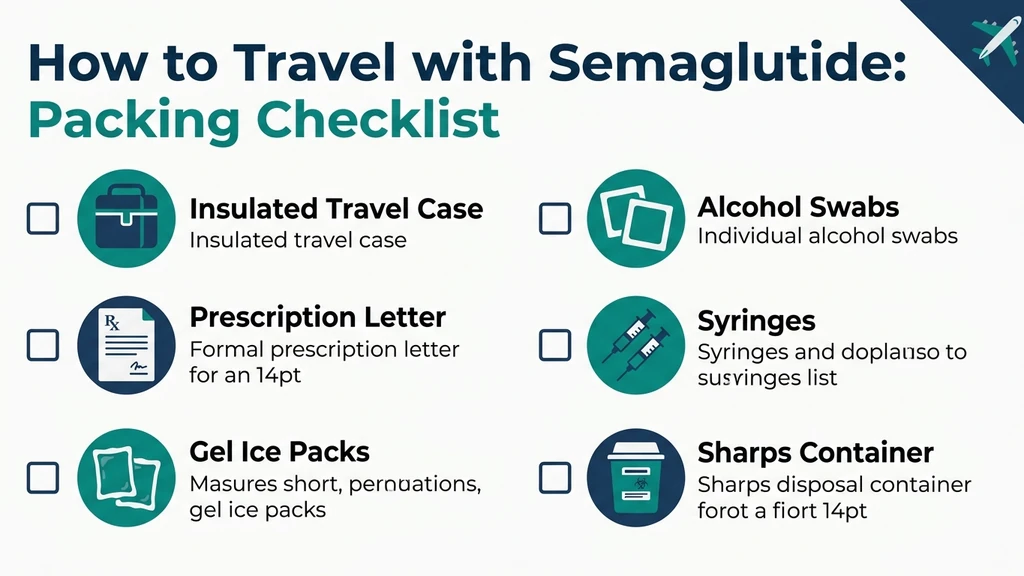
Complete Travel Packing Checklist
Print this checklist before your trip. Every item serves a specific purpose in maintaining medication integrity and clearing security checkpoints smoothly.
Medication and supplies: - [ ] Semaglutide pen or vial (enough for your trip plus one extra dose) - [ ] Pen needles or insulin syringes (enough for your trip plus 2-3 extras) - [ ] Alcohol swabs (one per injection, plus extras) - [ ] Bacteriostatic water vial (if traveling with lyophilized semaglutide) - [ ] Travel-size sharps container
Cold chain supplies: - [ ] Insulated medication travel case - [ ] Two gel ice packs (one in use, one for rotation) - [ ] Cloth barrier (washcloth or paper towel to prevent freezing) - [ ] Small digital thermometer (optional but recommended for compounded vials)
Documentation: - [ ] Prescription label on original packaging - [ ] Physician letter stating medication name, dosage, and medical necessity - [ ] Copy of prescription (digital backup on phone) - [ ] Photo ID matching prescription name - [ ] Insurance card - [ ] Prescriber's phone number (in case of emergency refill)
For international travel (additional): - [ ] Translated prescription letter (destination country's language) - [ ] Customs declaration form (if required by destination) - [ ] Embassy contact information for destination country - [ ] Medication quantity documentation (matching trip duration)
Storage note: For detailed information on how semaglutide shelf life works and what happens when storage conditions fail, review does semaglutide expire before your trip. For general peptide storage protocols, see how to store peptides.
Flying With Semaglutide: Step-by-Step Airport Walkthrough
Here is exactly what happens from curb to gate when you travel with semaglutide.
Before Leaving Home
Timing your injection: If your weekly injection falls on your travel day, inject before leaving for the airport. This eliminates the need to inject in an airport restroom or hotel room on arrival day. Semaglutide's 7-day half-life means the timing window is flexible. Injecting 12-24 hours early or late has minimal impact on blood levels. For detailed dosing guidance, see the semaglutide dosage chart.
Packing sequence: 1. Remove the pen or vial from the fridge. 2. Place it in the insulated case with a frozen gel pack and cloth barrier. 3. Put the insulated case, syringes, sharps container, and documentation into a clear ziplock bag or the top compartment of your carry-on for easy access at security. 4. Do not pack any semaglutide-related items in checked luggage.
At the Security Checkpoint
- 1.Approach the conveyor. Remove your insulated medication case from your carry-on bag. Place it in a separate bin, just like you would a laptop.
- 2.Declare verbally. Tell the officer: "I have medically necessary injectable medication and needles." This is not legally required but prevents surprises during X-ray screening.
- 3.X-ray screening. The semaglutide pen, vials, and syringes will pass through the X-ray machine. X-ray radiation at TSA energy levels does not damage peptide medications. The exposure time is less than one second.
- 4.Additional screening. The officer may ask to examine the medication visually, swab the case for explosive residue, or ask you to open the insulated case. Cooperate calmly. They will not open sealed medication vials or pens.
- 5.Collect your items. Return the insulated case to your carry-on once cleared.
TSA PreCheck and Global Entry do not change the medication declaration process. You still pass through an X-ray (or body scanner), and the medication still goes through the conveyor scanner. The only difference is shorter lines.
On the Plane
Store the insulated case under the seat in front of you, not in the overhead bin. The overhead compartment is not climate-controlled and can get warm on long flights. Under-seat storage keeps the case accessible and within the climate-controlled cabin.
Cabin pressure and altitude: Commercial aircraft cabins are pressurized to approximately 6,000-8,000 feet (1,800-2,400 meters). This pressure does not affect semaglutide pens or sealed vials. The pressure inside a sealed pen or vial is stable. Gas bubbles may expand slightly in reconstituted vials, but this does not affect the peptide's integrity.
Long-haul flights (8+ hours): Check the gel ice pack at the midpoint of the flight. If it has fully thawed and you are carrying compounded semaglutide, request a cup of ice from the flight attendant and pack it around the case in a ziplock bag. For Ozempic pens in use, no action is needed. The pen is rated for room temperature.
For understanding how semaglutide behaves over extended periods in your system, see how long does semaglutide stay in your system.
International Travel With Semaglutide
Crossing national borders with semaglutide introduces customs and regulatory requirements that do not apply to domestic U.S. travel. Each country has its own rules for importing prescription medications, and some countries restrict GLP-1 receptor agonists specifically because of their high demand and resale value.
General International Rules
Most countries allow travelers to import prescription medications for personal use in quantities matching the trip duration, typically up to a 90-day supply. The universal requirements are:
- 1.Original packaging with pharmacy labels. Remove the guesswork for customs officers. A labeled Ozempic box is immediately recognizable. An unlabeled vial raises questions.
- 2.Physician letter in English and the destination language. The letter should state your name, the medication name (both brand and generic: "semaglutide, brand name Ozempic"), the dosage, the prescribing indication, and a statement that the medication is for personal use.
- 3.Quantity matching trip duration. Bringing 12 pens for a 5-day trip will prompt questions. Bring enough for your trip plus one spare dose.
- 4.Medication in carry-on luggage. Most international airports follow the same logic as the TSA: medically necessary liquids are exempt from liquid restrictions in carry-on bags.
Contact the embassy or consulate of your destination country at least 4 weeks before travel to verify current regulations. Rules change, particularly in countries where semaglutide is not approved or is controlled differently than in the U.S.
Country-Specific Regulations
United Kingdom and EU: Semaglutide (Ozempic and Wegovy) is approved and widely available. The UK allows up to a 3-month supply for personal use with a prescription. EU countries follow similar rules under the Schengen Agreement, but carry a physician letter translated into the local language. Some EU pharmacies can provide emergency refills with a valid foreign prescription.
Canada: Semaglutide is approved by Health Canada. Travelers may bring a personal supply with documentation. The Canada Border Services Agency (CBSA) and CATSA (the Canadian TSA equivalent) follow similar medication screening procedures.
Mexico: Semaglutide is available in Mexican pharmacies, often without a prescription. However, bringing your own supply from the U.S. is permitted with documentation. Be aware that counterfeit semaglutide pens have been reported in some Mexican border pharmacies.
Japan: Japan has strict pharmaceutical import rules. Travelers must submit a "Yakkan Shoumei" (import certificate) for prescription medications if bringing more than a one-month supply of injectables. Apply through the Japanese Embassy at least 2 weeks before travel.
Middle East (UAE, Saudi Arabia): Semaglutide is approved and available. Carry your prescription and physician letter. The UAE customs authority may inspect medication, but insulin and GLP-1 agonists are routinely permitted.
Australia: The Therapeutic Goods Administration (TGA) allows travelers to bring up to a 3-month supply of prescription medication with documentation. Declare the medication on the incoming passenger card.
Southeast Asia (Thailand, Vietnam, Philippines): Rules vary significantly. Carry a physician letter and original packaging. Some countries require a narcotics certificate even for non-narcotic injectables. Check with the specific country's embassy.
For comprehensive peptide regulations and legal status, see peptide safety guide.
Customs Declaration Process
When arriving in a foreign country, you will typically encounter a customs declaration form (either paper or electronic). Here is how to handle medication declaration:
- 1.Mark "Yes" on the medication/goods declaration if the form asks whether you are carrying medications, drugs, or medical supplies.
- 2.Present your documentation proactively when speaking with the customs officer. Hand them your physician letter and prescription before they ask.
- 3.Keep medication in its labeled packaging until you clear customs. Do not pre-load syringes before crossing a border.
- 4.Layover countries matter. If your flight routes through a third country where you clear customs (common in international connections), that country's import rules also apply. A flight from the U.S. to Thailand through Tokyo means you may need documentation for both Japan and Thailand.
What if your medication is confiscated? This is extremely rare for labeled, documented prescription semaglutide. If it happens, ask for a written confiscation receipt, contact your embassy, and locate a local pharmacy or clinic that can provide an emergency supply. In most developed countries, a local physician can write a temporary prescription for semaglutide if you present your U.S. documentation.
Hotel and Accommodation Storage
Your hotel room becomes your pharmacy for the duration of the trip. Storage strategy depends on your semaglutide form and the facilities available.
Hotel Mini-Fridges
Most hotel mini-fridges operate at 4-10°C, which is acceptable for semaglutide storage (target range: 2-8°C). However, mini-fridges have quirks:
Temperature variation. Mini-fridges cycle between cooling and warming phases more aggressively than full-size refrigerators. The door area may be significantly warmer than the back wall. Place the vial or pen toward the back of the fridge, away from the door.
Freezing risk. Some hotel mini-fridges have a small freezer plate at the top rear. Anything touching this plate will freeze. Place a folded towel between the plate and your medication.
Automatic defrost cycles. Budget hotel fridges may warm to 12-15°C during defrost cycles. For Ozempic pens (tolerate up to 30°C), this is irrelevant. For compounded vials (require 2-8°C), this brief warming is acceptable if the overall average temperature stays in range.
If the room has no fridge: Ask the front desk to store your medication in the hotel kitchen's commercial refrigerator. Most hotels accommodate this request. Alternatively, buy a bag of ice from the hotel and store the insulated case in the hotel room ice bucket with fresh ice, refreshing it every 8-12 hours.
For the full science behind refrigeration requirements, see does semaglutide need to be refrigerated.
Airbnb, Hostels, and Camping
Airbnb and vacation rentals almost always include a full-size refrigerator. Check the listing photos before booking and confirm with the host. This is the ideal scenario for compounded semaglutide storage.
Hostels have shared kitchens with refrigerators. Label your medication clearly ("PRESCRIPTION MEDICATION - [YOUR NAME] - DO NOT DISCARD") and store it in the back of the fridge. Some hostels have lockers with power outlets where you can plug in a portable mini-cooler.
Camping and backcountry travel. This is the hardest scenario. Options: - Portable 12V cooler (plugs into a car or portable battery). These maintain 2-8°C reliably and are the gold standard for multi-day camping with injectable medications. - High-quality insulated case with gel packs. Rotate ice from a campsite cooler. Feasible for 2-3 day trips. - Lyophilized semaglutide. The freeze-dried powder form is ideal for camping. It requires no refrigeration until reconstituted. Pack the powder, a vial of bacteriostatic water, and syringes. Reconstitute on the day you need to inject and use within hours. - Timing adjustment. If your camping trip is 5 days and your injection falls on day 3, inject one day early (day before departure) and inject again one day late (day after return). The 7-day dosing cycle tolerates a 2-day shift without clinically significant blood-level changes.
For complete peptide storage protocols covering all environments, see how to store peptides.
Time Zone Adjustments for Weekly Dosing
Semaglutide is dosed once weekly. When you cross time zones, your injection schedule needs a minor adjustment. The good news: semaglutide's long half-life (approximately 168 hours, or 7 days) makes it one of the most forgiving injectable medications for time zone changes.
The Practical Rule
Shift your injection time by no more than 2 days in either direction. Semaglutide maintains therapeutic blood levels from day 3 through day 10 after injection. This means you have a wide window.
Example: Flying New York to Tokyo (13-hour time difference) - Normal injection: Tuesday at 8:00 AM Eastern - Arrival in Tokyo: Wednesday at 10:00 PM JST - Adjusted injection: Wednesday evening or Thursday morning JST (a shift of approximately 12-36 hours later) - Next injection: The following Wednesday morning JST (re-establishing a consistent local schedule)
Example: Flying Los Angeles to London (8-hour time difference) - Normal injection: Friday at 7:00 PM Pacific - Arrival in London: Saturday at 11:00 AM GMT - Adjusted injection: Saturday morning GMT (approximately 12 hours earlier) - Next injection: The following Saturday morning GMT
The key principle: after arrival, pick a consistent day and time in the local time zone and stick with it for the remainder of your trip. When you return home, shift back to your original schedule on the next injection day.
What Happens If You Miss a Dose While Traveling
According to the Ozempic prescribing information, if you miss a dose and the next scheduled dose is more than 2 days away, inject the missed dose as soon as you remember. If the next dose is within 2 days, skip the missed dose and resume the regular schedule.
Practical translation for travelers: - Missed by 1-2 days: Inject immediately, then resume your regular weekly schedule. - Missed by 3-4 days: Inject immediately. Your next dose should be on your regular day (you may have a shorter interval, which is fine). - Missed by 5+ days: Inject immediately. Some patients experience a return of appetite or mild nausea as blood levels dropped and then rise again. This is temporary.
Never double-dose to make up for a missed injection. Doubling the dose does not improve efficacy and increases the risk of nausea, vomiting, and hypoglycemia (in diabetic patients).
For understanding how semaglutide blood levels change over time, see how long does semaglutide stay in your system. For dose calculations when adjusting timing, use the semaglutide dosage calculator.
Troubleshooting Common Travel Problems
Even with perfect planning, travel introduces variables. Here is how to handle the most common semaglutide travel emergencies.
The Pen or Vial Was Left in a Hot Car
Ozempic pen (in use): If the pen was exposed to temperatures above 30°C for less than 1 hour, it is likely still usable. Semaglutide does not denature instantly at 31°C. The 30°C limit accounts for sustained exposure over weeks. A brief spike to 35-40°C, while not ideal, causes minimal degradation.
If the pen was in a car that reached 50-70°C for 30 minutes or more, discard it. At these temperatures, protein aggregation begins rapidly. The solution may not look different, but potency is compromised.
Compounded vial: Discard if left above 25°C for more than 2 hours. Compounded formulations lack the stabilizing excipients that give brand-name pens their heat tolerance.
Visual inspection: Check the solution for cloudiness, particles, fibers, or color change (yellow to brown). Any of these signs means the protein has aggregated or degraded. Discard the pen or vial. However, partial degradation (20-50% potency loss) produces no visible changes, so visual clarity alone does not confirm full potency.
For more on identifying degraded semaglutide and what happens when you use expired medication, see does semaglutide expire.
The Medication Froze
Freezing is more destructive than heat for liquid semaglutide. Ice crystals mechanically shear protein molecules, causing irreversible aggregation. This is why you never pack semaglutide in checked luggage (cargo holds can reach -20°C) and always use a cloth barrier between gel packs and the vial.
If your liquid semaglutide froze: - Discard it. There is no salvage procedure. Thawing a frozen pen or vial does not restore the protein's structure. - If you are mid-trip, locate a pharmacy at your destination. In the U.S. and most developed countries, a pharmacist can contact your prescriber for a replacement prescription or emergency supply.
Lyophilized semaglutide is the exception. Freeze-dried powder contains no water and cannot form ice crystals. Freezing a sealed lyophilized vial causes no damage. This is one of the key advantages of the lyophilized form for travel.
You Ran Out of Medication Mid-Trip
In the U.S.: Contact your prescriber or pharmacy. Most chain pharmacies (CVS, Walgreens, Rite Aid) can process a new fill or early refill with prescriber authorization. You can also use a telehealth service for an emergency prescription.
Internationally: Options depend on the country: - Countries where semaglutide is available (UK, EU, Canada, Australia, Japan): Visit a local clinic or hospital. Present your U.S. prescription documentation. Many physicians will write a temporary local prescription. - Countries where semaglutide is unavailable or restricted: Contact the nearest U.S. embassy or consulate for guidance on obtaining a replacement. - Compounded semaglutide is generally not available outside the U.S. If you travel with compounded semaglutide internationally, bring extra.
Prevention: Always pack one extra dose beyond what you need for the trip. For a 10-day trip with a weekly injection, bring two pens or two weeks' worth of vial solution.
TSA Confiscated or Damaged Your Medication
TSA confiscation of labeled prescription medication is exceptionally rare. If it occurs:
- 1.Request a supervisor. Ask to speak with a TSA supervisor and explain that the items are medically necessary prescription medication.
- 2.File a claim. If medication is damaged during screening, file a claim with the TSA Claims Management Branch (online at tsa.gov or by phone).
- 3.Get a replacement. Use the steps above (contact prescriber or visit a local pharmacy) to obtain a replacement before your flight.
TSA cannot confiscate medication that is properly labeled and declared. If an officer states that your needles or semaglutide pen are not permitted, politely cite the TSA's own policy on medically necessary items and request a supervisor.
Travel With Semaglutide Injection Supplies
Beyond the medication itself, you need to plan for the full injection workflow in an unfamiliar environment.
Injection in a Hotel Room
The injection process is identical to what you do at home. The only difference is the surface and disposal:
- 1.Wash your hands with soap and water (not just hand sanitizer).
- 2.Clean the injection site with an alcohol swab. The standard sites, abdomen, thigh, or upper arm, work in any location.
- 3.If using a pen, attach a new needle, dial the dose, and inject per the pen instructions.
- 4.If using a syringe and vial, draw the dose following the same protocol you use at home. For technique review, see how to inject peptides.
- 5.Dispose of the used needle in your sharps container. Do not leave used needles in the hotel trash.
Workspace tip: Use the bathroom counter (cleaned with an alcohol swab) or a clean towel spread on the desk. Avoid injecting on the bed where unsteady surfaces make pen or syringe handling harder.
Disposing of Sharps While Traveling
In the U.S.: Most pharmacies accept full sharps containers for free disposal. CVS, Walgreens, and Rite Aid offer this service. If you are driving, drop off the full container at a pharmacy and pick up a new one.
Internationally: Ask the hotel front desk or concierge about medical waste disposal. Hospitals and pharmacies in most countries accept sharps containers. In some European countries, you can return used needles to any pharmacy by law.
If you have no sharps container: Use a hard plastic container with a screw-on lid (a laundry detergent bottle or thick plastic water bottle). Label it "SHARPS - DO NOT RECYCLE." This is the CDC-recommended improvised container for travel.
Cruise Ship and Extended Travel Considerations
Cruise ships and extended international trips (2+ weeks) require additional planning because you lose easy access to pharmacies and medical providers.
Cruise Ships
Cabin refrigerators: Most cruise ship cabins have a mini-fridge or mini-bar fridge. These operate at 4-10°C, suitable for semaglutide storage. If your cabin does not have a fridge, contact the cruise line before departure to request one for medical purposes. Most lines accommodate this at no charge.
Ship medical center: Cruise ship medical centers carry basic medications but rarely stock semaglutide. Bring your entire supply plus one extra dose.
Port excursions: If you leave the ship for a full-day excursion in a tropical port, bring the insulated case with you. Do not leave compounded semaglutide in the cabin fridge during hours-long shore excursions, but Ozempic pens already in use are fine in the fridge.
Embarkation security: Cruise ship embarkation security follows similar rules to airports. Declare your medication and needles. Carry documentation.
Extended International Stays (30+ Days)
For stays exceeding 30 days, you face two challenges: carrying enough medication through customs and maintaining storage for the duration.
Quantity limits: Most countries allow up to a 90-day supply of personal prescription medication. For a 60-day trip with weekly injections, you need 8-9 doses. For Ozempic, this means 2-3 pens. For compounded semaglutide, calculate based on your concentration and dose volume.
Refills abroad: In countries where Ozempic is approved (most of the EU, UK, Canada, Australia, Japan), you may be able to obtain a local prescription from a physician. Bring your complete medical records and U.S. prescription documentation. The cost without insurance may differ significantly from your U.S. copay.
Mail-order from the U.S.: Some compounding pharmacies will ship internationally with cold-chain packaging, but this is expensive ($50-100 for shipping) and subject to customs inspection. Research your destination's rules on imported prescription medication via mail before relying on this option.
For mixing your own supply from lyophilized powder while abroad, see how much bacteriostatic water for semaglutide.
Semaglutide Travel FAQ: Quick Reference Answers
The most common questions about traveling with semaglutide, answered in brief. For the detailed science behind each answer, refer to the relevant section above.
Frequently Asked Questions
Can you bring semaglutide on a plane?
Yes. Semaglutide pens and vials are allowed in carry-on luggage on all U.S. flights. The TSA exempts injectable medications from the 3-1-1 liquids rule. Declare the medication at the security checkpoint and keep it in its original labeled packaging. For a full walkthrough of the TSA screening process, see how to inject peptides for injection supply packing tips.
Does semaglutide need to be refrigerated during travel?
It depends on the form. Ozempic pens already in use tolerate room temperature (up to 30°C / 86°F) for 56 days. Wegovy pens tolerate room temp for 28 days. Compounded semaglutide vials must stay refrigerated at 2-8°C throughout travel. Use an insulated case with gel ice packs for compounded vials. For complete refrigeration guidelines, see does semaglutide need to be refrigerated.
Can you take Ozempic on an international flight?
Yes. Most countries allow travelers to import prescription medications for personal use. Carry documentation including a physician letter, prescription, and original packaging. Contact the embassy of your destination country at least 4 weeks before travel to verify specific import rules. For broader medication safety guidelines, see the peptide safety guide.
How do you keep semaglutide cold while flying?
Pack the pen or vial in an insulated medication travel case with a frozen gel ice pack. Place a cloth barrier between the ice pack and the medication to prevent freezing. Store the case under the seat in front of you, not in the overhead bin. For long flights with compounded vials, request ice from flight attendants to refresh the case mid-flight. See how to store peptides for general cold chain principles.
Do you need a prescription letter to fly with semaglutide?
The TSA does not legally require a prescription letter for domestic U.S. flights. However, carrying one prevents delays during screening. For international travel, a physician letter is strongly recommended and often required by customs. The letter should include your name, medication name, dosage, and statement of medical necessity. See the semaglutide dosage chart for reference when documenting your dose.
What happens if semaglutide gets too hot during travel?
Brief exposure (under 1 hour) to temperatures between 30-40°C is unlikely to destroy an Ozempic pen. Sustained exposure above 30°C or any exposure above 50°C (as in a parked car) causes protein denaturation, aggregation, and potency loss. Discard the pen if it was in a hot car for 30+ minutes. Compounded vials are more sensitive and should be discarded after extended exposure above 25°C. See does semaglutide expire for degradation details.
Can you pack semaglutide in checked luggage?
No. Never pack semaglutide in checked luggage. Cargo holds can reach -20°C at cruising altitude, which will freeze and destroy liquid semaglutide. Additionally, checked bags are subject to rough handling that can break vials. Always carry semaglutide in your carry-on bag. For more on freezing risks, see does semaglutide need to be refrigerated.
How do you adjust semaglutide dosing when changing time zones?
Semaglutide's 7-day half-life gives you a flexible dosing window. After arrival, shift your injection to a consistent local day and time. Injecting 1-2 days early or late has minimal impact on blood levels. Never double-dose to compensate. For detailed pharmacokinetic data, see how long does semaglutide stay in your system.
What if my semaglutide freezes during travel?
Discard frozen liquid semaglutide immediately. Ice crystals mechanically destroy the protein structure, and thawing does not restore it. Lyophilized (freeze-dried) semaglutide powder is the exception: it contains no water, so freezing causes no damage. To prevent accidental freezing, always place a cloth barrier between gel ice packs and the medication. For mixing replacement doses from powder, see how much bacteriostatic water for semaglutide.
Can you travel with compounded semaglutide?
Yes, domestically. Carry the vial in its original pharmacy-labeled packaging with your prescription documentation. For international travel, compounded medications face additional scrutiny because they are not commercially marketed in other countries. Some customs authorities may not recognize compounded semaglutide as a standard medication. Carry extra documentation and contact the destination embassy in advance. For injection technique while traveling, review the peptide injection guide.
The Bottom Line
Traveling with semaglutide requires three things: the right packing, the right documentation, and a plan for temperature management. For Ozempic pens already in use, travel is straightforward because the pen tolerates room temperature for 56 days. For compounded semaglutide vials, you need an insulated case with gel packs and access to a refrigerator at your destination.
The TSA exempts all injectable medications from the 3-1-1 liquids rule. Declare your medication, keep it in original packaging, and carry a physician letter. International travel adds customs requirements: check with the destination embassy 4 weeks before departure.
The most important rule applies everywhere: never pack semaglutide in checked luggage. Cargo holds freeze. Carry-on bags are climate-controlled. This single decision prevents the most common cause of semaglutide loss during travel.
For dosing calculations before and during travel, use the semaglutide dosage calculator. For storage science, see does semaglutide need to be refrigerated. For shelf life data, see does semaglutide expire. For injection technique, see how to inject peptides. For mixing compounded semaglutide with bacteriostatic water, see how much bacteriostatic water for semaglutide.
Related articles: - Does Semaglutide Need to Be Refrigerated? - complete storage protocols for all semaglutide forms - Does Semaglutide Expire? - shelf life data and degradation indicators - How to Store Peptides - universal peptide storage guide covering 29 peptides - Semaglutide Dosage Chart (mL) - volume-based dosing reference - How Long Does Semaglutide Stay in Your System? - pharmacokinetic data for timing adjustments - Peptide Safety Guide - comprehensive safety protocols for injectable peptides - How to Inject Peptides - injection technique guide for all peptide types - How Much Bacteriostatic Water for Semaglutide? - reconstitution volumes and mixing instructions
Related Articles
Why Is My Semaglutide Red? Color Guide
Red or pink semaglutide means vitamin B12 was added by a compounding pharmacy. Brand Ozempic/Wegovy is always clear. Learn when color signals degradation.
Semaglutide Refrigeration Guide
Yes, semaglutide must be refrigerated at 2-8°C before first use. Ozempic pens last 56 days at room temp after opening. Compounded vials: 28 days.
GLP-1 Injection Sites: The 3 Approved Spots
GLP-1 injection sites: abdomen, front thigh, back of upper arm. What the Ozempic, Wegovy, Mounjaro and Zepbound labels say, plus a rotation plan that works.
Does Semaglutide Cause Heartburn?
Does semaglutide cause heartburn? Yes, in 1.9-5% of users. Delayed gastric emptying mechanism, GERD differences, and 7 ways to manage it.