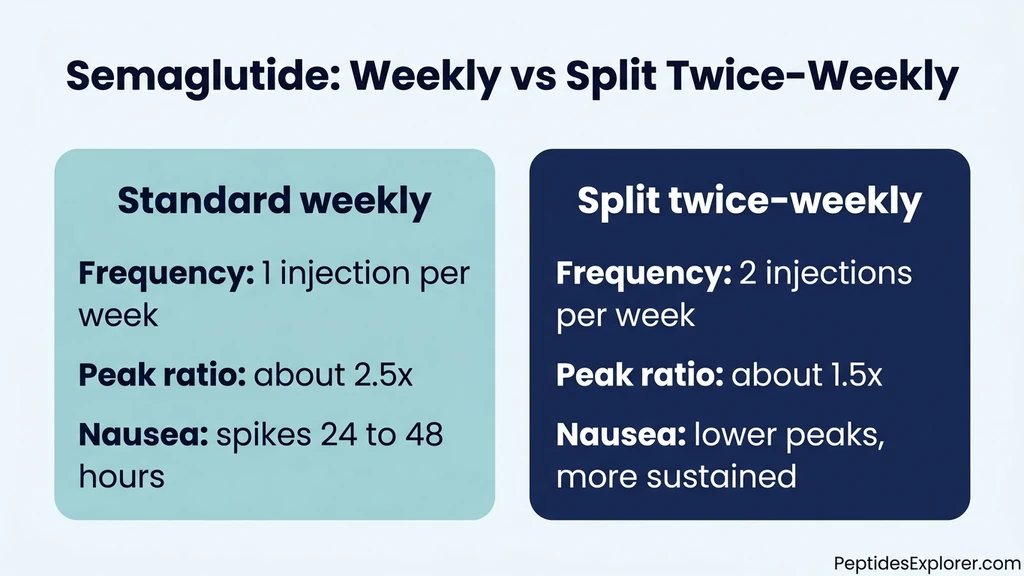
You are 8 weeks into semaglutide, the Monday shot triggers 2 days of nausea, and you are wondering if splitting the dose into two smaller injections might flatten the curve. The answer is pharmacokinetically yes: semaglutide's 7-day half-life technically supports twice-weekly dosing, and some compounded-peptide protocols do split the dose for exactly the side effect reason you are thinking about. But no randomized controlled trial has tested split-dose semaglutide against the standard weekly regimen, so there is no FDA-approved protocol for it. Split dosing is most defensible for people struggling with the post-injection nausea spike, and it is most risky for people using it as a justification to increase their total weekly dose. The trade-off is predictable: smoother side effects, but unproven efficacy and double the injection frequency.
| Quick Reference | Standard Weekly | Split Twice-Weekly |
|---|---|---|
| FDA approval | Yes (Ozempic, Wegovy labels) | No |
| Evidence base | Phase 3 STEP and SUSTAIN trials | Anecdotal, compounded-peptide community |
| Injection frequency | 1x per week | 2x per week (typically 3-4 days apart) |
| Peak/trough ratio | High (~2.5x) | Low (~1.5x) |
| Expected nausea pattern | Spikes 24-48h post-injection | Lower peaks, more sustained mild GI |
| Weight loss efficacy | Well-documented | Unknown (theoretically equivalent at same weekly total) |
| Cost impact | Baseline | More needles/supplies, similar drug cost |
The strongest argument for split dosing is the pharmacokinetic smoothness: two smaller injections 3 to 4 days apart produce a flatter concentration curve than one larger weekly injection. The strongest argument against is that nobody has run a trial to prove efficacy is preserved. If you are considering this protocol, talk to your provider first. For the standard weekly protocol, see semaglutide titration schedule.
This is educational content. Consult a healthcare provider before changing any medication dosing schedule.
Get your custom peptide protocol:
- Tailored to your body and goals
- Precise dosing and cycle length
- Safe stacking combinations
- Backed by peer-reviewed studies
- Ready in under 2 minutes
The Pharmacokinetic Case for Split Dosing
Semaglutide's half-life is approximately 7 days, one of the longest among GLP-1 agonists. This is specifically why the drug is approved for once-weekly dosing: with a 7-day half-life, levels at the end of one week (just before the next injection) are still approximately 50% of peak concentration.
But "approved for weekly" and "only effective weekly" are not the same thing. The same 7-day half-life that justifies weekly dosing also supports more frequent dosing with smaller per-injection amounts.
Standard weekly dosing produces: - Peak plasma concentration (Cmax) 24 to 72 hours after injection - Peak-to-trough ratio of approximately 2.5x (Cmax is ~2.5x the pre-injection level) - The peak is associated with the greatest nausea, appetite suppression, and gastric slowing - The trough is associated with milder effect and recovery time
Split twice-weekly dosing produces: - Lower Cmax at each injection (roughly half) - Smaller peak-to-trough ratio (about 1.5x) - Flatter overall concentration curve - Theoretically, the same average plasma concentration across the week as weekly dosing at the same total dose
Analogy: compare eating one 2000-calorie meal per day to three 650-calorie meals. Same daily calories, very different metabolic experience. Semaglutide's weekly spike vs a BIW (twice-weekly) flatter curve works on the same principle.
The missing trial: no published RCT has compared standard weekly to split twice-weekly at the same total weekly dose. Efficacy is assumed equivalent based on PK modeling, but has not been clinically demonstrated. For the formal pharmacokinetic profile, see how long does semaglutide stay in your system.
Who Actually Benefits From Splitting the Dose
Not everyone should split doses. The protocol has a specific use case.
Good candidates: - Patients who experience strong, predictable nausea in the 24 to 48 hours after each weekly injection - Patients whose work, family, or social schedule is disrupted by the post-injection side effect window - Patients at higher doses (1.7 mg or 2.4 mg weekly) where the peak-vs-trough gap is largest - Patients already on a compounded semaglutide product that allows flexible dosing volumes
Poor candidates: - New semaglutide users in the first 4 to 8 weeks (tolerance building happens through the weekly cycle; splitting may slow it down) - Patients at low starting doses (0.25 mg or 0.5 mg) where side effects are usually minimal and splitting adds logistics without benefit - Patients using brand-name Ozempic or Wegovy pens (pen-dispensed doses are not designed for split delivery) - Patients seeking to "save" by splitting a vial across more weeks (this usually reduces effective dose, see below)
Wrong reasons to split doses: - Thinking two smaller injections mean less total drug and fewer side effects for the same weight loss (it does not; total weekly dose drives total effect) - Using split dosing as a way to ramp to a higher total dose faster (this accelerates side effects, not tolerance) - Splitting to make a vial last longer by reducing each dose (this is under-dosing, not splitting; see the next section)
The core principle: split dosing preserves your weekly total and redistributes it into two smaller peaks. It is not a way to change your total weekly dose or accelerate titration. For titration guidance, see semaglutide titration schedule and what is microdosing tirzepatide (the concept translates to semaglutide).
How to Split Semaglutide: Practical Protocols
If you and your provider decide to run a split-dose protocol, here are the most common patterns. All assume you are on a compounded vial (not a pre-filled pen).
Pattern 1: Classic BIW (twice-weekly), 3-4 days apart
Take your total weekly dose and divide by 2. Inject half on Day 1, half on Day 4 or 5.
- Weekly 0.5 mg → 0.25 mg on Monday + 0.25 mg on Thursday
- Weekly 1.0 mg → 0.5 mg on Monday + 0.5 mg on Thursday
- Weekly 1.7 mg → 0.85 mg on Monday + 0.85 mg on Thursday
- Weekly 2.4 mg → 1.2 mg on Monday + 1.2 mg on Thursday
Pattern 2: 60/40 split (larger first dose, smaller mid-week dose)
Some people prefer loading the first injection slightly heavier. This mimics the peak of weekly dosing more closely while still smoothing the trough.
- Weekly 2.4 mg → 1.4 mg on Monday + 1.0 mg on Thursday
Pattern 3: Microdose weekend taper
A less common variant: a larger Monday dose followed by a small Friday top-up specifically to counter weekend appetite. Not supported by any data but used in some social-weight-loss communities.
- Weekly 1.0 mg → 0.75 mg on Monday + 0.25 mg on Friday
Injection logistics: - Use two separate syringes, two separate injection sites (or the same site with at least 2 inches between punctures) - Rotate sites on a 4-site grid to avoid repeat bruising: left abdomen, right abdomen, left thigh, right thigh - Keep a dosing log; split schedules are easier to lose track of than weekly - Use the semaglutide dosage calculator to verify unit counts at each dose
What NOT to do: - Split the weekly dose into 3 or 4 injections (diminishing benefit, escalating logistics) - Inject twice on the same day to "catch up" if you miss one (spread them out) - Mix two doses into one syringe as a single injection (this defeats the purpose of the split)
For reconstitution and mixing reference at the smaller volumes split dosing requires, see semaglutide mixing chart.
What the Evidence Does and Does Not Say
What is documented:
- Semaglutide's 7-day half-life supports any dosing frequency from twice-weekly to weekly at steady state (Hall et al., 2018, semaglutide PK review)
- In clinical trials (STEP-1, SUSTAIN-6, SELECT), all dosing was once-weekly
- No head-to-head trial has compared weekly vs split twice-weekly at the same total dose
- No trial has shown split dosing produces different efficacy than weekly
What is reported (anecdotally, not peer-reviewed):
- Lower peak nausea with BIW dosing
- Similar subjective appetite suppression across the week
- Subjectively smoother appetite control without the "second half of week slip" that some weekly-dose patients report
- No documented efficacy penalty
What is unknown:
- Whether BIW dosing produces identical cardiovascular outcome benefits (the SELECT trial's 20% reduction in major adverse cardiovascular events was based on weekly dosing)
- Whether BIW affects long-term weight maintenance differently than weekly
- Whether BIW changes the rate of GI side effect adaptation
The practical takeaway: split dosing is a pharmacokinetically reasonable experiment, but it is an experiment. If your provider is comfortable with it, the worst-case scenario is equivalent efficacy with smoother side effects. The best-case scenario is the same. It is unlikely to be worse than weekly dosing in terms of efficacy, but also has no evidence base showing it is better.
For context on what the evidence does support, see semaglutide before and after and not losing weight on semaglutide.
Risks and Common Mistakes With Split Dosing
Risk 1: Under-dosing through miscalculation. When you split a weekly dose into two, the easiest mistake is losing track of the total weekly amount. Always write down your weekly target first (e.g., 1.0 mg) and then divide (0.5 mg + 0.5 mg). People who split from 0.5 mg to "half each" and then mentally bump to "0.75 mg each" without recalculating end up at 1.5 mg total weekly without noticing.
Risk 2: Over-dosing by not waiting long enough between injections. Splitting into two injections 24 hours apart essentially doubles the peak without the pharmacokinetic smoothing. Keep at least 3 days between injections to let the first dose's Cmax decline before adding the second.
Risk 3: Missing a dose without knowing how to recover. If you miss the Monday injection in a BIW protocol, do you take both on Thursday? No. Take the missed Monday injection as soon as you remember (unless within 2 days of Thursday) and continue the Thursday injection at the normal time. Do not stack them.
Risk 4: Running out of drug mid-cycle. BIW injections consume vial content faster in small aliquots, and there is more risk of miscalculating how much vial you have left. Mark the vial volume each injection.
Risk 5: Using a pre-filled pen for split dosing. Brand-name Ozempic and Wegovy pens are designed for single-weekly dispensing. Splitting requires a compounded vial with bacteriostatic water reconstitution and an insulin syringe. Attempting to "split" a pen dose is error-prone and usually under-doses.
Risk 6: Assuming split dosing allows higher total weekly doses safely. It does not. Split dosing redistributes a given weekly total across two injections. It does not let you escape the total-dose ceiling that determines side effects and efficacy. For maintenance dose considerations, see tirzepatide maintenance dose after weight loss (same logic applies to semaglutide).
Frequently Asked Questions
Can I split my semaglutide dose into twice a week?
Pharmacokinetically, yes. Semaglutide's 7-day half-life supports any dosing frequency from twice-weekly to weekly. But no RCT has tested split dosing, so the protocol is not FDA-approved. The most common use case is reducing peak nausea at higher weekly doses (1.7 or 2.4 mg). Talk to your provider before changing schedules.
Does splitting semaglutide reduce side effects?
For most people with predictable post-injection nausea, yes. Splitting reduces the peak-to-trough ratio from about 2.5x to about 1.5x, which flattens the nausea spike. The total weekly nausea burden may be similar but is spread across two smaller peaks instead of one large one. See how to relieve nausea from semaglutide.
How do I split a 2.4 mg weekly dose of semaglutide?
The standard split is 1.2 mg on Monday and 1.2 mg on Thursday or Friday. Some people prefer a 60/40 split (1.4 mg + 1.0 mg) to partially mimic the standard weekly peak. Both work. Use the semaglutide dosage calculator to verify unit counts at your vial concentration.
Does splitting affect weight loss efficacy?
Likely not, based on pharmacokinetic modeling. Average plasma concentration across the week is what drives cumulative effect, and splitting preserves the weekly average. But this has not been tested in a head-to-head RCT, so the efficacy equivalence is assumed, not proven. For established efficacy data, see semaglutide before and after.
Should I split from day 1 or wait until I am at a higher dose?
Wait. At 0.25 mg or 0.5 mg weekly, side effects are usually mild and the titration is designed to build tolerance. Splitting at low doses adds injection burden without clear benefit. Consider splitting at 1.0 mg or higher if side effects are disrupting your week. See semaglutide titration schedule for the full ramp.
Can I split Ozempic or Wegovy from the pre-filled pen?
No, not practically. Pre-filled pens dispense fixed doses and are not designed for fractional delivery. Split dosing requires a compounded semaglutide vial, bacteriostatic water, and insulin syringes. If you are on a pen, discuss switching to compounded with your provider or accepting weekly dosing. See compound semaglutide with B12 for compounded product considerations.
What happens if I miss one of my twice-weekly injections?
Take the missed dose as soon as you remember, unless it is within 2 days of your next scheduled injection. In that case, skip the missed dose and take the next one as normal. Do not double up. Semaglutide's 7-day half-life means missing a single split dose has minimal impact on weekly average levels.
Is split dosing the same as microdosing semaglutide?
No. Microdosing means taking a lower total weekly dose than the standard labeled doses (e.g., 0.15 mg weekly instead of 0.25 mg). Split dosing means redistributing a standard weekly dose into two smaller injections. Some people combine both (microdose AND split), but the concepts are separate. See how to microdose semaglutide.
The Bottom Line
Splitting semaglutide into twice-weekly injections is pharmacokinetically sound. The 7-day half-life supports it, and the peak-to-trough ratio becomes flatter, which reduces the post-injection nausea spike many patients find disruptive. But no clinical trial has tested split dosing against the standard weekly protocol, so the efficacy equivalence is assumed based on PK modeling, not proven in patients.
The use case is narrow: people at higher weekly doses (1.0 mg or above) who experience strong, predictable nausea 24 to 48 hours after their weekly injection, and who want smoother appetite control through the week. It is not a way to increase your total weekly dose safely, not a way to make a vial last longer, and not usually worth the extra injections at low starting doses.
If you are considering this protocol, talk to your prescriber first. If they approve, use compounded semaglutide (pre-filled pens are not designed for split delivery), keep 3 to 4 days between injections, and maintain a dosing log. Verify unit counts with the semaglutide dosage calculator every time. Watch your total weekly dose to avoid creeping up through miscalculation.
For the standard weekly titration, see semaglutide titration schedule. For reconstitution reference, see semaglutide mixing chart. For the microdosing concept (often combined with split dosing), see how to microdose semaglutide. For side effect management, see how to relieve nausea from semaglutide.
Related Articles: - Semaglutide Titration Schedule - Semaglutide Mixing Chart - How to Microdose Semaglutide - How Long Does Semaglutide Stay in Your System - How to Relieve Nausea From Semaglutide - Not Losing Weight on Semaglutide
Helpful Tools
Related Articles
Semaglutide to Tirzepatide Switching
Switching semaglutide to tirzepatide? Clinical dose equivalence table, step-by-step protocol, titration schedule, and common mistakes to avoid.
Semaglutide Titration Schedule: 6-Month Plan
Week-by-week semaglutide titration from 0.25 to 2.4 mg. Based on STEP trial data. When to extend, down-titrate, or restart after missing doses.
Semaglutide Results: Week-by-Week Timeline
Semaglutide results week by week from STEP-1 data: weeks 1-4 (titration), 5-12 (early loss), 13-28 (steady), 29-68 (maximum loss).
What Color Is Semaglutide? Clear vs Cloudy
What color is semaglutide? Properly reconstituted is clear. Yellow tint is fine, red means added B12, cloudy means discard. Safe-use rules.