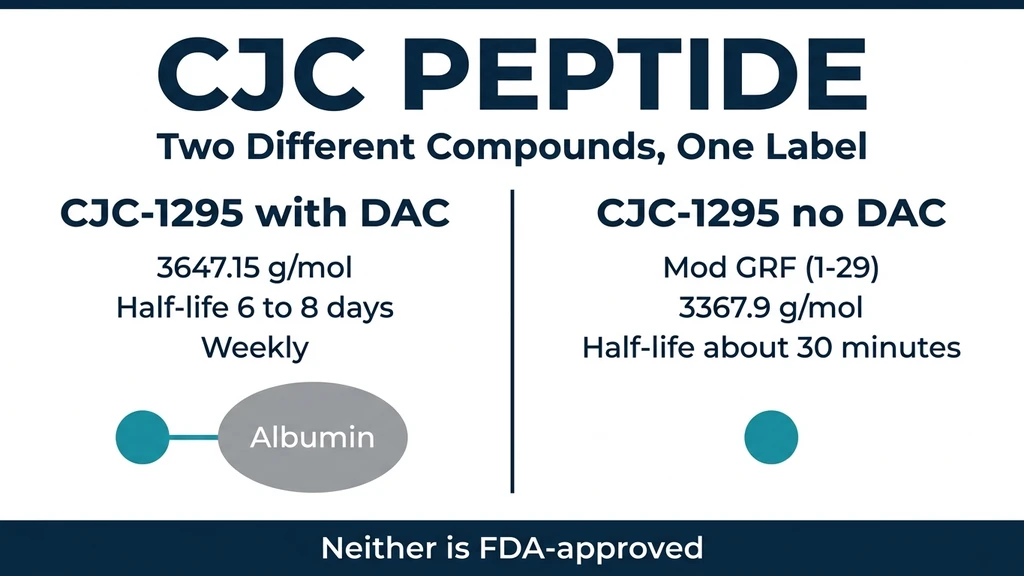
You are holding a vial labelled CJC-1295. Nothing on it says whether there is DAC inside, and the two products sold under that name are dosed twenty-fold apart. CJC-1295 with DAC binds albumin, lasts 6 to 8 days, and is injected once weekly at 2 mg. CJC-1295 without DAC is Mod GRF (1-29): it clears in about 30 minutes and is injected at 100 mcg, two or three times daily.
| Question | Answer |
|---|---|
| Is "CJC peptide" one compound? | No. Two, sold under one name |
| CJC-1295 with DAC | GHRH analogue bound to albumin, half-life 5.8-8.1 days |
| CJC-1295 without DAC | Chemically Mod GRF (1-29), half-life ~30 minutes |
| Receptor for both | GHRH receptor on pituitary somatotrophs |
| Ipamorelin | Different class: ghrelin receptor (GHS-R1a) |
| FDA approval | None, for either version |
| Typical DAC dose | 2 mg once weekly |
| Typical no-DAC dose | 100 mcg, 2-3x daily |
The name is the problem. Vendors print "CJC-1295" on both vials, and the buyer who follows a protocol written for the wrong one either accumulates a week of unclearable peptide or wastes a cycle on nothing. Sort out which molecule you own before you touch bacteriostatic water.
Deep protocol detail lives elsewhere on this site. For numbers, see the CJC-1295 dosage guide. For the full head-to-head, see CJC-1295 DAC vs no DAC. This page is the map.
Get your custom peptide protocol:
- Tailored to your body and goals
- Precise dosing and cycle length
- Safe stacking combinations
- Backed by peer-reviewed studies
- Ready in under 2 minutes
Two Molecules, One Name
Both versions start from the same 29-amino-acid fragment of growth hormone-releasing hormone, carrying four amino acid substitutions that block the DPP-IV enzyme from chewing it apart in the bloodstream. That shared backbone is why they share a name.
The DAC version adds one thing: a Drug Affinity Complex, a maleimidopropionyl group hung off a C-terminal lysine (Jetté et al., Endocrinology, 2005). Once injected, that group latches onto a free thiol on serum albumin and stays there.
Picture a dog and a long leash staked into the ground. Without the leash, the peptide wanders off within half an hour: filtered, degraded, gone. The DAC is the leash, and albumin is the stake. The peptide cannot leave circulation, so it keeps signalling the pituitary for days. Literally: the DAC group forms a covalent bond with albumin, the most abundant protein in plasma, and the peptide's measured half-life stretches to 5.8-8.1 days (Teichman et al., J Clin Endocrinol Metab, 2006).
Strip the DAC off and you have Mod GRF (1-29), also written Modified GRF 1-29 or "CJC-1295 no DAC." Same four substitutions, no tether, roughly 30 minutes of activity. The molecular weights differ accordingly: 3647.15 g/mol for the DAC version, 3367.9 g/mol for Mod GRF (1-29).
Why Vendors Call Both of Them CJC-1295
The original ConjuChem compound was the albumin-bound one. Research suppliers later began selling the unmodified tetrasubstituted fragment and marketed it under the recognisable name with a "no DAC" suffix, which some vendors print and some do not.
The practical result is that a search for "CJC peptide" returns two products with a 336-fold gap in half-life and a 20-fold gap in dose. Neither vendor is technically lying. The buyer is the one who absorbs the ambiguity.
One paragraph on which to choose, then move on. Weekly convenience and a sustained IGF-1 baseline point toward DAC. Pulse timing, an ipamorelin pairing, and a short washout if something goes wrong point toward no DAC. Once you have chosen, the version-specific protocols live in the CJC-1295 with DAC guide and the CJC-1295 no DAC guide.
What CJC Does at the Pituitary
Both versions bind the GHRH receptor on pituitary somatotrophs, the same receptor natural GHRH uses. Neither one contains growth hormone. They ask the pituitary to release its own, which is why the ceiling on the response is your own somatotroph capacity.
Sustained stimulation does not flatten your GH rhythm the way many forum posts claim. In healthy adults given CJC-1295, GH pulse frequency and amplitude were unchanged; what rose was the trough between pulses, by 7.5-fold, along with a 45% increase in IGF-1 (Ionescu & Frohman, J Clin Endocrinol Metab, 2006). The DAC version lifts the floor rather than the peaks.
Ipamorelin sits in a different pharmacological family and gets confused with CJC constantly, largely because blends are sold as a single product labelled "CJC/Ipa." Ipamorelin is a pentapeptide that activates the ghrelin receptor (GHS-R1a), and it does so selectively: at doses more than 200-fold above its GH-releasing threshold it left ACTH, cortisol, prolactin, LH, FSH and TSH untouched (Raun et al., Eur J Endocrinol, 1998).
Two receptors, two doors, one room. That is the entire rationale for the stack, and the reasons it works are laid out in CJC-1295 and ipamorelin benefits, with the trade-offs in CJC-1295 and ipamorelin side effects.
Two Ways the Name Confusion Hurts You
These are the two failures that follow directly from not knowing which vial you own. Both are common, and both are quantifiable.
Scenario 1: A DAC Product on a No-DAC Schedule
You bought CJC-1295 with DAC. Your protocol came from a bodybuilding thread describing 2 mg injections. You inject 2 mg three times a day, because that is what the no-DAC schedule looks like.
Weekly exposure: 42 mg against an intended 2 mg. Twenty-one times the dose. The half-life is the trap. With a 6 to 8 day clearance curve, almost nothing you injected on Monday has left by Sunday, so roughly three-quarters of that 42 mg is still tethered to albumin at the end of week one and it keeps climbing in week two.
Sustained supraphysiological GH shows up fast: 4 to 8 pounds of water weight, hands that go numb overnight from carpal tunnel compression, joint stiffness, headaches through the first fortnight, and a fasting glucose that drifts upward because GH opposes insulin around the clock. Stopping does not fix it quickly. Washout is 2 to 3 weeks.
The fix: DAC is dosed in milligrams, once or twice per week. A 2 mg vial is one dose, not a week of doses. Model the accumulation before you inject with the peptide half-life tracker.
Scenario 2: You Ordered CJC-1295 and Received Mod GRF (1-29)
The listing said "CJC-1295, 5 mg." You assumed DAC. You reconstitute, inject 2 mg on Sunday night, and wait for the week-long IGF-1 elevation you read about.
You got a single GH pulse lasting 2 to 3 hours. Out of a 168-hour week, the peptide was active for under 2% of it, and that pulse was 20 times the standard 100 mcg Mod GRF dose, so you paid for a flushed face and a pounding head on Sunday and nothing at all from Monday to Saturday. Six weeks in, at $40 to $70 a month plus supplies, bloodwork shows IGF-1 unchanged and you conclude the peptide does not work.
The fix: read the certificate of analysis, not the marketing label. A molecular weight near 3367.9 g/mol means Mod GRF (1-29), and Mod GRF is dosed in micrograms, two to three times daily, on an empty stomach. Vendor screening matters more here than dosing skill. See where to buy peptides in 2026.
How to Identify the CJC You Actually Hold
Nobody teaches this, so buyers guess. Four signals, in descending order of reliability.
1. The certificate of analysis. Every legitimate supplier publishes one per batch. Look for molecular weight. 3647.15 g/mol (C165H269N47O46) is CJC-1295 with DAC. 3367.9 g/mol (C152H252N44O42) is Mod GRF (1-29), the no-DAC version. If no COA exists, you do not know what you bought.
2. The label wording. "CJC-1295 DAC," "CJC-1295 with DAC," and "CJC-1295 (DAC)" mean the tethered version. "CJC-1295 no DAC," "CJC-1295 w/o DAC," "Mod GRF (1-29)," and "Modified GRF 1-29" all mean the 30-minute version. A bare "CJC-1295" with no qualifier is most often the DAC version, and betting on "most often" is how scenario 2 happens.
3. Vial size. DAC is commonly sold in 2 mg vials because 2 mg is one weekly dose. Mod GRF ships in 5 mg and 10 mg vials, because at 100 mcg per injection a 5 mg vial carries 50 doses. A 10 mg vial of "CJC-1295" is almost never DAC.
4. Price per milligram. DAC carries the extra synthesis step and prices higher per milligram. When a 5 mg "CJC-1295" vial costs less than a 2 mg one, you are looking at Mod GRF. Run the numbers with the peptide cost calculator.
Blends deserve their own warning. "CJC ipa peptide," "CJC/Ipa," and "CJC-1295 + Ipamorelin 5mg" are premixed vials, and the split is rarely printed. A 5 mg blend might be 2 mg CJC and 3 mg ipamorelin, or the reverse. Blends almost always use the no-DAC version, since the pairing depends on synchronised pulses. Ask the vendor for the ratio in writing, then dose from the CJC-1295 + Ipamorelin dosage calculator rather than the vial's total milligrams.
Once identified, reconstitution is the same procedure for both: same bacteriostatic water, same technique, different volumes. Work through the peptide reconstitution calculator, then refrigerate. Reconstituted vials of either version hold potency about 21 to 28 days at 2-8°C (how long reconstituted peptides last).
CJC in Context: Five GH Peptides Compared
Four of these five are GHRH analogues. Ipamorelin is the outlier, and the table is the fastest way to see why the stack pairs the two classes.
| Peptide | Class | Receptor | Half-life | Primary use | FDA status |
|---|---|---|---|---|---|
| CJC-1295 with DAC | GHRH analogue + albumin binder | GHRH receptor | 5.8-8.1 days | Sustained IGF-1, weekly convenience | Not approved |
| CJC-1295 no DAC (Mod GRF 1-29) | GHRH analogue | GHRH receptor | ~30 minutes | Timed GH pulses, stacking base | Not approved |
| Sermorelin | GHRH analogue (1-29, unmodified) | GHRH receptor | 10-20 minutes | GH-deficiency testing, anti-aging clinics | Formerly approved (Geref), withdrawn 2008 |
| Tesamorelin | Stabilised GHRH analogue | GHRH receptor | 26-38 minutes | HIV-associated visceral fat | Approved (Egrifta) for HIV lipodystrophy |
| Ipamorelin | Ghrelin receptor agonist (GHRP) | GHS-R1a | ~2 hours | Selective GH pulse, stack partner | Not approved |
Mod GRF (1-29) is sermorelin with four amino acids swapped for protease resistance, which is why it outlasts sermorelin by roughly a factor of two while doing the same job. The comparison is worked through in CJC-1295 vs sermorelin.
Tesamorelin is the only member with a completed approval and an indication behind it, and the only one whose fat-loss effect has been measured against placebo in a registration trial. If the visceral fat question is what brought you here, read tesamorelin vs CJC-1295 before ordering anything.
Benefits, Evidence, and Regulatory Status
The claimed benefits of the CJC peptide family follow from raising GH and IGF-1: deeper slow-wave sleep, improved body composition, faster soft-tissue recovery, better skin quality. The measured evidence is thinner than the marketing.
What human data exists: a single injection of CJC-1295 with DAC raised mean plasma GH 2- to 10-fold for 6 days or more and IGF-1 1.5- to 3-fold for 9 to 11 days, with IGF-1 staying above baseline for up to 28 days after multiple doses, and no serious adverse reactions at 30 or 60 mcg/kg (Teichman et al., J Clin Endocrinol Metab, 2006). That is a pharmacodynamic result. It shows the peptide does what it is supposed to do to a hormone level. No trial has taken it further and shown that the hormone change produces fat loss, muscle gain, or improved sleep in healthy adults.
Neither version of CJC-1295 has ever been approved by the FDA for any indication. Both CJC-1295 and ipamorelin acetate were added to Category 2 of the interim 503A bulks list in September 2023, the bin for substances FDA considers to present significant safety risks in compounding. Both were removed from Category 2 in September 2024 after their nominators withdrew the nominations, and a December 2024 FDA advisory committee voted against adding CJC-1295 to the 503A bulks list. Removal from Category 2 is not approval, and it is not permission to compound. The compound sits in regulatory limbo, sold legally only as a research chemical.
Read the FDA peptide crackdown for the current landscape and the peptide safety guide for contraindications. Active malignancy, pregnancy, pituitary disease, and diabetic retinopathy rule out GH peptides entirely.
Four Mistakes That Start With the Name
1. Reading a protocol without checking which version it describes. A "2 mg" instruction is correct for DAC and a 20-fold overdose for Mod GRF. Verify the version before you copy any number, then verify your own vial.
2. Assuming a blend is DAC. Premixed CJC/Ipa vials use the no-DAC version because the stack depends on both peptides peaking together at 15 to 30 minutes. Dosing a blend weekly gives you three hours of activity per week.
3. Treating ipamorelin as a CJC variant. It works through the ghrelin receptor rather than the GHRH receptor, and it cannot substitute for either CJC version. Adding it does not change your CJC dose. The peptide stacking guide explains what combines and what merely overlaps.
4. Buying on price without a certificate of analysis. A cheap 10 mg "CJC-1295" vial is Mod GRF (1-29) roughly every time. The COA settles it in ten seconds by molecular weight. Store whichever you get correctly from day one (how to store peptides).
CJC Peptide FAQ
Frequently Asked Questions
What is the CJC peptide?
CJC refers to two different GHRH analogues sold under the name CJC-1295. The DAC version binds albumin and lasts 5.8 to 8.1 days at 2 mg weekly. The no-DAC version is Mod GRF (1-29), lasts about 30 minutes, and is dosed at 100 mcg two to three times daily. Start with the CJC-1295 profile.
Is CJC-1295 the same as Mod GRF 1-29?
CJC-1295 without DAC is chemically identical to Mod GRF (1-29): the same 29-amino-acid GHRH fragment with four protease-resistant substitutions, molecular weight 3367.9 g/mol. CJC-1295 with DAC adds a maleimidopropionyl group that binds albumin, raising the weight to 3647.15 g/mol. Compare both in CJC-1295 DAC vs no DAC.
What are the benefits of CJC peptide?
Human data shows CJC-1295 raises GH 2- to 10-fold and IGF-1 1.5- to 3-fold (Teichman, JCEM 2006). Users report deeper sleep, better recovery, and improved body composition. No trial has confirmed those downstream outcomes in healthy adults. See CJC-1295 and ipamorelin benefits for what the stack is actually documented to do.
What is CJC ipa peptide?
It is a premixed vial of CJC-1295 (almost always the no-DAC version) and ipamorelin, sold as a single product. The ratio is often unlisted, which makes accurate dosing impossible without asking the vendor. Calculate each component separately with the CJC-1295 + Ipamorelin dosage calculator.
How do I know if my vial has DAC?
Check the certificate of analysis for molecular weight: 3647.15 g/mol means DAC, 3367.9 g/mol means no DAC. Vial size is a secondary clue, since DAC ships in 2 mg vials (one weekly dose) while Mod GRF ships in 5 mg and 10 mg vials. Vet suppliers first: see where to buy peptides in 2026.
Is CJC-1295 FDA approved?
No. Neither version has ever been approved for any indication. Both were placed in Category 2 of the interim 503A bulks list in 2023, removed in September 2024 after nomination withdrawal, and an FDA advisory committee voted against 503A inclusion in December 2024. Removal is not approval. See are peptides legal.
How is CJC peptide different from sermorelin?
Sermorelin is the unmodified GHRH(1-29) fragment with a 10 to 20 minute half-life. CJC-1295 no DAC is the same fragment with four amino acid substitutions that resist DPP-IV, roughly doubling its duration. The DAC version extends that to days. Read how long sermorelin takes to work for the practical difference.
Does CJC-1295 raise IGF-1 permanently?
No. After multiple weekly doses of the DAC version, IGF-1 stayed above baseline for up to 28 days, then returned to normal (Teichman, JCEM 2006). The no-DAC version produces IGF-1 spikes that clear within hours. Track clearance with the peptide half-life tracker and monitor bloodwork every 6 to 8 weeks.
The Bottom Line
CJC-1295 with DAC is albumin-tethered, half-life 5.8-8.1 days, dosed at 2 mg once weekly. CJC-1295 without DAC is Mod GRF (1-29), half-life about 30 minutes, dosed at 100 mcg two to three times daily. Both act on the GHRH receptor. Ipamorelin acts on the ghrelin receptor and is a different class of drug entirely.
Every serious error with this compound traces back to a label that refused to specify. Check the certificate of analysis, match the molecular weight, and only then open a protocol.
Pick your version with CJC-1295 DAC vs no DAC, then get the numbers from the CJC-1295 dosage guide. More peptide research, tools, and evidence reviews at PeptidesExplorer.
This content is educational and not medical advice. Consult a healthcare provider before starting any peptide protocol.
Helpful Tools
Related Articles
CJC-1295 DAC vs No DAC: How to Choose
CJC-1295 DAC (6-8 day half-life, weekly injection) vs no DAC/Mod GRF 1-29 (30-min half-life, 2-3x daily). Compare dosing, GH patterns, and cost.
CJC-1295 With DAC: Long-Acting GHRH Analog
CJC-1295 with DAC: 6-8 day half-life, 2-10x GH increase, 1-2 mg weekly. GH bleed effect, desensitization risk, and stacking protocols.
CJC-1295 No DAC (Mod GRF 1-29): Complete Guide
CJC-1295 without DAC (Modified GRF 1-29): pulsatile GH release, 30-minute half-life. Dosing protocols, ipamorelin stacking, and reconstitution.
CJC-1295/Ipamorelin Side Effects: Manage Them
CJC-1295/ipamorelin side effects: injection reactions 20-30%, water retention 15-25%, flushing 15-20%. DAC comparison and management.