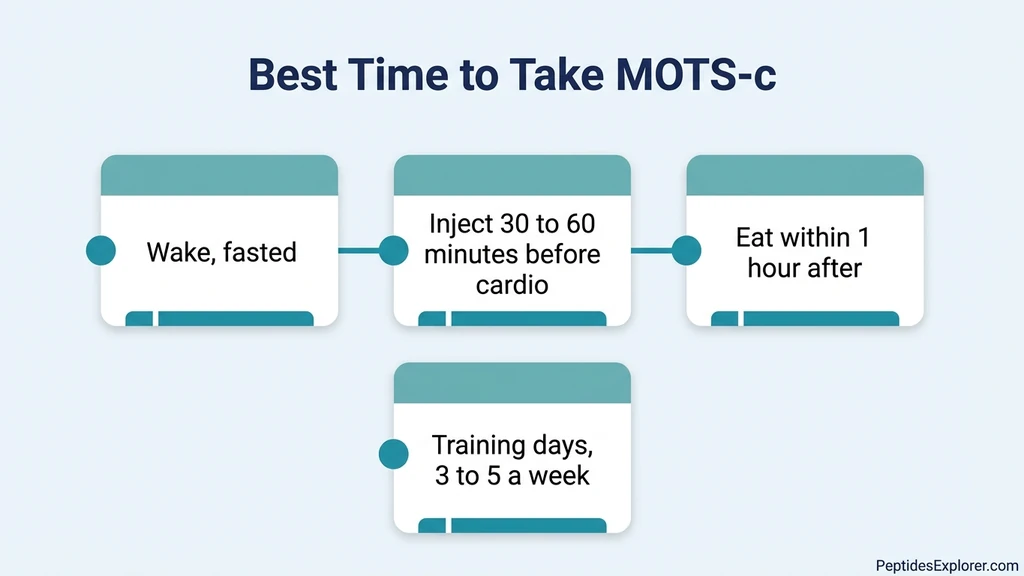
The vial is reconstituted, the syringe is drawn, and you are standing in the kitchen at 7 AM wondering whether to inject now or after breakfast. Here is the answer: the best time to take MOTS-c is in the morning, fasted, 30 to 60 minutes before cardio, on the days you train. The peptide is an exercise signal, and the signal lands hardest when it arrives with the stress it mimics.
| Timing question | Short answer |
|---|---|
| Morning or night? | Morning. Evening works if you train in the evening; a minority report restless sleep |
| Fasted or fed? | Fasted. Eat 30 to 60 minutes after the injection |
| Before or after a workout? | 30 to 60 minutes before cardio or a mixed session |
| How often? | Training days, 3 to 5 a week. Three times a week is the pattern used in the long-term mouse work |
| How long after can you eat? | Any time. Waiting 30 to 60 minutes is the common practice |
| Missed dose? | Take the next scheduled one. Never double |
No human trial has tested MOTS-c injection timing. What follows is the pharmacology of an exercise-induced mitochondrial peptide, the mouse protocols that produced the published results, and the practice that has settled in the research community. Milligram doses live in the MOTS-c dosage guide, how many weeks to run it in MOTS-c cycle length, needle placement in where to inject MOTS-c, and the results timeline in MOTS-c before and after. This page covers timing only. MOTS-c is a research compound with no FDA approval for any use.
Get your custom peptide protocol:
- Tailored to your body and goals
- Precise dosing and cycle length
- Safe stacking combinations
- Backed by peer-reviewed studies
- Ready in under 2 minutes
Why Timing Matters More for MOTS-c Than for a Weekly Peptide
Striking a match in a cold, empty room does nothing for the room. Striking it next to dry kindling starts a fire that burns long after the match is out. MOTS-c is the match. A fasted morning and a workout are the kindling.
Literally stated: MOTS-c is a 16-amino-acid peptide encoded in the mitochondrial 12S rRNA gene. It inhibits the folate cycle, which activates AMPK, and in mice it prevented age-related and diet-induced insulin resistance and diet-induced obesity (Lee et al., Cell Metab, 2015, PMID 25738459). AMPK is the same energy sensor that exercise and fasting switch on.
The natural signal is brief. In healthy young men, a single bout of exercise raised skeletal-muscle MOTS-c 11.9-fold and circulating MOTS-c about 1.5-fold, and plasma levels returned to baseline after 4 hours of rest (Reynolds et al., Nat Commun, 2021, PMID 33473109). The same paper showed MOTS-c injections improving treadmill performance in young, middle-aged and old mice.
That is the whole timing argument. A weekly GLP-1 with a 6-day half-life does not care what hour you inject; the tirzepatide timing guide explains why. MOTS-c clears from plasma within hours, so the injection has to be placed next to the state it evolved to respond to. The clearance detail is in MOTS-c half-life.
Morning, Fasted, Before Cardio: The Default Protocol
This is the schedule most people settle on, and it is the one that matches the published biology most closely.
- 1.Wake up, drink water, eat nothing. The overnight fast is free; you do not have to engineer it.
- 2.Inject subcutaneously 30 to 60 minutes before training. Abdomen or thigh, rotated; the sites and depth are in where to inject MOTS-c, and the general technique in how to inject peptides.
- 3.Train for 20 to 45 minutes. Zone 2 cardio, intervals, or a mixed session that starts with 10 minutes of cardio.
- 4.Eat within an hour of finishing. Protein and carbohydrate, a normal meal.
Why cardio rather than lifting: in a randomized human study, 45 minutes of cycling at 70% of estimated VO2max raised circulating mitochondrial-derived peptides, while a leg-press and knee-extension session did not (von Walden et al., J Appl Physiol (1985), 2021, PMID 34351816). Endurance work is the stimulus the body pairs with this peptide.
Why fasted: in cultured cells, MOTS-c moved into the nucleus under glucose restriction, in an AMPK-dependent way, and switched on antioxidant-response genes once it was there (Kim et al., Cell Metab, 2018, PMID 29983246). Low glucose is the condition that sends the peptide to the nucleus, and a fasted morning is the easiest way to be in that condition.
No study has injected MOTS-c into fed versus fasted humans. The fasted default is an extrapolation from those two findings. A fed injection still works; the signal is simply weaker, the way a match still lights damp kindling, just more slowly.
How Long After MOTS-c Can You Eat?
You can eat immediately. The dose goes under the skin, so food never touches absorption. The reason to wait is the metabolic state, and 30 to 60 minutes is the window that keeps the fasted, AMPK-on state through the peptide's first hour without turning the morning into a fast you resent.
Black coffee is fine before or after the shot. A protein shake 30 minutes after the injection is fine. What you want to avoid is a large carbohydrate meal in the 30 minutes before you inject, because that is the opposite of glucose restriction.
Scenario 1, the stacked fast. You inject at 6 AM after a 14-hour overnight fast, run 45 minutes of intervals, then skip breakfast until a noon lunch. That is 20 hours without food plus hard cardio. By 10 AM you are lightheaded and the work session is wrecked. A PubMed search for MOTS-c and hypoglycemia returns no study, and the mouse data show better insulin sensitivity rather than glucose crashes, but stacking a long fast, an insulin-sensitizing peptide and hard training is exactly where people feel faint. Fix: eat within 60 minutes of finishing the workout, every time.
Scenario 2, the dessert injection. You inject at 9:30 PM after a full dinner and a glass of wine, then lie down. Glucose is high, AMPK is off, and the peptide's plasma window closes while you sleep. Nothing dangerous happens. You simply paid for a vial dose that landed on wet kindling. The alcohol rules for the whole peptide class are in can you drink alcohol on peptides.
Morning vs Night: What Actually Changes
Evening injection is a legitimate second choice, mainly for people who train after work. The trade-offs are practical rather than pharmacological.
| Factor | Morning injection | Evening injection |
|---|---|---|
| Fasted state | Free, from the overnight fast | Needs 3 to 4 hours without food first |
| Workout pairing | Natural for morning cardio | Natural for a 5 to 7 PM session |
| Daytime energy | Users commonly report a lift through the day | Lift lands after dark |
| Sleep | No interference reported | A minority report restlessness; no study exists |
| Consistency | Easiest slot to repeat | Easiest slot to forget |
If you train at 6 PM, inject at 5 PM on an empty stomach, train, and eat dinner afterward. That keeps the fasted-plus-exercise pairing intact; it just moves it twelve hours. The energy reports are anecdotal and the mechanism is plausible, since the peptide's measured job is metabolic; the broader list of options is in peptides for energy.
What to avoid is the 10 PM injection with no training and a full stomach. It is the weakest version of the signal and the one most likely to produce the restless night that some users describe. The same morning-versus-night logic for a different daily peptide is worked through in KPV morning or night. Anything unusual after an evening dose belongs in the MOTS-c side effects guide.
How Often to Take MOTS-c: Daily, Training Days or 3 Times a Week
Frequency is a bigger decision than the clock, because the plasma signal clears in hours and the next injection is what renews it. Three patterns dominate, and each has a different amount of evidence behind it.
| Pattern | Who uses it | What supports it |
|---|---|---|
| Daily, 7 days a week | Short 2 to 4 week blocks | Mice dosed daily for 7 days to 2 weeks improved insulin sensitivity and running capacity (Lee 2015; Reynolds 2021) |
| Training days only, 3 to 5 a week | The most common pattern | The exercise-signal logic; no trial |
| 3 times a week | Longer cycles, older users | Late-life mice dosed 3 times a week gained physical capacity and healthspan (Reynolds 2021) |
| Once a week | Nobody expecting an effect | Nothing. Plasma is clear within a day |
The two mouse schedules are worth reading closely. Daily injections for 2 weeks improved treadmill performance in young mice; separately, intermittent dosing 3 times a week, started at 23.5 months of age, increased physical capacity and healthspan in old mice (Reynolds et al., Nat Commun, 2021, PMID 33473109). The long-term data come from the 3-times-a-week arm, which is why that pattern suits a 10 to 12 week run.
The body's own signal also responds to repeated training rather than a single session. A 16-week aerobic and resistance program raised fasting plasma MOTS-c in non-Hispanic White breast cancer survivors (Dieli-Conwright et al., Sci Rep, 2021, PMID 34413391). Repetition, not a single large exposure, is the model.
Which pattern you choose sets how long a vial lasts and how many weeks the cycle runs; the week counts are in MOTS-c cycle length and a printable schedule in the MOTS-c dosage protocol PDF. A daily schedule burns 84 injections over 12 weeks against 36 for 3 times a week, with no published evidence that the extra 48 buy anything.
Timing Around Fasting, Lifting and Rest Days
Intermittent fasting. On a 16:8 schedule, inject near the end of the fasting window, train, then break the fast with the first meal. Injecting at the start of the fast wastes the overlap. On extended fasts past 24 hours, skip the peptide; there is no data for that state and the lightheadedness risk from Scenario 1 climbs.
Lifting days. Inject before the session as usual, but open with 10 minutes of cardio. The acute rise in circulating mitochondrial-derived peptides was an endurance-exercise effect in humans, with resistance exercise producing no significant change (von Walden et al., J Appl Physiol (1985), 2021, PMID 34351816). The cardio warm-up supplies the stimulus the lifting alone does not. The recovery side of training is covered in peptides for recovery.
Rest days. On a training-days-only schedule, rest days are skip days. If you run the 3-times-a-week pattern on non-consecutive days, a rest-day injection should still be fasted and followed by a brisk 20-minute walk rather than nothing. The evidence that exercise training chronically changes MOTS-c levels is mixed and depends on mode, duration and intensity (Woodhead et al., Biochim Biophys Acta Gen Subj, 2021, PMID 34520826), which is one more reason to attach each dose to an actual session.
Who should expect the most from timing. Obesity, diabetes and aging are associated with lower circulating mitochondrial-derived peptides (Merry et al., Am J Physiol Endocrinol Metab, 2020, PMID 32776825). People in those groups have the lowest baseline and the largest gap for a timed signal to fill. Lean, trained athletes already produce the surge every session; the context for that group is in peptides for bodybuilding.
Missed Doses, Late Doses and Switching Your Time
The rules are simple because the peptide is short-lived. There is no reservoir to protect and no overlap to avoid.
- 1.Missed the morning dose? If you can still inject fasted before a session later that day, do it. If the day is already fed and sedentary, skip and resume tomorrow.
- 2.Never double. Two doses in one day do not compensate for yesterday. The second dose lands on the same kindling as the first.
- 3.Switching from morning to evening? Make the change on a rest day. No washout is needed, because plasma levels are back to baseline within hours; the exercise-driven surge itself was gone 4 hours after the session (Reynolds et al., Nat Commun, 2021, PMID 33473109).
- 4.Travel across time zones? Inject by local morning, fasted, and keep the training pairing. The reconstituted vial stays refrigerated between doses; the limits are in how long reconstituted peptides last and how to store peptides.
For planning the gap between doses, the peptide half-life tracker shows how fast a short half-life compound drops to nothing, and the reconstitution calculator sets the concentration so each draw is a round number of units. Mixing steps are in how to reconstitute MOTS-c.
One honesty note on the half-life itself: no human pharmacokinetic study of MOTS-c has been published. The only published pharmacokinetics for a mitochondrial-derived peptide are for humanin analogues in rodents, where the half-life varied by analogue and by species (Chin et al., Endocrinology, 2013, PMID 23836030). The "hours, not days" statement rests on the human exercise data and on the chemistry of a 16-amino-acid unmodified peptide, and the detection question for testing is in do peptides show up on drug tests.
Common Timing Mistakes
Injecting after breakfast because the morning was rushed. The dose lands on high glucose with AMPK off. Fix: inject first, then shower and dress; the 30 minutes pass on their own.
Dosing on the couch. Seven injections a week with no training is the pattern with the least support and the highest cost. Fix: cut to training days, or add a 20-minute walk to every rest-day dose.
Night dosing after dinner and wine. Fed, sedentary, and sometimes a restless night for nothing. Fix: if evenings are the only slot, move dinner after the workout and inject before it.
Doubling up after a missed day. Yesterday's kindling is gone. Fix: one dose per day, and the frequency table above decides which days.
Frequently Asked Questions
What is the best time of day to take MOTS-c?
Morning, fasted, 30 to 60 minutes before cardio. Exercise raised muscle MOTS-c 11.9-fold and plasma levels about 1.5-fold in humans, and the surge cleared within 4 hours (PMID 33473109), so the injection works best placed next to the training it mimics. The pharmacology is in the MOTS-c profile.
Should you take MOTS-c in the morning or at night?
Morning for most people, because the overnight fast is free and the energy lift lands in daylight. Night works if you train at 5 to 7 PM: inject on an empty stomach, train, then eat. No study has compared the two. Anything odd after an evening dose belongs in MOTS-c side effects.
How long after taking MOTS-c can you eat?
Any time; the dose is subcutaneous, so food does not touch absorption. The common practice is to wait 30 to 60 minutes and train in between, keeping the low-glucose state that sent MOTS-c into the nucleus in cell studies (PMID 29983246). Eat within an hour of finishing. Injection sites are in where to inject MOTS-c.
Should MOTS-c be taken on an empty stomach?
Yes, by extrapolation. Glucose restriction is the condition under which MOTS-c moved to the nucleus and switched on antioxidant genes (PMID 29983246), and a fasted morning is the easiest way to be in it. No human fed-versus-fasted injection study exists. A fed dose still works, only weaker. Mixing instructions are in how to reconstitute MOTS-c.
How often do you take MOTS-c?
On training days, 3 to 5 times a week, is the common pattern. The long-term mouse data used 3 injections a week started late in life and improved healthspan (PMID 33473109); daily dosing was used for 2-week blocks. Once a week does nothing, since plasma clears in hours. Week counts are in MOTS-c cycle length.
Can you take MOTS-c at night?
Yes. Inject 3 to 4 hours after your last meal and before an evening session, then eat afterward. Avoid the 10 PM fed, sedentary dose, which is the weakest version of the signal and the one linked to the restless-sleep reports. The clearance timeline is in MOTS-c half-life.
Do you take MOTS-c before or after a workout?
Before, by 30 to 60 minutes. In humans, 45 minutes of cycling at 70% of VO2max raised circulating mitochondrial-derived peptides while a resistance session did not (PMID 34351816), so start lifting days with 10 minutes of cardio. Track how quickly a short half-life clears with the peptide half-life tracker.
The Bottom Line
The best time to take MOTS-c is a fasted morning, 30 to 60 minutes before cardio, on the days you train, with a meal inside the hour after you finish. Evening works for evening trainers. Frequency matters more than the clock: training days or 3 times a week, never once a week, never doubled.
The principle: MOTS-c is a brief exercise signal, cleared from plasma in hours, and it does the most when it arrives with the fasted state and the effort it evolved alongside. Timing is how you supply the kindling.
MOTS-c is a research compound with no FDA approval, and no human trial has tested its injection timing; the schedule here is built from mouse protocols and human exercise physiology. Set your concentration with the reconstitution calculator, check the dose in the MOTS-c dosage guide, and find the rest of the cluster at PeptidesExplorer. Educational content, not medical advice.
Helpful Tools
Related Articles
Best Time to Take Retatrutide: Morning or Night?
Best time to take retatrutide: any hour, same weekday. Evening blunts nausea, morning suits diarrhea. Missed-dose rule, day switching, food, travel, alcohol.
MOTS-c Half-Life: How Long It Stays in Your System
MOTS-c half-life: no human PK study exists. Exercise-raised plasma MOTS-c clears within 4 hours, yet gene effects last days. Washout, detectability, drug tests.
MOTS-c Dosage: Protocols & Timing
Complete MOTS-c dosage guide: 5-10mg/week protocols, reconstitution steps, week-by-week results timeline, side effects, and stacking options backed by research.
SLU-PP-332: Dose, Evidence, and Why It Is Not a Peptide
SLU-PP-332 is a small-molecule pan-ERR agonist, not a peptide, with zero human trials. What the mouse data shows, what vendors claim, and the dose math.