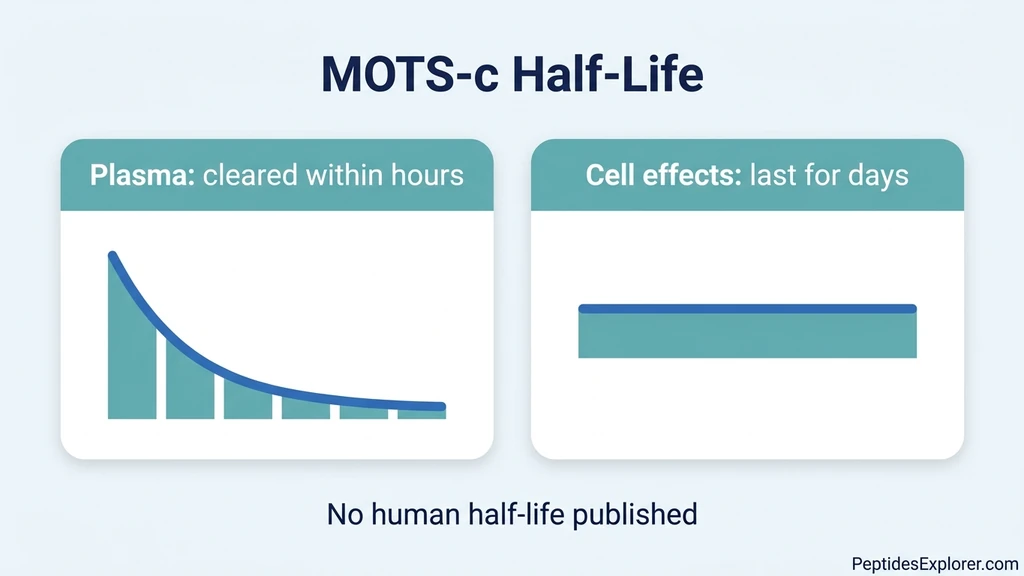
You injected MOTS-c this morning, the vial is back in the fridge, and you want to know whether anything is still working by dinner. Here is the honest answer: no peer-reviewed study has measured the plasma half-life of injected MOTS-c in humans. The best human data show that exercise-raised plasma MOTS-c returns to baseline within 4 hours, so the peptide itself is likely gone from blood in hours, while the gene-expression program it switches on runs for days.
| Question | What the evidence says |
|---|---|
| Measured human half-life? | None published. The 2 to 4 hour figure quoted online is an extrapolation |
| Closest human signal | Plasma MOTS-c back to baseline 4 hours after exercise (Reynolds 2021) |
| Closest analogue PK | CB4211, a MOTS-c analogue, dosed once daily in a phase 1a/1b trial |
| Plasma washout after a dose | Expect under 24 hours |
| Cellular effects | Nuclear gene regulation, measurable over days (Kim 2018) |
| Standard drug panels | Do not test for it |
| Anti-doping LC/MS assay | Exists, detects down to 100 pg/mL (Knoop 2019) |
This page covers pharmacokinetics only: what is known, what is extrapolated, and what it means for frequency and washout. How much to inject lives in the MOTS-c dosage guide, how many weeks to run it in the MOTS-c cycle length guide, and what people report in MOTS-c before and after. The compound profile is at MOTS-c.
Get your custom peptide protocol:
- Tailored to your body and goals
- Precise dosing and cycle length
- Safe stacking combinations
- Backed by peer-reviewed studies
- Ready in under 2 minutes
What Is Actually Published About MOTS-c Half-Life
MOTS-c is a 16-amino-acid peptide encoded inside the mitochondrial 12S rRNA gene. The discovery paper established its target as skeletal muscle and its mechanism as folate-cycle inhibition leading to AMPK activation, and it detected the peptide in both human and rodent plasma (Lee et al., Cell Metab, 2015, PMID 25738459). It reported no half-life, no clearance rate, and no plasma curve after injection.
That gap has never been filled. A PubMed search for MOTS-c combined with pharmacokinetics or half-life returns zero studies as of October 2026. Every half-life number you see on vendor pages and forums, including the 2 to 4 hours this site has used as a working figure, is an inference from peptide size and from related molecules.
| Evidence type | What was measured | What it tells you |
|---|---|---|
| Human, endogenous | Plasma MOTS-c rose 1.6-fold during exercise and 1.5-fold after, then returned to baseline after 4 hours of rest | Circulating MOTS-c clears on an hours scale |
| Human, endogenous | Endurance cycling raised plasma humanin significantly; MOTS-c showed only a trend, sampled at 30 min and 3 h | The rise is modest and short |
| Mouse, injected | Daily or 3x/week intraperitoneal injections produced effects measured after days to weeks | Effects outlast the dose, but no blood curve was drawn |
| Human, analogue | CB4211 given subcutaneously once daily for 4 weeks | A once-daily schedule was judged adequate for a modified version |
The human numbers come from a 2021 study in which young men exercised on a bike while blood and muscle were sampled. Plasma MOTS-c returned to baseline after 4 hours of rest, while skeletal muscle MOTS-c rose 11.9-fold and stayed elevated at that same 4-hour mark (Reynolds et al., Nat Commun, 2021, PMID 33473109). A separate Swedish trial sampled 30 minutes and 3 hours after endurance or resistance exercise and found that plasma humanin rose significantly while MOTS-c only trended upward (von Walden et al., J Appl Physiol (1985), 2021, PMID 34351816).
Those are measurements of the body's own MOTS-c, released and cleared under its own rules. They are the closest thing to a human half-life that exists, and they say the same thing a 16-residue linear peptide with no protective modification would be expected to say: blood levels fall within hours.
CB4211: The Closest Human Pharmacokinetic Data
The only MOTS-c molecule to go through formal human pharmacokinetics is CB4211, an analogue developed by CohBar. Its phase 1a stage in healthy volunteers was designed to assess safety, tolerability and pharmacokinetics; the phase 1b stage gave 25 mg subcutaneously once daily for 4 weeks to 23 obese subjects with fatty liver. The company reported ALT 25% lower and AST 17% lower than placebo at day 28, with a non-significant trend toward lower body weight (CohBar topline press release, August 2021).
Two caveats keep this from answering your question. The half-life itself was never published in a peer-reviewed journal; the press release and investor deck report biomarkers, not a plasma curve. And CB4211 was engineered specifically to last longer than native MOTS-c, so whatever its half-life is, the unmodified peptide in your vial is shorter.
What the trial does establish is a design decision made by people who had the PK data in hand: once daily was enough for a stabilized analogue. For native MOTS-c, that is the ceiling on how slowly anyone with real data thought it needed to be given, and the floor is unknown.
Why a Short Plasma Half-Life Does Not Mean Short Action
Think of a software update. The download takes a few minutes, and once it finishes the installer is gone from memory. The new behaviour, though, runs every day until the next update. MOTS-c is the installer. The changed gene expression inside the muscle cell is the new behaviour.
Literally stated: under metabolic stress such as glucose restriction, MOTS-c moves into the cell nucleus in an AMPK-dependent manner and regulates a broad set of nuclear genes, including antioxidant-response genes controlled through the transcription factor NRF2 (Kim et al., Cell Metab, 2018, PMID 29983246). A peptide that has entered the nucleus and altered transcription has left the bloodstream behind. Its clearance from plasma no longer limits what it does.
The time course of the animal work confirms the lag. In the discovery study, mice injected daily showed lower blood glucose after 4 days, improved glucose tolerance after 7 days, and AMPK activation in muscle after 8 weeks on a high-fat diet (Lee et al., Cell Metab, 2015, PMID 25738459). In cultured cells the same paper saw metabolic enzyme changes after 72 hours of exposure. None of these readouts tracks the hours-scale presence of peptide in blood.
Cell entry is quick, which is the other half of the picture. MOTS-c can enter cells within 30 minutes of exposure, and uptake appears tightly regulated by cellular context (Reynolds et al., Nat Commun, 2021, PMID 33473109). A short plasma window matters less when the peptide leaves plasma for tissue that fast. The same logic explains why PT-141 outlasts its 2.7-hour half-life: the drug is the trigger, and the cell supplies the duration.
What This Means for Injection Frequency and Timing
Two dosing frequencies have animal evidence behind them, and both produced results. The discovery study injected mice daily for 7 days and for 8 weeks (Lee et al., Cell Metab, 2015, PMID 25738459). The 2021 aging study ran daily injections for 2 weeks before treadmill tests, then switched late-life mice to an intermittent schedule of three injections per week, and old mice on that regimen ran 2-fold longer and 2.16-fold farther than untreated controls (Reynolds et al., Nat Commun, 2021, PMID 33473109).
Nothing in the pharmacokinetics argues for more than one injection per day. If native MOTS-c clears in hours, a second daily shot restores plasma levels, but the readouts that matter are transcriptional and move over days. The only human schedule with PK behind it, CB4211's, was once daily. Splitting the day into multiple injections has no study behind it in any species.
Timing within the day is a different question, and the pharmacology gives a hypothesis rather than a rule. MOTS-c's nuclear translocation is triggered by metabolic stress, and exercise is the stimulus that raises the endogenous peptide in humans (Kim et al., Cell Metab, 2018, PMID 29983246). Pairing the injection with a fasted window or a training session mimics the condition under which the peptide is naturally deployed. No trial has tested that pairing against an unpaired injection, so treat it as a reasonable guess, not a finding.
Site choice does not change clearance. Subcutaneous absorption from abdomen or thigh is covered in where to inject MOTS-c, and the solution's own shelf life, which has nothing to do with half-life in the body, is in how to reconstitute MOTS-c. The Peptide Half-Life Tracker lets you model the plasma curve under any half-life assumption you choose.
Washout and Detectability After You Stop
Washout runs on two clocks. Plasma empties fast. Cellular effects fade slowly. Both matter when you stop, and they answer different questions.
| Clock | Assumption | Time to reach about 3% of peak |
|---|---|---|
| Plasma, short estimate | 30-minute half-life (humanin analogue in mice) | About 2.5 hours |
| Plasma, long estimate | 4-hour half-life (the common online figure) | About 20 hours |
| Cellular gene effects | No half-life applies | Days, declining with normal protein turnover |
| Endogenous production | Continues regardless | Never zero; your mitochondria make it |
Five half-lives clear about 97% of any compound. Under the longest plausible plasma half-life for native MOTS-c, that is under a day. Under the shortest, it is an afternoon. Either way, the morning after your last injection, what remains in your blood is your own MOTS-c, which healthy people carry at baseline and which exercise and fasting move up and down (Lee et al., Cell Metab, 2015, PMID 25738459).
Detectability is where the endogenous background cuts both ways. Synthetic MOTS-c has the same 16-residue sequence as the human peptide, so a lab cannot tell them apart by sequence alone. The anti-doping laboratory in Cologne built an LC/MS assay for MOTS-c in plasma that detects down to 100 pg/mL and also tracks four metabolites and two oxidation products, which extends traceability beyond the parent peptide (Knoop et al., Rapid Commun Mass Spectrom, 2019, PMID 30394592). The same paper found that a commercial ELISA reported endogenous levels of 45.9 to 218.5 ng/mL in 20 healthy subjects that the mass spectrometry method could not confirm, a reminder that MOTS-c blood tests sold to consumers are measuring something uncertain.
No study has published a detection window for injected MOTS-c, so any number you read is invented. A conservative reading of the assay paper: a sample drawn within the first day after an injection could show a parent-peptide spike above endogenous range, and metabolites may linger somewhat longer. Side effects, by contrast, resolve on the fast clock; the timeline is in MOTS-c side effects.
MOTS-c vs Other Mitochondrial Peptides: Half-Life Table
MOTS-c sits in a family of short peptides that act on mitochondria or mimic exercise. None of them is long-lived in blood, and the one with full human data clears in hours.
| Peptide | Length | Measured half-life | Species and route | Source |
|---|---|---|---|---|
| MOTS-c | 16 aa | Not measured; endogenous rise clears within 4 h | Human, endogenous | Reynolds 2021, PMID 33473109 |
| Humanin analogue (HNG) | 24 aa | About 30 minutes in mice; over 4 hours in rats | Rodent, intraperitoneal | Chin 2013, PMID 23836030 |
| Elamipretide (SS-31) | 4 aa | Approximately 3 to 4 hours, no accumulation at steady state | Human, subcutaneous, once daily | FDA briefing document, 2024 |
| Retatrutide (for scale) | 39 aa, lipidated | Approximately 6 days | Human, subcutaneous, once weekly | Urva 2022, PMID 36354040 |
The humanin row shows how much species matters. The same analogue, same route, cleared in about 30 minutes in wild-type mice yet persisted beyond 4 hours in rats, with peak plasma levels at 10 minutes in mice and 4 hours in rats (Chin et al., Endocrinology, 2013, PMID 23836030). Any MOTS-c half-life borrowed from a mouse would carry the same uncertainty into a human.
The retatrutide row is the contrast. A retatrutide molecule carries a fatty-acid chain that binds albumin and stretches its half-life to about 6 days, which is why its injection timing barely matters. Native MOTS-c has no such modification. Elamipretide, the closest mitochondrial peptide with an FDA label, is given once daily on a 3 to 4 hour half-life, a schedule that mirrors what the CB4211 trial chose. More on the two cousins is in the humanin guide and the SS-31 guide.
Drug Tests: Panels, WADA, and the Honest Answer
Workplace panels screen for drug classes such as amphetamines, opioids, cannabinoids and benzodiazepines. MOTS-c belongs to none of them, and no standard 5-, 10- or 12-panel urine screen includes a peptide assay. The general rules are in do peptides show up on drug tests.
Sport is different. The Cologne assay was built explicitly for sports drug testing because MOTS-c activates AMPK, the same pathway behind listed metabolic modulators (Knoop et al., Rapid Commun Mass Spectrom, 2019, PMID 30394592). If you are tested under WADA or USADA rules, assume MOTS-c is a prohibited substance by class and that a validated method exists to find it. A short plasma half-life shortens the window, but no one has published how short, and metabolite tracking extends it.
Common Half-Life Mistakes
Injecting three times a day to "keep levels up." Three shots triple the weekly peptide load against a schedule no study has used in any species. The readouts that matter moved over 7 days and 8 weeks in mice on one injection a day (Lee et al., Cell Metab, 2015, PMID 25738459). Fix: one injection a day at most, and let the cellular clock, not the plasma clock, judge the result.
Judging it at day 3 because "it clears in 4 hours." A short half-life tempts people to expect a same-day signal. The earliest glucose change in mice came at day 4 and glucose tolerance improved at day 7, and the muscle AMPK change took 8 weeks. Fix: evaluate on the cellular timescale.
Stopping 24 hours before a sport test and assuming a clean sample. Plasma may well be back to baseline, but the LC/MS method tracks four metabolites and two oxidation products in addition to the parent peptide, and no published detection window exists. Fix: if you are in a tested population, treat MOTS-c as detectable for an unknown period and do not use it.
Confusing vial shelf life with body half-life. A reconstituted vial lasting 28 days in the fridge says nothing about how long a dose lasts in you. The two numbers come from different chemistry; see how long reconstituted peptides last.
Frequently Asked Questions
What is the half-life of MOTS-c?
No peer-reviewed study has measured it in humans or animals after injection. The commonly quoted 2 to 4 hours is an extrapolation from peptide size and related molecules. The closest human data show exercise-raised plasma MOTS-c returning to baseline within 4 hours (PMID 33473109). The MOTS-c profile covers the compound itself.
How long does MOTS-c stay in your system?
In blood, likely under 24 hours: five half-lives at a 4-hour estimate is 20 hours, and at 30 minutes it is 2.5 hours. In cells, gene-expression changes driven by nuclear translocation (PMID 29983246) persist for days. Model any assumption with the Peptide Half-Life Tracker.
Why does MOTS-c keep working after it leaves the blood?
Because it changes transcription. Under metabolic stress MOTS-c enters the nucleus in an AMPK-dependent manner and regulates antioxidant-response genes through NRF2 (PMID 29983246). In mice, glucose tolerance improved at day 7 and muscle AMPK activation appeared at 8 weeks (PMID 25738459). The effect timeline is in MOTS-c before and after.
Does the short half-life mean I should inject MOTS-c more than once a day?
No study supports it. Mouse work used one injection daily or three per week, and the three-per-week late-life regimen still made old mice run 2.16-fold farther (PMID 33473109). The only human analogue trial, CB4211, was once daily. Site and technique questions are in where to inject MOTS-c.
Can a drug test detect MOTS-c?
Standard workplace panels do not test for it. Anti-doping labs can: a validated LC/MS assay detects MOTS-c in plasma at 100 pg/mL and tracks four metabolites and two oxidation products (PMID 30394592). No detection window has been published. The general rules are in do peptides show up on drug tests.
What is the half-life of CB4211 compared to MOTS-c?
CB4211 is a MOTS-c analogue engineered for longer exposure and was dosed 25 mg subcutaneously once daily for 4 weeks in its phase 1b trial, with ALT 25% below placebo at day 28. Its half-life was never published in a journal. Native MOTS-c, unmodified, clears faster. Compare the structure in the humanin guide, its mitochondrial cousin.
How does MOTS-c half-life compare to other peptides?
A humanin analogue cleared in about 30 minutes in mice but over 4 hours in rats (PMID 23836030); elamipretide clears in 3 to 4 hours in humans and is dosed once daily; retatrutide lasts about 6 days (PMID 36354040). MOTS-c, unmeasured, almost certainly sits at the hours end. The SS-31 guide covers the elamipretide comparison.
The Bottom Line
The MOTS-c half-life has never been measured in a published study. Exercise-raised plasma MOTS-c clears within 4 hours in humans, the only stabilized analogue with real PK was dosed once daily, and the gene-expression program the peptide starts inside muscle cells runs on a clock of days, not hours.
The principle: with MOTS-c, the plasma curve tells you when the peptide left, and the cell tells you when the effect ends. Plan frequency around the second clock, expect washout of the peptide itself within a day, and assume anti-doping labs can find it for longer than that.
MOTS-c is a research compound with no FDA approval for any use. Model your own assumptions in the Peptide Half-Life Tracker and find the rest of the MOTS-c cluster at PeptidesExplorer. Educational content, not medical advice.
Helpful Tools
Related Articles
How Long Does Retatrutide Stay in Your System?
Retatrutide stays in your system about 30 days after the last dose (6-day half-life): 45% left at day 7, 3% at day 30. Washout table, switching and surgery.
Best Time to Take MOTS-c: Morning, Fasted or Night?
Best time to take MOTS-c: morning, fasted, 30 to 60 minutes before cardio. The eating window after the shot, daily vs 3x a week, night dosing, missed doses.
How Long Does KPV Take to Work? Timeline
How long does KPV take to work: gut symptoms in 1 to 2 weeks, skin in 2 to 4, systemic inflammation in 2 to 6. Half-life, onset by route, and when to stop.
Humanin Peptide: Benefits, Dosing, Safety
Humanin is a 24-amino-acid mitochondrial peptide studied for neuroprotection since 2001. What the research shows, reported protocols, and the safety gaps.