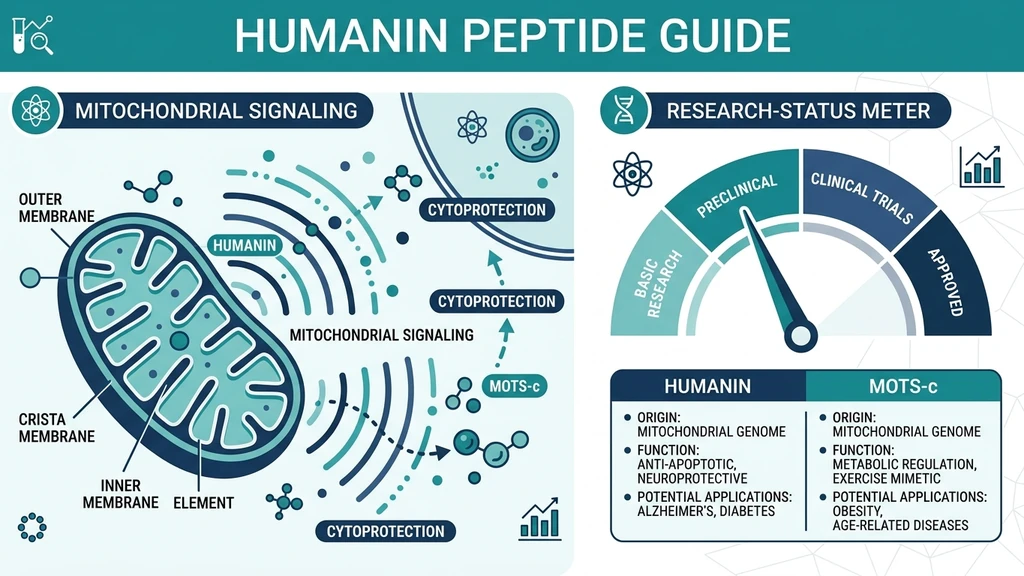
You keep seeing humanin next to MOTS-c in longevity threads and want to know if it deserves a spot in the same conversation. Here is the direct answer: humanin is a 24-amino-acid peptide encoded inside the mitochondrial genome, shown to protect neurons and heart cells in lab and animal studies since 2001, and it has no established human dose. Every protocol you see online is extrapolated from preclinical work, not trials.
| Quick facts | |
|---|---|
| Class | Mitochondrial-derived peptide (MDP) |
| Size | 24 amino acids, encoded in the 16S rRNA region of mitochondrial DNA |
| Discovered | 2001, in surviving neurons from an Alzheimer's brain |
| Research focus | Neuroprotection, cardioprotection, metabolism, aging |
| Human trials | None completed for supplementation |
| Established human dose | None |
| Legal status | Research chemical, not FDA-approved |
This page covers what humanin actually is, how it compares to MOTS-c, what the research supports, and where the safety gaps sit. It is education for evaluating a research compound, not a protocol to follow.
Get your custom peptide protocol:
- Tailored to your body and goals
- Precise dosing and cycle length
- Safe stacking combinations
- Backed by peer-reviewed studies
- Ready in under 2 minutes
What Humanin Is and Where It Comes From
Think of your mitochondria as power plants that can send radio messages. When the cell comes under stress, the plant broadcasts a short signal that tells nearby machinery to hold the line instead of self-destructing. Humanin is one of those broadcasts.
Literally stated: humanin is a micropeptide encoded within the 16S ribosomal RNA gene of mitochondrial DNA, released by cells under stress, and it inhibits apoptosis, the programmed cell-death cascade. Researchers in Japan found it in 2001 while studying why some neurons in an Alzheimer's-affected brain refused to die (Hashimoto et al., PNAS, 2001, PMID 11371646).
That origin matters for one practical reason. Humanin belongs to the same family as MOTS-c and the SHLP peptides, all encoded by mitochondrial DNA rather than the nuclear genome. Circulating levels decline with age, which is why the longevity field watches this family closely.
Most vials sold as humanin are actually HNG (S14G-humanin), a lab-modified analog roughly 1,000 times more potent in cell studies than the natural sequence (Gao et al., 2017, PMID 29043002). Check which form a listing describes before you compare any numbers.
Humanin vs MOTS-c: Same Family, Different Jobs
Both peptides come from mitochondrial DNA, and vendors often shelve them together. The research profiles are not interchangeable.
| Humanin | MOTS-c | |
|---|---|---|
| Primary research focus | Neuroprotection, anti-apoptosis | Metabolism, insulin sensitivity, exercise capacity |
| Discovery | 2001, Alzheimer's brain tissue | 2015, metabolic screening |
| Best-studied effect | Protecting neurons and cardiac cells from stress-induced death | AMPK activation, fat oxidation |
| Human supplementation data | None | Minimal, small early studies |
| Community adoption | Low, mostly longevity researchers | High, established protocols circulate |
MOTS-c is the sibling with actual usage history on this site: dosing conventions are documented in the MOTS-c dosage guide, cycle patterns in MOTS-c cycle length, and user-reported outcomes in MOTS-c before and after. Humanin has none of that accumulated practice.
If your goal is metabolic (fat loss, insulin sensitivity, endurance), the evidence weight sits with MOTS-c. Humanin's case is cellular protection, and that case is still preclinical. For mitochondrial support aimed at muscle and performance, SS-31 comes up in bodybuilding contexts with the same caveat: promising mechanism, thin human data.
What the Research Actually Shows
The honest summary: strong, consistent results in cells and rodents, and essentially nothing in supplemented humans.
The foundational work showed humanin rescuing neurons from death triggered by familial Alzheimer's genes and amyloid-beta toxicity (Hashimoto et al., 2001, PMID 11371646), with follow-up characterization across a wide range of Alzheimer's-relevant insults the same year (PMID 11717357). The potent HNG analog extended these findings to stroke-model neuroprotection and cardiac protection in animal studies (PMID 29043002).
A 2025 review of mitochondrial-derived peptides in neurodegenerative disease sums up the current position: mechanisms are increasingly mapped, therapeutic potential is real, and clinical translation has not happened (Thakur et al., Molecular Neurobiology, 2025, PMID 40715951).
What is missing is the part that matters for anyone holding a vial. No completed human trial has tested injected humanin for cognition, longevity, or anything else. No dose-ranging study exists. Observational studies correlate higher natural humanin levels with better outcomes, and correlation in blood work does not validate injection protocols.
Reported Research Protocols, and Why They Are Guesses
Animal studies dose humanin by weight, typically intraperitoneal injections in the low mg/kg range for rodents. Converting a mouse IP dose to a human subcutaneous dose involves surface-area math, absorption differences, and assumptions no one has verified. Every human number below is community practice, not evidence.
| Reported community practice | Range seen | Evidence level |
|---|---|---|
| Daily subcutaneous | 1 to 5 mg per day | Anecdote, forums |
| Cycle length | 4 to 8 weeks | Anecdote, forums |
| Form | HNG analog in most products | Vendor listings |
Run the danger math before touching any of it. A 10 mg vial reconstituted with 1 mL of bacteriostatic water yields 10 mg/mL, so 10 units on an insulin syringe delivers 1 mg. Draw 50 units because a MOTS-c habit taught you that volume, and you inject 5 mg, the top of the reported range, on day one. The fix is the same as every peptide: run the reconstitution calculator and label the vial before the first draw.
The potency trap is worse. If a product is HNG rather than natural-sequence humanin, its cell-study potency runs roughly 1,000-fold higher. Treating the two as interchangeable means your "conservative" dose can be three orders of magnitude off on activity. The general procedure for handling any lyophilized peptide is covered in how to reconstitute a peptide and how to inject peptides.
Side Effects and the Safety Gaps
No human safety database exists for humanin supplementation. That sentence is the whole side-effect profile, and it cuts both ways: no documented harms, and no documented absence of harm.
Two mechanistic flags deserve respect. First, humanin interacts with the IGF-1 axis by binding IGFBP-3, and long-term manipulation of growth-factor signaling is exactly the kind of intervention that needs trial data before chronic use. Second, an anti-apoptotic agent protects cells indiscriminately in principle; apoptosis is also how the body removes damaged and precancerous cells. Whether exogenous humanin meaningfully blunts that surveillance in humans is unknown, and unknown is the point.
Quantify the exposure gap: MOTS-c users can lean on several years of community usage and early human data, summarized in MOTS-c side effects. Humanin users have zero published human supplementation-years. Anyone injecting it is the experiment.
If you proceed anyway as a research matter, the harm-reduction basics in the peptide safety guide apply: sterile technique, single-compound introduction, conservative start, and documented response. Injection-site practice mirrors where to inject MOTS-c: rotate subcutaneous sites, abdomen or thigh.
Frequently Asked Questions
What is humanin peptide used for?
In research, humanin is studied for protecting neurons and heart cells from stress-induced death, with the first neuroprotection data published in 2001. It has no approved medical use and no completed human supplementation trials. Its better-studied mitochondrial sibling is covered in the MOTS-c dosage guide.
What is the correct humanin dosage?
No correct dose exists because no human trial has established one. Community reports mention 1 to 5 mg daily for 4 to 8 weeks, which is extrapolation from rodent studies, not evidence. If you handle any vial, verify concentration with the reconstitution calculator first.
Is humanin the same as MOTS-c?
No. Both are mitochondrial-derived peptides, but MOTS-c is 16 amino acids and studied mainly for metabolism and exercise capacity, while humanin is 24 amino acids and studied for cell protection. Their research maturity differs sharply, as detailed in MOTS-c before and after.
What is HNG or S14G-humanin?
HNG is a modified humanin analog with a serine-to-glycine swap at position 14, making it roughly 1,000 times more potent in cell studies (PMID 29043002). Most commercial vials contain HNG. That potency gap is why copying doses between products fails; see the peptide safety guide.
Does humanin extend lifespan?
Higher natural humanin levels correlate with longevity in observational studies, and centenarian offspring show elevated levels. No study has shown that injecting humanin extends life in humans. Correlation in blood work is not a supplementation result, a distinction the list of peptides applies across every longevity compound.
Are there humanin side effects?
No human safety data exists either way, which is itself the risk: zero published supplementation-years versus documented community experience with siblings like MOTS-c, covered in MOTS-c side effects. Mechanistic concerns include IGF-1 axis effects and blunted apoptosis, neither quantified in humans.
How is humanin stored and reconstituted?
Like most lyophilized peptides: refrigerate the powder, reconstitute with bacteriostatic water, and use within roughly 4 weeks refrigerated. A 10 mg vial with 1 mL of water gives 1 mg per 10 units on an insulin syringe. The full technique is in how to reconstitute a peptide.
The Bottom Line
Humanin is a 24-amino-acid mitochondrial peptide with two decades of promising cell and animal data, no human supplementation trials, and no established dose. That combination makes it a compound to watch, and a poor candidate to inject ahead of the evidence.
The principle: research maturity, not mechanism, is what separates a protocol from a gamble.
If mitochondrial peptides interest you, start with the sibling that has actual usage history in the MOTS-c dosage guide, and browse the full list of peptides at https://peptidesexplorer.com to see where each compound sits on that evidence ladder.
Helpful Tools
Related Articles
P21 Peptide: What the Research Actually Shows
P21 (P021) is a CNTF-derived peptide that boosted neurogenesis and memory in mouse Alzheimer's models. The research, reported protocols, and safety gaps.
NAD Peptide: Why NAD+ Is Not a Peptide at All
NAD+ is a coenzyme, not a peptide: formula C21H27N7O14P2, zero amino acids. What NAD injections actually deliver, what the trials measured, and real costs.
Reta Peptide: What Is It Really?
Reta peptide is slang for retatrutide, Eli Lilly's investigational triple agonist. What the name hides, why grey-market vials differ, and how to read a COA.
Where to Inject IGF-1 LR3: Sites, SubQ vs IM, Rotation
Where to inject IGF-1 LR3: abdomen, thigh or glute, subcutaneous, 29-31G needle. Why site-specific growth is a myth, a rotation map, and the hypoglycemia rule.