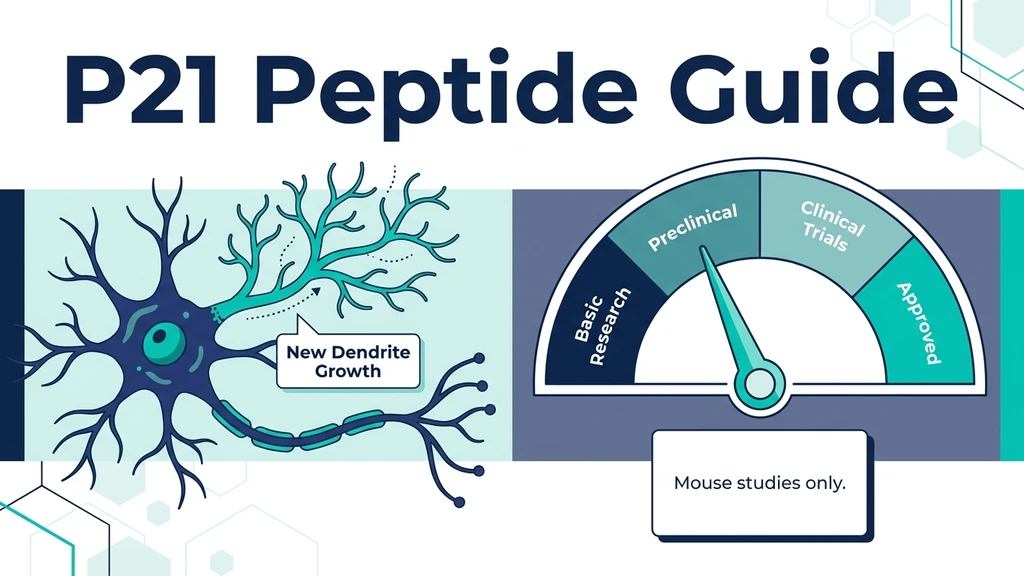
You found P21 on a research vendor's site next to a claim about growing new brain cells and want to know if any of it is real. Here is the direct answer: P21, published as P021, is a four-amino-acid fragment of ciliary neurotrophic factor (CNTF) that increased neurogenesis and rescued memory in mouse Alzheimer's models. It has never been tested in a human trial, and no human dose exists.
| Quick facts | |
|---|---|
| Class | Neurotrophic peptidergic compound, CNTF fragment derivative |
| Origin | Designed from the active region of CNTF, Iqbal lab, New York |
| Research focus | Neurogenesis, synaptic repair, Alzheimer's and cognitive aging models |
| Key property | Orally active and brain-penetrant in mice |
| Human trials | None |
| Established human dose | None |
| Legal status | Research chemical, not FDA-approved |
Every number on this page comes from animal work. Read it as a map of what P21 might become, not instructions for what to inject. For compounds with actual human dosing conventions, the peptide dosage chart covers the established library.
Get your custom peptide protocol:
- Tailored to your body and goals
- Precise dosing and cycle length
- Safe stacking combinations
- Backed by peer-reviewed studies
- Ready in under 2 minutes
What P21 Is
CNTF is a large nerve-growth protein your body already makes. It keeps neurons alive and pushes new ones to form, but as a drug it fails twice: it cannot cross the blood-brain barrier, and the immune system attacks it. P21 is the keycard trimmed down to just the chip. Researchers cut the four-amino-acid stretch that does the work, capped it with an adamantane group for stability, and got a molecule small enough to slip into the brain.
Literally stated: P021 is a tetrapeptide derived from the biologically active region of ciliary neurotrophic factor, chemically modified to resist degradation and cross the blood-brain barrier, and it is orally bioavailable in mice (Kazim and Iqbal, Molecular Neurodegeneration, 2016, PMID 27400746).
Its proposed mechanism runs through brain-derived neurotrophic factor. P021 increases BDNF expression, which activates the TrkB receptor, which in turn dials down GSK-3 beta, a kinase central to tau pathology in Alzheimer's disease. One small molecule, three linked effects: more neurogenesis, more synaptic connections, less abnormal tau.
The Mouse Evidence, Honestly Read
The P21 literature is real, peer-reviewed, and consistent. It is also entirely rodent-based. The three pillars:
| Study | Model | Result |
|---|---|---|
| Kazim et al., 2014 (PMID 25046994) | 3xTg Alzheimer's mice, chronic oral dosing | Reduced tau pathology and amyloid, rescued cognition |
| Bolognin et al., 2014 (PMID 24702821) | Aged mice | Reversed cognitive-aging deficits, restored neurogenesis markers |
| Baazaoui and Iqbal, 2017 (PMID 28655344) | Alzheimer's model mice | Prevented dendritic and synaptic deficits and cognitive impairment |
Notice what the pillars share: prevention and rescue in mice with engineered disease, dosed orally through feed for months, under controlled conditions. None of that maps cleanly onto a healthy adult self-injecting from a gray-market vial.
The translation gap is not a technicality. Compounds that cure Alzheimer's-model mice have failed human trials for thirty years running. P21 has not failed a human trial; it has never entered one. That places it earlier on the evidence ladder than every compound with human data in the list of peptides.
Reported Protocols, and What They Are Worth
Mouse studies delivered P021 orally, mixed into food at controlled concentrations for weeks to months. Human equivalents were never established, so the community filled the void.
| Reported community practice | Range seen | Evidence level |
|---|---|---|
| Subcutaneous or intranasal | 1 to 2 mg per day | Anecdote, forums |
| Cycle length | 4 to 8 weeks | Anecdote, forums |
| Stacking | Often combined with other nootropic peptides | Anecdote |
Run the math on the standard error. A 10 mg vial reconstituted with 2 mL of bacteriostatic water gives 5 mg/mL, so 1 mg is 20 units on an insulin syringe. Reconstitute with 1 mL instead, keep drawing 20 units, and every injection delivers 2 mg, double the intended dose for the entire cycle. The fix is mechanical: run the reconstitution calculator, write the concentration on the vial, and recheck before the first draw. The base technique is covered in how to reconstitute a peptide.
The second error is subtler. Oral delivery in feed and subcutaneous injection produce different absorption and different exposure curves. Community subQ protocols copy the mouse milligram scale while changing the route entirely, which means even the extrapolation is extrapolated. General injection technique lives in how to inject peptides, but no technique fixes an unvalidated route.
P21 vs Established Nootropic Peptides
If cognition is the goal, P21 competes with peptides that have human history. The comparison is lopsided.
| Peptide | Human data | Community usage history | Best coverage |
|---|---|---|---|
| P21 | None | Thin, recent | This page |
| Selank | Russian clinical use for anxiety | Extensive | Selank dosage guide |
| Semax | Russian clinical use for cognition | Extensive | Semax profile |
| DSIP | Decades of human studies, mixed results | Long | DSIP dosage |
Selank and Semax carry actual human clinical literature from Russian practice, plus years of community protocols. DSIP has decades of human research, even if results stay inconsistent. P21 offers a more exciting mechanism, neurogenesis rather than neuromodulation, backed by exactly zero human exposures in the literature.
Mechanism is the argument vendors sell. Exposure history is what keeps users out of trouble. For mood-adjacent goals there is also human-data context in peptides for depression, and the broader cognitive landscape sits in peptides for cognitive function.
Safety: What Is Known and What Is Not
Mouse studies reported chronic oral P021 as well tolerated, without the weight loss and immune reactions that killed full-length CNTF as a drug candidate. That is the entire safety record. No human pharmacokinetics, no interaction data, no long-term surveillance.
Two unknowns deserve numbers. First, BDNF-TrkB signaling is dose-sensitive in both directions; the mouse studies tuned exposure through feed concentration over months, and a self-injector has no way to replicate that curve. Second, a compound that pushes neurogenesis pushes cell proliferation in a tissue where uncontrolled proliferation is catastrophic. No study has quantified that risk for P021 because no study has looked.
Quantify your exposure honestly: choosing P21 over Selank trades roughly 20 years of documented human use for zero. That trade can be rational inside a lab. Outside one, it is a bet with no odds published. If you handle research compounds anyway, the baseline practices in the peptide safety guide are the minimum: sterile technique, one new compound at a time, conservative start, written log.
Frequently Asked Questions
What is P21 peptide?
P21, published as P021, is a four-amino-acid fragment of ciliary neurotrophic factor modified for stability and brain penetration. In mouse studies it increased neurogenesis and rescued memory deficits (PMID 25046994). It has no human trial data, unlike the established compounds in the peptide dosage chart.
What is the correct P21 dosage?
No correct dose exists because no human study has established one. Community reports mention 1 to 2 mg daily for 4 to 8 weeks, extrapolated from mouse feed dosing with a changed route. If you handle a vial, verify concentration with the reconstitution calculator before drawing anything.
Does P21 grow new brain cells?
In mice, yes: P021 restored neurogenesis markers and prevented synaptic deficits across multiple studies, including aged and Alzheimer's-model animals (PMID 24702821, PMID 28655344). No human study has tested this. The distinction between mouse rescue and human benefit is the theme of the list of peptides evidence rankings.
Is P21 better than Semax or Selank?
Better mechanism on paper, worse evidence in practice. Semax and Selank carry Russian clinical literature and roughly two decades of community use, documented in the Selank dosage guide. P21 has zero human exposures in the published literature, so risk comparison currently favors the older compounds.
Is P21 safe?
Unknown. Chronic oral dosing was well tolerated in mice, avoiding the immune reactions that ended full-length CNTF trials, but no human safety data exists at all. The proliferation question around any neurogenesis-promoting compound remains unstudied. Baseline handling rules are in the peptide safety guide.
How do you store and reconstitute P21?
Like other lyophilized peptides: refrigerated powder, bacteriostatic water for reconstitution, use within about 4 weeks refrigerated. A 10 mg vial with 2 mL gives 5 mg/mL, so 1 mg equals 20 units. Full technique with stream-aiming details is in how to reconstitute a peptide.
Why does P21 rank on soft search results?
Because the field is young: few authoritative sites cover it, and most listings repeat vendor copy. The primary literature is a handful of mouse papers from one lab group (PMID 27400746 reviews them). Cross-check any P21 claim against the studies, then against compounds with human data in peptides for cognitive function.
The Bottom Line
P21 is a genuinely interesting molecule: a brain-penetrant CNTF fragment that reversed cognitive deficits in multiple mouse models. It is also a compound with zero human trials, zero established dosing, and a community protocol built on route-swapped extrapolation.
The principle: a mechanism is a hypothesis, and only human exposure turns a hypothesis into a protocol.
If cognitive peptides are your target, start where the human data lives, with the Selank dosage guide, and browse the full list of peptides at https://peptidesexplorer.com to see where every compound sits on the evidence ladder.
Helpful Tools
Related Articles
Humanin Peptide: Benefits, Dosing, Safety
Humanin is a 24-amino-acid mitochondrial peptide studied for neuroprotection since 2001. What the research shows, reported protocols, and the safety gaps.
Reta Peptide: What Is It Really?
Reta peptide is slang for retatrutide, Eli Lilly's investigational triple agonist. What the name hides, why grey-market vials differ, and how to read a COA.
Where to Inject IGF-1 LR3: Sites, SubQ vs IM, Rotation
Where to inject IGF-1 LR3: abdomen, thigh or glute, subcutaneous, 29-31G needle. Why site-specific growth is a myth, a rotation map, and the hypoglycemia rule.
When to Take IGF-1 LR3: Best Time & Fed vs Fasted
When to take IGF-1 LR3: post-workout with carbs on training days, morning with breakfast on rest days, never fasted. Half-life, spacing from GH peptides, FAQ.