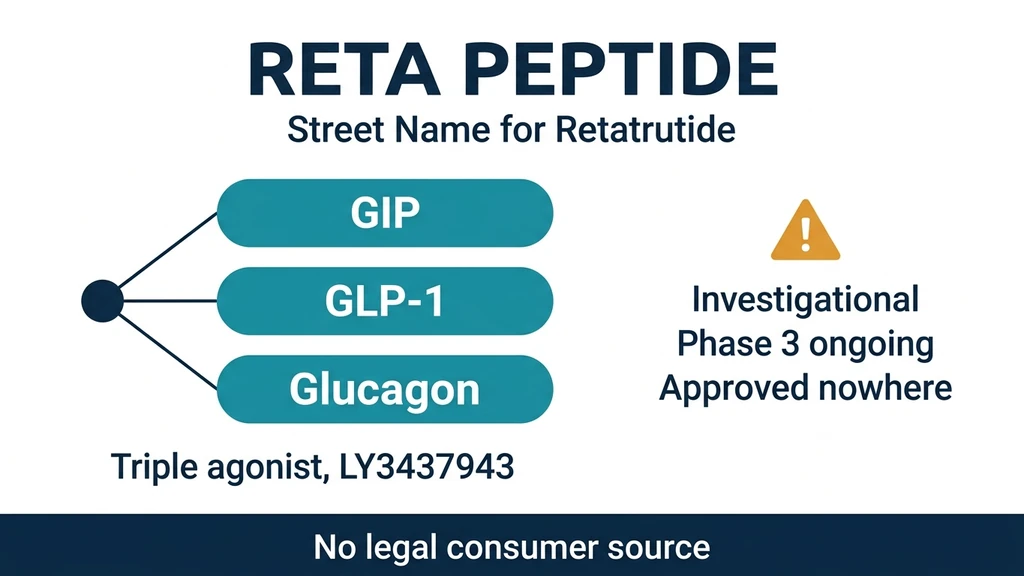
You are holding a vial stamped "Reta 10 mg," or reading a forum post from someone running "reta" at 4 mg a week. Reta is the research-chemical community's nickname for retatrutide (LY3437943), Eli Lilly's investigational triple agonist. Same molecule, informal name. It is not FDA-approved, cannot be prescribed, and cannot legally be compounded.
| Quick Reference | Answer |
|---|---|
| What is "reta peptide"? | Shorthand for retatrutide (LY3437943) |
| Developer | Eli Lilly |
| Mechanism | One peptide, three receptors: GIP, GLP-1, glucagon |
| Regulatory status (July 2026) | Investigational. Not approved in any country |
| Trial stage | Phase 3 (TRIUMPH programme) ongoing |
| Prescription available? | No |
| Compounding pharmacy version? | No. Investigational drugs are ineligible |
| How it is sold online | Labeled "research use only," not for human use |
| Molecule | 39 amino acids, roughly 4,731 Da, CAS 2381089-83-2 |
The gap between those two facts is where people get hurt. The molecule in the Phase 3 trials is sterile-filled, mass-verified, and dosed by a clinician. The molecule in a mail-order vial shares a name and, sometimes, a chemical structure. Everything else about it is unverified.
This page covers the naming, the legality, and how to tell what you actually have. For the mechanism and trial data, read the retatrutide pillar guide. For anything about doses, read the retatrutide dosage guide. Nothing here is medical advice.
Get your custom peptide protocol:
- Tailored to your body and goals
- Precise dosing and cycle length
- Safe stacking combinations
- Backed by peer-reviewed studies
- Ready in under 2 minutes
"Reta" and Retatrutide Are the Same Molecule
Retatrutide arrived with an ugly development code, LY3437943, and a five-syllable generic name. Bodybuilding forums and peptide sellers shortened it. Reta stuck.
You will meet the same molecule under at least four labels: retatrutide, LY3437943, reta, and "GLP-3 peptide." That last one is a marketing invention with no pharmacological meaning, explained in our breakdown of the GLP-3 peptide label. There is no third GLP hormone.
Two naming traps matter. A vial sold as "Cagri-Reta" is a blend, meaning it contains cagrilintide alongside retatrutide, and the milligram figure on the label may describe the total or only one component. Read what is cagrilintide before you assume the numbers refer to reta alone.
The second trap: "reta" also appears as a prefix on unrelated research chemicals with similar-looking codes. If the vendor page does not state LY3437943 or CAS 2381089-83-2 anywhere, you have no evidence the product is retatrutide at all. A brand name and a peptide identity are different claims.
One Molecule, Three Locks
Picture a hotel keycard programmed to open three doors: the lobby entrance, the gym, and the parking garage. One card, three separate locks, three different rooms behind them. The card does not become three cards. It carries the credentials for all three.
Retatrutide is a single 39-amino-acid peptide that binds and activates three distinct receptors: GIP, GLP-1, and glucagon. It was engineered from a GIP backbone with non-coded residues and a C20 fatty diacid chain that lets it ride on albumin for a long half-life (Coskun et al., Cell Metabolism, 2022, Coskun et al., Cell Metab, 2022).
Each receptor contributes something different. GLP-1 slows gastric emptying and blunts appetite. GIP modulates insulin secretion and appears to soften nausea. Glucagon raises energy expenditure and mobilises hepatic fat, which is the arm that semaglutide and tirzepatide do not touch.
The numbers followed. In a 48-week Phase 2 obesity trial of 338 adults, the 12 mg group lost about 24% of body weight against 2% on placebo (Jastreboff et al., New England Journal of Medicine, 2023, Jastreboff et al., N Engl J Med, 2023). In a Phase 2a liver trial, liver fat fell 82.4% at 12 mg over 24 weeks, and 86% of that group reached a normal liver fat content below 5% (Sanyal et al., Nature Medicine, 2024, Sanyal et al., Nat Med, 2024). A parallel Phase 2 trial in type 2 diabetes recorded HbA1c reductions up to 2.02% at 24 weeks (Rosenstock et al., Lancet, 2023, Rosenstock et al., Lancet, 2023).
Three receptors also means three sets of adverse effects, and glucagon agonism brings signals the other drugs do not have. The full catalogue lives in retatrutide side effects. The mechanistic walkthrough lives in how does retatrutide work.
Where the Grey Market Sits Legally
Retatrutide has not been approved by the FDA or any comparable regulator as of July 2026. Eli Lilly has not filed a New Drug Application. Phase 3 TRIUMPH trials are still reporting.
That status closes every legitimate route. There is no prescription. There is no compounded version, because compounding pharmacies may only work from approved drugs or from bulk substances the FDA has cleared, and an investigational molecule qualifies as neither. Clinical trial enrolment is the one lawful path, described in how to get retatrutide and dated in when will retatrutide be available.
Vendors resolve this by printing "research use only, not for human consumption" on the label and selling anyway. In September 2025 the FDA issued a wave of warning letters to sellers marketing retatrutide and other peptides under research-use labels while advertising them for weight loss in people. The disclaimer transfers risk to you. It does not create a legal supply.
We do not name, rank, or link vendors, and this page will not tell you where to buy. For the regulatory picture, read are peptides legal and the FDA peptide crackdown. For what the vials cost and why the price varies, see retatrutide cost.
Two Ways This Goes Wrong, With Numbers
Scenario one: the milligram on the label is not the milligram in the vial.
Two vials, both labeled "Retatrutide 10 mg." The first contains 10 mg of gross lyophilised cake, and the cake is peptide plus trifluoroacetate counterions plus residual water. Net peptide content: 78%, so 7.8 mg of actual retatrutide. You add 2 mL of bacteriostatic water expecting 5 mg/mL. You have 3.9 mg/mL.
You draw 40 units on a U-100 syringe, which is 0.40 mL. You believe you injected 2.0 mg. You injected 1.56 mg, 22% short. Weeks later you reorder, and the new lot runs 96% net peptide content: 9.6 mg in 2 mL, or 4.8 mg/mL. The same 40 units now delivers 1.92 mg, a 23% jump in a single injection with no change in your technique.
A 23% unplanned escalation on a triple agonist is the classic trigger for the vomiting, diarrhea, and nausea that drive people to the emergency room for dehydration. The fix: net peptide content is a line item on a real certificate of analysis. If it is absent, your concentration is a guess, and the peptide reconstitution calculator is only as accurate as the milligram figure you feed it.
Scenario two: assuming a research vial equals trial-grade drug.
Trial material is manufactured under GMP, sterile-filled, tested for bacterial endotoxin, and identity-confirmed by mass spectrometry. A grey-market vial usually ships with one number: purity by HPLC.
Endotoxin is a lipopolysaccharide shed by gram-negative bacteria. It survives autoclaving, it is invisible, and it does not show up on an HPLC purity trace. The USP limit for most parenteral drugs is 5 endotoxin units per kilogram per hour, which for a 70 kg adult is 350 EU. Cross that and you get rigors, fever, and tachycardia within one to four hours of injecting a "99% pure" solution.
The fix: sterility and endotoxin are separate assays with separate results, run under USP chapters 71 and 85. A vendor who cannot show them has not tested for them. See our peptide safety guide and where to buy peptides in 2026 for how sourcing decisions compound.
How to Read a Certificate of Analysis
A COA is a lab report about one batch of powder. Most people glance at the purity percentage and stop. That percentage is the least informative number on the page.
Step 1: Match the lot. Find the lot or batch number on the COA and compare it, character by character, to the number printed on your vial. A COA describing lot RT-2409 tells you nothing about the vial in your hand stamped RT-2512. Most vendor COAs are batch-generic and fail this test immediately.
Step 2: Read the HPLC chromatogram, not the headline. Reversed-phase HPLC separates compounds by hydrophobicity and measures them by UV absorbance, usually at 214 or 220 nm. Purity is the area of the main peak divided by the total peak area. It reports the relative abundance of UV-absorbing peptide species. It does not say what the main peak is.
Step 3: Find the mass spectrum. Identity comes from ESI-MS or MALDI-TOF. The observed mass should match the theoretical mass of retatrutide, roughly 4,731 Da, allowing for the multiply-charged ion series that ESI produces. A peptide missing one amino acid can co-elute with the parent and read 99% pure. Its mass will be off by a hundred daltons or more, and only the MS trace catches it.
Step 4: Look for what is missing. Net peptide content (by amino acid analysis or nitrogen determination), sterility, bacterial endotoxin, and residual solvent are four separate tests. If the document omits them, they were never run.
Step 5: Check the lab. An in-house COA on unbranded letterhead with no analyst name, no instrument model, and no date of analysis is a design file. A third-party report names the laboratory and the method. A scanned image with no vector text is worth suspicion.
This skill transfers to every vial you will ever handle, which is why it appears here rather than in the reconstitution walkthrough. When you do reconstitute, how to reconstitute retatrutide covers the technique, and bacteriostatic water vs sterile water explains why the diluent choice changes how long the solution lasts.
What Each Test Proves, and What It Does Not
Use this table when a vendor sends you a document and calls it proof.
| Test or document | What it establishes | What it cannot establish |
|---|---|---|
| RP-HPLC purity (%) | Relative abundance of UV-absorbing species at 214 nm | Identity, mass, sterility, endotoxin, mg content |
| ESI-MS or MALDI-TOF | Molecular mass matches retatrutide (~4,731 Da) | Purity, sterility, endotoxin, how much is in the vial |
| Amino acid analysis | Net peptide content (mg of peptide per mg of cake) | Identity of impurities, contamination |
| Sterility, USP chapter 71 | Absence of viable microorganisms in the tested sample | Endotoxin from bacteria already killed |
| Bacterial endotoxin, USP chapter 85 | Endotoxin load below a stated EU/mg limit | Identity, purity, potency |
| Residual solvent / TFA | Leftover synthesis reagents below threshold | Anything about the peptide itself |
| "Third-party tested" badge | Nothing, unless a named lab and lot appear | Everything |
| Lot number on COA vs vial | Whether the report describes your batch | Whether the report is genuine |
No single row is sufficient. Trial-grade material clears every row plus a GMP manufacturing record, and that combination is what separates the drug in the TRIUMPH programme from the powder in a padded envelope. Compare the underlying molecules in retatrutide vs tirzepatide and retatrutide vs Zepbound, where the approved comparators clear all of it by default.
Four Mistakes People Make With Reta
Mistake 1: Believing reta and retatrutide are different products. People search for "reta side effects" and skip the retatrutide literature, missing the Phase 2 and Phase 3 safety data entirely. The fix: treat the two words as synonyms and read the retatrutide side effects evidence.
Mistake 2: Trusting the milligram on the label. Gross fill weight and net peptide content differ by 4% to 25% depending on the salt form and residual water. A 78% net content vial delivers 1.56 mg where you calculated 2.0 mg. The fix: demand net peptide content, then run the numbers through the peptide unit converter.
Mistake 3: Reading 99% HPLC purity as a safety certificate. Purity is a ratio of peak areas. Endotoxin, bacterial contamination, and wrong-molecule identity all pass through a purity assay untouched. The fix: sterility and endotoxin are separate tests, and their absence is an answer.
Mistake 4: Escalating the dose because the last one felt easy. Adverse events in the Phase 2 obesity trial were dose-related, and glucagon agonism raises heart rate on top of the gastrointestinal load (Jastreboff et al., NEJM, 2023). The fix: dose is a protocol question, answered in the retatrutide dosage guide and modelled by the retatrutide dosage calculator, never by how you felt on Tuesday.
Frequently Asked Questions
Is reta peptide the same as retatrutide?
Yes. Reta is community shorthand for retatrutide, also written LY3437943, a 39-amino-acid triple agonist from Eli Lilly with a molecular weight near 4,731 Da. The nickname carries no chemical meaning of its own. Everything documented about retatrutide applies, including the mechanism explained in how does retatrutide work.
Is reta peptide FDA approved?
No. As of July 2026 retatrutide remains investigational, with Phase 3 TRIUMPH trials still reporting and no New Drug Application filed. It is approved in no country, cannot be prescribed, and cannot be compounded because compounding requires an approved drug or a cleared bulk substance. See when will retatrutide be available.
Where can I buy reta peptide?
There is no legal consumer source. Sellers label vials "research use only, not for human consumption" and the FDA issued warning letters in September 2025 to sellers advertising retatrutide for weight loss. Clinical trial enrolment is the only lawful route, covered in how to get retatrutide. We do not recommend vendors.
What are the benefits of reta peptide in trials?
In a 48-week Phase 2 trial of 338 adults with obesity, the 12 mg group lost roughly 24% of body weight versus 2% on placebo. A Phase 2a liver trial recorded an 82.4% reduction in liver fat at 12 mg over 24 weeks. Full trial data sits in the retatrutide pillar guide.
What are the side effects of reta peptide?
Gastrointestinal effects dominate: nausea, vomiting, diarrhea, and constipation, all dose-related in Phase 2. Glucagon agonism adds heart rate elevation, and Phase 3 surfaced dysesthesia. Grey-market vials add endotoxin fever and dosing error on top. The catalogue is in retatrutide side effects and retatrutide nausea.
How do I know if a reta vial contains what the label says?
You cannot know from the label. A lot-matched certificate of analysis showing mass spectrometry, HPLC purity, net peptide content, sterility, and bacterial endotoxin is the minimum evidence, and most vendor documents show only purity. Storage matters too: see how to store peptides and how long reconstituted peptides last.
Is reta stronger than tirzepatide?
In separate trials retatrutide produced larger mean weight loss than tirzepatide, driven by the third receptor arm that raises energy expenditure. No head-to-head trial has compared them directly, so the difference is cross-trial inference. The comparison is worked through in retatrutide vs tirzepatide.
Can I switch from tirzepatide to reta?
Tirzepatide is FDA-approved and prescribable; retatrutide is neither. Trading a regulated drug for an unregulated vial swaps a known concentration for an unverified one. If you are weighing the question anyway, read switching from tirzepatide to retatrutide and how to take retatrutide first.
The Bottom Line
Reta peptide is retatrutide. One name comes from Eli Lilly's clinical programme, the other from forums and vendor listings, and they describe the same 39-amino-acid triple agonist that has not been approved anywhere as of July 2026.
The molecule and the vial are separate questions. Trial retatrutide clears identity, purity, potency, sterility, and endotoxin testing under a GMP record. A mail-order vial usually clears one of those five, and the four it skips are the four that send people to the emergency room with fever or a 23% dose jump they never intended.
Learn to read a certificate of analysis, match the lot number, and treat a purity percentage as one line in a five-line document. Then go deeper: the retatrutide pillar guide for mechanism and trial data, retatrutide cost for pricing, how long does retatrutide take to work for timelines, and the retatrutide dosage calculator when a clinician has given you a number to model. Explore the full peptide library at PeptidesExplorer. This is education, not medical advice.
Related Articles
Retatrutide Cost: 2026 Price Guide
Retatrutide cost in 2026: research vial pricing, projected prescription price, per-mg breakdown, and what drives the numbers. Why no insurance covers it yet.
How to Take Retatrutide (2026)
How to take retatrutide: once-weekly subcutaneous injection, 2mg to 12mg titration over 12 weeks. Injection sites, meal timing, and storage.
GLP-3 Peptide: What It Really Is
GLP-3 does not exist. What clinics call 'GLP-3' is retatrutide (LY3437943), Eli Lilly's triple agonist targeting GLP-1, GIP, and glucagon receptors.
Retatrutide Availability & Timeline
Retatrutide is expected to receive FDA approval in mid-2027 with pharmacy availability in late 2027. Full timeline and Phase 3 trial status.