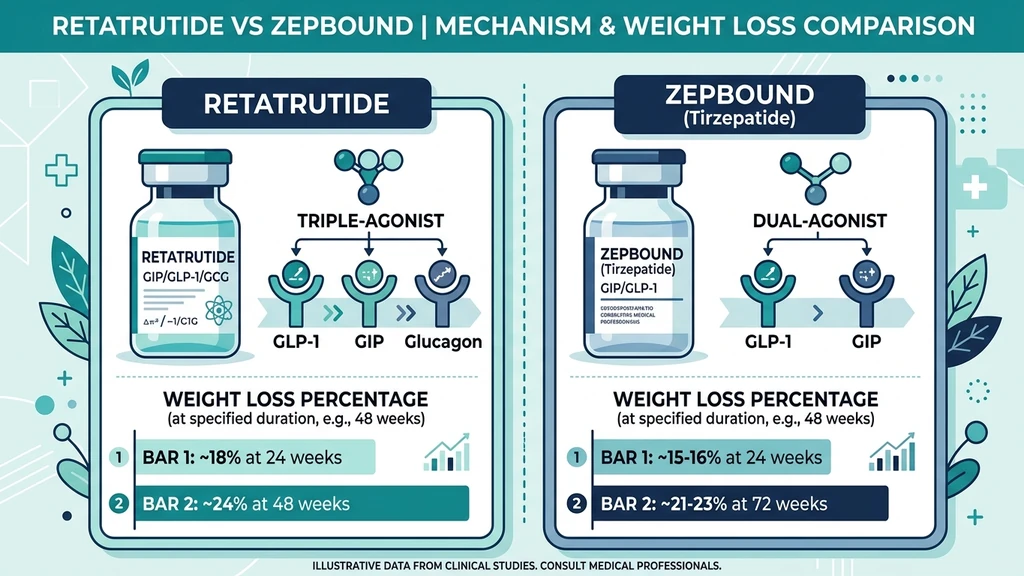
A patient reads two headlines on the same day: one drug delivered 24% weight loss in a trial, the other is sitting in a pharmacy fridge right now. The first is retatrutide. The second is Zepbound. In trials, retatrutide produced larger average weight loss (about 24.2% at 48 weeks versus roughly 20.9% for tirzepatide at 72 weeks). But Zepbound is FDA-approved and available today, while retatrutide remains investigational and is not yet on the market.
That is the core trade-off. This guide compares the two on mechanism, efficacy, approval status, cost, and side effects, then explains which one fits which situation. None of this replaces medical advice. Talk to a healthcare provider before starting or switching any prescription.
Get your custom peptide protocol:
- Tailored to your body and goals
- Precise dosing and cycle length
- Safe stacking combinations
- Backed by peer-reviewed studies
- Ready in under 2 minutes
The Verdict: Retatrutide Wins on Trial Data, Zepbound Wins on Availability
Retatrutide produced the largest average weight loss reported in a Phase 2 obesity trial to date, but it cannot be legally prescribed for weight loss as of June 2026. Zepbound (tirzepatide) has been FDA-approved since November 2023 and is the most effective weight-loss drug you can actually fill at a pharmacy.
Here is the head-to-head at a glance.
| Factor | Retatrutide | Zepbound (tirzepatide) |
|---|---|---|
| Mechanism | Triple agonist (GLP-1 + GIP + glucagon) | Dual agonist (GLP-1 + GIP) |
| Avg weight loss | ~24.2% at 48 wks (12 mg) | ~20.9% at 72 wks (15 mg) |
| FDA status | Phase 3, not approved | Approved Nov 2023 |
| Availability | Not available (trials only) | Prescription, widely available |
| Cost | No legal retail price yet | ~$1,000-$1,300/mo list; ~$349-$499 vials |
| Injection | Once weekly | Once weekly |
| Side effects | GI (nausea, diarrhea), dose-related | GI (nausea, diarrhea), dose-related |
The short answer: if you want results on paper, retatrutide leads. If you want a drug you can start this month under a doctor's supervision, Zepbound is the only one of the two that qualifies. See the full retatrutide profile for deeper background.
Mechanism: Three Hormone Targets vs Two
Retatrutide activates three receptors; Zepbound activates two. That single difference drives most of the efficacy gap between them.
Zepbound's active molecule, tirzepatide, is a dual agonist. It mimics two gut hormones, GLP-1 and GIP. GLP-1 slows stomach emptying, curbs appetite, and improves insulin response. GIP adds a second appetite and metabolic signal that appears to amplify the GLP-1 effect.
Retatrutide adds a third target: the glucagon receptor. Glucagon agonism is the new ingredient. Beyond appetite suppression, glucagon signaling raises energy expenditure and promotes fat breakdown in the liver. In effect, retatrutide tells the body to eat less (GLP-1 and GIP) while also burning more (glucagon).
That extra lever is why researchers call retatrutide a "triple G" agonist. For a full breakdown of the biology, read how retatrutide works. The mechanistic contrast with tirzepatide is covered in detail in retatrutide vs tirzepatide.
Weight Loss Efficacy: Head-to-Head Trial Data
Retatrutide produced the highest average weight loss in its Phase 2 trial, but the two drugs were tested in separate studies at different time points, so the comparison is indirect rather than a direct trial.
In the Phase 2 trial published in the New England Journal of Medicine (Jastreboff et al., 2023), 338 adults with obesity took retatrutide for 48 weeks. The highest dose, 12 mg, produced a mean weight reduction of about 24.2%. That figure is the largest reported for any obesity drug in a completed trial.
Zepbound's evidence comes from SURMOUNT-1, also published in NEJM (Jastreboff et al., 2022). Over 72 weeks, the 15 mg dose delivered a mean weight reduction of about 20.9%, and the 10 mg dose about 19.5%. Roughly 40% of participants on the 15 mg dose lost at least 25% of their body weight.
Reading the numbers carefully
The trials are not identical, so treat the gap as suggestive, not definitive.
- Different durations. Retatrutide's 24.2% came at 48 weeks; tirzepatide's 20.9% came at 72 weeks. Retatrutide's weight loss had not plateaued at 48 weeks, which hints the gap could widen with longer exposure.
- Different trial phases. Retatrutide's number is from a smaller Phase 2 study. Tirzepatide's is from a large, completed Phase 3 program. Phase 3 results sometimes regress toward more conservative figures.
- Same population. Both enrolled adults with obesity or overweight without type 2 diabetes, which makes the comparison more reasonable than most cross-trial matchups.
The honest read: retatrutide looks stronger, and the early data is genuinely impressive, but it has not finished the rigorous Phase 3 testing that tirzepatide passed. For dosing context, see the retatrutide dosage guide.
FDA Status and Availability: The Deciding Factor
Zepbound is FDA-approved; retatrutide is not. This is the single most important practical difference between them.
The FDA approved Zepbound for chronic weight management in November 2023, and later expanded it to obstructive sleep apnea in adults with obesity. It is a prescription medication, widely stocked at pharmacies, and prescribable today by any qualified provider.
Retatrutide is still in Phase 3 clinical trials under Eli Lilly's TRIUMPH program. It has not received FDA approval for any indication. That means no pharmacy can legally dispense FDA-approved retatrutide for weight loss in 2026. Analysts widely expect a potential approval window around 2026 to 2027, pending trial completion and regulatory review. For the latest timeline, see when will retatrutide be available.
Research-grade retatrutide is sold online by peptide vendors, but those products are not FDA-approved, not quality-controlled for human use, and labeled "for research use only." The realities of sourcing are covered in how to get retatrutide.
Cost and Access
Zepbound has a published price; retatrutide does not, because it is not yet sold as an approved drug.
Zepbound's list price runs roughly $1,000 to $1,300 per month without insurance. Eli Lilly's self-pay vial program (LillyDirect) offers lower single-dose vials, often in the $349 to $499 range depending on dose. Commercial insurance and manufacturer savings cards can cut out-of-pocket cost further, though many plans still restrict coverage for weight loss.
Retatrutide has no approved retail price. Once approved, pricing will likely land in the same general range as other branded GLP-1 drugs, but no official figure exists yet. Any current online price reflects unapproved research material, not a regulated medication. The retatrutide cost breakdown explains what to expect and why "cheap" research peptides carry real risk.
Side Effects Compared
Both drugs share the same dominant side effect profile: gastrointestinal, dose-related, and usually worst early in treatment.
In both trials, the most common adverse events were nausea, vomiting, diarrhea, and constipation. These tend to appear during dose escalation and fade as the body adapts. Slow titration is the standard tool for managing them with either drug.
The theoretical difference comes from retatrutide's glucagon activity. Glucagon raises blood glucose and heart rate, so trials monitored both closely. In the Phase 2 study, retatrutide produced small, dose-related increases in heart rate and transient changes in glucose metabolism that resolved over time. Tirzepatide, without glucagon agonism, does not carry that specific signal.
Neither drug is a casual purchase. Both can cause significant GI distress, both require medical supervision, and both carry class warnings, including a boxed warning for thyroid C-cell tumors based on rodent studies. A fuller list lives in retatrutide side effects.
Who Should Consider Which
Choose based on what you can access safely today, not just trial percentages.
Zepbound makes sense if you:
- Want to start treatment now under a licensed prescriber
- Value a drug with completed Phase 3 data and FDA approval
- Have insurance coverage or can use the self-pay vial program
- Prefer a known, regulated safety profile
Retatrutide may interest you if you:
- Are tracking the most aggressive weight-loss results in development
- Did not reach your goal on tirzepatide and want to know what comes next
- Are willing to wait for FDA approval rather than buy unregulated material
- Want to discuss clinical trial enrollment with your doctor
For people already on Zepbound who are curious about a future switch, the practical considerations are laid out in switching from tirzepatide to retatrutide. The decision should always run through a healthcare provider who knows your history.
Frequently Asked Questions
Is retatrutide stronger than Zepbound?
In trials, yes. Retatrutide produced about 24.2% mean weight loss at 48 weeks (Jastreboff et al., 2023), versus roughly 20.9% for tirzepatide at 72 weeks. The likely reason is retatrutide's third hormone target, glucagon, explained in how retatrutide works. But retatrutide is not yet FDA-approved.
When will retatrutide be available?
Retatrutide is in Phase 3 trials and is not FDA-approved as of June 2026. Industry analysts expect a potential approval window around 2026 to 2027, pending trial results and regulatory review. The current best estimates are tracked in when will retatrutide be available.
Can you switch from Zepbound to retatrutide?
Not through an approved prescription yet, because retatrutide is still investigational. Once approved, a managed transition would be possible under medical supervision. The expected timing, dose-matching logic, and washout considerations are covered in switching from tirzepatide to retatrutide. Always involve your prescriber.
What is the cost difference between retatrutide and Zepbound?
Zepbound lists at roughly $1,000 to $1,300 monthly, with self-pay vials often $349 to $499. Retatrutide has no approved retail price because it is not yet marketed, so any online price reflects unregulated research material. Details are in the retatrutide cost guide.
Are retatrutide's side effects worse than Zepbound's?
Both share GI side effects like nausea, vomiting, and diarrhea that ease over time. Retatrutide's glucagon activity adds small, dose-related increases in heart rate and glucose seen in trials. The full profile is in retatrutide side effects. Either drug needs medical supervision and slow titration.
How are retatrutide and tirzepatide different?
Tirzepatide (Zepbound's active drug) is a dual agonist targeting GLP-1 and GIP. Retatrutide is a triple agonist that adds glucagon, which raises energy expenditure. That third target appears to drive its larger trial weight loss. The mechanism comparison is detailed in retatrutide vs tirzepatide.
What dose of retatrutide matched the best trial results?
The 12 mg dose produced the largest mean weight loss, about 24.2% at 48 weeks, in the Phase 2 trial (Jastreboff et al., 2023). Doses are reached through gradual escalation to limit side effects. You can model schedules with the retatrutide dosage calculator and read the retatrutide dosage guide.
The Bottom Line
Retatrutide leads on trial data, with about 24.2% mean weight loss at 48 weeks against roughly 20.9% for tirzepatide. Zepbound leads on reality: it is FDA-approved, prescribable, and available right now, while retatrutide remains in Phase 3 and cannot be legally filled for weight loss as of June 2026.
For most people choosing today, that makes Zepbound the practical winner and retatrutide the one to watch. The triple-agonist mechanism is promising, but promise is not approval. Avoid unregulated research peptides, and let a healthcare provider weigh your medical history, goals, and insurance before you commit to either path.
This article is educational and is not medical advice. For more evidence-based peptide comparisons and the latest on retatrutide's progress, explore the full library at https://peptidesexplorer.com.
Helpful Tools
Related Articles
Retatrutide vs Tirzepatide Compared
Retatrutide vs tirzepatide compared: 28.7% vs 22.5% weight loss, triple vs dual agonist mechanism, side effects, dosing, cost, and FDA status.
Retatrutide vs Semaglutide: Results, Risks, Cost
Retatrutide vs semaglutide (Ozempic, Wegovy): 24.2% vs 14.9% trial weight loss, side effects, heart rate, dosing cadence, cost, FDA status, and how to switch.
Orforglipron vs Tirzepatide: Pill vs Shot
Orforglipron vs tirzepatide: 12.4% weight loss for the oral GLP-1 pill vs 22.5% for tirzepatide. ATTAIN-1 NEJM data and switching results.
Mazdutide vs Tirzepatide: Which Dual Agonist Wins?
Mazdutide vs tirzepatide: 20.1% weight loss (GLORY-2) vs 22.5% (SURMOUNT-1). GLP-1/glucagon vs GIP/GLP-1 mechanisms and 2026 availability.