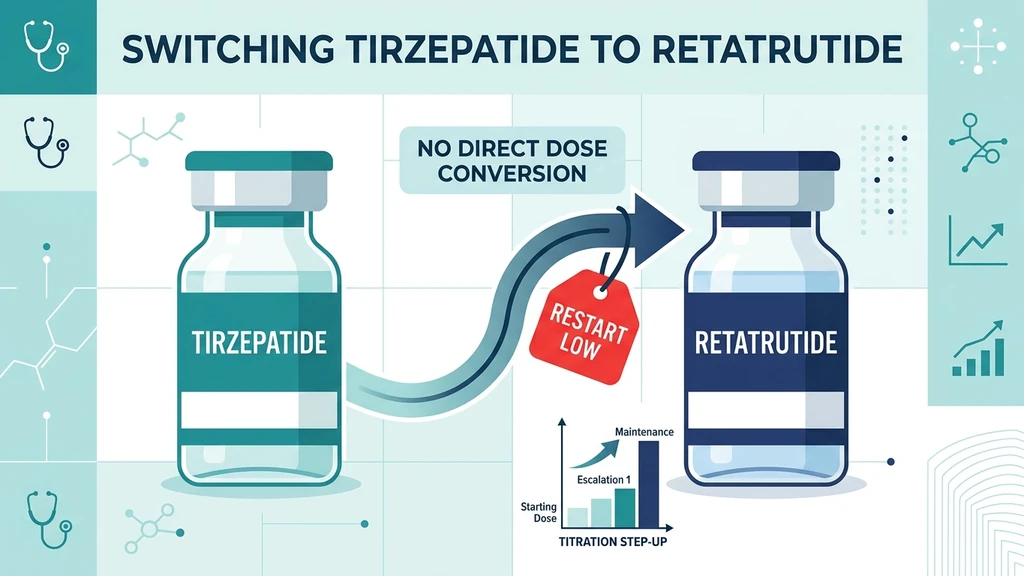
You have been on tirzepatide and want to move to retatrutide, usually because weight loss stalled or you want the stronger triple-agonist effect. The key thing to understand: there is no validated dose-conversion ratio between the two drugs. Retatrutide adds a third receptor target, so the standard approach is to stop tirzepatide and restart retatrutide at its own low starting dose, then titrate up, rather than trying to "convert" your tirzepatide dose.
| Quick Reference | Details |
|---|---|
| Validated conversion ratio? | No |
| Recommended approach | Restart low, titrate up |
| Retatrutide start dose | ~2 mg weekly (trial starting point) |
| Tirzepatide washout | ~1 week (matches weekly dosing) |
| Why restart low | Retatrutide adds glucagon receptor activity |
| Main risk | Stacking effects if transitioned too fast |
| FDA status | Retatrutide is investigational, not approved |
Retatrutide is not FDA-approved and these protocols come from clinical-trial design and community practice, not official switching guidelines. This is educational information, not medical advice. Coordinate any switch with a licensed provider.
For background, see retatrutide vs tirzepatide and how does retatrutide work.
Get your custom peptide protocol:
- Tailored to your body and goals
- Precise dosing and cycle length
- Safe stacking combinations
- Backed by peer-reviewed studies
- Ready in under 2 minutes
Why There Is No Direct Conversion
People want a simple formula: "10 mg tirzepatide equals X mg retatrutide." That formula does not exist, and chasing one is the most common mistake in switching.
Tirzepatide is a dual agonist, hitting GLP-1 and GIP receptors. Retatrutide is a triple agonist, adding glucagon receptor activity on top of those two (Jastreboff et al., N Engl J Med, 2023). That extra mechanism changes how the body responds, so the drugs are not interchangeable on a milligram-for-milligram basis.
Think of it like switching from a two-cylinder engine to a three-cylinder one. You cannot just match the fuel input and expect identical behavior, because the third cylinder changes the whole system. The added glucagon agonism affects energy expenditure and metabolism in ways tirzepatide does not.
Because of this, the trial-based and community approach is to treat retatrutide as a fresh start: begin at its own low dose and titrate up while watching tolerance, rather than mapping your old tirzepatide dose onto it. See retatrutide dosage guide for the standard ramp.
The Recommended Switching Approach
The safest transition treats retatrutide as a new drug, because functionally it is. Here is the standard logic.
Step 1: Finish your last tirzepatide dose. Because both are weekly drugs, your built-in washout is roughly the one-week interval between injections. Tirzepatide has a long half-life of around five days, so it clears gradually over the following week or two.
Step 2: Start retatrutide low. Begin at retatrutide's trial starting dose (around 2 mg weekly), not at a dose "equivalent" to your tirzepatide level. This avoids stacking strong effects while tirzepatide is still partly in your system.
Step 3: Titrate slowly. Increase retatrutide over weeks based on tolerance and response, following its own escalation schedule.
Step 4: Monitor closely. Track appetite, GI symptoms, energy, and weight as you ramp. Keep the injection on the same weekday and roughly the same hour your tirzepatide shot used, for the reasons laid out in the best time to take retatrutide guide.
| Phase | Action | Timing |
|---|---|---|
| Last tirzepatide dose | Complete your normal weekly shot | Week 0 |
| Transition | Skip to retatrutide on the next weekly slot | Week 1 |
| Retatrutide start | ~2 mg weekly | Week 1 onward |
| Titration | Increase per schedule and tolerance | Weeks 2+ |
Use the retatrutide dosage calculator to plan the ramp and the tirzepatide dosage calculator to confirm your final tirzepatide dose.
Do You Need a Washout Period?
Washout is one of the most asked questions, and the answer is nuanced. A long, total washout is usually unnecessary because both drugs are weekly and the natural gap between doses provides a built-in buffer.
Tirzepatide's half-life of roughly five days means a meaningful amount remains in your system for one to two weeks after your last dose. If you start retatrutide on the next weekly slot, you are not on a clean slate; some tirzepatide overlap is expected and generally acceptable at retatrutide's low starting dose.
The reason to start retatrutide low is precisely this overlap. Beginning at a high retatrutide dose while residual tirzepatide is active risks stacking appetite suppression and GI effects, which can mean severe nausea or other symptoms.
Some people prefer a deliberate one- to two-week gap with no medication to let tirzepatide clear before starting retatrutide. This is reasonable, especially if you had significant side effects, but it can allow appetite to return. The trade-off is comfort versus continuity. Neither extreme, immediate high-dose switching or a very long washout, is ideal. The low-and-slow restart threads the needle. See how long does tirzepatide stay in your system.
Side Effects to Expect During the Switch
Switching restarts the adjustment process, so expect a return of early-titration symptoms even though you tolerated tirzepatide well.
Likely during the switch: - Renewed nausea as you adapt to retatrutide - GI changes (constipation or diarrhea) - Fatigue during the first weeks - Appetite fluctuations as the new mechanism takes hold
Why it happens: Your body adapted to tirzepatide's dual-receptor profile. Retatrutide's added glucagon agonism is a new signal, so the adjustment period resets. Tolerance to one GLP-1 drug does not fully transfer to another, especially one with a different mechanism.
Red flags that warrant stopping and seeking care: - Severe, persistent vomiting - Signs of pancreatitis (severe abdominal pain radiating to the back) - Signs of dehydration - Any severe or escalating reaction
The intensity of side effects is a major reason to start retatrutide low rather than matching your tirzepatide dose. A high starting dose layered on residual tirzepatide can make the adjustment far worse than necessary. See retatrutide side effects, retatrutide nausea, and does tirzepatide cause diarrhea for managing GI symptoms.
Why People Switch From Tirzepatide to Retatrutide
Understanding your reason for switching helps set realistic expectations and decide whether the switch is even worth it.
Weight-loss plateau. The most common reason. After months on tirzepatide, weight loss slows. Retatrutide's stronger trial results make it appealing as a next step. Before switching, rule out non-drug causes of a plateau. See why am I not losing weight on tirzepatide.
Seeking stronger results. Retatrutide showed up to 24% body-weight reduction in trials, exceeding tirzepatide's roughly 21%. Some users want that ceiling.
Side-effect profile. A minority switch hoping for better tolerability, though this is unpredictable given retatrutide's added mechanism.
Curiosity and access. The triple agonist is novel and heavily discussed, driving experimentation.
The honest caveat: retatrutide is investigational, not approved, so switching means moving from an FDA-approved drug (tirzepatide) to a research compound with no regulated supply. That is a meaningful step down in quality assurance, even if the efficacy ceiling is higher. Weigh that carefully. See retatrutide vs tirzepatide and where to buy peptides in 2026.
Should You Switch at All?
Switching is not automatically the right move. Run through this checklist before deciding.
Reasons switching may make sense: - You have genuinely plateaued after optimizing diet, sleep, and activity - You have maxed tirzepatide's dose without reaching your goal - You can source quality retatrutide and have medical oversight
Reasons to stay on tirzepatide: - You are still losing weight on tirzepatide - You have not yet maxed your tirzepatide dose - You value the quality assurance of an FDA-approved drug - You cannot verify retatrutide source quality
A common error is switching at the first sign of a plateau when the real issue is dose, diet, or a normal temporary stall. Tirzepatide titrates up to 15 mg; if you are at 5 or 10 mg, you may have room to increase before abandoning it. Retatrutide is also not the only next step; CagriSema, the cagrilintide and semaglutide pairing now under FDA review, is titrated on a different schedule and belongs in the same comparison.
If you do switch, do it deliberately: confirm a quality retatrutide source, start low, titrate slowly, and keep a provider involved. The triple agonist's higher ceiling is real, but so is the trade-off of leaving an approved drug for an investigational one. Plan with the retatrutide dosage calculator and review retatrutide cost.
Common Mistakes When Switching
Mistake 1: Looking for a conversion ratio. There is no validated milligram equivalence between the drugs. The fix: restart retatrutide at its own low dose.
Mistake 2: Starting retatrutide at a high dose. Matching your tirzepatide level stacks effects with residual tirzepatide and causes harsh side effects. The fix: begin around 2 mg weekly and titrate.
Mistake 3: Switching at the first plateau. Often the real issue is dose or lifestyle, not the drug. The fix: optimize and consider increasing tirzepatide first. See why am I not losing weight on tirzepatide.
Mistake 4: Ignoring source quality. Trading an approved drug for an untested research vial is a real downgrade in safety. The fix: verify the retatrutide source and consider whether the switch is worth it.
Mistake 5: Switching without medical oversight. Both drugs are potent metabolic agents. The fix: involve a licensed provider in the transition. See our peptide safety guide.
Frequently Asked Questions
How do I convert my tirzepatide dose to retatrutide?
You do not. There is no validated dose-conversion ratio between the two drugs because retatrutide adds glucagon receptor activity that tirzepatide lacks. The recommended approach is to stop tirzepatide and restart retatrutide at its own low starting dose (around 2 mg weekly), then titrate up. Use the retatrutide dosage calculator.
Do I need a washout period switching to retatrutide?
A long total washout is usually unnecessary since both drugs are weekly. Tirzepatide's roughly five-day half-life means some overlap when you start retatrutide on the next weekly slot, which is why you start retatrutide low. Some people prefer a one- to two-week gap, especially after side effects. See how long does tirzepatide stay in your system.
What dose of retatrutide should I start at after tirzepatide?
Start at retatrutide's trial starting dose of around 2 mg weekly, not a dose matched to your tirzepatide level. Starting high while residual tirzepatide is still active risks stacking effects and harsh nausea. Titrate up slowly based on tolerance. See our retatrutide dosage guide.
Will side effects come back when I switch?
Likely yes. Switching restarts the adjustment period, so expect renewed nausea, GI changes, and fatigue even if you tolerated tirzepatide well. Tolerance to one GLP-1 drug does not fully transfer to another with a different mechanism. Starting retatrutide low minimizes this. See retatrutide nausea and retatrutide side effects.
Why would I switch from tirzepatide to retatrutide?
The most common reason is a weight-loss plateau plus the appeal of retatrutide's stronger trial results (up to 24% versus tirzepatide's ~21%). Before switching, rule out dose and lifestyle causes of a plateau, since tirzepatide titrates to 15 mg. See why am I not losing weight on tirzepatide and retatrutide vs tirzepatide.
Is it safe to switch from tirzepatide to retatrutide?
The main safety risk is starting retatrutide too high while tirzepatide is still active, which stacks effects. Beyond that, switching means moving from an FDA-approved drug to an investigational research compound with no regulated supply, a real downgrade in quality assurance. Coordinate any switch with a licensed provider and review our peptide safety guide.
Should I switch if I have not maxed my tirzepatide dose?
Usually no. Tirzepatide titrates up to 15 mg, so if you are at 5 or 10 mg and plateaued, you likely have room to increase before abandoning an approved drug for an investigational one. Switching at the first plateau is a common mistake when the real issue is dose or lifestyle. Optimize first, then decide. See retatrutide cost for the trade-offs.
The Bottom Line
Switching from tirzepatide to retatrutide is not a conversion; it is a fresh start. There is no validated milligram equivalence between a dual agonist and a triple agonist, so the right approach is to finish your tirzepatide, then restart retatrutide at its own low dose (around 2 mg weekly) and titrate up while monitoring tolerance.
Expect the adjustment period to reset. Nausea, GI changes, and fatigue commonly return because tolerance does not fully transfer between drugs with different mechanisms. Starting low is what keeps that adjustment manageable, especially given the overlap from tirzepatide's long half-life.
Before switching at all, make sure you have a real reason: a genuine plateau after maxing tirzepatide and optimizing lifestyle, not a temporary stall. Remember you are trading an FDA-approved drug for an investigational one. Plan the transition with the retatrutide dosage calculator, review retatrutide vs tirzepatide, and always coordinate with a licensed healthcare provider.
Related Articles
Retatrutide Cost: 2026 Price Guide
Retatrutide cost in 2026: research vial pricing, projected prescription price, per-mg breakdown, and what drives the numbers. Why no insurance covers it yet.
How to Reconstitute Retatrutide
How to reconstitute retatrutide step by step for 5mg, 10mg, and 20mg vials. Concentration tables, BAC water volumes, syringe units per dose, and storage guide.
Best Time to Take Retatrutide: Morning or Night?
Best time to take retatrutide: any hour, same weekday. Evening blunts nausea, morning suits diarrhea. Missed-dose rule, day switching, food, travel, alcohol.
Retatrutide Availability & Timeline
Retatrutide is expected to receive FDA approval in mid-2027 with pharmacy availability in late 2027. Full timeline and Phase 3 trial status.