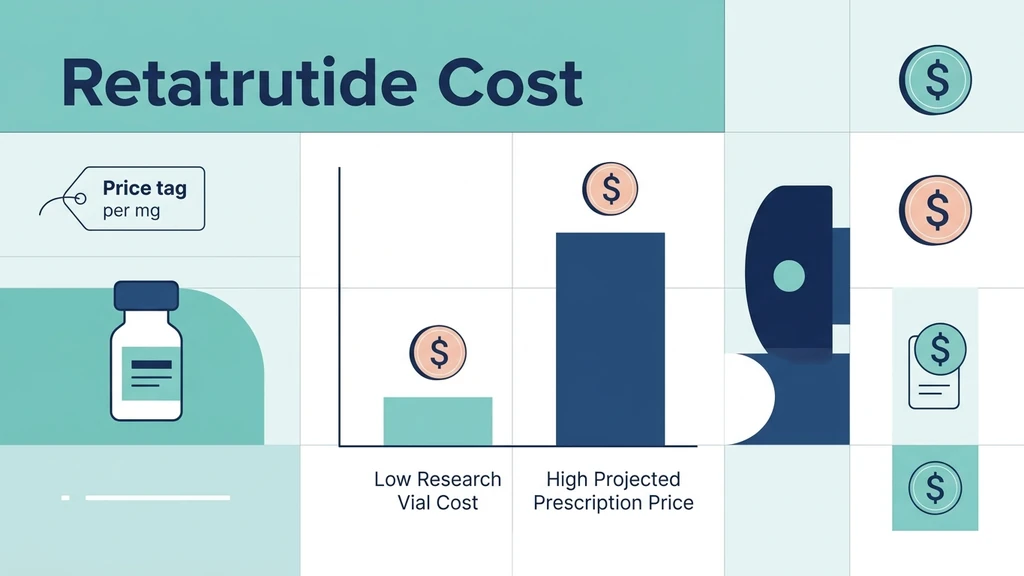
You searched a price for retatrutide and found numbers ranging from $150 to $1,200, with no clear explanation of what you actually get. The reason is simple: retatrutide is not FDA-approved and cannot be bought at a pharmacy. Every price you see today is for a gray-market "research" vial, not a finished prescription drug. A typical research vial of 10-20 mg currently runs $150 to $400 depending on quantity and vendor, which works out to roughly $15 to $30 per milligram.
| Quick Reference | Details |
|---|---|
| FDA status | Investigational (Eli Lilly Phase 3, not approved) |
| Prescription price | None — not legally sold as a medication |
| Research vial (10 mg) | $150-$250 typical |
| Research vial (20 mg) | $250-$400 typical |
| Cost per mg | ~$15-$30 |
| Insurance coverage | None (no approved indication) |
| Monthly cost estimate | $100-$300 at common research doses |
| Projected retail (post-approval) | $1,000-$1,300/mo (analog to Zepbound) |
Retatrutide is a triple agonist still in clinical trials. No completed FDA review exists, no pharmacy stocks it, and no insurer reimburses it. This guide explains what the circulating prices represent, what drives them, and how they compare to approved alternatives. Consult a licensed provider before pursuing any GLP-1 therapy.
For the full drug overview, see our retatrutide pillar guide. To understand availability timelines, read when will retatrutide be available.
Get your custom peptide protocol:
- Tailored to your body and goals
- Precise dosing and cycle length
- Safe stacking combinations
- Backed by peer-reviewed studies
- Ready in under 2 minutes
Why Retatrutide Has No Official Price
Retatrutide is an investigational drug owned by Eli Lilly. As of 2026 it is in Phase 3 trials and has not received FDA approval for any use. A drug without approval has no list price, no pharmacy stock, and no insurance code. That is the entire reason pricing feels chaotic.
The numbers circulating online come from a separate market: vendors selling lyophilized (freeze-dried) retatrutide labeled "for research purposes only." These are not pharmaceutical products. They are not manufactured under the same oversight as an approved medication, and their purity and dose accuracy vary widely between sellers.
When retatrutide eventually clears FDA review, Eli Lilly will set a list price the same way it did for tirzepatide. At that point the cost structure will look completely different: a fixed monthly price, possible manufacturer savings cards, and eventual insurance negotiation. Until then, every "retatrutide cost" is a research-market estimate. See our retatrutide vs tirzepatide comparison for how the approved sibling drug is priced.
Research Vial Pricing: What the Numbers Mean
Research retatrutide is sold by total milligrams per vial, not by monthly supply. This is the single biggest source of confusion for newcomers comparing prices.
| Vial Size | Typical Price Range | Cost Per mg | Approx. Weeks of Supply* |
|---|---|---|---|
| 5 mg | $90-$150 | $18-$30 | 2-5 weeks |
| 10 mg | $150-$250 | $15-$25 | 5-10 weeks |
| 15 mg | $210-$330 | $14-$22 | 7-15 weeks |
| 20 mg | $250-$400 | $13-$20 | 10-20 weeks |
*Supply depends entirely on weekly dose. A 2 mg/week user gets far more weeks per vial than a 12 mg/week user.
Larger vials lower the per-milligram cost, which is why experienced users buy in bulk. But a larger vial also means more reconstituted peptide sitting in your fridge, and reconstituted retatrutide has a limited shelf life. Buying more than you can use before degradation wastes money. See how long reconstituted peptides last for storage timelines.
The price you pay per month is a function of your weekly dose, not the sticker price of the vial. A single 10 mg vial costs the same whether you stretch it over five weeks or ten.
How Dose Drives Your Real Monthly Cost
Think of a retatrutide vial like a tank of fuel. The vial price is fixed, but how long it lasts depends entirely on how hard you run the engine. Clinical trials titrated retatrutide slowly, starting at 2 mg weekly and climbing toward 8-12 mg over months (Jastreboff et al., N Engl J Med, 2023).
| Weekly Dose | mg Per Month | Vials Needed (10 mg) | Est. Monthly Cost |
|---|---|---|---|
| 2 mg (starting) | 8 mg | ~0.8 | $120-$200 |
| 4 mg | 16 mg | ~1.6 | $240-$400 |
| 8 mg | 32 mg | ~3.2 | $480-$800 |
| 12 mg (high) | 48 mg | ~4.8 | $720-$1,200 |
Early titration months are cheap because doses are low. Costs climb sharply as you escalate. A person at a maintenance dose of 8-12 mg weekly can spend as much on research retatrutide as the projected retail price of approved Zepbound, but without the quality guarantees of an approved drug.
Use the retatrutide dosage calculator to map your protocol, and the peptide cost calculator to convert vial prices into a real monthly budget. For dosing logic, see our retatrutide dosage guide.
What Drives Retatrutide Prices Up or Down
Research peptide prices move for reasons that have nothing to do with the molecule itself. Understanding the levers helps you spot a fair price from a gouge or a too-good-to-be-true scam.
Quantity discounts. Per-milligram cost drops steeply with vial size and multi-vial orders. This is the largest single factor.
Purity and testing. Vendors who publish third-party certificates of analysis (mass spectrometry and HPLC purity above 98%) charge more, and the premium is worth it. Untested cheap vials may be underdosed, degraded, or contaminated.
Synthesis difficulty. Retatrutide is a complex triple agonist, harder and more expensive to synthesize than simpler peptides like BPC-157. That floor keeps legitimate prices from dropping below a certain point.
Payment method and shipping. Crypto discounts, domestic versus international shipping, and cold-chain handling all shift the final number.
Demand spikes. When media coverage surges, prices rise. Retatrutide search volume climbed over 300% year over year, and vendor pricing tracks that attention.
A price far below the $13-per-mg floor is a warning sign, not a bargain. See where to buy peptides in 2026 for vendor evaluation criteria.
Projected Prescription Cost After FDA Approval
When retatrutide is approved, its price will almost certainly anchor to Eli Lilly's existing GLP-1 lineup rather than the research market. Tirzepatide, sold as Zepbound for weight loss, carries a list price near $1,060 per month before any discounts.
| Scenario | Likely Monthly Cost | Notes |
|---|---|---|
| List price, no insurance | $1,000-$1,300 | Anchored to Zepbound pricing |
| Manufacturer savings card | $550-$700 | If eligibility programs mirror current ones |
| Commercial insurance (covered) | $25-$100 copay | Only if plan covers obesity drugs |
| Insurance (not covered) | Full list price | Many plans exclude weight-loss drugs |
These are projections, not guarantees. Approval timing, label indications, and competitive pressure from other triple agonists will all shape the final number. Retatrutide showing up to 24% body-weight reduction in trials gives Lilly strong pricing power (Jastreboff et al., N Engl J Med, 2023).
The gap between projected retail ($1,000+) and current research pricing ($100-$300 at low doses) is exactly why the gray market exists. It is also why buyers accept the quality and legal risks. For the approved-drug pricing model, compare with how much is semaglutide, tirzepatide cost with insurance, and the cheapest tirzepatide routes.
Retatrutide Cost vs Other GLP-1 Options
Most people pricing retatrutide are weighing it against approved or compounded alternatives. Here is how the monthly math compares at common maintenance doses.
| Drug | Status | Typical Monthly Cost | Route |
|---|---|---|---|
| Retatrutide (research) | Investigational | $100-$800 (dose-dependent) | Subcutaneous |
| Tirzepatide (Zepbound) | FDA-approved | $1,060 list / $550 card | Subcutaneous |
| Compounded tirzepatide | Pharmacy compounded | $200-$500 | Subcutaneous |
| Semaglutide (Wegovy) | FDA-approved | $1,350 list / $0-$650 | Subcutaneous |
| Compounded semaglutide | Pharmacy compounded | $150-$400 | Subcutaneous |
Research retatrutide can look cheaper than approved drugs at low doses, but the comparison is not apples to apples. Approved and compounded products come from regulated supply chains with dose accuracy and sterility guarantees. Research vials do not. You are trading quality assurance for a lower sticker price.
Retatrutide's trial efficacy outpaced both tirzepatide and semaglutide on weight loss, which is the main reason interest is so high despite the lack of approval. For the head-to-head, see retatrutide vs tirzepatide and how does retatrutide work.
Hidden Costs People Forget to Budget
The vial price is only part of what you spend. Several recurring costs catch first-time buyers off guard.
Bacteriostatic water. Required to reconstitute the lyophilized powder. A multi-dose vial costs $3-$10 and is consumed across reconstitutions.
Syringes and needles. Insulin syringes run $15-$30 per box of 100. You replace them constantly.
Alcohol swabs and sharps disposal. Small but recurring.
Bloodwork. Responsible use means baseline and periodic labs. Out of pocket, a metabolic panel runs $50-$150.
Wasted product. Degraded peptide from poor storage, dosing errors, or buying more than you can use before expiration. This is the silent budget killer. Missed and doubled doses belong in the same column; the best time to take retatrutide guide covers the missed-dose rule that keeps a late shot from becoming a wasted one.
A realistic all-in monthly cost adds roughly $20-$40 of supplies on top of the vial cost, more if you factor in labs. Budget for the full kit, not just the peptide. Our retatrutide dosage guide and how to reconstitute retatrutide cover the supplies you need.
Common Mistakes When Pricing Retatrutide
Mistake 1: Comparing vial price to monthly drug price. A $200 research vial is not "cheaper than Zepbound" until you calculate how many weeks it actually lasts at your dose. At high maintenance doses the math converges. The fix: always convert to cost-per-month using your real weekly dose.
Mistake 2: Chasing the lowest per-mg price. A vial priced well below $13 per mg is more likely underdosed or fake than a genuine bargain. The fix: prioritize third-party testing over price.
Mistake 3: Buying a 20 mg vial as a beginner. Large vials lower per-mg cost but reconstituted peptide degrades. If you cannot use it in time, you wasted money. The fix: match vial size to your realistic usage window.
Mistake 4: Ignoring supply and lab costs. The peptide is not the only expense. The fix: budget the full kit plus periodic bloodwork.
Mistake 5: Assuming insurance might help. No insurer covers an unapproved drug. The fix: treat retatrutide as a fully out-of-pocket cost until approval changes the picture.
Frequently Asked Questions
How much does retatrutide cost per month?
At common research doses, roughly $100-$300 per month during early low-dose titration and $480-$800+ at maintenance doses of 8-12 mg weekly. The exact figure depends on your weekly dose and vial size. Use our retatrutide dosage calculator and peptide cost calculator to estimate your specific budget.
Why is retatrutide so cheap compared to Zepbound?
Because research-market retatrutide is not an FDA-approved drug. It is sold as a research chemical without the regulated manufacturing, dose accuracy, or sterility guarantees of an approved medication. The lower price reflects the absence of those safeguards, not a better deal. See retatrutide vs tirzepatide for the full comparison.
Does insurance cover retatrutide?
No. Retatrutide has no FDA approval and no insurance code, so no plan reimburses it. Even after approval, coverage will depend on whether your plan covers obesity medications, which many exclude. For approved-drug coverage, see tirzepatide cost with insurance.
What is the cost per mg of retatrutide?
Research vials typically run $13-$30 per milligram, with larger vials and bulk orders at the lower end. Prices below roughly $13 per mg are a warning sign of underdosed or counterfeit product. Always verify third-party testing before buying. See where to buy peptides in 2026.
How much will retatrutide cost when FDA approved?
Projected list price is $1,000-$1,300 per month, anchored to Eli Lilly's Zepbound pricing. Manufacturer savings cards could lower that to $550-$700, and covered insurance could drop copays to $25-$100. These are estimates based on current GLP-1 pricing. Read when will retatrutide be available for timeline context.
Is buying research retatrutide worth the savings?
It depends on your risk tolerance. Research vials can cost a fraction of projected retail at low doses but carry no quality, purity, or sterility guarantees and exist in a legal gray area. The savings are real; so are the risks. Always consult a licensed provider and review our peptide safety guide first.
What extra costs come with retatrutide?
Beyond the vial, budget for bacteriostatic water ($3-$10), insulin syringes ($15-$30 per 100), alcohol swabs, sharps disposal, and periodic bloodwork ($50-$150 per panel). These add roughly $20-$40 per month plus lab costs. See how to reconstitute retatrutide for the full supply list.
The Bottom Line
Retatrutide cost is confusing because the drug occupies two worlds at once. Today it exists only as a research chemical, priced at $13-$30 per milligram, translating to roughly $100-$300 monthly at low doses and far more at maintenance. There is no prescription price, no pharmacy stock, and no insurance because the FDA has not approved it.
When approval comes, expect a list price near $1,000-$1,300 per month, anchored to Zepbound, with savings cards and possible insurance softening the blow for some. The wide gap between those two realities is the entire story behind the prices you see online.
Whatever route you consider, price is only one variable. Quality, legality, and medical supervision matter more for a drug this potent. Map your protocol with the retatrutide dosage calculator, budget honestly with the peptide cost calculator, and read our retatrutide pillar guide before making any decision. Always consult a licensed healthcare provider.
Helpful Tools
Related Articles
Switching Tirzepatide to Retatrutide
Switching from tirzepatide to retatrutide: dose conversion logic, washout, titration restart, side effects to expect, and why a clean restart matters.
How to Reconstitute Retatrutide
How to reconstitute retatrutide step by step for 5mg, 10mg, and 20mg vials. Concentration tables, BAC water volumes, syringe units per dose, and storage guide.
Best Time to Take Retatrutide: Morning or Night?
Best time to take retatrutide: any hour, same weekday. Evening blunts nausea, morning suits diarrhea. Missed-dose rule, day switching, food, travel, alcohol.
How Long Does Retatrutide Take to Work?
Retatrutide suppresses appetite within days, produces weight loss by week 4, and delivers up to 24.2% loss at 48 weeks in trials.