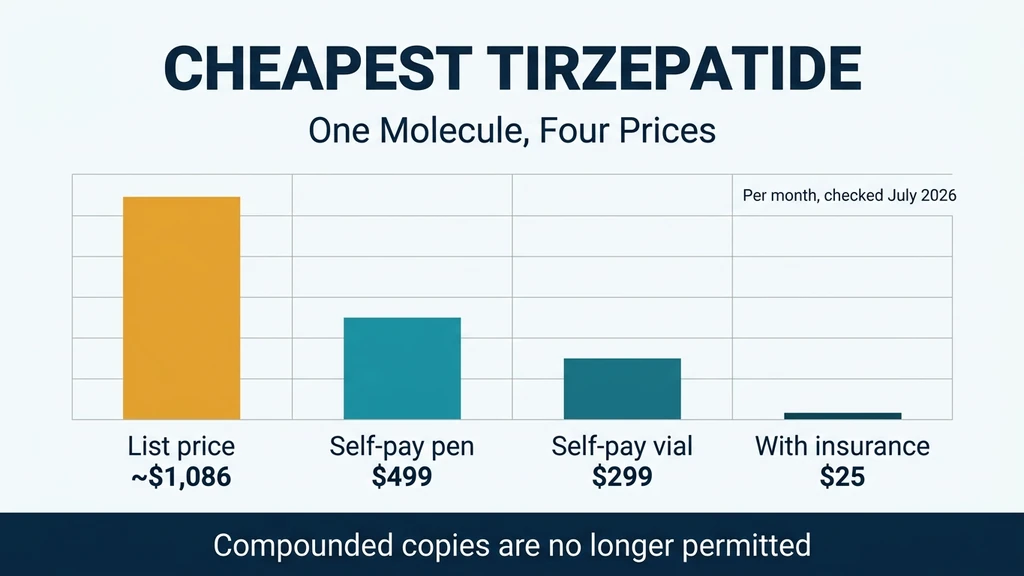
Your prescription says Zepbound. The pharmacy quoted four figures and you closed the tab. Checked July 8, 2026, the cheapest legitimate tirzepatide in the US is brand Zepbound bought straight from the manufacturer for self-pay: $299 per month at 2.5 mg, $399 at 5 mg, and $449 at 7.5 mg and above. If commercial insurance covers it, the savings card drops that to $25.
Every price below was read off a manufacturer page on July 8, 2026. Prices in this market move on a quarterly cadence, so treat any number older than a few months as fiction.
| Route | Typical monthly cost | What you give up |
|---|---|---|
| Commercial insurance + savings card | $25 | Nothing, if your plan covers obesity drugs |
| Manufacturer self-pay (Zepbound vial or KwikPen) | $299 to $449 | The single-dose pen; you draw or dial your own dose |
| Manufacturer self-pay (Mounjaro pen) | $499 | Requires a type 2 diabetes indication |
| Zepbound single-dose pen at list price | About $1,086 | Money, for no clinical gain |
| Telehealth subscription | Drug price plus a membership fee | Transparency on what the fee buys |
| Compounded tirzepatide | Historically lower | Legality, since 2025 |
Compounded tirzepatide is the cheapest number anyone will quote you and it is no longer a route you can lawfully take as a copy of the approved drug. Insurance coverage of tirzepatide remains the only route that beats $299, and it beats it by an order of magnitude.
Get your custom peptide protocol:
- Tailored to your body and goals
- Precise dosing and cycle length
- Safe stacking combinations
- Backed by peer-reviewed studies
- Ready in under 2 minutes
Why One Molecule Carries Five Different Prices
Zepbound and Mounjaro contain the same active molecule. So did every compounded vial sold in 2024. The five prices attached to that one molecule come from a rebate structure, not from a difference in the drug.
Picture a crate of oranges at a wholesale market. The grower posts a price on the crate. The supermarket chain never pays it, because it buys ten thousand crates and negotiates a rebate paid back after the season. The corner shop, buying one crate, pays close to the posted number. Same oranges, two prices, and the posted number exists mainly so the rebate has something to be subtracted from.
Drug list price works the same way. Zepbound's list price of roughly $1,086 per month is the number from which pharmacy benefit managers subtract negotiated rebates, and almost nobody with insurance pays it. The self-pay price of $299 to $449 is what Lilly charges when there is no rebate chain to feed, which is why the manufacturer selling direct undercuts the pharmacy counter by more than half.
This is also why "cheapest" depends entirely on which of those five contracts you are standing inside. A person with a plan that covers obesity medication pays $25. The same person, one plan change later, pays $449. Nothing about the molecule changed.
Coverage varies sharply by carrier and by employer rider, which is why whether a plan like Anthem covers GLP-1 drugs is worth checking before you assume you are a cash patient. Semaglutide's pricing collapsed along an identical path.
Danger Scenario 1: The Price That Doubles at 10 mg
You start at 2.5 mg for $299 and conclude tirzepatide costs about $300 a month. That conclusion is wrong by roughly $2,500 a year, because 2.5 mg is a four-week starter dose that nobody stays on.
Run the real titration. Four weeks at 2.5 mg ($299), four at 5 mg ($399), four at 7.5 mg ($449), four at 10 mg ($449), four at 12.5 mg ($449), then eight fills at 15 mg maintenance ($449 each, $3,592). Thirteen four-week fills covers 52 weeks. Total: $5,637 for year one, not the $3,588 that $299 times twelve suggests.
Now add the fine print. The $449 price on 7.5 mg and above applies only when you refill within 45 days of the previous delivery. Miss that window twice at 15 mg and those two fills cost $699 each instead of $449. Two late refills add $500 to the year, which is more than a full month of drug.
The fix is arithmetic done once, before you commit. Price the dose you will be on in month six, not the dose you start on, and set a calendar reminder at day 35 after each delivery.
For context on what that same year costs a person whose plan covers the drug: thirteen fills at $25 is $325, which is 17 times cheaper than the self-pay route for the identical medication.
Danger Scenario 2: Chasing a Compounded Price Into a Supply That Vanishes
Between 2023 and early 2025, compounded tirzepatide undercut every brand route, and hundreds of thousands of people titrated on it. Then the FDA closed the shortage exception and the supply stopped. People at 10 mg found their next vial cancelled.
Restarting is not a matter of picking up where you left off. After a gap of more than a few weeks, prescribers restart at 2.5 mg and re-titrate in four-week steps, so returning to 10 mg takes another twelve weeks. Counting an eight-week supply gap, that is twenty weeks lost and three fills ($299 plus $399 plus $449 = $1,147) spent a second time on doses you had already paid for.
The clinical cost is larger than the financial one. Gastrointestinal adverse events in the SURMOUNT-1 trial were "predominantly mild to moderate in severity, occurring primarily during dose escalation" (Jastreboff et al., N Engl J Med, 2022, PMID 35658024). A forced restart puts you back through the exact window where nausea clusters.
Weight follows. In SURMOUNT-4, participants who stopped tirzepatide after 36 weeks regained 14.0% of body weight over the following 52 weeks, a 19.4 percentage point swing against those who continued. Only 16.6% of the withdrawal group held onto at least 80% of the weight they had lost, versus 89.5% of those who stayed on drug (Aronne et al., JAMA, 2024, PMID 38078870).
A cheap price on a supply that cannot be guaranteed for eighteen months is not a cheap price. Read does compounded tirzepatide work before you build a plan around one, and understand that maintenance, not the first ten pounds, is where the money is actually spent. See tirzepatide maintenance dosing after weight loss.
The Skill: Computing Your True Cost Per Milligram
Sellers quote per month. Doses are per milligram. Those two units are deliberately hard to reconcile, and the gap is where offers hide.
The conversion takes one line. Tirzepatide is dosed once weekly, so a 28-day supply is four doses. Cost per mg = monthly price ÷ (dose in mg × 4).
Apply it to the manufacturer's own ladder and the shape of the pricing becomes visible:
| Dose | Monthly self-pay price | mg per month | Cost per mg |
|---|---|---|---|
| 2.5 mg | $299 | 10 mg | $29.90 |
| 5 mg | $399 | 20 mg | $19.95 |
| 7.5 mg | $449 | 30 mg | $14.97 |
| 10 mg | $449 | 40 mg | $11.23 |
| 12.5 mg | $449 | 50 mg | $8.98 |
| 15 mg | $449 | 60 mg | $7.48 |
The starter dose is the most expensive drug you will ever buy, at four times the per-milligram cost of maintenance. Anyone quoting you a headline "from $299" is quoting the worst value tier in the entire schedule.
Three traps live in this arithmetic. First, a "month" that means 30 days gives you 12 fills a year, while a 4-week supply gives you 13; multiplying a monthly price by 12 understates the year by one full fill, $449 at the top dose. Second, a multi-dose KwikPen holds four doses and a single-dose vial holds one, so "per pen" and "per vial" prices are not comparable until you divide. Third, a subscription price that bundles a consult fee is not a drug price, and you cannot compute cost per milligram from it at all until the platform separates the two lines.
Vials mean drawing your own dose with an insulin syringe, which introduces a unit conversion that has nothing to do with money and everything to do with safety. Work the numbers with the peptide unit converter before your first vial arrives.
Every Route, Priced at Every Dose
All figures read from manufacturer pages on July 8, 2026. A month means a 28-day supply, four weekly doses.
| Route | 2.5 mg | 5 mg | 10 mg | 15 mg |
|---|---|---|---|---|
| Commercial insurance + Zepbound savings card | $25 | $25 | $25 | $25 |
| Zepbound self-pay vial or KwikPen, refilled within 45 days | $299 | $399 | $449 | $449 |
| Zepbound self-pay vial or KwikPen, refilled after 45 days | $299 | $399 | $699 | $699 |
| Mounjaro self-pay single-dose pen | $499 | $499 | $499 | $499 |
| Zepbound single-dose pen, list price | ~$1,086 | ~$1,086 | ~$1,086 | ~$1,086 |
| Telehealth subscription (brand drug) | Drug price + membership fee | + fee | + fee | + fee |
| Compounded tirzepatide | Not a lawful copy route since 2025 | |||
| Grey-market "research" tirzepatide | Unapproved, not a price row |
Read the table by row, not by column. The cheapest column entry at 15 mg ($25) and the cheapest at 2.5 mg ($25) are the same row, because insurance coverage dominates every self-pay route at every dose. The self-pay ladder only becomes the answer once coverage is refused.
Mounjaro's flat $499 looks worse than Zepbound's $299 at the starter dose and better than Zepbound's $699 late-refill price at 10 mg. Mounjaro is also approved for type 2 diabetes, so it is not a route a weight-management patient can simply select. The two products are the same molecule with different labels and different self-pay contracts.
For how tirzepatide's cost compares against the rest of this space, see peptide therapy cost.
Compounded Tirzepatide: The Current Legal Position
The compounded route is the reason most people start asking this question, and it is closed. The sequence matters, because the internet is full of pages written before it happened.
The FDA declared the tirzepatide injection shortage resolved in October 2024 and affirmed that decision in December 2024. Enforcement discretion for 503A state-licensed compounding pharmacies ran to February 18, 2025, and for 503B outsourcing facilities to March 19, 2025. The Outsourcing Facilities Association sued; the US District Court for the Northern District of Texas upheld the FDA's shortage determination on May 7, 2025.
On April 30, 2026, the FDA proposed to leave semaglutide, tirzepatide, and liraglutide off the 503B bulk drug substances list, finding no clinical need for outsourcing facilities to compound them from bulk API while approved products are available.
What this leaves standing is narrow. Sections 503A and 503B both bar compounding a drug that is essentially a copy of a commercially available approved product. A 503A pharmacy may still compound for an individual patient where the prescriber documents a clinical difference the approved drug cannot meet for that person, such as an allergy to an inactive ingredient. Cost is not a clinical difference. A pharmacy shipping standard-strength tirzepatide to a subscriber list is not operating inside that exception, whatever its website says.
Treat any current offer of routine, low-cost compounded tirzepatide as a signal about the seller, not about the market. Background on the enforcement wave sits in the 2026 FDA peptide crackdown.
Grey-market tirzepatide sold as a "research chemical," labelled not for human consumption, is an unapproved drug of unverified identity and purity, and buying it to inject is not lawful. It has no place on a price table. It does not belong in a cost comparison, and putting it in one is how people end up injecting an unknown quantity of an unknown peptide. See are peptides legal.
Where Telehealth Subscriptions Fit
Telehealth platforms sit between you and one of the routes above. They do not manufacture tirzepatide and they cannot buy it below the manufacturer's price, so a subscription is a service fee wrapped around a drug price you could reach directly.
The fee buys real things for some people: a prescriber, titration oversight, refill logistics, and sometimes insurance appeals. It buys nothing for a person who already has a prescribing physician and a covered plan.
The structural question to ask any platform is whether the quoted price is the total, or the drug plus a membership that renews independently. A quote that changes when your dose escalates is a drug price with a fee attached. A quote that stays flat while your dose climbs is a fee with drug included, and the platform is absorbing the escalation somewhere.
We review individual programs separately rather than rank them, because pricing structures change faster than any ranking survives. See Ro weight loss cost and where to buy tirzepatide for how the categories differ.
Four Mistakes That Cost Real Money
Mistake 1: Budgeting from the starter price. The $299 tier lasts four weeks and costs $29.90 per milligram, four times the per-milligram cost of the 15 mg tier. Budgeting from it understates year one by around $2,000. The fix: price your month-six dose before you start, using how much peptides cost for the wider frame.
Mistake 2: Letting the 45-day refill clock expire. At 10 mg and above, a late refill takes the price from $449 to $699. Two late fills a year cost $500. The fix: a reminder at day 35 after each delivery, not day 44.
Mistake 3: Multiplying a monthly price by twelve. Weekly dosing produces thirteen 28-day fills per 52 weeks. At $449 that is one entire extra fill nobody budgeted for. The fix: multiply by 13.
Mistake 4: Cost-shopping instead of dose-shopping. People stall on tirzepatide far more often from an interrupted titration than from a dose being too low, and interruptions come from supply and money, not pharmacology. The fix: pick the route you can sustain for eighteen months at maintenance dose, then stay on it. Why you might not be losing weight on tirzepatide covers the rest.
Frequently Asked Questions
What is the cheapest tirzepatide available in 2026?
With commercial insurance that covers obesity treatment, the Zepbound savings card brings a month to $25. Without coverage, the manufacturer's self-pay vials and KwikPen run $299 at 2.5 mg, $399 at 5 mg, and $449 at 7.5 mg and above. Full breakdown in tirzepatide cost with insurance.
What is the cheapest way to get tirzepatide without insurance?
Buying brand Zepbound direct from the manufacturer as single-dose vials or a KwikPen, at $299 to $449 per 28-day supply depending on dose. The 7.5 mg and higher tiers require refilling within 45 days to keep the $449 price. Cost the full escalation with the peptide cost calculator.
Is compounded tirzepatide still legal to buy?
No, not as a copy of the approved drug. FDA enforcement discretion ended February 18, 2025 for 503A pharmacies and March 19, 2025 for 503B facilities, and a federal court upheld that in May 2025. A narrow individual-patient exception survives, but cost savings do not qualify. See is compounded tirzepatide safe.
Which is cheaper, tirzepatide or semaglutide?
At self-pay prices they are close, and both manufacturers now sell direct at a few hundred dollars a month. The deciding factor is coverage, not molecule. Tirzepatide produced larger average weight loss in head-to-head data, which changes the cost per pound. Compare in how much semaglutide costs.
Does microdosing tirzepatide make it cheaper?
It lowers milligrams used per month, but self-pay pricing is per vial and per pen, not per milligram, so a smaller dose out of the same 2.5 mg vial saves nothing at $299. Microdosing is a tolerance strategy, not a cost strategy. Details in the microdosing tirzepatide chart.
Why is a Zepbound vial cheaper than a Zepbound pen?
The single-dose pen carries the list price of roughly $1,086 and feeds a rebate chain. Vials and the KwikPen are sold direct at $299 to $449 with no intermediary. You draw or dial the dose yourself, which is where the savings come from. See how to inject tirzepatide.
How much does a full year of tirzepatide cost?
At self-pay prices, a standard escalation to 15 mg maintenance runs about $5,637 across thirteen 28-day fills. With insurance and a savings card at $25 per fill, the same year is $325. Late refills at 10 mg and above add $250 each. Run your own numbers on the tirzepatide dosage calculator.
Will retatrutide be cheaper than tirzepatide?
Retatrutide is not FDA approved and has no consumer price, so any figure quoted today is a grey-market number, not a drug price. Approved GLP-1 pricing has fallen steadily as competitors launch, which is the pattern to watch. Current estimates and caveats sit in retatrutide cost.
The Bottom Line
The cheapest legitimate tirzepatide in July 2026 is $25 a month if commercial insurance covers it, and $299 to $449 a month if it does not, buying brand Zepbound vials or a KwikPen direct from the manufacturer. Compounded tirzepatide, which used to sit below both, stopped being a lawful copy route in 2025.
One principle survives every price change: the drug only works while you are taking it, and the route that fails is the one you cannot afford at maintenance dose eighteen months from now. Price the dose you will be on, not the dose you start on.
Cost your full escalation with the peptide cost calculator, and see how the wider market is moving in the GLP-1 cost statistics. More cost and dosing guides at peptidesexplorer.com. This is educational content, not medical advice; work with a licensed prescriber.
Helpful Tools
Related Articles
Tirzepatide Cost With Insurance (2026)
Tirzepatide costs $550-$1,060/month at list price. With commercial insurance, copays range from $25-$150/month. Mounjaro, Zepbound, Medicare breakdown.
How to Reconstitute Tirzepatide
How to reconstitute tirzepatide step by step for 5mg, 10mg, 15mg, and 30mg vials. Concentration tables, BAC water volumes, syringe units, and storage guide.
What to Eat on Tirzepatide: Diet Guide
What to eat on tirzepatide to minimize nausea, prevent muscle loss, and maximize results. Protein targets, meal plans, foods to avoid, and hydration.
Does Tirzepatide Expire? Shelf Life
Tirzepatide expires in 24-36 months as powder and 28 days once reconstituted. Learn storage temps, degradation signs, and potency loss timelines.