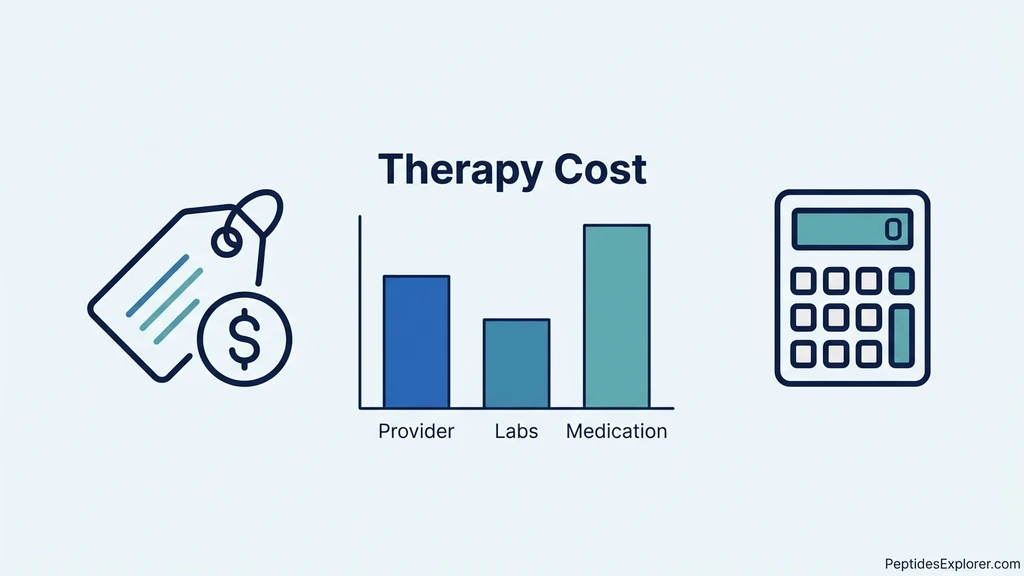
You signed up for a telehealth peptide program advertised at "$199/month," then the invoice arrived with a $250 lab fee, a $99 consultation charge, and a shipping line you did not expect. Peptide therapy cost is the all-in program price, not the vial price. In 2026, a physician-supervised peptide therapy program runs roughly $200 to $500 per month for recovery and anti-aging peptides, $199 to $549 per month for GLP-1 weight loss programs, and as little as $40 to $150 per month if you self-source research-grade vials and skip the provider entirely. That all-in figure bundles five things: the provider or telehealth consultation, baseline and follow-up lab work, the medication, compounding pharmacy fees, and ongoing monitoring or subscription costs. Insurance almost never covers peptide therapy, with the narrow exception of GLP-1 drugs prescribed for type 2 diabetes. For the lowest-cost route to one specific drug, see cheapest tirzepatide.
| Therapy Path | Typical All-In Monthly Cost | What You Get | Insurance? |
|---|---|---|---|
| Telehealth peptide therapy (BPC-157, CJC/Ipa, PT-141) | $200-$500 | Provider, Rx, compounded peptide, monitoring | No |
| Telehealth GLP-1 weight loss program | $199-$549 | Provider, compounded semaglutide/tirzepatide, monitoring | Rarely |
| In-person anti-aging clinic | $300-$800+ | In-person visits, broad labs, multi-peptide stack | No |
| Brand GLP-1 with insurance | $25-$100 copay | FDA-approved drug, prescriber | Sometimes (diabetes) |
| DIY research-grade self-source | $40-$150 | Vials only, no provider, no labs, no monitoring | No |
The reason the same molecule can cost $40 or $500 per month comes down to what surrounds it. A research-grade vial of BPC-157 is the cheapest version of peptide therapy you can buy, but it arrives with no prescription, no bloodwork, and no one watching your labs. A telehealth program wraps that same peptide in a provider relationship, pharmacy fulfillment, and follow-up monitoring, and you pay for every layer.
This guide breaks the all-in cost into its five components, gives realistic 2026 ranges for each therapy path, and runs the annual math on clinic versus telehealth versus DIY. Use the peptide cost calculator to model your own program. This is educational content, not medical advice; verify pricing with any provider before enrolling.
Get your custom peptide protocol:
- Tailored to your body and goals
- Precise dosing and cycle length
- Safe stacking combinations
- Backed by peer-reviewed studies
- Ready in under 2 minutes
The Five Components of Peptide Therapy Cost
The price of a peptide vial is one line item in a much longer invoice. A supervised peptide therapy program charges for five separate things, and skipping any one of them changes both the cost and the risk profile.
1. Provider or telehealth consultation. A licensed provider has to evaluate you, write the prescription, and stay legally responsible for your care. Telehealth platforms usually bundle this into the monthly fee. Standalone consultations run $99 to $299 for an initial visit and $50 to $150 for follow-ups.
2. Lab work. Baseline bloodwork is standard of care before starting most peptides, especially GLP-1s and growth hormone secretagogues. A comprehensive baseline panel costs $150 to $500. Follow-up panels at 8 to 12 weeks cost $75 to $200. Many programs advertise a monthly price that excludes labs entirely.
3. The medication itself. This is the part most people think of as "the cost." For compounded peptides it is bundled into the program fee. For research-grade vials it is the only cost, running $30 to $80 per vial.
4. Compounding pharmacy fees. Compounded peptides come from 503A or 503B pharmacies that formulate the active ingredient into an injectable product. This markup sits inside the program price and explains why compounded therapy costs more than a raw research vial.
5. Ongoing monitoring and subscription. Monthly or quarterly check-ins, dose adjustments, refill management, and provider messaging. On a subscription model this is folded into the recurring fee. It is the part DIY users lose entirely.
Add these together and the all-in number lands far above the vial price. A program quoting "$249/month" for the peptide often becomes $300 to $400 per month once the baseline labs and consultation are amortized across the year. For dose math behind the per-vial portion, see the peptide reconstitution calculator.
Telehealth Peptide Therapy: $200 to $500 Per Month
Telehealth is the most common entry point to supervised peptide therapy in 2026. You complete an intake form, do a virtual visit, get labs at a local draw site, and the peptide ships from a partner compounding pharmacy. The model is convenient and the all-in cost is mid-range.
Typical monthly program fees by peptide: - BPC-157 (recovery, gut, joint): $200-$350/month - CJC-1295/Ipamorelin (growth hormone secretagogue stack): $250-$400/month - PT-141 (sexual function): $200-$300/month - TB-500 (tissue repair): $250-$400/month - Multi-peptide protocol (2-3 peptides): $350-$500/month
These fees usually cover the provider, the prescription, the compounded medication, and monthly monitoring. What they typically exclude is lab work. Expect to add $150 to $500 for a baseline panel and $75 to $200 per follow-up.
Platforms like Transcend Peptides start around $269 per month for standard peptide therapy with labs billed separately. Marek Health runs an optimization-coaching model where the membership and labs are priced apart from the medication. The structure varies, so the advertised number rarely equals the all-in number.
Realistic all-in monthly cost, telehealth single-peptide therapy: - Program fee: $250 - Labs amortized (baseline $300 + one follow-up $150, spread over 12 months): about $38/month - Supplies (bac water, syringes, swabs): $10-$20/month - True monthly cost: roughly $300-$310
The convenience premium is real, but so is the oversight. You get a prescription, a licensed provider, and someone reading your bloodwork. Compare specific platforms in our Transcend Peptides review and Marek Health review before committing.
GLP-1 Weight Loss Programs: $199 to $549 Per Month
GLP-1 weight loss programs are the highest-volume category of peptide therapy in 2026, and pricing has compressed hard as telehealth platforms compete. The all-in cost depends on the molecule, the dose, and whether the product is compounded or brand.
Compounded GLP-1 telehealth programs (all-in, provider included): - Compounded semaglutide entry dose (0.25-0.5 mg weekly): $199-$299/month - Compounded semaglutide mid-to-high dose (1-2.4 mg weekly): $299-$399/month - Compounded tirzepatide entry dose (2.5-5 mg weekly): $249-$399/month - Compounded tirzepatide high dose (12.5-15 mg weekly): $399-$549/month
These programs bundle the provider visit, the compounded medication, and monthly check-ins into one subscription. Most still bill baseline labs separately at $100 to $300.
Brand GLP-1 through a program: - Brand Zepbound or Wegovy via manufacturer self-pay (LillyDirect, NovoCare): $349-$549/month for the drug, plus a separate prescriber relationship - Brand with insurance coverage: $25-$100/month copay, but coverage for obesity is rare
Insurance is the dividing line. Most commercial plans cover GLP-1s for type 2 diabetes and exclude them for obesity. If you carry a diabetes diagnosis your odds of coverage rise sharply. See tirzepatide cost with insurance and how much is semaglutide for the coverage navigation.
A note on compounded safety, because cheaper carries a documented tradeoff. An FDA Adverse Event Reporting System pharmacovigilance analysis found compounded GLP-1 products had higher reporting odds ratios for abdominal pain (2.84), suicidality (6.34), and cholecystitis (3.39) compared with FDA-approved products (Hoffman et al., 2025). The program fee buys provider oversight, which matters most when something goes wrong. Profiles for semaglutide and tirzepatide cover the clinical side.
In-Person Clinics vs Telehealth vs DIY: Annual Math
The cleanest way to understand peptide therapy cost is to run a full year of the same protocol three ways. Take a recovery and longevity goal using BPC-157 plus CJC-1295/Ipamorelin as the example.
Path A: In-person anti-aging clinic. - Initial consultation and intake: $300 one-time - Baseline labs (comprehensive): $400 one-time - Monthly peptide protocol with clinic markup: $450/month - Two follow-up visits at $150 each: $300/year - Two follow-up lab panels at $150 each: $300/year - Year-one total: about $6,700, or roughly $560/month all-in
Path B: Telehealth peptide therapy. - Virtual consultation: bundled - Baseline labs: $300 one-time - Monthly program fee: $300/month - One follow-up lab panel: $150/year - Supplies: $15/month - Year-one total: about $4,230, or roughly $350/month all-in
Path C: DIY research-grade self-source. - No consultation, no provider: $0 - No labs ordered (the hidden risk): $0 - Research-grade BPC-157 and CJC/Ipa vials: $120/month - Bac water, syringes, swabs, shipping: $25/month - Year-one total: about $1,740, or roughly $145/month
DIY is roughly a quarter the cost of the clinic path. The savings come entirely from removing the provider, the labs, and the monitoring. That is also exactly where the risk concentrates: research-grade peptides are sold "for laboratory use only," carry no prescription protection, and leave you reading your own bloodwork, if you order it at all.
The hidden lab-fee trap. The single most common surprise in telehealth peptide therapy is the lab bill. A program advertised at $199/month becomes effectively $230 to $240/month once a $300 baseline and a $150 follow-up are spread across the year. Always ask whether labs are included before you read the headline price as your true cost. Model all three paths with your own doses using the peptide cost calculator, and see where to buy peptides 2026 for the DIY sourcing reality.
Cost By Peptide: Comprehensive Reference Table
This table shows the typical all-in monthly therapy cost for each common peptide, assuming a supervised program, plus the main factor driving the price. Self-sourced research-grade vials cost far less but include none of the provider, lab, or monitoring layers.
| Peptide | Typical Monthly Therapy Cost (Supervised) | What Drives The Price |
|---|---|---|
| Semaglutide (compounded) | $199-$399 | Dose tier, compounding fee, provider |
| Tirzepatide (compounded) | $249-$549 | Higher API cost, dose tier, provider |
| Semaglutide/tirzepatide (brand self-pay) | $349-$549 | Manufacturer pricing, no compounding |
| BPC-157 | $200-$350 | Provider relationship, low drug cost |
| TB-500 | $250-$400 | Higher peptide cost per mg |
| CJC-1295/Ipamorelin | $250-$400 | Two-peptide blend, GH monitoring |
| PT-141 | $200-$300 | Episodic use, low monitoring |
| GHK-Cu | $200-$350 | Low drug cost, provider time |
| Tesamorelin | $300-$600 | Expensive molecule, lipid monitoring |
| Sermorelin | $150-$350 | Compounded, GH labs |
| Thymosin Alpha-1 | $250-$450 | Pricier peptide, immune monitoring |
| Multi-peptide stack (3+) | $400-$800 | Several drugs, broad labs, clinic markup |
The supervised numbers above bundle the provider, the medication, and monitoring, but usually not labs. Add $150 to $500 for baseline bloodwork and $75 to $200 per follow-up panel. For dosing context on any of these, the peptide dosage chart covers standard protocols, and individual profiles like BPC-157 and CJC-1295 cover the clinical detail. If you are pricing the raw vials instead of a program, the how much do peptides cost breakdown covers per-vial pricing across all categories.
Common Mistakes That Inflate Your Cost
Most people overpay for peptide therapy through avoidable errors, not because the therapy is inherently expensive.
Mistake 1: Reading the advertised price as the all-in price. A "$199/month" headline rarely includes labs, and sometimes excludes the initial consultation. The real all-in cost is often 20 to 40 percent higher. Spread a $300 baseline panel and a $150 follow-up across the year and that $199 program is closer to $235/month.
Mistake 2: Paying clinic markup for simple peptides. An in-person clinic charging $500/month for BPC-157 is marking up a low-cost drug 5 to 10 times over the unbundled price. You are paying for the in-person relationship. That is a valid choice for accountability, but for a straightforward single peptide, telehealth delivers the same prescription for $200 to $350. Compare options in where to buy peptides 2026.
Mistake 3: Skipping labs to save money, then guessing. Cutting the $300 baseline panel saves money up front and removes the only data that tells you whether the therapy is helping or harming. For GLP-1s and growth hormone peptides, baseline and follow-up labs are not optional extras. They are the safety system.
Mistake 4: Chasing the cheapest research vial. A supplier priced 50 to 70 percent below the market floor is not a deal. Reputable production has a cost floor set by raw materials, purification, and testing. Below it, something was skipped, usually identity testing or actual peptide mass. See peptide sciences alternatives for vetted suppliers.
Frequently Asked Questions
How much does peptide therapy cost per month in 2026?
A supervised telehealth peptide therapy program runs $200 to $500 per month all-in for recovery and anti-aging peptides, and $199 to $549 per month for GLP-1 weight loss programs. In-person clinics run higher, often $300 to $800-plus. DIY research-grade self-sourcing costs $40 to $150 per month but includes no provider, labs, or monitoring. See how much do peptides cost for per-vial pricing.
What is included in peptide therapy cost versus the vial price?
Peptide therapy cost is the all-in program price: the provider consultation, lab work, the medication, compounding pharmacy fees, and ongoing monitoring. The vial price is only the medication line. A research vial of BPC-157 might cost $40, but a supervised BPC-157 program costs $200 to $350 per month because it adds the provider, prescription, and monitoring around that vial.
Does insurance cover peptide therapy?
Almost never. The narrow exception is GLP-1 drugs prescribed for type 2 diabetes, which many commercial plans cover with a $25 to $100 copay. GLP-1s for obesity, all research peptides, and all compounded peptide therapy are typically out of pocket. HSA and FSA funds may reimburse certain prescribed peptides. See tirzepatide cost with insurance for the coverage details.
Why is telehealth peptide therapy cheaper than an in-person clinic?
Telehealth skips the overhead of a physical office and in-person visit time, so the same protocol runs $300 to $350 per month all-in versus $500 to $560 at an in-person clinic. The medication and prescription are equivalent. You trade in-person accountability for a lower price. Compare platforms in our Marek Health review and Transcend Peptides review.
How much are the hidden lab fees in a peptide program?
Baseline bloodwork runs $150 to $500 and follow-up panels run $75 to $200, and most programs bill these separately from the advertised monthly fee. Spread across a year, labs add roughly $30 to $50 per month to a program's true cost. Always ask whether labs are bundled before reading the headline price as your total. Model the full cost with the peptide cost calculator.
Is it cheaper to do peptide therapy yourself without a provider?
Yes, dramatically. Self-sourcing research-grade vials costs $40 to $150 per month versus $300-plus for a supervised program, roughly a quarter of the price. The savings come from removing the provider, the labs, and the monitoring. Research peptides are sold for laboratory use only, with no prescription protection and no one reviewing your bloodwork. See where to buy peptides 2026 for the sourcing reality.
How much does a GLP-1 weight loss program cost all-in?
Compounded semaglutide programs run $199 to $399 per month and compounded tirzepatide programs run $249 to $549 per month, including the provider and medication. Brand drugs via manufacturer self-pay run $349 to $549 per month. Most programs bill baseline labs separately at $100 to $300. See how much is semaglutide for the full pricing breakdown.
What is the most expensive part of peptide therapy?
For GLP-1 weight loss, the medication dominates, especially high-dose tirzepatide at $400 to $549 per month. For recovery and anti-aging peptides where the drug is cheap, the provider relationship and clinic markup are the biggest cost, which is why an in-person clinic can charge $500 per month for a low-cost peptide. Labs are the most commonly overlooked recurring expense.
The Bottom Line
Peptide therapy cost is the all-in program price, not the vial price. In 2026, supervised telehealth peptide therapy runs $200 to $500 per month, GLP-1 weight loss programs run $199 to $549 per month, in-person clinics run $300 to $800-plus, and DIY research-grade self-sourcing costs $40 to $150 per month with none of the provider, lab, or monitoring protection.
The principle that explains every number is layering: each layer you add around the vial, the provider, the labs, the pharmacy, the monitoring, raises both the cost and the safety net. The cheapest path removes all of them, and the most expensive path bundles them with in-person convenience. Choose the layer of oversight that matches your peptide and your risk tolerance, and always price the labs before you read the headline figure as your true monthly cost.
Use the peptide cost calculator to model your full program including provider, labs, and supplies, and the peptide reconstitution calculator to translate vial pricing into per-dose cost. Verify current pricing directly with any provider, since program fees and lab costs both move. Learn more at peptidesexplorer.com.
This is educational content. Consult a healthcare provider before starting peptide therapy.
Related Articles: - How Much Do Peptides Cost - Tirzepatide Cost With Insurance - How Much Is Semaglutide - Where to Buy Peptides 2026 - Transcend Peptides Reviews - Marek Health Reviews - Peptide Sciences Alternatives
Related Articles
Where to Inject IGF-1 LR3: Sites, SubQ vs IM, Rotation
Where to inject IGF-1 LR3: abdomen, thigh or glute, subcutaneous, 29-31G needle. Why site-specific growth is a myth, a rotation map, and the hypoglycemia rule.
When to Take IGF-1 LR3: Best Time & Fed vs Fasted
When to take IGF-1 LR3: post-workout with carbs on training days, morning with breakfast on rest days, never fasted. Half-life, spacing from GH peptides, FAQ.
Where to Inject BPC-157 for Back Pain: Lower Back Sites
Where to inject BPC-157 for lower back pain, herniated disc, sciatica and SI joint pain: abdomen vs paraspinal sites, landmarks, zones to avoid, red flags.
Best Time to Take Retatrutide: Morning or Night?
Best time to take retatrutide: any hour, same weekday. Evening blunts nausea, morning suits diarrhea. Missed-dose rule, day switching, food, travel, alcohol.