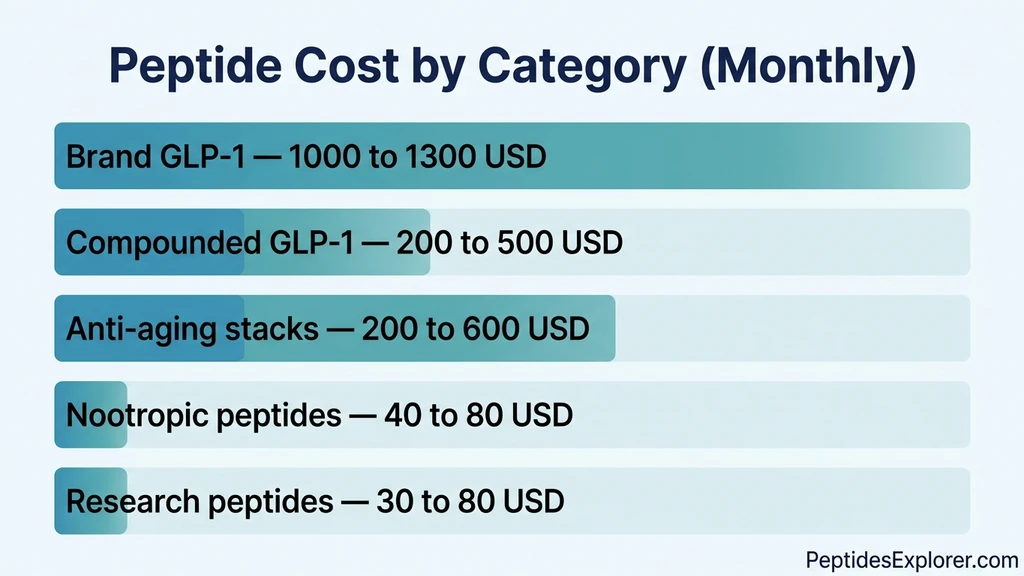
You looked up BPC-157 on three sites and got three different prices: $39, $62, and $140. Then you saw a tirzepatide telehealth ad for $199/month, remembered your friend paying $1,300 for Zepbound at the pharmacy, and now nothing makes sense. Peptide pricing is not one market, it is four markets stacked on top of each other, each with its own regulatory status, supply chain, and realistic monthly spend. Weight loss GLP-1s run $200 to $1,300 per month depending on whether you buy compounded, brand self-pay, or with insurance. Research peptides like BPC-157, TB-500, and GHK-Cu run $30 to $80 per vial. Anti-aging stacks typically land at $200 to $600 per month. Nootropic peptides are the cheapest at $40 to $80 per month. Almost none of these are covered by insurance, and the sticker price is rarely the true cost once you add bacteriostatic water, syringes, shipping, and provider consults.
| Category | Typical Monthly Cost | FDA Status | Insurance Likely? |
|---|---|---|---|
| Brand GLP-1 (Zepbound, Wegovy) | $1,000-$1,300 list, $350-$550 self-pay direct | FDA-approved | Sometimes (diabetes yes, obesity rarely) |
| Compounded GLP-1 (telehealth) | $200-$500 | Not FDA-approved (compounded) | No |
| Research peptides (BPC-157, TB-500, GHK-Cu) | $30-$80 per 5-10 mg vial | Research-use-only | No |
| Anti-aging stacks (GHK-Cu, epithalon, etc.) | $200-$600 | Research-use-only | No |
| Nootropic peptides (Selank, Semax) | $40-$80 | Research-use-only | No |
| Growth hormone peptides (CJC/Ipamorelin) | $150-$400 | Research-use-only (compounded in some clinics) | Rarely |
The real answer to "are peptides expensive" is: it depends on which peptide, which supplier, and whether you care about FDA approval. A month of BPC-157 at a reputable research supplier can cost less than a dinner out. A month of brand Zepbound without insurance can cost more than a car payment. Both are "peptides" in the pop-science sense, but they belong to completely different economic universes.
This guide walks through each category, the hidden costs almost everyone forgets, and how to calculate your real total. Use the peptide cost calculator as you read to model your own stack. This is educational content, not medical advice; verify pricing directly with any provider before purchasing.
Get your custom peptide protocol:
- Tailored to your body and goals
- Precise dosing and cycle length
- Safe stacking combinations
- Backed by peer-reviewed studies
- Ready in under 2 minutes
Why Peptide Prices Vary So Wildly
If you try to answer "how much do peptides cost" with a single number, you will get it wrong every time. Five variables drive the spread:
1. FDA-approval status. FDA-approved peptides (semaglutide as Ozempic/Wegovy, tirzepatide as Mounjaro/Zepbound, liraglutide as Saxenda, teriparatide as Forteo) go through Phase 3 trials, manufacturer scale-up, and marketed distribution. That process costs hundreds of millions of dollars, and the price reflects it. Research peptides sold "for laboratory use only" skip that entire pipeline, which is why a vial can cost $30.
2. Brand vs compounded vs research-grade. Even within a single molecule like tirzepatide, you have three tiers: - Brand (Eli Lilly's Zepbound): highest price, strongest regulatory oversight, standardized formulation - Compounded (503A/503B pharmacies via telehealth): mid price, variable oversight, may include additives - Research-grade (peptide suppliers, technically not for human use): lowest price, supplier-dependent quality
3. Insurance coverage. Insurance covers FDA-approved peptides only when used for FDA-approved indications, and even then often with step therapy, prior authorization, and formulary restrictions. Semaglutide for type 2 diabetes is often covered; semaglutide for obesity (as Wegovy) is often not. See how much is semaglutide and tirzepatide cost with insurance for the details.
4. Dose and cycle length. A peptide that costs $50 per vial does not cost $50 per month if you need two vials per month. Higher-dose GLP-1 titration schedules (12.5 to 15 mg weekly tirzepatide) cost meaningfully more than entry doses. Long cycles of anti-aging stacks compound quickly.
5. Supply chain and geography. Peptides synthesized in the US are more expensive than peptides imported from overseas manufacturers. Reputable US research suppliers cost 2-3x more than random overseas sellers, and the price gap reflects quality control differences (identity testing, purity assays, endotoxin screening, cold-chain handling). Cheap is often expensive once you factor in the risk.
The four category breakdowns below give you realistic numbers for each, with the hidden-cost corrections layered on at the end.
Weight Loss Peptides: The Most Expensive Category
GLP-1 receptor agonists (semaglutide, tirzepatide, liraglutide, retatrutide in trials) are the headline-grabbing peptides and also the most expensive. The cost depends entirely on which tier you access.
Brand name, full list price: - Zepbound (tirzepatide): approximately $1,060 per month - Wegovy (semaglutide): approximately $1,350 per month - Mounjaro (tirzepatide for diabetes): approximately $1,100 per month - Ozempic (semaglutide for diabetes): approximately $970 per month - Saxenda (liraglutide): approximately $1,350 per month
These are the numbers on the pharmacy receipt before any insurance or discount is applied.
Brand name with manufacturer direct-to-consumer self-pay: - LillyDirect Zepbound: $349-$549 per month depending on dose and vial vs pen - Novo Nordisk Wegovy direct: similar price band with their savings card program
Direct self-pay dropped dramatically in 2024-2025 once manufacturers realized the compounded market was eating their lunch. These prices are now competitive with telehealth compounded for lower doses and make the FDA-approved product the smarter choice for many patients.
Brand name with insurance: - Covered with standard copay: $25-$100 per month (rare for obesity, more common for diabetes) - Covered after deductible: varies wildly; some plans cover 80-100% after deductible, others cover 50% - Not covered (formulary exclusion or obesity exclusion): full list price or manufacturer savings card
A US cost-effectiveness analysis found that at current net prices, tirzepatide costs $197,023 per quality-adjusted life year (QALY) and semaglutide costs $467,676/QALY, neither meeting standard $100,000/QALY cost-effectiveness thresholds. Tirzepatide would need a 30% price reduction and semaglutide an 80% reduction to be considered cost-effective (Hwang et al., 2025).
The key insurance reality: most commercial plans do not cover GLP-1s for obesity, only for type 2 diabetes. If you have type 2 diabetes (or prediabetes progressing to diabetes) plus obesity, your odds of coverage jump significantly.
Compounded GLP-1 via telehealth: - Entry dose (2.5-5 mg weekly tirzepatide, 0.25-0.5 mg weekly semaglutide): $150-$250 per month - Mid dose (7.5-10 mg weekly tirzepatide, 1-1.7 mg weekly semaglutide): $250-$350 per month - High dose (12.5-15 mg weekly tirzepatide, 2.4 mg weekly semaglutide): $300-$500 per month
These prices are from providers like Henry Meds, Ivim Health, Mochi Health, Vitastir, and many others. They are cheaper than brand because the compounding pharmacy buys raw active pharmaceutical ingredient and formulates in-house, skipping manufacturer margin and FDA-approved packaging.
Research-grade tirzepatide or semaglutide: - Per 5 mg vial: $35-$80 from reputable research suppliers - Monthly cost at typical dosing: $40-$120 per month
This is the cheapest option and the most regulatory gray. Research peptides are explicitly "not for human use," which means you lose legal protection, quality guarantees, and any safety net if something goes wrong. A FDA Adverse Event Reporting System pharmacovigilance analysis found compounded GLP-1 products had higher reporting odds ratios for abdominal pain (2.84), suicidality (6.34), and cholecystitis (3.39) compared to FDA-approved products (Hoffman et al., 2025). See fda peptide crackdown and is compound tirzepatide safe.
Bottom-line monthly cost for weight loss peptides: - Insurance covers brand: $25-$100 - Self-pay brand via LillyDirect or similar: $350-$550 - Telehealth compounded: $200-$500 - Research-grade (not medical-grade): $40-$150
For a deeper comparison, see how much is semaglutide and tirzepatide cost with insurance.
Research Peptides: The Cheapest Category
Research peptides are what most people mean when they ask "are peptides expensive" after reading a fitness forum. Examples include BPC-157 (gut healing, joint recovery), TB-500 (tissue repair), GHK-Cu (skin, hair, wound healing), Melanotan II (tanning), PT-141 (sexual function), and many others. They are sold "for laboratory use only" by research chemical suppliers.
Typical per-vial pricing from reputable research suppliers: - BPC-157 (5 mg vial): $25-$50 - BPC-157 (10 mg vial): $45-$85 - TB-500 (5 mg vial): $35-$65 - TB-500 (10 mg vial): $60-$110 - GHK-Cu (50 mg vial): $40-$80 - GHK-Cu (100 mg vial): $70-$140 - Melanotan II (10 mg vial): $25-$45 (the Melanotan 2 dosage calculator shows how many doses one vial yields) - PT-141 (10 mg vial): $40-$70 - Selank (10 mg vial): $30-$60 - Semax (10 mg vial): $35-$65 - Epithalon (50 mg vial): $30-$60
A "5 mg vial" lasts between two and six weeks depending on dosing protocol, so per-month cost usually lands between half a vial and two vials.
Monthly cost by typical protocol: - BPC-157 at 500 mcg/day subcutaneous: about $20-$40 per month (one 5 mg vial lasts 10 days, so ~3 vials/month, but lower doses stretch further) - TB-500 at 2-4 mg per week: about $30-$60 per month - GHK-Cu at 1-2 mg/day: about $40-$80 per month - Anti-aging stack (BPC-157 + TB-500 + GHK-Cu): about $100-$200 per month for the peptides alone
Where the price range comes from: - Low end ($25-$40 per vial): overseas suppliers or cut-rate US sellers with minimal testing documentation - Middle ($40-$70 per vial): US-based suppliers with certificates of analysis (COA) and third-party purity testing - High end ($70-$140 per vial): premium US suppliers with mass spec verification, endotoxin testing, and cold-chain shipping
Price does not perfectly correlate with quality, but the floor prices almost always come from lower-quality sources. If a site sells BPC-157 at $12 per 5 mg vial, something is wrong: either the vial contains less than labeled, the peptide is not what is claimed, or corners were cut on manufacturing.
For a vetted supplier list, see where to buy peptides 2026 and peptide sciences alternatives. For reconstitution logistics, see where to buy bacteriostatic water for injection.
Bottom-line monthly cost for research peptides: - Single research peptide (BPC-157, GHK-Cu, Melanotan II, etc): $30-$80 per month - Two-peptide stack: $60-$150 per month - Comprehensive stack (3-5 peptides): $150-$400 per month
Anti-Aging and Longevity Peptide Stacks
The anti-aging peptide category overlaps with research peptides but deserves its own discussion because full protocols stack several peptides together and cycle them over months.
Common anti-aging peptides and their monthly costs: - Epithalon (telomere support, sleep): $30-$60 per month on cycle - GHK-Cu (skin, hair, collagen): $40-$80 per month - BPC-157 (systemic healing): $30-$80 per month - TB-500 (tissue repair): $30-$60 per month - Thymosin alpha-1 (immune support): $100-$200 per month (pricier, less common) - NAD+ peptides (cellular energy): $60-$150 per month - MOTS-c (mitochondrial function): $80-$150 per month
Typical "longevity stack" monthly budgets: - Basic (GHK-Cu + BPC-157): $80-$160 per month - Intermediate (GHK-Cu + BPC-157 + epithalon cycled): $100-$200 per month - Advanced (GHK-Cu + BPC-157 + TB-500 + epithalon + MOTS-c): $300-$600 per month
Most protocols cycle peptides, meaning 6-12 weeks on, 4-8 weeks off, which reduces true annual cost but not the per-month-on-cycle cost.
Growth hormone secretagogue stacks (CJC-1295 + Ipamorelin, Sermorelin, Tesamorelin): These are a separate subcategory because they are sometimes prescribed by anti-aging clinics as compounded products rather than purchased research-grade.
- Research-grade CJC-1295 + Ipamorelin blend: $50-$100 per vial, $80-$180 per month
- Clinic-compounded CJC/Ipamorelin via anti-aging provider: $200-$450 per month
- Tesamorelin (brand Egrifta is FDA-approved for lipodystrophy, list price $4,000+/month; research-grade around $100-$200/month)
- Sermorelin (compounded from anti-aging clinics): $150-$350 per month
The clinic-compounded tier includes provider consultations, blood work panels, and regulatory compliance cost, which explains the 3-5x premium over research-grade.
Bottom-line monthly cost for anti-aging stacks: - Single peptide: $30-$80 per month - Standard stack: $100-$250 per month - Advanced or clinic-managed stack: $300-$600 per month
For background on which peptides have the best evidence base, see are peptides legal for the regulatory landscape before investing in any protocol.
Nootropic Peptides: The Budget Tier
Nootropic peptides are the cheapest category because dosing is low, vials last long, and the primary options (Selank, Semax, Cerebrolysin, noopept adjacent peptides) are produced in Russia and Eastern Europe at scale.
Typical monthly cost: - Selank (10 mg vial at 300-600 mcg/day): $30-$60 per vial, one vial lasts 2-4 weeks - Semax (10 mg vial at 500-1000 mcg/day): $35-$65 per vial, one vial lasts 2-3 weeks - Cerebrolysin (5 mL ampoule from European pharmacies): $5-$15 per ampoule, $40-$100 per month for daily cycling - Dihexa (oral, not technically injectable): $50-$100 per month
Monthly cost for typical nootropic use: - Single peptide (Selank or Semax): $40-$80 per month - Dual stack (Selank + Semax): $70-$130 per month - Full stack with Cerebrolysin cycle: $120-$250 per month during cycle
These peptides have thinner clinical evidence than GLP-1s or even BPC-157, but they are inexpensive enough that the hobbyist market is sizeable. For context on the intranasal-vs-injectable tradeoffs and whether the cost is justified, most users run short cycles (4-8 weeks) rather than continuous dosing.
Hidden caveat for Eastern European nootropics: Shipping times from original-source suppliers (often Russia, Ukraine, Kazakhstan) are longer, payment processing is sometimes awkward, and customs seizures do happen. Many US buyers pay a 20-40% premium to go through US-based resellers who handle import risk.
Hidden Costs Almost Everyone Forgets
The vial sticker price is rarely the true monthly cost. Here is what adds up behind the scenes.
Bacteriostatic water (bac water). - A 30 mL vial costs $10-$25 from compounding pharmacies or $3-$8 from research suppliers - One 30 mL vial lasts roughly 1-3 months depending on protocol - Per-month cost: $3-$12
See where to buy bacteriostatic water for injection for sources.
Syringes and needles. - Insulin syringes with attached needles: $15-$30 per box of 100 - A daily injector uses roughly 30 per month: $5-$10 per month - Larger-gauge draw needles (if separate): add $5-$15 per month
Alcohol swabs and sharps disposal. - Alcohol prep pads: $5-$10 per box of 200 - Sharps container: $10-$20 per quarter - Monthly cost: $3-$8
Shipping and cold-chain fees. - Research suppliers: free over some threshold, otherwise $10-$20 per order - Telehealth compounded: usually included in subscription, sometimes $15-$30 for one-offs - Cold-chain surcharges in summer: $10-$25 occasionally
Provider consultations. - Telehealth subscription (Vitastir, Henry Meds, etc.): consult typically bundled into monthly fee - Anti-aging clinic intake: $200-$600 one-time - Anti-aging clinic ongoing: $150-$400 per visit, every 3-6 months - Lab work (baseline + follow-up): $150-$500 per panel depending on scope
Dose escalations and waste. - If you titrate up mid-vial and now have leftover peptide at the old concentration, you may waste 20-30% of that vial - Expired peptides that were reconstituted too long ago and not used: another 10-15% waste over a year
Annual total true cost correction: If a telehealth subscription advertises $250 per month, your true annualized cost including supplies, lab work, and occasional ancillaries is usually $300-$400 per month. If a research peptide stack looks like $100 per month on the vial prices alone, your true cost with bac water, syringes, swabs, and shipping is usually $120-$160.
Use the peptide cost calculator to model your actual spend including these line items. For dose math, see peptide reconstitution calculator.
How to Decide What You Actually Need to Spend
Cost-optimization for peptides depends heavily on goal and risk tolerance. Three common scenarios and the budget framing for each.
Scenario 1: Medical weight loss, insured. - First check: is Zepbound or Wegovy on your plan's formulary? Call the pharmacy benefit manager - If yes with prior auth: you are looking at $25-$100 per month copay. Use the FDA-approved brand. - If no: LillyDirect at $349-$549 for Zepbound is the next-safest option and often cheaper than telehealth at higher doses - Last resort if cost is still prohibitive: compounded telehealth at $200-$400 per month with the legitimacy checklist from is compound tirzepatide safe
Scenario 2: Joint recovery or injury healing (BPC-157, TB-500). - Insurance will not cover this category - Reputable US research supplier with COA: $60-$150 per month for a typical stack - Budget for 2-3 months to see results, not one month - Total realistic budget: $150-$500 for a healing protocol
Scenario 3: Longevity or anti-aging exploration. - Start with one peptide (usually GHK-Cu or BPC-157) for 8-12 weeks to see whether you notice anything - Total introductory budget: $100-$300 over the first cycle - Scale up only if you see results and have budget headroom
The cost-per-outcome framing. The right question is not "are peptides expensive" but "what is the cost per measurable outcome." A $300/month GLP-1 that takes you from obese to healthy weight is one of the most cost-effective medical interventions available when you price in the downstream healthcare savings. A $50/month research peptide that provides vague benefits you cannot measure is expensive per unit of actual gain.
Red-flag cheap. If a supplier is 50-70% below the market floor for a peptide, that is not a deal, that is a quality warning. Reputable production has a floor cost driven by raw materials, purification, and testing. Below that floor means something was skipped, usually quality control, identity testing, or actual peptide mass.
Red-flag expensive. Anti-aging clinics charging $600-$1,200 per month for a stack of 2-3 research-grade peptides are marking up 5-10x over the unbundled cost. You are paying for the provider relationship. That can be worth it for accountability and medical oversight, but it is a choice, not a necessity.
For the full framework on where to source safely, see where to buy peptides 2026 and peptide sciences alternatives.
Frequently Asked Questions
Are peptides expensive compared to other supplements?
It depends on the peptide. Research peptides like BPC-157 at $30-$80 per month are comparable to a mid-tier supplement stack. Weight loss GLP-1s at $200-$1,300 per month are much more expensive than any supplement and closer to a prescription medication cost. Nootropic peptides like Selank and Semax are closer to supplement pricing. See where to buy peptides 2026 for how to avoid overpaying.
How much does a month of BPC-157 cost?
Typically $30-$80 per month for a single user at standard dosing (250-500 mcg once or twice daily) from a reputable research supplier. A 5 mg vial costs $25-$50 and lasts 10-20 days at typical protocols. Add $5-$15 per month for bacteriostatic water, syringes, and swabs. See peptide reconstitution calculator to work out your exact per-dose cost.
Why is tirzepatide so much cheaper through telehealth than at the pharmacy?
Telehealth compounded tirzepatide ($200-$500/month) skips brand-name manufacturing, marketing, and distribution costs that brand Zepbound ($1,000-$1,300/month list) carries. The active molecule is the same, but compounded products are not FDA-approved as finished dosage forms. See is compound tirzepatide safe for the tradeoffs and tirzepatide cost with insurance for covered options.
Does insurance cover peptide therapy?
Rarely. FDA-approved peptides for FDA-approved indications are sometimes covered (semaglutide for type 2 diabetes, teriparatide for osteoporosis, tesamorelin for lipodystrophy). Everything else including all research peptides and all compounded GLP-1s is out of pocket. HSA and FSA may reimburse certain prescribed peptides. See tirzepatide cost with insurance for the insurance navigation details.
What is the cheapest legitimate way to buy peptides?
For research peptides: buy from established US-based suppliers with certificates of analysis at per-vial prices (not the cheapest listing, but the middle-market price). For GLP-1s: check insurance first, then LillyDirect or Novo Nordisk direct self-pay for brand, then reputable telehealth compounded. Cheap overseas sellers are not actually cheap once you factor in purity and identity risk. See where to buy peptides 2026 and peptide sciences alternatives.
How much does a full anti-aging peptide stack cost per month?
A basic stack (GHK-Cu + BPC-157) runs $80-$160 per month. An intermediate stack adding epithalon or TB-500 runs $100-$250 per month. An advanced stack with 4-5 peptides including MOTS-c or thymosin alpha-1 runs $300-$600 per month. Clinic-managed protocols add $150-$400 per consultation on top. Most protocols cycle rather than running continuously, which reduces annual spend. See are peptides legal before investing in any protocol.
Are cheap overseas peptides safe?
Usually not. Peptides priced 50-70% below the US market floor typically skipped identity testing, purity assays, or endotoxin screening, any of which can ruin the product. Import seizures also happen, so you may pay and receive nothing. The per-dollar value is almost always better with a mid-priced reputable US supplier with a public certificate of analysis. See peptide sciences alternatives for a vetted supplier list.
What hidden costs should I budget for beyond the vial price?
Bacteriostatic water ($3-$12/month), insulin syringes ($5-$10/month), alcohol swabs ($3-$8/month), sharps disposal ($3-$7/month), shipping ($0-$20/order), and occasional provider consultations ($150-$600 per visit for clinic-managed stacks). The total hidden cost runs 20-40% above the sticker price of the peptide itself. See where to buy bacteriostatic water for injection for supply sourcing and peptide cost calculator to model your full spend.
The Bottom Line
Peptides are not one price point, they are four overlapping markets with wildly different economics. Brand-name weight loss GLP-1s can hit $1,300 per month at list price, compounded versions of the same molecule land at $200-$500, research-grade versions of that molecule hit $40-$150, and pure research peptides like BPC-157 or Selank run $30-$80 per month. Where you land depends on which peptide you need, whether insurance covers it, and how much regulatory certainty you want in the product.
The single most useful cost-reduction move is ordering in the right sequence: for FDA-approved indications, always check insurance first, then manufacturer direct self-pay (LillyDirect, Novo Nordisk direct), then telehealth compounded, then research-grade as a last resort with full understanding of the regulatory gray. For research peptides, pay the middle-of-market price from a supplier with a public certificate of analysis rather than chasing the cheapest listing. And always price the hidden costs (bac water, syringes, shipping, consults) when you build your budget, because they reliably add 20-40% to the sticker price.
Verify current pricing with any supplier or provider directly before purchasing, because telehealth subscriptions and research peptide vial prices both move monthly. Use the peptide cost calculator to model your stack and the peptide reconstitution calculator to translate per-vial pricing into per-dose pricing. This guide gives you the realistic 2026 ranges, but the specific number you pay will be the one on the invoice you actually receive.
This is educational content, not medical advice. Peptide therapy involves clinical and regulatory risk, and prices reflect only the financial side of that decision.
Related Articles: - Tirzepatide Cost With Insurance - Where to Buy Peptides 2026 - Where to Buy Bacteriostatic Water for Injection - Is Compound Tirzepatide Safe - Are Peptides Legal - Peptide Sciences Alternatives - FDA Peptide Crackdown
Related Articles
Tirzepatide Cost With Insurance (2026)
Tirzepatide costs $550-$1,060/month at list price. With commercial insurance, copays range from $25-$150/month. Mounjaro, Zepbound, Medicare breakdown.
GLP-1 Cost Statistics 2026: Real Prices, Verified
How much GLP-1 drugs really cost in 2026: Wegovy lists at $1,349/mo but self-pay runs $349, Zepbound vials $299-449, compounded from $149. Verified prices.
Elite Research Peptides Reviews 2026: Legit or Not?
Elite Research USA review 2026 (eliteresearchusa.com): login-gated shop, public COAs, 23 of 50 Finnrick tests passed, 5 Trustpilot reviews, Reddit, red flags.
Best Time to Take MOTS-c: Morning, Fasted or Night?
Best time to take MOTS-c: morning, fasted, 30 to 60 minutes before cardio. The eating window after the shot, daily vs 3x a week, night dosing, missed doses.