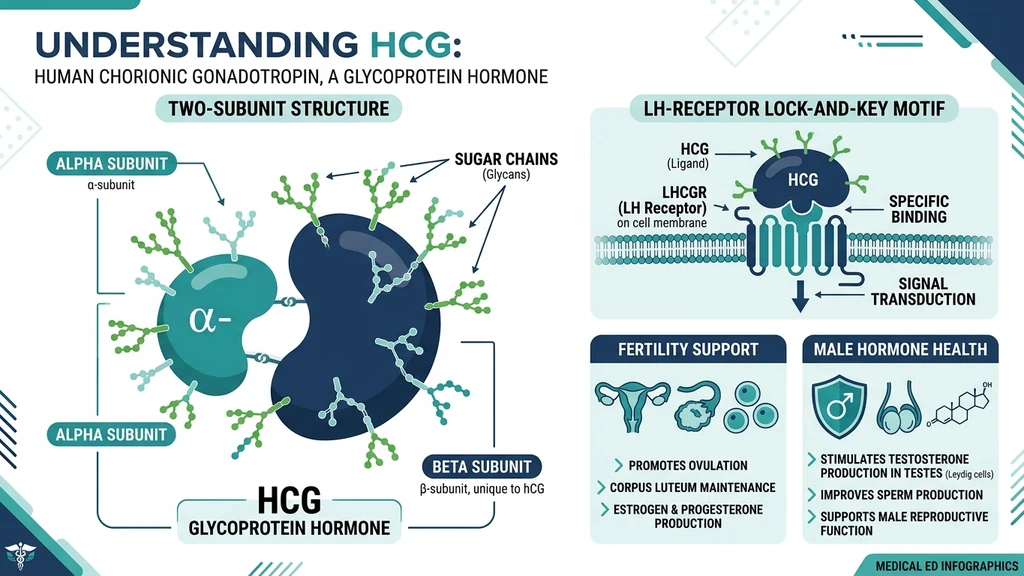
You found "HCG" listed in a peptide catalog, sitting between BPC-157 and a stack of research vials, tagged as a men's hormone tool. Then a fertility clinic mentions the same three letters, and a diet blog swears it melts fat. The label is doing a lot of work, and most of it is misleading. HCG (human chorionic gonadotropin) is a glycoprotein hormone. Biochemists do not classify it as a peptide, because it is a large two-subunit protein carrying sugar chains. The peptide community groups it with peptides because it is injected and dosed the same way. HCG is an FDA-approved prescription medicine for female fertility and, in men, for treating hypogonadism and restarting natural testosterone and sperm production. The FDA says it does not work for weight loss.
| Quick Reference | Detail |
|---|---|
| What it is | Glycoprotein hormone (two subunits, glycosylated) |
| Is it a peptide? | No, not in the strict sense; grouped with peptides by convention |
| Drug class | Gonadotropin |
| Medical uses | Female fertility/ovulation, male hypogonadism, testosterone and sperm restart |
| Regulatory status | FDA-approved prescription medicine |
| Weight loss | Not effective; FDA warns against the HCG diet |
| Route | Subcutaneous or intramuscular injection, physician-directed |
HCG is real medicine with a real prescription pad behind it, which separates it from most of the research chemicals it gets shelved next to. That distinction changes how you should think about it. This guide covers the biochemistry that answers "is HCG a peptide," what the hormone actually does in the body, its legitimate uses in fertility and men's health, its role alongside testosterone therapy, and why the weight-loss version is a myth the FDA has already knocked down.
Get your custom peptide protocol:
- Tailored to your body and goals
- Precise dosing and cycle length
- Safe stacking combinations
- Backed by peer-reviewed studies
- Ready in under 2 minutes
Is HCG a Peptide? The Honest Biochemistry
You came for a yes or no, so here it is with the reasoning attached. A peptide is a short chain of amino acids, usually under 50, held together by peptide bonds and nothing else. HCG is far bigger and more decorated than that.
HCG is built from two separate protein chains, called the alpha and beta subunits, locked together into one working unit. Hanging off those chains are branched sugar molecules, which is what "glycoprotein" means. Those sugars are not decoration. They protect the hormone from breakdown and give it an unusually long life in the bloodstream compared to a bare peptide.
So the strict answer is no. HCG is a glycoprotein hormone, in the same structural family as LH, FSH, and TSH. Calling it a peptide is a convenience the research-chemical market uses because HCG is a lyophilized powder you reconstitute and inject, exactly like the peptides men actually run.
The distinction matters for one practical reason. True peptides sold online often move through a legal gray zone, while HCG is a scheduled prescription drug you cannot legally buy without a doctor. If the legal status of these compounds is what you are weighing, the are peptides legal guide draws the line clearly. HCG sits firmly on the prescription side of it.
What HCG Actually Does in the Body
Think of luteinizing hormone, or LH, as the key your brain cuts and sends down to the testes. That key fits a specific lock on the Leydig cells, and turning it tells those cells to make testosterone. HCG is a duplicate key cut to the same shape.
The literal version: HCG binds the same LH receptor that natural LH uses, so the body reads it as an LH signal. In men, that stimulates the testes to produce testosterone and maintain sperm production. In women, the same receptor signal triggers final egg maturation and ovulation.
This is why HCG behaves so differently from taking testosterone directly. Injected testosterone shuts the testes down, because the brain sees enough hormone and stops sending its own signal. HCG does the opposite. It reaches past the brain and pokes the testes awake, keeping them working even when the brain has gone quiet.
That single mechanism explains every legitimate use of the drug. Fertility clinics use it to force ovulation on schedule. Men's health clinics use it to keep the testosterone factory running. The difference between peptides and steroids turns on exactly this kind of signaling logic, and HCG is a clean example of a signal rather than a replacement.
Legitimate Medical Uses of HCG
HCG earns its FDA approval in two clinical settings, and both are worth understanding before you judge the hormone by its diet-blog reputation.
Female fertility and ovulation induction. In assisted reproduction, a woman's ovaries are stimulated with other hormones until the eggs are nearly ready. A single "trigger shot" of HCG then mimics the natural LH surge that releases the egg, timing ovulation precisely for insemination or egg retrieval. This is standard, decades-old practice in fertility medicine.
Male hypogonadism. In men whose testosterone runs low because the brain's signal is weak, HCG can substitute for that missing LH and restart the testes directly. A 2019 study found HCG monotherapy improved hypogonadal symptoms in men, working through the body's own testosterone production rather than replacing it (Int Braz J Urol, 2019).
Preserving fertility during treatment. This is where HCG has become genuinely important. Standard testosterone therapy suppresses sperm production, which is a problem for younger men who still want children. A 2025 review in Nature Reviews Urology describes HCG as a core tool for maintaining spermatogenesis in reproductive-age men on or coming off testosterone (Nat Rev Urol, 2025).
None of these uses is a shortcut you self-prescribe. Each runs through bloodwork, a diagnosis, and a physician who adjusts the dose to your labs. If you are new to hormone-adjacent compounds entirely, getting started with peptides sets the right baseline expectations first.
HCG in TRT and Post-Steroid Recovery
This is the use that drives most searches for "HCG peptide," and it is legitimate when a doctor runs it. Two scenarios dominate.
Alongside testosterone therapy (TRT). When a man goes on TRT, his own LH signal switches off and his testes shrink and stop making sperm. Low-dose HCG run in parallel keeps the testes stimulated, which preserves testicular size and fertility while the man stays on testosterone. A 2022 study reported that HCG monotherapy was safe in men with previous exogenous testosterone use, supporting its role in this population (Cureus, 2022).
Restarting the system after anabolic steroids. Men who used anabolic steroids often crash into a suppressed state where the brain has stopped signaling and testosterone stays on the floor for months. This condition has a name, anabolic steroid-induced hypogonadism, and a 2014 paper in Fertility and Sterility lays out HCG as part of the treatment used to reboot the natural axis (Fertil Steril, 2014).
The recovery logic is straightforward. HCG wakes the testes directly, and drugs like clomiphene push the brain to resume its own signaling, so the two are often paired. This is the medical counterpart to the informal "post-cycle" protocols discussed around peptides versus steroids, except it is prescribed and monitored.
HCG is not a growth or performance drug, and it is not interchangeable with growth hormone. If your interest is body composition rather than fertility, the HGH versus peptides comparison covers that lane instead. HCG lives in the hormone-axis lane.
The HCG Diet Myth
The HCG diet pairs daily HCG shots or drops with a starvation-level 500-calorie diet, and it promises rapid, targeted fat loss. The weight comes off. The HCG has nothing to do with it.
The FDA's position is blunt. The agency states that HCG is not approved for weight loss, that no substantial evidence shows it increases fat loss beyond calorie restriction alone, and that over-the-counter "homeopathic HCG" weight-loss products are illegal. Any pounds lost on the protocol come from eating 500 calories a day, which almost anyone can do to themselves without a hormone.
The danger is in that number. A 500-calorie diet is roughly a quarter of what an average adult needs, and running it for weeks risks gallstones, electrolyte imbalance, muscle loss, and heart rhythm problems. The hormone gives the starvation a medical costume, which makes people trust a diet they would otherwise recognize as unsafe.
Here is the clean summary. HCG signals the gonads, not fat cells. It has no mechanism to burn fat, and no controlled trial has shown it does. If a product promises weight loss from HCG, treat that as a marketing claim the FDA has already rejected, and read the peptide safety guide before trusting any vendor making it.
Dosage Context: This Is Prescription Medicine
You will find dosing charts online, and you should treat them as context rather than instructions. HCG dosing is set by a physician against your diagnosis and your bloodwork, and the right number for fertility differs completely from the right number for maintaining testes on TRT.
A few orienting facts, not a protocol: - HCG is dosed in international units (IU), not milligrams, which trips up people used to peptide charts. - Fertility "trigger" doses are large and given once at a precise time in the cycle. - Maintenance doses used alongside TRT are far smaller and given a few times per week. - Post-steroid recovery courses are time-limited and paired with other drugs and follow-up labs.
The reason self-dosing fails is that HCG works through a feedback system. Too much, too often, can desensitize the very Leydig-cell receptors you are trying to stimulate, blunting the response you paid for. A physician titrates against measured testosterone and estrogen levels precisely to avoid that.
HCG also arrives as a lyophilized powder that you reconstitute with bacteriostatic water, and a misread on an insulin syringe swings the dose several-fold. That handling risk is identical to any injectable, and the peptide safety guide walks through sterile technique. The dose itself, though, belongs to your prescriber. Not sure this compound fits your goal at all? The peptide quiz is a faster starting point than copying a forum protocol.
Safety and Side Effects
HCG has a long clinical track record, which means its side effects are well characterized rather than mysterious. Most are downstream of the hormone doing its job.
In men. Because HCG drives testosterone production, it can also raise estrogen as the body converts some of that testosterone, leading to water retention, moodiness, acne, or breast tenderness. Doses that are too high can overstimulate and eventually desensitize the testes. The 2022 safety analysis found monotherapy well tolerated in men with prior testosterone use, but that was under clinical supervision (Cureus, 2022).
In women. The main serious risk is ovarian hyperstimulation syndrome, where the ovaries overrespond, which is why fertility HCG is always given inside a monitored cycle. Multiple pregnancy is also more likely when it is used to induce ovulation.
General cautions. HCG can promote fluid retention, so it deserves care in anyone with heart, kidney, or seizure conditions. It is not used in hormone-sensitive cancers without specialist oversight. Injection-site reactions and headaches are common and mild.
Who should not self-source it. Everyone. HCG is a prescription drug for a reason, and vials bought through research-chemical channels carry the added risk of being underdosed, contaminated, or something else entirely. The vetting framework in the peptide safety guide applies, but the cleaner answer for HCG is to get it through a clinic that also runs the labs that make it work.
Frequently Asked Questions
Is HCG a peptide?
No, not in the strict sense. HCG is a glycoprotein hormone built from two protein subunits and sugar chains, which makes it much larger than a true peptide of under 50 amino acids. The peptide community groups it with peptides because it is injected and reconstituted the same way, as covered in getting started with peptides.
What is HCG used for in men?
In men, HCG treats hypogonadism, preserves testicular size and fertility during testosterone therapy, and helps restart natural testosterone after anabolic steroid use (Fertil Steril, 2014). It stimulates the testes directly rather than replacing testosterone. See peptides for men for the wider men's-health context.
Does HCG work for weight loss?
No. The FDA states HCG is not approved for weight loss and shows no fat-loss benefit beyond calorie restriction. Any weight lost on the HCG diet comes from its dangerous 500-calorie plan, not the hormone. HCG signals the gonads, not fat cells, so treat weight-loss claims as marketing per the peptide safety guide.
How does HCG differ from testosterone therapy?
Testosterone therapy replaces the hormone and shuts the testes down, while HCG mimics LH and stimulates the testes to keep producing their own testosterone and sperm. This is why the two are often combined (Nat Rev Urol, 2025). Compare the options in best peptides for testosterone.
Is HCG legal to buy?
HCG is an FDA-approved prescription drug, so it is legal only with a doctor's prescription, unlike many research peptides sold in a legal gray zone. Buying it through research-chemical channels risks contamination and legal exposure. The line between prescription and gray-market compounds is drawn in are peptides legal.
What are the side effects of HCG?
In men, HCG can raise estrogen, causing water retention, acne, moodiness, or breast tenderness, and excessive doses can desensitize the testes (Cureus, 2022). In women, the main risk is ovarian hyperstimulation. Injection-site reactions are common and mild. Review handling risks in the peptide safety guide.
Can HCG restore fertility after steroids?
Yes, it is a core tool for it. Anabolic steroids suppress the natural hormone axis, and HCG wakes the testes directly while other drugs restart brain signaling (Fertil Steril, 2014). This is prescribed and monitored recovery, not a self-run protocol. See how signaling differs in peptides vs steroids.
How is HCG dosed?
HCG is dosed in international units by a physician against your bloodwork, and fertility, TRT-maintenance, and recovery doses differ widely. Self-dosing risks desensitizing the receptors you are trying to stimulate. It is prescription medicine, so a clinic sets the number. Unsure it fits your goal? Start with the peptide quiz.
The Bottom Line
HCG sits in a category most peptide catalogs get wrong. It is a glycoprotein hormone rather than a true peptide, an FDA-approved prescription medicine rather than a research chemical, and a fertility and hormone-axis tool rather than a fat-loss drug. The honest summary is that HCG mimics LH to stimulate the testes or ovaries, which gives it real value in fertility care, male hypogonadism, and recovery from testosterone suppression.
The weight-loss reputation is the part to discard. The FDA has rejected it, the mechanism does not exist, and the danger lives in the starvation diet the hormone is used to disguise. For its legitimate uses, HCG belongs in a clinic, with bloodwork and a prescriber setting the dose, because that supervision is what makes it work and keeps it safe.
If you are exploring men's hormone health, start with peptides for men and best peptides for testosterone. For the closely related fertility gonadotropin, see the HMG peptide guide, and for handling any injectable safely, read the peptide safety guide.
This is educational content, not medical advice. HCG is a prescription medicine; consult a licensed healthcare provider before use. Explore more peptide research and tools at https://peptidesexplorer.com.
References
- 1.Anabolic steroid-induced hypogonadism: diagnosis and treatment. Fertil Steril, 2014. PMID 24636400
- 2.The Safety of Human Chorionic Gonadotropin Monotherapy Among Men With Previous Exogenous Testosterone Use. Cureus, 2022. PMID 35822152
- 3.Human Chorionic Gonadotropin monotherapy for the treatment of hypogonadal symptoms in men. Int Braz J Urol, 2019. PMID 31408289
- 4.Testosterone replacement therapy and spermatogenesis in reproductive age men. Nat Rev Urol, 2025. PMID 40346275
Related Articles
Best Time to Take MOTS-c: Morning, Fasted or Night?
Best time to take MOTS-c: morning, fasted, 30 to 60 minutes before cardio. The eating window after the shot, daily vs 3x a week, night dosing, missed doses.
What Size Needle for Peptide Injections? Gauge
What size needle for peptide injections: 29 to 31 gauge, 5/16 inch (8 mm), U-100 insulin syringe. Gauge chart, length by body fat, draw vs inject needles.
How Long Does KPV Take to Work? Timeline
How long does KPV take to work: gut symptoms in 1 to 2 weeks, skin in 2 to 4, systemic inflammation in 2 to 6. Half-life, onset by route, and when to stop.
Where to Inject KPV: Best Sites and Technique
Where to inject KPV: belly fat, outer thigh, arm or flank with a 29 to 31G insulin needle. Why the site barely matters, rotation grid and step-by-step.