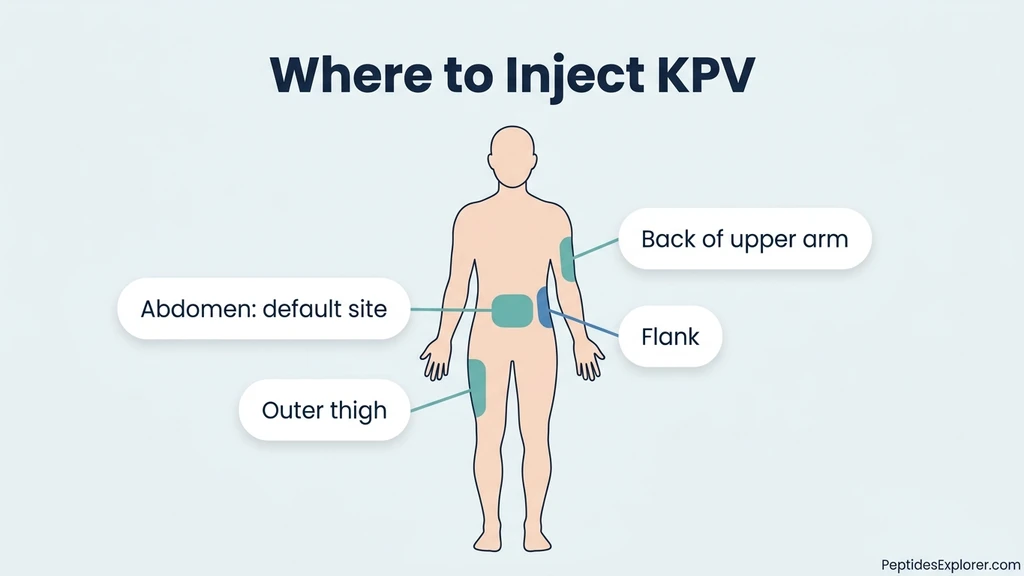
The KPV vial is mixed, the insulin syringe reads 4 units, and the thing that hurts is your gut, a knee, or a patch of skin. Here is the answer: inject KPV subcutaneously into belly fat at least 2 inches from the navel, with a 29 to 31 gauge insulin syringe, and rotate between the abdomen, outer thigh, back of the upper arm and flank. A three-amino-acid peptide enters the bloodstream within minutes and reaches inflamed tissue wherever it sits, so the needle never needs to go near the problem.
| Site | Landmark | Average fat depth | Self-injection ease | Role |
|---|---|---|---|---|
| Abdomen | 2+ inches from the navel, between ribs and hip bones | 13.9 mm | Easiest | Default site |
| Outer thigh | Middle third, front-outer quadrant | 10.4 mm | Easy, seated | Rotation partner |
| Back of upper arm | Fatty strip between shoulder and elbow | 10.8 mm | Awkward alone | Occasional, with help |
| Flank / upper-outer glute | Above the hip bone, toward the side | 15.4 mm | Moderate, mirror helps | Extra rotation room |
This page covers sites, depth, needle choice, rotation and the injection itself. How many micrograms to draw lives in the KPV dosage chart, and whether the shot belongs at breakfast or bedtime in KPV morning or night. The compound is profiled on the KPV page.
Get your custom peptide protocol:
- Tailored to your body and goals
- Precise dosing and cycle length
- Safe stacking combinations
- Backed by peer-reviewed studies
- Ready in under 2 minutes
Local or Systemic: Why Subcutaneous Anywhere Is the Default
Think of a teaspoon of salt dropped into a pot of soup. Drop it at the near edge or the far edge, and two stirs later every spoonful tastes the same. KPV in subcutaneous fat behaves the same way: capillaries carry it into the blood within minutes, and the blood goes everywhere.
Literally stated: KPV is lysine-proline-valine, the last three amino acids of alpha-MSH, about 341 daltons. At nanomolar concentrations it blocks NF-kB and MAP kinase signaling in intestinal epithelial and immune cells and cuts pro-inflammatory cytokine output (Dalmasso et al., Gastroenterology, 2008, PMID 18061177). Nothing about that mechanism requires the peptide to arrive by a particular door.
The animal data say the same. In mice, intraperitoneal injections of KPV reduced ear swelling caused by picryl chloride, measured 3 and 6 hours after the irritant (Hiltz et al., Peptides, 1991, PMID 1788140). The inflamed ear sat as far from the injection as a mouse allows. In two colitis models, KPV-treated mice recovered earlier, regained more body weight, and had significantly less myeloperoxidase in the colon (Kannengiesser et al., Inflamm Bowel Dis, 2008, PMID 18092346).
So what about injecting next to a swollen knee or an eczema patch? No study has tested it with KPV. The fat over a knee drains into the same veins as belly fat; the peptide does not soak downward through a joint capsule. Injecting into the joint itself is a sterile clinical procedure with infection risk, and nobody has done it with this compound. The only "local" deliveries with data are oral, where the peptide meets the gut lining through the PepT1 transporter, and topical, where it meets the skin.
Pick the site for comfort, fat depth and rotation, and let circulation handle the targeting. KPV has no human pharmacokinetic study and no FDA approval for any use; the whole-body reach described here rests on rodent data and on what a 341-dalton peptide does in blood. What it may do once it arrives is covered in KPV peptide benefits and, for the wider class, in peptides for inflammation.
Site-by-Site Walkthrough
Every subcutaneous site targets the same layer: the fat between skin and muscle. Skin is thin everywhere, 1.9 to 2.4 mm in 388 adults measured by ultrasound; what changes between sites is the fat underneath, from 10.4 mm on the thigh to 15.4 mm on the buttocks, with women carrying about 5 mm more than men and every 10 BMI points adding roughly 4 mm (Gibney et al., Curr Med Res Opin, 2010, PMID 20429833). Those numbers decide your angle.
Abdomen
Stay at least 2 inches from the navel in every direction and above the belt line. The ring of tissue around the navel is denser and more vascular, which means more bruising for no gain.
The abdomen is the default because it carries the thickest and most uniform fat layer on most bodies, 13.9 mm on average, and because you can see the site and both hands are free. Imagine a grid of 2-inch squares on each side of the navel and work through it.
Outer Thigh
Sit down, relax the leg, and use the middle third of the front-outer quadrant. Skip the inner thigh and the area just above the knee.
Thigh fat averages 10.4 mm and runs thinner on lean legs, so pinch a real fold and enter at 45 degrees. On a muscular quad, an 8 mm needle pushed straight in with no pinch lands in muscle.
Back of the Upper Arm
The usable strip is the fatty back of the arm, halfway between the shoulder and the elbow. It works well when someone else gives the injection and poorly when you do it yourself, because you cannot pinch and inject with the same hand.
If you are alone and want the arm anyway, press the back of the arm against a door frame to bunch the fat, then inject at 45 degrees. Most solo users leave this site out of the rotation.
Flank and Upper-Outer Glute
The flank above the hip bone and the upper-outer quadrant of the glute give most people a generous fold and double the rotation real estate. Use a mirror the first few times and keep the needle well away from the midline of the back.
With 15 mm of fat, 90 degrees without a pinch is fine here for most adults. The landmarking matches the one in the BPC-157 injection site guide.
Step-by-Step: Subcutaneous KPV Injection
A full KPV dose is tiny, 0.04 to 0.1 mL on a standard 10 mg vial mixed with 2 mL of bacteriostatic water. The whole procedure takes under two minutes.
- 1.Wash your hands with soap for 20 seconds and lay out the vial, a fresh insulin syringe, two alcohol swabs and dry gauze.
- 2.Check the vial. The solution should be clear and colorless, cold from the fridge, and inside the window given in how long reconstituted peptides last. Cloudiness or floating particles means the vial is finished.
- 3.Swab the rubber stopper and let it dry for 10 seconds.
- 4.Draw air equal to your dose, push it into the vial, invert the vial, and pull the plunger to your mark. At 5,000 mcg/mL, 200 mcg is 4 units and 500 mcg is 10 units; confirm your own vial in the peptide reconstitution calculator.
- 5.Clear bubbles. Hold the syringe needle-up, tap the barrel with a fingernail, and push the air back into the vial. A bubble the size of a pinhead in a 4-unit dose is a quarter of your dose.
- 6.Swab the site and wait until the alcohol is fully dry. Wet alcohol dragged in by the needle is the most common cause of a sting.
- 7.Pinch a fold of skin and fat between thumb and two fingers and lift it off the muscle. Keep the fold relaxed; a white-knuckle squeeze hurts and compresses the fat.
- 8.Insert in one motion, 45 degrees on the thigh or arm, 90 degrees on an abdomen or flank with a finger-width of fat. Slow needle entry is more painful than a quick one.
- 9.Push the plunger steadily over 2 to 3 seconds, then count to 5 before you move anything.
- 10.Release the fold, withdraw at the same angle, press with dry gauze, no rubbing, and drop the syringe into a sharps container.
The sequence is the same one taught in the general peptide injection guide; only the volume differs, and KPV's volume is among the smallest you will ever draw.
Needle Gauge, Length and Angle
Use a 29 to 31 gauge insulin syringe, 0.3 or 0.5 mL barrel, with half-unit markings if you can find them. A 4-unit dose on a 1 mL syringe is a hairline; on a 0.3 mL syringe it is a clear, readable gap.
Shorter is safer. The 2016 FITTER recommendations, written by 183 diabetes experts from 54 countries, name the shortest needles, 4 mm pens and 6 mm syringes, as first choice for every patient category and state that intramuscular injection should be avoided (Frid et al., Mayo Clin Proc, 2016, PMID 27594187). Most insulin syringes sold for peptides carry an 8 mm (5/16 inch) or 12.7 mm (1/2 inch) needle, which is why the pinch and the 45-degree angle matter so much.
| Needle | Abdomen or flank | Thigh or arm |
|---|---|---|
| 4 to 6 mm | 90 degrees, no pinch needed | 90 degrees, pinch if lean |
| 8 mm (5/16 inch) | 90 degrees with a pinch | 45 degrees with a pinch |
| 12.7 mm (1/2 inch) | 45 degrees with a pinch | Avoid |
Thinner also hurts less. In controlled insertions, 63% of 23 gauge needles caused pain, 53% of 27 gauge, and 31% of the thinnest 32 gauge; insertions that bled were about 1.3 times more painful than those that did not (Arendt-Nielsen et al., Somatosens Mot Res, 2006, PMID 16846958).
Scenario one: the long needle on a lean thigh. You use a 12.7 mm needle at 90 degrees, no pinch, on a quad carrying 8 mm of fat. The tip rests 4 to 5 mm inside the muscle. In insulin users, an accidental intramuscular thigh injection absorbed at least 50% faster than the neighboring fat (Frid et al., Diabetes Care, 1988, PMID 3276476); for KPV the effect of that speed is unstudied, and the certain result is a sore, bruised leg. Fix: 8 mm or shorter, a pinch, 45 degrees, or move to the abdomen.
Mix with bacteriostatic water so the vial survives daily draws; the bacteriostatic vs sterile water guide explains the difference.
A Rotation Grid for Daily Injections
KPV is injected once a day for 4 to 8 weeks, which is 28 to 56 sticks. Put them in the same square inch and the tissue answers with lipohypertrophy, a rubbery lump that absorbs erratically. In 430 insulin users, 64.4% had lumps, and 98% of those with lumps rotated poorly or not at all, against 5% among correct rotators (Blanco et al., Diabetes Metab, 2013, PMID 23886784).
The rule: every injection at least 1 inch from the last one, and a full week before any square gets reused.
| Day | Site |
|---|---|
| 1 | Left abdomen, upper |
| 2 | Right abdomen, upper |
| 3 | Left abdomen, lower |
| 4 | Right abdomen, lower |
| 5 | Left outer thigh |
| 6 | Right outer thigh |
| 7 | Left or right flank |
| 8 | Back to day 1, 1 inch from the old mark |
Retire any zone that feels firm, rubbery or numb for several weeks and let it recover. The same grid logic applies to every daily peptide, and the GHK-Cu injection site guide shows how it scales when two compounds share the same skin.
Pain and Site Reactions: Normal vs Not
Normal: a brief sting, a coin-sized red spot, a small bruise, and mild tenderness that fades within 1 to 3 days. KPV's 0.04 to 0.1 mL volume is too small to cause the stretch ache that larger injections produce.
Not normal: redness that spreads after the first day, warmth, growing swelling, pus, a red streak, or fever. That pattern means possible infection and needs a clinician before the next injection. Hives, lip or tongue swelling, or wheezing within an hour is an allergic reaction and is an emergency.
To keep reactions small: let the syringe warm in your hand for a minute, let the alcohol dry, enter quickly, push slowly, and do not rub afterward. Reactions that look like a welt and itch for days are covered pattern by pattern in the injection site reaction guide; the mechanics are identical across peptides.
Scenario two: the favorite spot. Thirty daily injections into the same patch left of the navel. By week five there is a firm, slightly numb bump, and because it is numb you keep using it. Lipohypertrophy of this kind absorbs unpredictably, which for insulin users meant 39.1% had unexplained hypoglycemia versus 5.9% without lumps (Blanco 2013); for KPV it means some days the dose sits in scar tissue and does little. Fix: the rotation grid above, and a fresh needle every time.
What Not to Do
Intramuscular. No study supports it for KPV, it hurts more, it bleeds more, and the absorption profile is unknown. The rodent injection studies used the intraperitoneal route, which has no home-use equivalent; subcutaneous fat is the practical default for every small research peptide.
Intravenous. Never. Research-grade vials are not sterile pharmaceutical products, and intravenous use turns a bacterial contaminant or an endotoxin into a systemic infection within hours.
Into or next to a wound, rash or lesion. Broken skin is an open door for bacteria, and inflamed skin absorbs unpredictably. For a patch of eczema or a healing wound, the peptide reaches it through the blood from a clean site, or through a topical preparation applied on top.
Into a lump, bruise, scar or stretch mark. Scarred tissue absorbs erratically. Move at least 1 inch away.
Through clothing, with a reused needle, or with a shared syringe. A 31 gauge tip dulls and barbs after a single pass, and a reused needle multiplies both pain and infection risk.
Into muscle you are about to train. Blood flow in working muscle rises several-fold, and an accidental intramuscular dose is absorbed on the muscle's schedule, not yours. On leg day use the abdomen.
If You Would Rather Not Inject
KPV is one of the few research peptides with a credible non-injection route. It enters gut cells through PepT1, a di- and tripeptide transporter that is induced in the colon during inflammatory bowel disease, and KPV added to the drinking water of mice reduced DSS and TNBS colitis (Dalmasso 2008). For gut-focused use, oral KPV meets the inflamed tissue directly, which no injection site can do; for skin, topical creams put it in contact with the lesion. The route choice by condition is laid out in the KPV dosage chart, and the logic of oral versus injected delivery for a gut peptide is worked through in BPC-157 oral vs injection.
Frequently Asked Questions
Where is the best place to inject KPV?
Subcutaneous belly fat, at least 2 inches from the navel, with a 29 to 31 gauge insulin syringe. Abdominal fat averages 13.9 mm deep (PMID 20429833), the thickest and most uniform layer on most bodies. Rotate to the outer thigh and flank on a 7-day grid; the KPV profile covers the compound itself.
Should I inject KPV near the inflamed area, like a sore joint or my stomach?
No. KPV is a 341-dalton tripeptide that enters the bloodstream from any subcutaneous site and reaches inflamed tissue everywhere; intraperitoneal injections in mice reduced swelling in the ear (PMID 1788140). Fat over a knee does not drain into the joint. For gut inflammation, oral KPV reaches the lining directly, as the KPV dosage chart explains.
Is KPV injected subcutaneously or intramuscularly?
Subcutaneously. The 2016 FITTER recommendations state that intramuscular injection should be avoided and that the shortest needles are first choice (PMID 27594187). Muscle injections hurt more, bleed more, and have no KPV data behind them. The step-by-step subcutaneous method is the same one in the peptide injection guide.
What needle size do you use for KPV?
A 29 to 31 gauge insulin syringe with a 0.3 or 0.5 mL barrel and an 8 mm (5/16 inch) or shorter needle. In controlled insertions, 32 gauge needles caused pain 31% of the time versus 63% for 23 gauge (PMID 16846958). Convert your vial concentration into units with the peptide reconstitution calculator.
How do you inject KPV step by step?
Wash hands, swab the stopper, draw your dose (4 units for 200 mcg at 5,000 mcg/mL), tap out bubbles, swab the site and let it dry, pinch a fold, insert at 45 to 90 degrees, push over 2 to 3 seconds, count to 5, withdraw, press without rubbing. Vial freshness limits are in how long reconstituted peptides last.
How often should I rotate KPV injection sites?
Every injection, at least 1 inch from the last mark, with a week before any spot is reused. Poor rotation explained 98% of lipohypertrophy cases in 430 insulin users (PMID 23886784), and those lumps absorb erratically. The same 7-day grid is illustrated for another daily peptide in the GHK-Cu injection site guide.
Why is my KPV injection site red or sore?
A coin-sized red spot, mild tenderness or a small bruise for 1 to 3 days is normal and usually comes from wet alcohol, a slow needle entry, or rubbing afterward. Redness that spreads after day one, warmth, pus or fever means possible infection. Pattern-by-pattern photos and timelines are in the injection site reaction guide.
Can I inject KPV in my arm?
Yes, into the fatty back of the upper arm, which averages 10.8 mm of fat (PMID 20429833), at 45 degrees with a pinch. It is awkward to pinch and inject one-handed, so most solo users keep it for days when someone else can help. Mixing instructions and water choice are in the bacteriostatic vs sterile water guide.
The Bottom Line
Belly fat, 2 inches off the navel, 29 to 31 gauge, 8 mm or shorter, 45 degrees with a pinch on lean sites, 1 inch between marks, a week before a square is reused. That is the entire site technique for KPV.
The principle: a three-amino-acid peptide in subcutaneous fat is in the bloodstream within minutes and everywhere within the hour, so the site is a comfort and tissue decision, never a targeting one. Protect the skin and let circulation carry the dose to the gut, the joint or the lesion.
KPV is a research compound with no human trials and no FDA approval; the whole-body reach described here comes from rodent studies and insulin injection science. Run your vial through the peptide reconstitution calculator before the first draw, and find the rest of the KPV cluster at PeptidesExplorer. Educational content, not medical advice.
Helpful Tools
Related Articles
Where to Inject IGF-1 LR3: Sites, SubQ vs IM, Rotation
Where to inject IGF-1 LR3: abdomen, thigh or glute, subcutaneous, 29-31G needle. Why site-specific growth is a myth, a rotation map, and the hypoglycemia rule.
Where to Inject CJC-1295 and Ipamorelin: Sites & Rotation
Where to inject CJC-1295 and ipamorelin: abdomen 2 inches from the navel, thigh, love handles. Site table, rotation map, timing, and welt fixes.
How to Inject Sermorelin: Step-by-Step Guide
How to inject sermorelin step by step: 29 to 31G insulin syringe, units vs mcg math, the pinch, 45 vs 90 degrees, bedtime on an empty stomach, common mistakes.
GLP-1 Injection Sites: The 3 Approved Spots
GLP-1 injection sites: abdomen, front thigh, back of upper arm. What the Ozempic, Wegovy, Mounjaro and Zepbound labels say, plus a rotation plan that works.