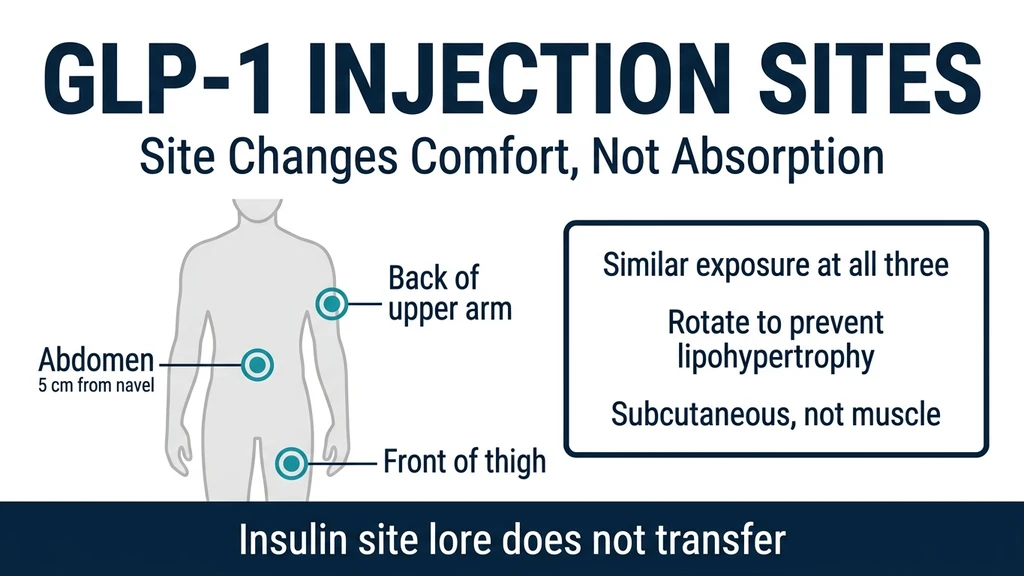
You have the pen uncapped and your shirt lifted, and now you have to decide where it goes. Every GLP-1 medication approved in the US goes into subcutaneous fat at one of three places: the abdomen, staying at least 2 inches from the navel; the front of the thigh; or the back of the upper arm. All three deliver the same amount of drug. Choose the one you can reach cleanly, then move the spot each week.
| Site | How to find it | Who can reach it | Label notes |
|---|---|---|---|
| Abdomen | Below the ribs, above the hip bones, 2 in (5 cm) out from the navel | Anyone, no mirror | Approved on all four US labels |
| Front of thigh | Middle third of the front and outer thigh, between hip crease and kneecap | Anyone, seated | Approved on all four; liraglutide AUC 22% lower here |
| Back of upper arm | Fleshy posterior arm, halfway between shoulder and elbow | Needs a second person for tirzepatide | Mounjaro and Zepbound: "another person should inject" |
| Anywhere else | Buttock, flank, calf, love handle | Nobody | No label, no PK data. Do not use. |
The semaglutide and tirzepatide labels both state that similar exposure is achieved in the abdomen, thigh, or upper arm. Site choice changes how the injection feels and how your tissue holds up over a year. It does not change your dose. For the tirzepatide-specific ranking of the three sites, see best injection sites for tirzepatide.
Get your custom peptide protocol:
- Tailored to your body and goals
- Precise dosing and cycle length
- Safe stacking combinations
- Backed by peer-reviewed studies
- Ready in under 2 minutes
What the FDA Labels Actually Say
Four GLP-1 receptor agonists carry US prescribing information with an injection site instruction. Three of the four wordings are nearly identical. One of them quietly forbids something most people do anyway.
Ozempic (semaglutide), Section 2.1: "Inject OZEMPIC subcutaneously in the abdomen, thigh, or upper arm. Instruct patients to use a different injection site each week when injecting in the same body region."
Wegovy (semaglutide), Section 2: "Inject WEGOVY subcutaneously in the abdomen, thigh, or upper arm. The time of day and the injection site can be changed without the need for a dosage modification. Rotate injection sites with each dose."
Mounjaro (tirzepatide), Section 2.2: "Inject MOUNJARO subcutaneously in the abdomen, thigh, or another person should inject in the back of the upper arm. Rotate injection sites with each dose."
Zepbound (tirzepatide), Section 2.4: "Inject ZEPBOUND subcutaneously in the abdomen, thigh, or another person should inject in the back of the upper arm."
Read the Lilly sentences twice. Both tirzepatide labels assign the upper arm to a second person. Novo Nordisk makes no such distinction for semaglutide. Same three anatomical sites, different assumption about who is holding the pen.
Victoza (liraglutide), Section 2.3: "Inject VICTOZA subcutaneously in the abdomen, thigh or upper arm. No dosage adjustment is needed if changing the injection site and/or timing." The same section adds a rotation reason the weekly drugs omit: "Rotate injection sites within the same region in order to reduce the risk of cutaneous amyloidosis."
Retatrutide has no FDA label. It remains investigational, and the phase 2 obesity trial administered it subcutaneously once weekly, producing a 24.2% mean body weight reduction at 48 weeks at the highest dose (Jastreboff et al., N Engl J Med, 2023). People injecting research retatrutide use the same three sites by convention, not by regulatory instruction. See how to take retatrutide and when retatrutide will be available.
No label lists the buttock, the flank, the calf, or the back of the thigh. No pharmacokinetic study has measured a GLP-1 injected there.
Why the Site Barely Matters (and What Actually Sets the Pace)
Think of the subcutaneous layer as a rain barrel with a pinhole drilled in the bottom. You dump the week's water in all at once. What comes out, and how fast, is decided by the pinhole, not by how you poured. Muscle is the same barrel with the tap wide open.
Literally: subcutaneous fat is sparsely vascularized. An acylated peptide like semaglutide or tirzepatide sits in that tissue bound to albumin and leaves it over days, which is why the absorption phase, rather than the injection, governs the plasma curve. Semaglutide reaches maximum concentration 1 to 3 days after the dose. Tirzepatide reaches it at a median of 24 hours, with a range of 8 to 72 hours.
The pinhole is the same size in your belly, your thigh, and your arm. That is the plainest way to state what the labels report. Absolute bioavailability is 89% for semaglutide and 80% for tirzepatide, and both prescribing informations use the identical phrase: similar exposure was achieved with subcutaneous administration in the abdomen, thigh, or upper arm.
A population pharmacokinetic analysis of once-weekly semaglutide across the SUSTAIN program tested injection site as a covariate against exposure and found no clinically relevant effect, alongside sex, age, race, ethnicity, and renal function (Carlsson Petri et al., Diabetes Ther, 2018).
Liraglutide is the one partial exception, and it is instructive. Its label reports that AUC from the thigh runs 22% lower than from the abdomen, while arm and abdomen are equivalent. Novo Nordisk still concludes that liraglutide exposures "were considered comparable among these three subcutaneous injection sites," and the label explicitly says no dose adjustment is needed when you change sites. Liraglutide is a daily drug with an 8 to 12 hour Tmax and 55% bioavailability, so it sits much closer to the absorption-sensitive end of the spectrum than the weekly agents do.
Here is the trap. Almost everything written about injection site rotation on the internet descends from insulin practice, where site does move absorption speed enough to matter for a mealtime bolus. Insulin lispro peaks in under an hour. Semaglutide peaks in one to three days. Carrying insulin's kinetics over to a weekly GLP-1 is the single most common error on competitor pages, and it leads people to chase a "faster" site instead of protecting the tissue they inject into every week for years. For the broader technique background, see how to inject peptides and the peptide injections complete guide.
Subcutaneous, Not Intramuscular: Needle Length, Pinch, and Angle
Every GLP-1 label says subcutaneous. Under the skin sits a layer of fat, and under the fat sits muscle. Your job is to park the drug in the middle layer.
Skin thickness is remarkably consistent across adults, averaging roughly 2 mm at the injection sites and varying little by sex, BMI, or age. Subcutaneous fat is what varies, from under 10 mm at a lean anterior thigh to 30 mm or more at an abdomen. An ultrasound study of 388 adults with diabetes concluded that needles 4 to 5 mm long enter subcutaneous tissue with minimal risk of intramuscular injection in virtually all adults when inserted perpendicular to the skin (Gibney et al., Curr Med Res Opin, 2010).
Three variables decide which layer the needle tip lands in.
Needle length. A pen with a fixed hidden needle solves this for you. An insulin syringe does not. A 5/16 inch needle is 7.9 mm. A 1/2 inch needle is 12.7 mm. That 4.8 mm difference is the entire subcutaneous layer of a lean thigh.
Pinch. Lifting a skin fold between thumb and index finger pulls fat away from the muscle beneath and roughly doubles the depth of tissue the needle can occupy. Pinch with two fingers, not your whole hand, which grabs muscle along with the fat.
Angle. At 90 degrees, the full needle length becomes depth. At 45 degrees, a 12.7 mm needle penetrates about 9 mm. The rule reduces to one test: if you can lift less than an inch of tissue between two fingers, pinch and go in at 45 degrees. If more, go straight in at 90.
Auto-injector pens are designed for 90-degree placement flat against unpinched skin. Do not pinch for a Mounjaro, Zepbound, or Wegovy pen. Do assess the pinch before using an insulin syringe with a compounded vial, whether that is compounded tirzepatide or reconstituted 5 mg semaglutide.
How to Inject a GLP-1: Step by Step
These steps apply to all three sites and to both delivery formats, pen and syringe.
1. Take the medication out of the fridge 30 minutes early. Cold drug stings on the way in. Set it on the counter and do something else. Refrigeration rules differ by product, so check does semaglutide need to be refrigerated and how long tirzepatide lasts in the fridge.
2. Inspect the liquid. It should be clear and colorless with no particles. Discoloration means stop. See what color is semaglutide if yours looks off.
3. Pick the site and confirm it is clean skin. No scars, no stretch marks, no bruises, no moles, no firm lumps, no area that is red or tender from a previous injection.
4. Swab with 70% isopropyl alcohol and let it air dry for 10 seconds. Injecting through wet alcohol drags it into the puncture and burns.
5. Decide on the pinch. Lift the tissue with your thumb and index finger. Less than an inch means pinch and inject at 45 degrees. More than an inch means no pinch, 90 degrees. Skip this entirely for an auto-injector pen, which goes flat against the skin.
6. Insert with one steady motion. Hesitation drags the bevel across the dermis and stings more than committing does.
7. Deliver slowly. With a syringe, push the plunger over 5 to 10 seconds. With a pen, press and hold the button until the counter or window signals completion.
8. Count before you withdraw. Hold the needle in place for the interval the device specifies. Mounjaro and Zepbound single-dose pens instruct holding until the second click and up to 10 seconds. Ozempic instructs counting slowly to 6 after the dose counter reaches zero. Wegovy holds until the yellow bar stops moving, then a further 5 seconds. Withdrawing early leaves drug in the needle track and on your skin.
9. Withdraw straight out, release the pinch, press with a dry cotton ball for 10 seconds. Do not rub. Rubbing spreads the depot through the tissue plane and increases bruising.
10. Write down the site and the date. Ten seconds now saves a year of guessing. This is the step everybody skips.
For device-specific walkthroughs, see how to inject tirzepatide. To confirm the volume before you draw it, use the semaglutide dosage calculator or the tirzepatide dosage calculator.
Two Ways This Goes Wrong
Both failures come from the mechanics of the injection rather than the choice of body region. Both are quantifiable.
Scenario 1: the needle is longer than the fat.
A lean man, BMI 22, injects compounded tirzepatide into the front of his thigh with a 1/2 inch (12.7 mm) insulin syringe, straight in at 90 degrees, no pinch. His skin measures about 2 mm. His anterior thigh fat measures 6 mm. The needle traverses 8 mm of skin and fat, and the remaining 4.7 mm of the shaft sits inside the vastus lateralis. He has given himself an intramuscular injection.
Muscle carries several times the capillary density of subcutaneous fat. Nothing in the Mounjaro, Zepbound, Ozempic, or Wegovy prescribing information authorizes intramuscular administration, and no published pharmacokinetic study has measured a GLP-1 given that way, so the exposure he actually received is unknown. What is not unknown: intramuscular injections hurt more, bleed more, and bruise more. He reports a deep ache for two days and a bruise the size of a plum.
The fix costs nothing. Use a 4 to 6 mm needle at the thigh, or pinch a fold and enter at 45 degrees, which drops effective depth from 12.7 mm to about 9 mm while the pinch pulls the muscle away. Gibney's ultrasound data support 4 to 5 mm as safe in virtually all adults at 90 degrees.
Scenario 2: the same square inch, fifty-two times.
A woman injects semaglutide into the same spot two inches left of her navel every Sunday, because it worked the first time and she never wrote anything down. After eight months there is a soft, rubbery, painless swelling under the skin, about the size of a walnut. That is lipohypertrophy: fibrous, thickened fat produced by repeated trauma and the local growth signal of the injectate.
The consequences are documented in insulin, where the same lesion is common. In a randomized crossover trial in 13 adults with type 1 diabetes, injecting lispro into lipohypertrophic tissue instead of normal fat cut the insulin AUC from 165 to 131 h·mU/L, dropped peak concentration from 79 to 61 mU/L, and raised the coefficient of variation for exposure from 11% to 52%. Postprandial glucose ran at least 26% higher, and blood glucose above 300 mg/dL occurred only after the lipohypertrophic injections (Famulla et al., Diabetes Care, 2016).
A 52% coefficient of variation means the tissue, not the syringe, is now setting your dose. No trial has repeated this experiment with a GLP-1, so the number is an insulin number. The lesion, the mechanism, and the erratic permeability are the same tissue physics.
How common is it? In 430 insulin-injecting outpatients, 64.4% had lipohypertrophy. Among those who had it, 98% either did not rotate sites or rotated incorrectly. Among those who rotated correctly, 5% had it. Unexplained hypoglycemia occurred in 39.1% of the lipohypertrophy group versus 5.9% of the rest (Blanco et al., Diabetes Metab, 2013).
The fix is a written rotation scheme, below. If you already have a lump, stop injecting into it and let it recover for months, not weeks.
Finding the Abdominal Zone by Measurement
"Two inches from the navel" gets estimated by eye and estimated badly. The tissue immediately around the umbilicus is tethered and fibrous, absorbs unpredictably, and hurts.
Use an object you already own. A standard credit card is 3.37 inches (8.56 cm) long. Set one short edge against your navel and lay it flat in any direction. The far edge sits well clear of the 2-inch ring. Everything from that line outward, as far as the lowest rib above and the crest of the hip bone below, is usable.
The zone is a ring, not a patch. Centered on the navel, it runs from a 2-inch radius out to the flank on both sides, top and bottom. That surface holds dozens of distinct injection points at 1-inch spacing.
For the 1-inch spacing itself, a US quarter measures 0.955 inches across. Set one down beside last week's mark and inject at the far edge. That is the whole measurement system: a credit card for the boundary, a quarter for the spacing.
The eight-week rotation. Four abdominal quadrants, then thighs, then arms.
| Week | Site | Note |
|---|---|---|
| 1 | Upper left abdomen | One quarter-width from any previous mark |
| 2 | Upper right abdomen | |
| 3 | Lower right abdomen | |
| 4 | Lower left abdomen | |
| 5 | Left thigh, middle third | Pinch if under 1 inch of tissue |
| 6 | Right thigh, middle third | |
| 7 | Left back of upper arm | Second person injects for tirzepatide |
| 8 | Right back of upper arm |
Then start over, offsetting each abdominal point by one quarter-width from where it was in the last cycle. Every square inch of skin gets a minimum of eight weeks before the needle returns, and in practice far longer because the offset walks each spot around its quadrant.
If you cannot use the arms, run a six-week cycle: four abdominal quadrants, left thigh, right thigh. The Ozempic label sets the floor at "a different injection site each week when injecting in the same body region." Treat that as the floor and aim well above it.
Track it. A phone note with two words and a date beats memory. People who rotate correctly develop lipohypertrophy at roughly a twentieth the rate of people who do not (Blanco et al., 2013). Ten seconds a week buys that.
GLP-1 Injection Sites by Drug: Reference Table
Every row reflects the current US prescribing information, or the absence of one.
| Drug (brand) | Label-approved sites | Device | Needle | Notes |
|---|---|---|---|---|
| Semaglutide (Ozempic) | Abdomen, thigh, upper arm | Multi-dose pen | User attaches pen needle | Self-injection of the arm is not restricted; different site each week within a region |
| Semaglutide (Wegovy) | Abdomen, thigh, upper arm | Single-dose pen, hidden needle | Fixed by device | Site and time of day can change with no dose adjustment |
| Tirzepatide (Mounjaro) | Abdomen, thigh; back of upper arm by another person | Single-dose pen and KwikPen | Fixed by device, no pinch | 80% bioavailability, Tmax median 24 h (8 to 72 h) |
| Tirzepatide (Zepbound) | Abdomen, thigh; back of upper arm by another person | Single-dose pen and KwikPen | Fixed by device, no pinch | Same site language as Mounjaro |
| Liraglutide (Victoza) | Abdomen, thigh, upper arm | Multi-dose daily pen | User attaches pen needle | Thigh AUC 22% lower than abdomen, still deemed comparable; rotate within region to reduce cutaneous amyloidosis risk |
| Retatrutide | No FDA label | Research vial, insulin syringe | 4 to 8 mm, user chooses | Investigational; phase 2 dosed subcutaneously once weekly |
| Compounded semaglutide or tirzepatide | No FDA label | Vial, insulin syringe | 4 to 8 mm, user chooses | Follow the reference-product sites; pinch and 45 degrees if under 1 inch of tissue |
Bioavailability figures: semaglutide 89%, tirzepatide 80%, liraglutide approximately 55%, all per the respective labels. None of these numbers change with the site you pick.
For compounded products, the volume you draw depends entirely on your reconstitution concentration, so run the number before you touch skin: peptide reconstitution calculator, peptide unit converter, and the semaglutide mixing chart.
Four Mistakes Worth Naming
Mistake 1: chasing a "faster" site. People move to the abdomen believing it absorbs quicker, then move again when weight loss stalls. The semaglutide and tirzepatide labels both state that similar exposure is achieved in all three sites, and a population PK analysis of semaglutide found no clinically relevant site effect on exposure (Carlsson Petri et al., 2018). Site selection has never been the reason a plateau happened. Read why am I not losing weight on tirzepatide instead.
Mistake 2: a 1/2 inch needle on a lean thigh or arm. At 12.7 mm with no pinch, the tip clears 8 mm of skin and fat and lands in muscle. Use 4 to 6 mm, or pinch and enter at 45 degrees. The upper arm has the thinnest fat pad of the three sites, which is part of why both tirzepatide labels hand it to a second person.
Mistake 3: injecting into a lump, a scar, or the 2-inch navel ring. Lipohypertrophic tissue delivered 21% less insulin AUC and five times the exposure variability (Famulla et al., 2016). Scars and stretch marks have disrupted vasculature. The navel ring is fibrous and tethered. Skip all three.
Mistake 4: withdrawing early and rubbing the site. Pull out before the pen finishes and part of the dose ends up on your skin. Rub afterward and you disperse the depot, which increases bruising and local irritation. Hold for the interval the device specifies, then press with a dry cotton ball without moving it. If a reaction develops anyway, see tirzepatide injection site reaction. Injection-site reactions are a recognized tolerability issue across the GLP-1 class (Kunutsor & Seidu, Drugs, 2026), and a tirzepatide-specific case has been documented in a patient who had tolerated dulaglutide without incident (Mizumoto, Cureus, 2023).
Frequently Asked Questions
What are the three GLP-1 injection sites?
The abdomen (at least 2 inches or 5 cm from the navel), the front of the thigh, and the back of the upper arm. All four US labels for semaglutide and tirzepatide list these three and no others. The buttock, flank, and calf have no label and no pharmacokinetic data. See how to inject peptides.
Does the injection site change how much GLP-1 you absorb?
No. The Ozempic, Wegovy, Mounjaro, and Zepbound labels all state that similar exposure is achieved in the abdomen, thigh, or upper arm. Bioavailability runs 89% for semaglutide and 80% for tirzepatide regardless of site. Rotation exists to protect tissue. See best injection sites for tirzepatide for the site-by-site comparison.
Can I inject a GLP-1 into my thigh?
Yes. Use the middle third of the front and outer thigh, between the hip crease and the kneecap. Thigh fat is thinner than abdominal fat, often under 10 mm, so pinch a fold and inject at 45 degrees if you can lift less than an inch. Confirm your volume with the tirzepatide dosage calculator first.
Can I inject Mounjaro or Zepbound into my own arm?
Both Lilly labels say another person should inject the back of the upper arm. Novo Nordisk places no such restriction on Ozempic or Wegovy. If you inject alone, use the abdomen or thigh for tirzepatide. Full device walkthrough: how to inject tirzepatide.
What happens if I inject a GLP-1 into muscle?
No GLP-1 label authorizes intramuscular administration and no published PK study has measured it, so your exposure becomes unknown. Muscle is far more vascular than fat, and the injection hurts, bleeds, and bruises more. A 12.7 mm needle at 90 degrees reaches muscle through 8 mm of lean thigh tissue. Use 4 to 6 mm, or see how to inject tirzepatide.
How far from my belly button should I inject?
At least 2 inches (5 cm) in every direction. A standard credit card is 3.37 inches long, so laying one flat from the navel marks a boundary well outside the ring. The usable zone runs from there to the lowest rib above and the hip bone below. Related: how to inject peptides.
If absorption is the same everywhere, why rotate injection sites?
To prevent lipohypertrophy. Among 430 insulin-injecting patients, 64.4% had it, and 98% of those either did not rotate or rotated incorrectly; correct rotators had a 5% rate (Blanco et al., 2013). Lipohypertrophic tissue delivers drug erratically. The Victoza label adds cutaneous amyloidosis as a second reason. See tirzepatide injection site reaction.
What needle length should I use with compounded semaglutide or tirzepatide?
A 4 to 6 mm needle enters subcutaneous tissue with minimal intramuscular risk in virtually all adults at 90 degrees (Gibney et al., 2010). A 1/2 inch (12.7 mm) needle is too long for a lean thigh or arm unless you pinch and angle at 45 degrees. Calculate your draw volume with the peptide reconstitution calculator.
The Bottom Line
GLP-1 medications go into subcutaneous fat at three places: the abdomen at least 2 inches from the navel, the front of the thigh, and the back of the upper arm. The Ozempic, Wegovy, Mounjaro, and Zepbound labels agree that all three give similar exposure. Mounjaro and Zepbound alone ask that a second person handle the arm.
Absorption speed belongs to the tissue you inject into, and repeated punctures in one square inch degrade that tissue until delivery turns erratic. Rotate to protect the tissue. A credit card finds the boundary, a quarter sets the spacing, and eight weeks of written rotation keeps every spot fresh.
Confirm the dose before you confirm the site. Run your numbers through the semaglutide dosage calculator or the tirzepatide dosage calculator, check the escalation plan in the semaglutide titration schedule, and read the peptide safety guide before your first injection. More at peptidesexplorer.com. This is educational content and not medical advice; work with the prescriber who wrote your script.
Related Articles
Best Place to Inject Tirzepatide: 3 Sites Ranked
Best tirzepatide injection site: the abdomen, for fat pad and access. Compare abdomen, thigh, and upper arm with rotation maps and BMI guidance.
Semaglutide to Tirzepatide Switching
Switching semaglutide to tirzepatide? Clinical dose equivalence table, step-by-step protocol, titration schedule, and common mistakes to avoid.
Cheapest Tirzepatide: Every Route Priced (2026)
The cheapest tirzepatide in 2026: manufacturer self-pay vials from $299/month, $25 insured copays, true cost per milligram, and why compounded copies ended.
Where to Inject GHK-Cu: Sites by Goal
Where to inject GHK-Cu for skin, hair, wounds, and anti-aging. Subcutaneous site map by goal, rotation patterns, needle depth, and angle guidance.