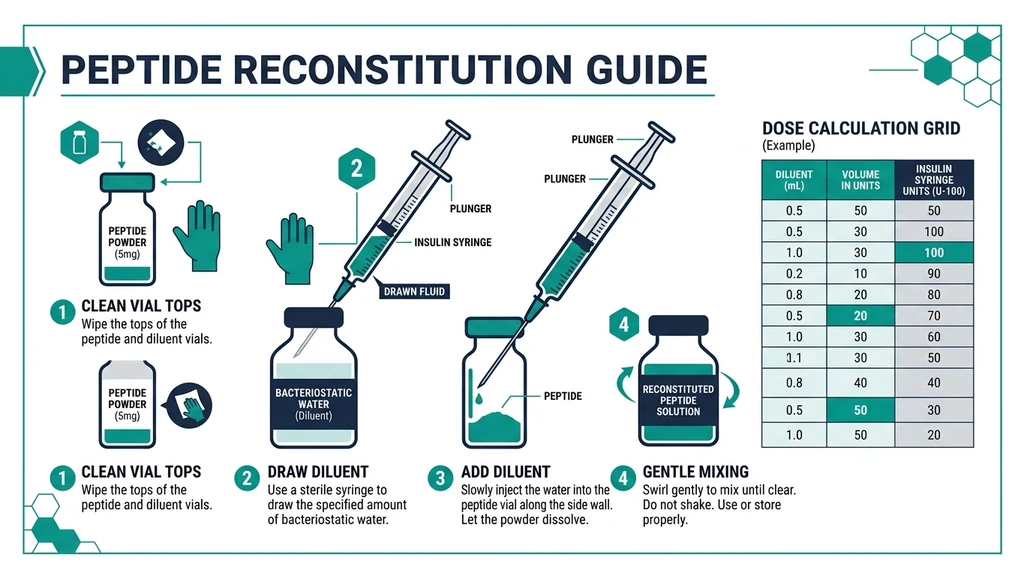
You are holding a 5mg vial of dry semaglutide powder, a bottle of bacteriostatic water, and an insulin syringe that reads in units instead of milligrams. The vial gives you no mixing instructions. To reconstitute a 5mg semaglutide vial, inject 2 mL of bacteriostatic water down the inside wall of the glass to make a 2.5 mg/mL solution, swirl gently until clear, and store it refrigerated. At 2.5 mg/mL, a 0.25 mg starting dose equals 10 units on a U-100 insulin syringe.
The unit math is one formula: Units = (dose in mg ÷ concentration in mg/mL) × 100. The quick chart below shows the three common mixes for a 5mg vial.
| BAC water added | Concentration | 0.25 mg dose | 2.4 mg dose | Best for |
|---|---|---|---|---|
| 1 mL | 5.0 mg/mL | 5 units | 48 units | Smallest fluid volume |
| 2 mL | 2.5 mg/mL | 10 units | 96 units | Default, cleanest numbers |
| 2.5 mL | 2.0 mg/mL | 12.5 units | 120 units (over one syringe) | Easy-to-read low doses |
Pick the BAC volume first, then read only the column that matches it. The danger is mixing one volume and dosing off another column, which scales every shot by a fixed multiplier.
Get your custom peptide protocol:
- Tailored to your body and goals
- Precise dosing and cycle length
- Safe stacking combinations
- Backed by peer-reviewed studies
- Ready in under 2 minutes
How Much Bacteriostatic Water for a 5mg Semaglutide Vial
The standard answer is 2 mL of bacteriostatic water added to a 5mg vial, which yields 2.5 mg/mL. That concentration gives the roundest unit numbers across the full titration ladder.
You have two alternatives. Add 1 mL for a 5.0 mg/mL solution if you want the smallest injection volume, or add 2.5 mL for a 2.0 mg/mL solution if you want larger, easier-to-read draws at low starting doses. All three are valid; the only rule is that your chart column must match the volume you actually added.
The same logic applies to other GLP-1 vials. The approach for reconstituting tirzepatide follows the identical formula with different mg-per-vial inputs. For a deeper breakdown of water ratios across every vial size, see how much bacteriostatic water for semaglutide.
Use bacteriostatic water, not plain sterile water, for a multi-dose vial. Bacteriostatic water contains roughly 0.9% benzyl alcohol, a preservative that inhibits bacterial growth and lets a reconstituted vial last weeks instead of hours (USP monograph for Bacteriostatic Water for Injection). The difference is covered in bacteriostatic vs sterile water.
Why Concentration Controls Your Unit Count
Think of it like making espresso versus drip coffee. The same scoop of grounds dissolved in a small cup is strong; dissolved in a tall mug it is weak. The caffeine never changed, only the water around it.
Semaglutide works the same way. Your 5mg vial always holds 5 mg of drug. Add less water and each unit on the syringe carries more drug; add more water and each unit carries less. The dose in milligrams is what your provider sets, but the units you draw depend entirely on how much water you added.
That is why a single "10 units" instruction is meaningless without a concentration attached. At 2.5 mg/mL, 10 units delivers 0.25 mg. At 5.0 mg/mL, the same 10 units delivers 0.5 mg, double the intended starting dose. The peptide unit converter translates between mg and units once you know your concentration.
5mg Semaglutide Mixing Chart (Units to Draw)
This is the table to bookmark. The formula above each value is Units = (dose ÷ concentration) × 100, read on a U-100 insulin syringe. Match your column to the BAC volume you added.
| Dose | @ 5.0 mg/mL (1 mL added) | @ 2.5 mg/mL (2 mL added) | @ 2.0 mg/mL (2.5 mL added) |
|---|---|---|---|
| 0.25 mg | 5 units | 10 units | 12.5 units |
| 0.5 mg | 10 units | 20 units | 25 units |
| 1.0 mg | 20 units | 40 units | 50 units |
| 1.7 mg | 34 units | 68 units | 85 units |
| 2.4 mg | 48 units | 96 units | 120 units (exceeds one syringe) |
The arithmetic worked out in plain numbers:
- At 2.5 mg/mL: 0.25 mg ÷ 2.5 mg/mL = 0.1 mL = 10 units.
- At 2.5 mg/mL: 2.4 mg ÷ 2.5 mg/mL = 0.96 mL = 96 units.
- At 5.0 mg/mL: 1.0 mg ÷ 5.0 mg/mL = 0.2 mL = 20 units.
- At 2.0 mg/mL: 2.4 mg ÷ 2.0 mg/mL = 1.2 mL = 120 units.
One number stands out. At 2.0 mg/mL, a 2.4 mg dose needs 120 units, which is more than a single 100-unit syringe holds and forces two draws. If you plan to titrate up to 2.4 mg, mix at 2 mL added (2.5 mg/mL) so the top dose still fits on one syringe at 96 units. For the full chart across every vial size, see the full semaglutide mixing chart for every vial size, and the semaglutide dosage chart in mL for the volume view.
Two Mixing Mistakes That Multiply Your Dose
A wrong BAC volume does not produce a random error. It scales every injection by a fixed multiplier, which is why it slips past people who feel like they are following the chart.
Danger 1: Adding 1 mL when your chart assumed 2 mL. You intended 2.5 mg/mL but actually mixed 5.0 mg/mL. Every unit now carries twice the drug you planned. Drawing "10 units" for a 0.25 mg starting dose delivers 0.5 mg instead. That is a 2x overdose on the very first injection, the opposite of a careful titration start, and the kind of jump that drives severe nausea and vomiting.
Danger 2: Adding 2.5 mL but dosing off the 1 mL column. You mixed 2.0 mg/mL but read units from the 5.0 mg/mL row. Drawing "20 units" for an intended 1.0 mg dose delivers only 0.4 mg. That is a 60% underdose, which stalls weight loss and gets misread as the medication "not working" when the real problem is the chart column.
The fix for both is one habit: confirm the BAC volume you added, then read only the column with that volume in its header. If you are unsure how much you added, rebuild the vial rather than guess. The peptide reconstitution calculator recomputes your true concentration from any water volume.
The Physical Technique: Aiming the Stream and Swirling
Most guides tell you to add water and stop there. How you add it decides whether the peptide survives intact.
Aim the water stream at the inside glass wall, never straight down onto the powder. Insert the needle at an angle and push the plunger slowly so the bacteriostatic water runs down the wall and pools onto the powder from the side. A direct jet onto the powder foams the solution and shears the peptide chain, which can degrade potency.
Then swirl, never shake. Roll the vial in slow circles in your palm until the powder fully dissolves and the liquid turns clear and colorless. Shaking creates a froth of bubbles that distort how far the plunger draws, so your "10 units" of foam is less than 10 units of liquid drug.
Give it time. A clean swirl usually clears the powder within 30 to 60 seconds. If cloudiness or particles remain after gentle swirling, set the vial down and wait; do not force it with vigorous agitation. The general how to inject peptides walkthrough covers drawing technique once the vial is mixed.
10-Step Reconstitution Procedure
Run these in order. Each step is one action plus the reason it matters.
- 1.Gather supplies. Lay out the 5mg semaglutide vial, bacteriostatic water, a 3 mL reconstitution syringe, alcohol swabs, and U-100 insulin syringes for dosing. The reconstitution syringe is only for adding water; the insulin syringe is for injecting.
- 1.Sanitize both stoppers. Wipe the semaglutide top and the bacteriostatic water top with separate alcohol swabs and let them air-dry 10 seconds. This prevents pushing surface bacteria into a multi-use vial.
- 1.Draw your BAC volume. Pull 2 mL of bacteriostatic water into the reconstitution syringe for the default 2.5 mg/mL mix. This is the volume with the cleanest unit numbers across the dose ladder.
- 1.Break the vacuum (optional). Inject a small puff of air into the bacteriostatic water vial before drawing, which makes the water pull smoothly without a fight against the seal.
- 1.Aim the stream down the wall. Insert the needle at an angle into the semaglutide vial and release the water slowly so it runs down the inner glass onto the powder, not as a direct jet that foams and shears the peptide.
- 1.Swirl, do not shake. Roll the vial gently in your palm until the powder dissolves and the liquid is clear and colorless. Vigorous shaking damages the molecule and creates bubbles that distort dosing.
- 1.Inspect the solution. Confirm it is clear with no particles, cloudiness, or color. A cloudy or discolored solution signals contamination or degradation; do not inject it.
- 1.Label and date the vial. Write the reconstitution date and the concentration, 2.5 mg/mL, on the vial or a strip of tape. The storage clock starts the moment you add water.
- 1.Store refrigerated. Keep the vial at 36 to 46°F (2 to 8°C), away from light, and never frozen. Cold storage preserves potency across the multi-week use window (USP cold storage guidance for compounded preparations). The detail is covered in does semaglutide need to be refrigerated.
- 1.Draw your dose on a U-100 syringe. Use the mixing chart to convert your prescribed mg dose into units, then draw to that line. Insulin syringes read in units, not milligrams, so this conversion is mandatory.
Storage, Shelf Life, and When to Toss the Vial
Once water hits the powder, the vial is on a clock. Store reconstituted semaglutide refrigerated at 2 to 8°C and treat roughly 28 days as the conservative use window for a self-mixed vial, after which preservative effectiveness and potency are no longer assured (USP <797> beyond-use dating principles for compounded sterile preparations).
Never freeze it. Freezing forms ice crystals that can fracture the peptide and leave you injecting degraded drug at an unknown potency. Keep the vial in the main body of the fridge, not the door, where temperature swings each time it opens.
Discard the vial if the solution turns cloudy, develops particles, changes color, or passes your beyond-use date, even if liquid remains. For the broader shelf-life picture across peptides, see how long reconstituted peptides last and the general how to store peptides guide. If you suspect a vial is past its window, what happens if you use expired semaglutide covers the risk.
Frequently Asked Questions
How much bacteriostatic water do I add to a 5mg semaglutide vial?
Add 2 mL of bacteriostatic water for the standard 2.5 mg/mL concentration, which gives the cleanest unit numbers across the dose ladder. Use 1 mL for a stronger 5.0 mg/mL mix with smaller volume, or 2.5 mL for an easy-to-read 2.0 mg/mL mix. See how much bacteriostatic water for semaglutide for every ratio.
How many units is 0.25 mg of semaglutide from a 5mg vial?
It depends on your concentration: 5 units at 5.0 mg/mL, 10 units at 2.5 mg/mL, or 12.5 units at 2.0 mg/mL on a U-100 syringe. The default 2 mL mix gives 10 units for a 0.25 mg starting dose. Confirm your mix against the semaglutide dosage chart in mL before drawing.
Can I use regular or sterile water instead of bacteriostatic water?
For a multi-dose vial, use bacteriostatic water. Its 0.9% benzyl alcohol inhibits bacterial growth so the vial lasts weeks. Plain sterile water has no preservative and is meant for single use, leaving a multi-dose vial open to contamination. The full comparison is in bacteriostatic vs sterile water.
Why shouldn't I shake the semaglutide vial?
Shaking shears the peptide chain and whips the solution into foam, which can degrade potency and distort how far your plunger draws. Foam means your measured units hold less liquid drug than intended. Swirl the vial gently instead until it clears, a technique echoed in how to reconstitute tirzepatide.
How long does reconstituted 5mg semaglutide last?
Treat about 28 days refrigerated at 2 to 8°C as the conservative window for a self-mixed vial, after which potency and preservative effectiveness are no longer assured (USP <797>). Never freeze it. Discard sooner if the solution turns cloudy or discolored. More detail sits in how long reconstituted peptides last.
What size syringe do I use to draw the dose?
Use a U-100 insulin syringe to draw and inject your dose, since it reads in units that match the mixing chart. The larger 3 mL reconstitution syringe is only for adding bacteriostatic water to the vial, not for injecting. The full method is in how to inject peptides.
What concentration should I choose if I plan to titrate to 2.4 mg?
Mix at 2 mL added for 2.5 mg/mL. At that strength, a 2.4 mg top dose is 96 units and still fits on one U-100 syringe. A 2.0 mg/mL mix would need 120 units for 2.4 mg, forcing two draws. Plan ahead using the semaglutide titration schedule.
What happens if I added the wrong amount of water?
Your real dose scales by a fixed multiplier. Mix 1 mL instead of 2 mL and every dose doubles; mix 2.5 mL and dose off the wrong column and you underdose by 60%. Recalculate from your actual mg/mL or rebuild the vial. The peptide reconstitution calculator gives your true concentration from any water volume.
The Bottom Line
To reconstitute a 5mg semaglutide vial, add 2 mL of bacteriostatic water for a 2.5 mg/mL solution, swirl until clear, and store it refrigerated; at that concentration a 0.25 mg dose is 10 units and a 2.4 mg dose is 96 units on a U-100 syringe.
The principle behind every number is that the water you add sets the concentration, and the concentration sets the units. Match your chart column to the BAC volume you actually used, because a mismatch multiplies every injection by a fixed factor instead of giving a small, forgivable error.
Run your exact dose and water volume through the peptide reconstitution calculator, and convert any mg dose to units with the peptide unit converter. Learn more at peptidesexplorer.com.
This is educational content, not medical advice. Follow your prescriber's dosing and verify your concentration before every injection.
Related Articles: - Semaglutide Mixing Chart - How Much Bacteriostatic Water for Semaglutide - How to Reconstitute Tirzepatide - Semaglutide Dosage Chart in mL - Bacteriostatic vs Sterile Water - How Long Do Reconstituted Peptides Last
Related Articles
Where to Inject IGF-1 LR3: Sites, SubQ vs IM, Rotation
Where to inject IGF-1 LR3: abdomen, thigh or glute, subcutaneous, 29-31G needle. Why site-specific growth is a myth, a rotation map, and the hypoglycemia rule.
When to Take IGF-1 LR3: Best Time & Fed vs Fasted
When to take IGF-1 LR3: post-workout with carbs on training days, morning with breakfast on rest days, never fasted. Half-life, spacing from GH peptides, FAQ.
Where to Inject BPC-157 for Back Pain: Lower Back Sites
Where to inject BPC-157 for lower back pain, herniated disc, sciatica and SI joint pain: abdomen vs paraspinal sites, landmarks, zones to avoid, red flags.
Best Time to Take Retatrutide: Morning or Night?
Best time to take retatrutide: any hour, same weekday. Evening blunts nausea, morning suits diarrhea. Missed-dose rule, day switching, food, travel, alcohol.