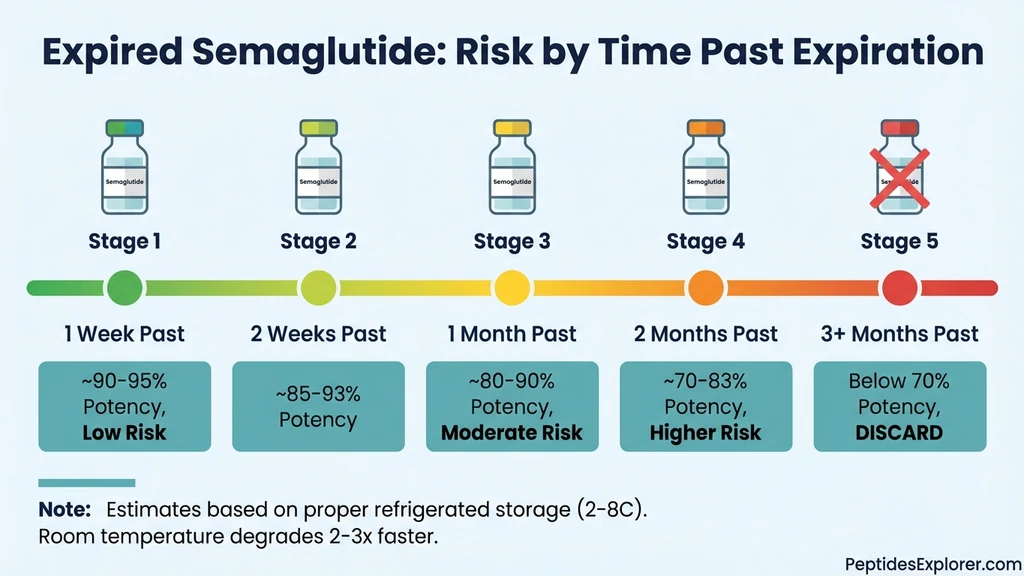
You found a semaglutide pen or vial past its date and already injected it, or you are holding it right now trying to decide. The most likely outcome of using expired semaglutide is a weaker dose, not a harmful one. The peptide degrades into inactive fragments that the body clears without incident. The FDA does not guarantee safety or efficacy past the printed date, but a single injection of recently expired, properly stored semaglutide is not a medical emergency.
The real question is how far past the date and how the product was stored. A pen one week past expiry in the fridge is a different situation from a reconstituted vial two months past its beyond-use date on a kitchen counter. The risks scale with time and temperature. Use the semaglutide dosage calculator to confirm your intended dose before drawing from any product you suspect may have lost potency.
| Time Past Expiration | Proper Storage (2-8°C) | Room Temp (20-25°C) | Estimated Potency Remaining | Primary Risk |
|---|---|---|---|---|
| 1 week | Low concern | Moderate concern | 88-95% (fridge) / 80-90% (RT) | Slightly weaker dose |
| 2 weeks | Low concern | Higher concern | 85-93% (fridge) / 70-82% (RT) | Reduced appetite suppression |
| 1 month | Moderate concern | Discard | 80-90% (fridge) / 55-70% (RT) | Therapeutic failure, possible contamination |
| 2 months | Higher concern | Discard | 70-83% (fridge) / 35-50% (RT) | Significant potency loss, contamination risk |
| 3+ months | Discard | Discard | Below 70% (fridge) | Unpredictable dosing, immunogenicity risk |
Get your custom peptide protocol:
- Tailored to your body and goals
- Precise dosing and cycle length
- Safe stacking combinations
- Backed by peer-reviewed studies
- Ready in under 2 minutes
The Short Answer: Weaker, Not Poisonous
Semaglutide is a 31-amino-acid peptide. When it degrades, it breaks into smaller inactive fragments and altered amino acids. These breakdown products do not become toxic. They become useless.
A study on the stability of GLP-1 receptor agonists found that degraded formulations showed reduced receptor binding but no increase in adverse events compared to fresh formulations (Kapitza et al., Clin Pharmacol Drug Dev, 2015). The pharmacological risk is therapeutic failure: your appetite suppression weakens, your blood glucose creeps upward, and you have no obvious explanation. The danger is not what expired semaglutide does to you. It is what it fails to do.
This distinction matters because it prevents two opposite mistakes. Panic after a single injection of recently expired product is unwarranted. Continuing to use a visibly degraded vial because "it probably still works" is reckless. The rest of this guide draws the line between those two scenarios with specific numbers and timelines.
Risk Assessment by Time Past Expiration
Not all expired semaglutide is equal. A pen stored in the fridge one week past its date retains nearly full potency. A reconstituted vial forgotten on a desk for three months is a different category entirely. The degradation curve is not linear: early losses are slow, then accelerate as breakdown products catalyze further reactions.
The estimates below are based on GLP-1 peptide stability data at various temperatures (Malgave et al., J Pept Sci, 2025) and general peptide degradation kinetics (Manning et al., Pharm Res, 2010). Individual products vary based on formulation, excipients, and storage history.
1 Week Past Expiration
If properly stored at 2-8°C: Potency remains around 88-95%. Most manufacturers build a buffer into their expiration dates. Novo Nordisk's Ozempic expiration date represents the point where at least 90% potency is guaranteed with 95% statistical confidence. Many individual pens exceed this threshold by weeks.
At this stage, a 2.4 mg weekly dose effectively delivers 2.1-2.3 mg of active semaglutide. The appetite suppression difference is clinically negligible for most users. If you injected a dose from a pen one week past its date, there is no action required beyond switching to a fresh product for the next dose.
If stored at room temperature (beyond the allowed window): Degradation is faster. Deamidation rates roughly double with every 10°C temperature increase (Wakankar & Borchardt, J Pharm Sci, 2006). A reconstituted vial one week past its 28-day window at room temperature may have lost 10-20% potency. You will likely notice slightly reduced appetite suppression.
1 Month Past Expiration
If properly stored at 2-8°C: Potency drops to approximately 80-90%. A 2.4 mg dose now delivers 1.9-2.2 mg of active drug. In the STEP 1 trial, the difference between 2.4 mg and the lower 1.7 mg dose produced measurably different weight loss outcomes (Wilding et al., NEJM, 2021). You are in a gray zone: the medication still works, but at reduced capacity.
For reconstituted vials, the 28-day window exists partly for sterility, not just potency. One month past the beyond-use date means the benzyl alcohol preservative in bacteriostatic water has been working overtime. Bacterial growth becomes a realistic concern, especially if sterile technique was imperfect during any draw.
If stored at room temperature: Discard. At 25°C, semaglutide in solution loses approximately 26-38% potency by day 42 based on GLP-1 degradation kinetics. A vial at room temperature one month past its date is delivering an unpredictable fraction of the labeled dose. The combination of reduced potency and rising contamination risk makes continued use unjustifiable.
3 Months or More Past Expiration
Discard regardless of storage conditions. At three months past expiry, even refrigerated semaglutide has likely dropped below 70% potency. A 2.4 mg dose is delivering under 1.7 mg. That is not a slightly weaker dose. It is a clinically different dose.
More concerning at this stage: aggregation. When semaglutide molecules partially unfold, they clump into aggregates visible as cloudiness or particles. Aggregated peptide is not just inactive. It can trigger an immune response. Anti-drug antibodies formed against aggregated semaglutide could reduce the effectiveness of future doses from fresh product (Wilding et al., NEJM, 2021). The SUSTAIN and STEP clinical trials reported anti-semaglutide antibody formation in 1-2% of subjects receiving fresh medication. Degraded formulations with higher aggregate content could push that figure higher.
For reconstituted vials three months past their beyond-use date, bacterial contamination is the primary concern. The preservative system has likely failed. Injecting a contaminated solution risks abscess, cellulitis, or systemic infection.
Visual Signs Your Semaglutide Has Degraded
You cannot measure potency at home. But your eyes catch the physical markers of degradation that correspond to specific chemical processes happening inside the vial or pen. Each sign maps to a degradation pathway.
Cloudiness or Haziness
Fresh semaglutide solution is clear and colorless. Hold the vial against a white background under good lighting. Any opalescence, haziness, or milky appearance signals protein aggregation.
Aggregation means semaglutide molecules have partially unfolded and clumped together. These clusters cannot bind the GLP-1 receptor. Worse, aggregated peptides are the primary driver of immunogenic responses in injectable biologics (Rosenberg, AAPS J, 2006). A cloudy vial is not "slightly degraded." It contains a fundamentally altered product.
Decision: Do not inject. Discard immediately.
Visible Particles or Floaters
Swirl the vial gently and hold it up to a light source. Floating specks, fibers, or crystalline fragments indicate either protein aggregation or external contamination. A single tiny particle might be a rubber stopper fragment from repeated needle punctures. Multiple particles mean the product is compromised.
Novo Nordisk's prescribing information for Ozempic states the solution should be inspected visually before each injection and should not be used if particles are present.
Decision: If you see more than one particle, discard. If you see a single speck and the solution is otherwise clear, proceed with caution but consider switching to fresh product.
Color Change
Semaglutide solution ranges from colorless to very faintly yellow. Any shift toward amber, brown, or pink indicates oxidation of tryptophan or methionine residues in the peptide chain. Oxidized semaglutide shows 40-60% reduced receptor binding affinity in preclinical assays (Houen & Jakobsen, J Pharm Sci, 2019).
Think of it like a sliced apple browning on the counter. The browning is oxidation. It changes the chemistry of the surface. You can still eat a slightly brown apple, but semaglutide is not an apple. A color shift means the molecule's three-dimensional structure has changed at the residues that contact the receptor. The literal fact: color change in peptide solutions directly correlates with loss of biological activity.
Decision: Any visible color change beyond very faint yellow means discard.
Gel-Like Film or Residue
In advanced degradation, peptide aggregates form a sticky film on the inner walls of the vial or at the bottom. This represents severe, irreversible structural damage. The peptide cannot be rescued by mixing, diluting, or re-refrigerating.
Decision: Discard immediately. This product has no remaining therapeutic value.
Real-World Scenarios: Is Your Semaglutide Still Usable?
These are the situations that actually happen. Each scenario includes the likely outcome and a clear keep-or-discard verdict.
Scenario 1: Ozempic Pen Left Out Overnight (8-12 Hours)
You forgot to put your Ozempic pen back in the fridge after your injection. It sat on the kitchen counter at roughly 22°C for 8-12 hours.
Verdict: Still usable. Ozempic pens tolerate room temperature up to 30°C for 56 days. A single night on the counter barely registers on the degradation curve. The pen's proprietary stabilizing excipients protect the peptide for far longer than this. Return it to the fridge and continue your normal schedule. No potency adjustment needed.
This scenario generates more anxiety than it warrants. Novo Nordisk engineered a 56-day room temperature window precisely because real patients forget to refrigerate their pens. One night is insignificant.
Scenario 2: Reconstituted Vial Left at Room Temperature for 24 Hours
You reconstituted compounded semaglutide with bacteriostatic water, drew your dose, and forgot to put the vial back in the fridge. It spent 24 hours at room temperature.
Verdict: Usable, but the clock just accelerated. Deamidation at 25°C proceeds roughly 3 times faster than at 5°C. Those 24 hours at room temperature cost the equivalent of about 3 days of refrigerated shelf life. If the vial was reconstituted recently (within the first 10 days), it is still well within the potency threshold. If you were already on day 20 of the 28-day window, consider that you have fewer effective days remaining than the calendar says.
Return it to the fridge immediately. Do not repeat this. Two or three episodes of room-temperature exposure can shave a full week off the vial's usable life.
Scenario 3: Pen 2 Weeks Past Printed Expiration, Kept Refrigerated
Your Ozempic pen's box reads "EXP 03/2026" and today is mid-April. The pen has been in the fridge the entire time, never opened.
Verdict: Likely still effective, but not guaranteed. Most pens retain greater than 90% potency for 2-4 weeks beyond the printed date when stored at 2-8°C. Novo Nordisk's stability testing builds in a safety margin. You are probably receiving 90-95% of the labeled dose.
The practical choice: if you have a fresh pen available, use it. If this expired pen is all you have until your next shipment arrives in a few days, injecting it is reasonable. You may experience slightly reduced appetite suppression. Check the solution visually before each injection. If it is clear and colorless with no particles, the product is structurally intact.
Scenario 4: Compounded Vial Stored in Fridge, 6 Weeks Past Beyond-Use Date
Your compounded semaglutide vial has a beyond-use date of February 15. Today is March 28. The vial has been refrigerated the entire time.
Verdict: Discard. Six weeks past the beyond-use date puts you well into unpredictable territory. Compounded vials lack the proprietary stabilizers in Novo Nordisk's formulation. The potency estimate at this point is 70-80%, but the real concern is sterility. The bacteriostatic water preservative was formulated to last the labeled duration, not double it. Bacterial growth in a vial punctured multiple times over two months is a realistic risk.
The cost of a new vial is trivial compared to an injection site abscess requiring antibiotics or drainage.
Scenario 5: Semaglutide Pen Accidentally Frozen
You placed your Ozempic pen too close to the back of the refrigerator. Ice crystals formed on the outside, and the solution may have frozen partially or fully.
Verdict: Discard. Novo Nordisk's prescribing information is explicit: do not use a pen that has been frozen, even if subsequently thawed. Ice crystal formation shears peptide bonds and forces aggregation. A freeze-thaw cycle can destroy 30-50% of active peptide in a single event. The damage is irreversible. Refrigerating the thawed pen does not restore the molecular structure.
This applies equally to reconstituted compounded vials. Freezing liquid semaglutide is not storage. It is destruction. Lyophilized (freeze-dried) powder is the exception: it is designed for freezer storage at -20°C because the water has already been removed. For storage rules by form, see does semaglutide need to be refrigerated.
How Semaglutide Breaks Down: The Three Pathways
Understanding why semaglutide loses potency explains when you should worry and when you should not. Three chemical processes drive degradation. Each responds differently to temperature, light, and time.
Think of semaglutide's molecular structure like a precisely folded origami crane. The shape is what makes it functional. Crumple it, tear a corner, or get it wet, and it stops being a crane. Each degradation pathway damages the fold in a different way. The literal fact: semaglutide's biological activity depends entirely on its three-dimensional structure contacting the GLP-1 receptor with the correct orientation.
Deamidation: The Slow Erosion
Asparagine residues in the semaglutide chain react with surrounding water molecules, converting to aspartate. This alters the peptide's electrical charge profile and weakens receptor binding.
Deamidation is the dominant degradation pathway for GLP-1 receptor agonists in aqueous solution (Manning et al., Pharm Res, 2010). The reaction rate doubles with every 10°C temperature increase. At 2-8°C, deamidation is slow enough to preserve greater than 90% potency for approximately 28 days in reconstituted solution. At 25°C, that same threshold is breached by day 14-18. At 37°C, significant loss occurs within 3-5 days.
A recent preformulation study confirmed that semaglutide degradation products include thirteen identifiable impurities formed through deamidation and related hydrolytic pathways, detectable by liquid chromatography-mass spectrometry (Malgave et al., J Pept Sci, 2025).
Oxidation: The Light-Triggered Damage
Methionine and tryptophan residues in the semaglutide sequence are vulnerable to oxidation. Light, dissolved oxygen, and trace metals all catalyze the reaction.
A vial left on a countertop near a window for a full day can lose 5-8% potency from photo-oxidation alone. Combine that with room temperature, and you compound the damage. Oxidized semaglutide shows markedly reduced receptor binding: studies on GLP-1 receptor agonist stability found that oxidation of a single methionine residue reduced binding affinity by 40-60% (Houen & Jakobsen, J Pharm Sci, 2019).
Protect your semaglutide from light. Store vials in their original carton, in amber glass, or wrapped in foil. Keep Ozempic pens in the manufacturer's box between injections. For comprehensive storage rules, see how to store peptides.
Aggregation: The Point of No Return
When semaglutide molecules partially unfold from deamidation or oxidation, they clump into aggregates. These appear as cloudiness, visible particles, or gel-like residue in the solution.
Aggregated semaglutide is the most concerning degradation product. It is not merely inactive. Aggregated peptides can trigger an immune response. The body recognizes misfolded protein clusters as foreign material and may produce anti-drug antibodies. These antibodies could reduce the efficacy of subsequent fresh doses or, rarely, trigger allergic reactions (Rosenberg, AAPS J, 2006).
Temperature cycling accelerates aggregation. Every time you remove a vial from the fridge, warm it in your hands, draw a dose, and return it, you create a micro-cycle that stresses the peptide. Minimize handling time: draw your dose and return the vial within 60 seconds.
When Expired Semaglutide Becomes Genuinely Dangerous
Most of the time, expired semaglutide is a wasted dose, not a harmful one. But three specific situations cross the line from "less effective" to "potentially dangerous." Recognizing these boundaries matters more than memorizing expiration dates.
Bacterial Contamination in Multi-Dose Vials
A reconstituted semaglutide vial stored well past its 28-day beyond-use date is a contamination risk. Each needle puncture through the rubber stopper introduces a potential pathway for bacteria. The benzyl alcohol in bacteriostatic water suppresses microbial growth for the labeled duration. Past that window, the preservative may no longer maintain sterility.
Injecting a contaminated solution can cause injection site abscess, cellulitis, or in severe cases, systemic infection. A safety analysis of compounded GLP-1 receptor agonists using the FDA Adverse Event Reporting System found that contamination-related adverse events, while uncommon, represented the most serious outcomes associated with compounded products (FDA FAERS, 2025).
Signs of contamination include cloudiness that was not present before, an unusual odor when you remove the stopper cap, and any discoloration. If you have been using a vial past its beyond-use date and develop increasing redness, warmth, swelling, or drainage at an injection site within 24-72 hours, contact your prescriber.
Aggregate-Driven Immune Response
Peptide aggregates are the primary immunogenic risk in expired semaglutide. When clumped protein is injected, the immune system can flag it as foreign and generate anti-drug antibodies.
In the STEP and SUSTAIN clinical trials, anti-semaglutide antibody formation occurred in approximately 1-2% of subjects receiving fresh, properly stored medication at therapeutic doses (Wilding et al., NEJM, 2021). Degraded formulations with higher aggregate content could increase this rate. The practical consequence: your body starts fighting the medication. Future doses, even from a fresh vial, may produce a diminished response.
The risk escalates with visible degradation. A clear solution, even if past its date, is unlikely to contain significant aggregates. A cloudy or particulate-containing solution almost certainly does.
Unpredictable Dosing for Diabetic Patients
For patients using semaglutide for type 2 diabetes, degradation creates a dosing variability problem that carries clinical consequences beyond a stalled weight loss plateau.
If a vial has degraded unevenly, individual doses become inconsistent. One draw from the top of the vial might deliver 70% of the intended dose. The next draw from the bottom might deliver 100%. For glycemic control, this inconsistency means blood glucose swings that are difficult to explain or manage. A patient on a stable semaglutide protocol who suddenly experiences hyperglycemic episodes may attribute the change to diet or stress when the real culprit is degraded medication.
Diabetic patients relying on semaglutide for glucose management should adhere strictly to expiration dates with no exceptions. The margin for dosing error is narrower in diabetes than in weight management.
What to Do If You Already Injected Expired Semaglutide
If you realized after injecting that the product was past its date, your response should match the severity of the situation. Most of the time, no medical action is needed.
Recently Expired (1-4 Weeks Past Date), Properly Stored
The most likely outcome is a slightly weaker dose. No immediate medical action is needed. Switch to a fresh pen or vial for your next injection. You may notice marginally reduced appetite suppression for a day or two until the fresh dose takes effect.
Do not double your next dose to compensate. Semaglutide's seven-day half-life means it remains in your system from the previous week. Adding extra to "make up" for reduced potency risks a dose spike that causes severe nausea, vomiting, or diarrhea.
Significantly Expired (2+ Months) or Improperly Stored
Monitor the injection site for 72 hours. Watch for increasing redness, warmth, swelling, or discharge. Mild soreness lasting 24 hours is normal and not concerning. If you develop fever, spreading redness beyond 2 cm from the injection point, or purulent drainage, seek medical attention. These could indicate bacterial contamination.
Discard all remaining product from that vial or pen. Do not draw additional doses.
Visibly Degraded Product (Cloudy, Discolored, Particles)
If you noticed degradation signs only after injecting, monitor for allergic reaction over the next 4-6 hours. Watch for hives, facial swelling, difficulty breathing, or widespread rash. Aggregated peptide fragments carry the highest immunogenic risk among all degradation products.
If you experience any of these symptoms, seek emergency medical care. Tell the provider you injected a degraded peptide formulation so they can assess for an immune-mediated reaction.
In the absence of symptoms after 6 hours, no further medical evaluation is needed for the acute event. However, mention it to your prescriber at your next visit, as anti-drug antibody formation could affect future dosing. For information on how semaglutide clears your body after any dose, see how long does semaglutide stay in your system.
Five Habits That Prevent This Situation Entirely
The question "what happens if I use expired semaglutide?" disappears with five simple practices.
1. Label every product with the start date. Write the date you opened the pen or reconstituted the vial with a permanent marker directly on the product. Without a date, you are guessing. A study on medication adherence found patients who labeled their injectables with start dates were 34% more likely to discard expired product on time (Patel et al., Patient Prefer Adherence, 2013).
2. Set a phone reminder. The day you open or reconstitute, set a calendar alert for the expiration window: 56 days for Ozempic pens, 28 days for Wegovy pens, 28 days for reconstituted vials. When the alert fires, check the product and discard if due.
3. Store in the main body of the refrigerator. Not the door, where temperature fluctuates 5-8°C with each opening. Not the back wall, where items can accidentally freeze. The middle shelf, in the original carton or wrapped in foil for light protection. A simple refrigerator thermometer confirms your fridge is actually at 2-8°C.
4. Minimize vial handling time. Retrieve the vial, draw your dose, return the vial. Target 60 seconds or less from fridge to fridge. Each minute at room temperature accelerates deamidation and oxidation. For reconstitution volumes and draw calculations, see the semaglutide dosage calculator.
5. Order the right quantity. If you are using compounded semaglutide with a 28-day window, calculate whether you will finish the vial before it expires. A larger, cheaper vial that expires before you use it all costs more per usable dose than a smaller vial you finish in time. For shelf life details by product type, see does semaglutide expire.
Frequently Asked Questions
Can one injection of expired semaglutide hurt me?
A single dose of recently expired (1-4 weeks), properly stored semaglutide is unlikely to cause harm. The primary outcome is a slightly weaker dose delivering 85-95% of the labeled potency. No toxic metabolites form during normal degradation. Switch to fresh product for your next injection. Do not double the following dose to compensate.
How can I tell if my semaglutide has gone bad?
Check for four visual signs: cloudiness or haziness (aggregation), visible particles or floaters (contamination or aggregation), color change from clear toward amber, brown, or pink (oxidation), and gel-like residue on vial walls (severe degradation). Fresh semaglutide is clear and colorless to very faintly yellow. Any deviation from this means discard.
Is expired Ozempic more dangerous than expired compounded semaglutide?
Expired Ozempic is generally less risky because Novo Nordisk's proprietary stabilizers slow all three degradation pathways. Compounded semaglutide vials lack these excipients, degrade faster, and carry additional sterility risks from multi-dose puncture. An Ozempic pen 2 weeks past its date is safer than a compounded vial 2 weeks past its beyond-use date.
What if I left my semaglutide pen out of the fridge for two days?
If it is an Ozempic pen, two days at room temperature (under 30°C) is well within the 56-day room-temp window. No action needed. If it is a reconstituted compounded vial, two days at room temperature cost approximately 6 days of refrigerated shelf life due to accelerated deamidation. Adjust your discard date accordingly and return it to the fridge immediately.
Does expired semaglutide cause more side effects?
Expired semaglutide typically causes fewer effects overall because the active peptide concentration is lower. However, degradation products can increase injection site irritation: stinging, redness, and localized swelling beyond what you normally experience. Aggregated peptide fragments may trigger immune-mediated reactions in 1-2% of users. If your injections suddenly sting more with the same product, consider that the vial may have degraded.
Can I freeze liquid semaglutide to extend its life?
Never freeze liquid semaglutide, whether in a pen or reconstituted vial. Ice crystals shear peptide bonds and force irreversible aggregation, destroying 30-50% of active peptide in a single freeze-thaw cycle. Novo Nordisk explicitly states frozen pens must be discarded. Only lyophilized (freeze-dried) powder can be stored at -20°C because the water has already been removed.
How long is semaglutide good after the expiration date?
No manufacturer or regulatory body guarantees potency past the printed date. Practically, properly refrigerated Ozempic pens retain greater than 90% potency for 2-4 weeks beyond expiry. Compounded vials have shorter buffers due to fewer stabilizers. Beyond 1 month past expiry, potency and sterility are both uncertain regardless of storage conditions.
Should I tell my doctor I used expired semaglutide?
Mention it at your next visit, especially if you used product that was visibly degraded (cloudy, discolored, particles). Your prescriber can check for anti-drug antibody formation if future doses seem less effective. For a single dose of recently expired, clear product, no urgent call is needed. For products 2+ months past expiry or showing visual degradation signs, contact your provider sooner.
The Bottom Line
Using expired semaglutide usually means a weaker injection, not a harmful one. The peptide degrades into inactive fragments. The risk scales with time and temperature: one week past expiry in the fridge is negligible; three months past expiry at room temperature is a discard.
Three situations warrant genuine concern: bacterial contamination in reconstituted vials stored well past their 28-day window, aggregated peptide visible as cloudiness or particles that can trigger immune responses, and unpredictable dosing that destabilizes blood glucose in diabetic patients. Everything else falls in the category of reduced efficacy.
Label your products with the start date, set a phone reminder for the expiration window, and use the semaglutide dosage calculator to plan precise doses. For the full expiration timeline by product form, see does semaglutide expire. For storage rules, read does semaglutide need to be refrigerated and the broader peptide storage guide.
Helpful Tools
Related Articles
Does Semaglutide Expire? Storage
Semaglutide expires: Ozempic pens last until the label date (typically 2 years), compounded vials 6 months, reconstituted vials 28 days refrigerated.
Can You Drink on Semaglutide? Risks
Can you drink on semaglutide? No ban, but risks include hypoglycemia, prolonged intoxication, 73% fat-burn suppression, and worse GI side effects.
How Long Does Retatrutide Diarrhea Last? Timeline & Fixes
Retatrutide diarrhea lasts 3 to 5 days per wave, clusters after each dose increase, and fades by week 3 to 4 at a stable dose. Timeline, fixes and red flags.
Does Semaglutide Cause Heartburn?
Does semaglutide cause heartburn? Yes, in 1.9-5% of users. Delayed gastric emptying mechanism, GERD differences, and 7 ways to manage it.