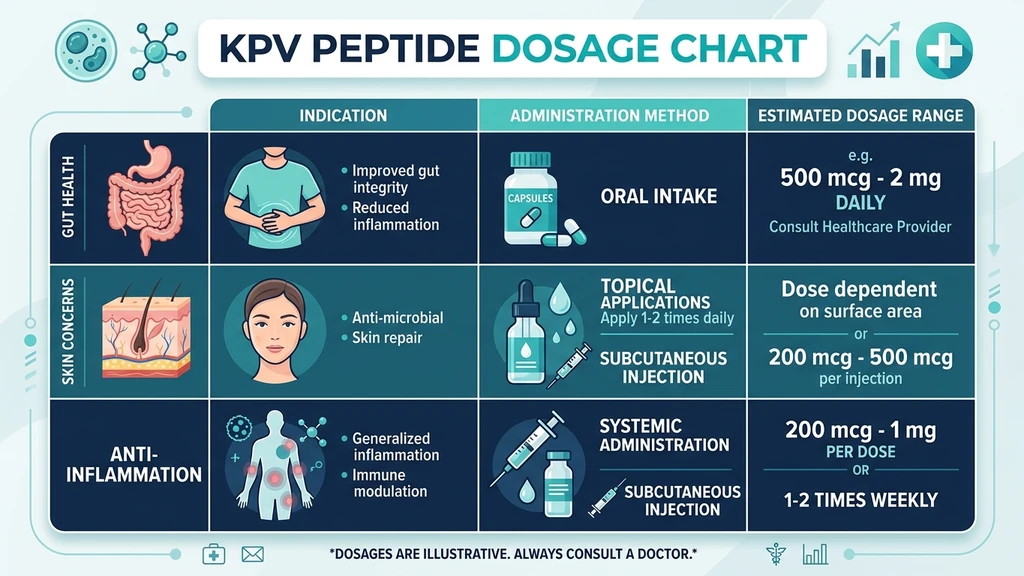
KPV is dosed at 200 to 500 mcg per day across most conditions. The route is what changes. Use oral KPV for gut inflammation and IBD because it self-targets inflamed intestinal tissue. Use subcutaneous injection for systemic inflammation, joints, or widespread skin conditions. The chart below maps each condition to a dose, route, and frequency so you can read off your protocol in one line.
This is research and education content. KPV is a research peptide with no human clinical trials and no FDA approval. Consult a qualified healthcare provider before acting on anything here.
Get your custom peptide protocol:
- Tailored to your body and goals
- Precise dosing and cycle length
- Safe stacking combinations
- Backed by peer-reviewed studies
- Ready in under 2 minutes
KPV Peptide Dosage Chart: Quick Reference
This KPV peptide dosage chart covers the three most common goals: gut and IBD, skin and eczema, and general systemic inflammation. Doses are daily totals. Routes reflect where the inflammation lives, not personal preference.
| Condition | Dose | Route | Frequency |
|---|---|---|---|
| Gut health / IBD / colitis | 200-500 mcg/day | Oral | Once daily, empty stomach |
| Skin / eczema (localized) | 0.01-0.1% cream | Topical | Twice daily |
| Skin (widespread) | 200-500 mcg/day | Subcutaneous | Once daily |
| General inflammation | 200-500 mcg/day | Subcutaneous | Once daily |
| Joint inflammation | 200-500 mcg/day | Subcutaneous | Once daily |
Most protocols run 4 to 8 weeks. Start at 200 mcg/day for the first week, then increase to 500 mcg if well tolerated. The low-then-high ramp lets you confirm tolerance before committing to the full dose, and it costs nothing in efficacy because the research-backed range spans both numbers. For the full route-by-route breakdown, see the KPV dosage guide. For where KPV sits among other anti-inflammatory peptides, see peptides for inflammation.
Read the chart by goal, not by habit. A person with ulcerative colitis and a person with shoulder inflammation can run the same 300 mcg daily dose, yet one swallows it and the other injects it. The milligram figure is shared. The delivery is not. That single distinction prevents most of the disappointment people report with KPV, because a correctly dosed peptide sent to the wrong tissue simply underperforms.
Oral vs subcutaneous in one sentence: oral for anything inside the gut, subcutaneous for anything outside it.
What KPV Is and How It Works
KPV is a three-amino-acid peptide (lysine-proline-valine) cut from the C-terminal tail of alpha-melanocyte-stimulating hormone (alpha-MSH), occupying positions 11 through 13. It carries the anti-inflammatory activity of the parent hormone but drops the receptor-binding region. That separation is the whole point.
Because KPV does not bind melanocortin receptors (MC1R, MC3R, MC5R), it produces no skin tanning or pigmentation at any dose, unlike full-length alpha-MSH or Melanotan II. The anti-inflammatory and the pigmentation functions of alpha-MSH live in different parts of the molecule, and KPV keeps only the first (Brzoska et al., 2008).
Inside the cell, KPV blocks NF-kB, the master switch for inflammatory gene transcription. Shutting that switch down lowers production of TNF-alpha, IL-1beta, IL-6, and other pro-inflammatory cytokines. The effect appears largely receptor-independent, which is why such a tiny peptide works at all.
KPV also modulates immune tone rather than suppressing it. It nudges macrophages from an inflammatory state toward a reparative one without disabling the body's ability to fight infection. That distinction matters for dosing decisions: KPV is not a corticosteroid and does not need tapering, and it does not blanket-suppress immunity the way systemic steroids do. The practical implication is a peptide that can run for weeks at a steady dose without the metabolic baggage that limits how long you can use stronger anti-inflammatories.
Its small size also helps. At roughly 341 daltons across three amino acids, KPV is among the smallest peptides used in this space, which contributes to both its oral absorption through PepT1 and its relative stability compared with larger peptides. For the full mechanism and benefits, see the KPV peptide profile.
KPV Dosage by Goal
The dose stays roughly constant. The goal decides the route, the timing, and the duration.
Gut Health, IBD, and Colitis
Dose: 200-500 mcg/day, oral, once daily on an empty stomach, 4 to 8 weeks.
Oral is the preferred route here for a mechanistic reason. KPV enters intestinal cells through the PepT1 transporter, and PepT1 expression rises in the colon during inflammation. The sicker the tissue, the more KPV it pulls in, which makes oral delivery self-targeting (Dalmasso et al., 2008).
In two standard mouse colitis models (DSS-induced and CD45RB-transfer), KPV produced earlier recovery, stronger body weight regain, and significantly lower colonic myeloperoxidase activity, a direct marker of inflammatory infiltrate (Kannengiesser et al., 2008). Take the dose 30 minutes before food to limit competition with dietary peptides for PepT1.
Expect the timeline to be gradual. Most people running oral KPV for gut symptoms notice the first changes, reduced bloating, less cramping, and steadier stool, around weeks two to four. Full mucosal calm takes longer, often the back half of an eight-week cycle. If nothing shifts by week four at the top of the range, the issue is usually quality or sourcing rather than dose, since this is the window where the colitis models showed clear separation from controls.
Skin and Eczema
Localized dose: 0.01-0.1% KPV cream or serum, twice daily to affected skin, 4 to 8 weeks. Widespread dose: 200-500 mcg/day subcutaneous when large areas are involved.
KPV calms inflammatory signaling in keratinocytes, which is why it appears in compounded creams for eczema, rosacea, and post-procedure redness. The catch is penetration: KPV crosses intact skin poorly by passive diffusion, so a thin layer on a small lesion behaves differently than a systemic dose.
For psoriasis or dermatitis covering large areas, subcutaneous dosing reaches the tissue more reliably than topical alone. Compounded pharmacy creams give more consistent concentration than DIY mixes, where guessing the percentage from a milligram vial is easy to get wrong by an order of magnitude.
A simple rule sorts the route: if you could cover the affected skin with a few fingertips, topical is reasonable; if the inflammation spans a region or recurs across the body, dose subcutaneously at 200 to 500 mcg/day and treat it as a systemic condition. The two approaches can overlap, with a subcutaneous base dose plus topical cream on the worst spots.
General and Systemic Inflammation
Dose: 200-500 mcg/day, subcutaneous, once daily, 4 to 6 weeks.
When the target sits outside the gut (joints, connective tissue, or whole-body inflammatory load), subcutaneous injection delivers KPV into circulation and bypasses first-pass gut metabolism. This is the route for arthritis-type joint inflammation and for inflammation that is not anchored to one organ.
Onset for systemic effects tends to run 1 to 2 weeks, faster than the 2 to 4 weeks typical of oral gut protocols, because the peptide reaches the bloodstream directly. See peptides for inflammation for how KPV compares to other systemic options.
Oral vs Injectable KPV Dosing
Oral and subcutaneous KPV use the same daily milligram range. The difference is destination, not dose size.
| Factor | Oral KPV | Subcutaneous KPV |
|---|---|---|
| Best target | Gut, IBD, colitis | Systemic, joints, widespread skin |
| Absorption | PepT1 transporter in gut lining | Direct into circulation |
| Self-targeting | Yes, PepT1 rises with inflammation | No |
| Typical onset | 2-4 weeks | 1-2 weeks |
| Timing | Empty stomach, 30 min before food | Anytime, rotate sites |
| Daily dose | 200-500 mcg | 200-500 mcg |
The common error is assuming injection is always stronger. For gut conditions it is not. Oral KPV places the peptide exactly where colitis occurs, and the PepT1 upregulation during inflammation creates a delivery advantage injection cannot copy (Dalmasso et al., 2008). For systemic targets the logic flips, and subcutaneous wins. Many users separate these by time of day as well, depending on goal.
Reconstitution and How to Measure
Injectable KPV ships as a lyophilized powder that you reconstitute with bacteriostatic water before drawing a dose.
The math: add 2 mL bacteriostatic water to a 10 mg vial, which yields 5,000 mcg/mL. On a U-100 insulin syringe, every 0.1 mL equals 10 units.
| Dose | Volume | Insulin units |
|---|---|---|
| 200 mcg | 0.04 mL | 4 units |
| 250 mcg | 0.05 mL | 5 units |
| 500 mcg | 0.10 mL | 10 units |
Run your exact vial size through the peptide reconstitution calculator before drawing the first dose. Inject the water slowly down the inside wall of the vial, then swirl gently until the powder dissolves. Never shake.
A worked example removes the guesswork. Say you want 300 mcg from that 5,000 mcg/mL solution. Divide 300 by 5,000 to get 0.06 mL, which is 6 units on a U-100 syringe. The arithmetic is always dose divided by concentration, then read the milliliter figure as units by multiplying by 100. Keeping the concentration round (5,000 mcg/mL) makes the units land on clean numbers.
Storage: refrigerate reconstituted KPV at 2 to 8 degrees Celsius and use within about 4 weeks. Do not freeze the solution, since freeze-thaw cycles can degrade peptide potency. Keep the vial out of direct light and away from heat. For full handling timelines, see how long reconstituted peptides last.
Common KPV Dosing Mistakes
Most KPV problems come from route and handling errors, not dose size.
- Injecting for gut issues. Subcutaneous KPV skips the PepT1 self-targeting that makes oral effective for colitis and IBD. Use oral for the gut.
- Taking oral KPV with food. Dietary peptides compete for PepT1 binding. Dose on an empty stomach, 30 minutes before eating.
- Shaking the vial. Shaking can damage the peptide. Swirl gently to dissolve.
- Skipping the dose math. Eyeballing units leads to large errors. Confirm with the reconstitution calculator every time.
- Running it during an active infection. Damping inflammation mid-infection can be counterproductive. Review the peptide safety guide and a clinician first.
- Expecting overnight results. Gut benefits typically appear at 2 to 4 weeks, not days. For the broader dosing landscape, see the peptide dosage chart.
Frequently Asked Questions
What is the standard KPV peptide dosage?
The standard KPV dosage is 200 to 500 mcg per day, oral or subcutaneous, run for 4 to 8 weeks. Start at 200 mcg daily and increase to 500 mcg after week one if tolerated. The full KPV dosage guide breaks down each route and condition.
Should I take KPV orally or inject it?
Take KPV orally for gut inflammation, IBD, or colitis, because it self-targets inflamed intestinal tissue through the PepT1 transporter. Inject subcutaneously for systemic inflammation, joints, or widespread skin conditions. The KPV peptide profile covers the mechanism behind each route.
What is the KPV dose for gut health?
For gut health and IBD, dose KPV at 200 to 500 mcg per day orally, once daily on an empty stomach, for 4 to 8 weeks. Animal colitis studies show reduced inflammation at these levels (Kannengiesser et al., 2008). See peptides for inflammation for context.
Will KPV cause skin tanning like Melanotan?
No. KPV comes from alpha-MSH but does not bind melanocortin receptors, so it produces zero pigmentation at any dose. It keeps only the anti-inflammatory fragment. If tanning is the goal, see the Melanotan II profile instead of KPV.
How do I reconstitute KPV for injection?
Add 2 mL bacteriostatic water to a 10 mg vial for 5,000 mcg/mL, then draw 10 units (0.1 mL) on a U-100 syringe for a 500 mcg dose. Confirm your vial with the reconstitution calculator before dosing.
When should I take KPV, morning or night?
Timing matters less than route, but consistency helps. Take oral KPV on an empty stomach 30 minutes before a meal, which often lands in the morning. The morning or night guide walks through how goal shifts the ideal time.
Does KPV have anti-cancer evidence?
Some preclinical work links KPV's gut anti-inflammatory action to reduced colitis-associated tumor development in mice through the PepT1 pathway. This is animal data only, not a human treatment. See the KPV and cancer overview for the research detail.
How long does reconstituted KPV last?
Reconstituted KPV stays usable for about 4 weeks when refrigerated at 2 to 8 degrees Celsius and kept out of light. Do not freeze the solution. For full stability timelines across peptides, see how long reconstituted peptides last.
The Bottom Line
KPV uses one dose range across nearly every condition: 200 to 500 mcg per day. The route is the variable that matters. Oral delivery wins for gut inflammation, IBD, and colitis because PepT1 transport self-targets inflamed tissue. Subcutaneous injection wins for systemic inflammation, joints, and widespread skin conditions. Topical sits in a narrow lane for small, localized skin lesions.
Pin the dose, match the route to the target, reconstitute with care, and run a 4 to 8 week cycle. Every figure here comes from preclinical research, not human trials, so work with a qualified healthcare provider before starting. For the deeper route-by-route protocol, read the KPV dosage guide, and explore more dosing tools and guides at https://peptidesexplorer.com.
Helpful Tools
Related Articles
KPV Peptide Dosage Chart by Route
KPV peptide dosage is 200-500 mcg/day. Full chart for oral (gut/IBD), injectable, topical, and nasal routes, plus the KPV + BPC-157 gut stack. PubMed-cited.
KPV Peptide Benefits: What the Evidence Shows
KPV peptide benefits ranked by evidence: strong preclinical colitis data, plausible skin effects, weak systemic claims. No registered human trial exists.
Ipamorelin Dosage: Protocols, Timing & Units
Ipamorelin dosage: 200-300 mcg subcutaneous, 1-3x daily, bedtime fasted. Charts by goal and weight, saturation dose, reconstitution units, safety data.
Epitalon Dosage: Khavinson Protocol, Cycles & Unit Math
Epitalon dosage: 5-10 mg/day subcutaneous for 10-20 days, 1-2 courses per year. Khavinson protocol, reconstitution units for 10-50 mg vials, evidence review.