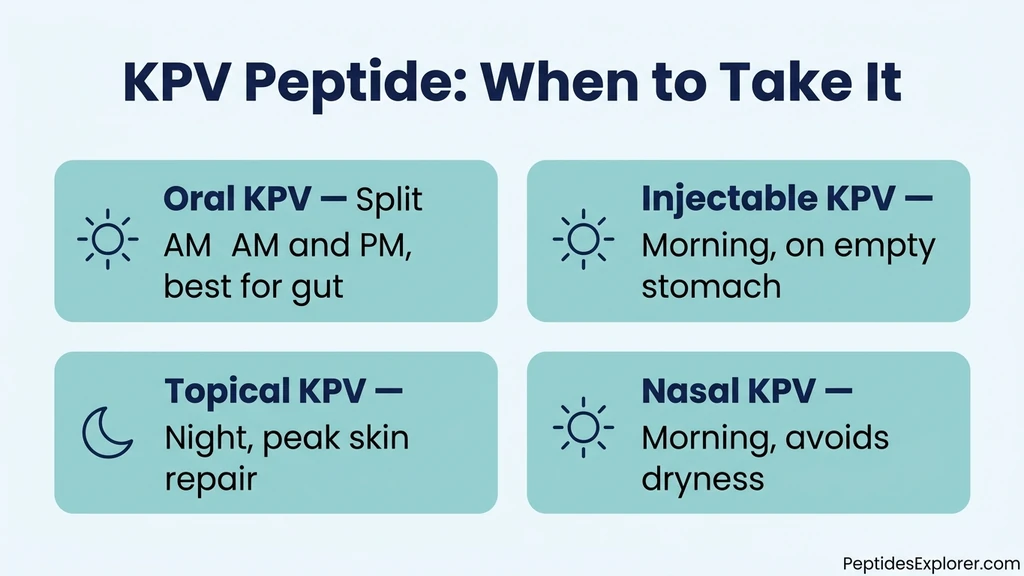
You mixed your KPV vial last night and now the bottle is sitting on the counter. The protocol sheet says "200 to 500 mcg daily" but it never told you *when*. Oral KPV works best split between morning and night (half the dose with breakfast, half before bed). Injectable KPV is best in the morning on an empty stomach. Topical KPV goes on at night so the peptide stays in contact with skin during the natural repair cycle. Nasal KPV can be dosed either time but most users pick morning to avoid congestion at bedtime. The right answer depends on what you are treating and how you are delivering the peptide.
| Quick Reference | Morning | Night | Split (BID) |
|---|---|---|---|
| Oral capsule or liquid | OK | OK | Best for IBD, gut inflammation |
| Subcutaneous injection | Best for systemic anti-inflammatory | Acceptable | Rarely needed at 200-500 mcg |
| Topical cream or serum | Wasted (sunscreen interferes) | Best for skin repair | Not practical |
| Nasal spray | Best (no sleep interference) | Avoid (may cause dryness) | Acceptable split |
The short logic: inflammatory cytokines like IL-6 and TNF-alpha peak at night (around 2 to 4 AM), so evening dosing puts KPV in your system during the worst inflammatory window. But gastric peristalsis and PepT1 transporter activity (how oral KPV absorbs) are highest in the morning. Split BID dosing solves both problems and is the protocol most gut-focused practitioners recommend. For the full dosage protocol across all routes, see our KPV peptide dosage guide.
This is educational content. Consult a healthcare provider before starting any peptide.
Get your custom peptide protocol:
- Tailored to your body and goals
- Precise dosing and cycle length
- Safe stacking combinations
- Backed by peer-reviewed studies
- Ready in under 2 minutes
Why KPV Timing Matters (And Why It Does Not for Some Uses)
KPV (lysine-proline-valine) is a tripeptide fragment of alpha-MSH. Its only job is anti-inflammatory signaling: it blocks NF-kB transcription, shifts macrophages from pro-inflammatory M1 to reparative M2 phenotype, and suppresses IL-6 and TNF-alpha production (Getting et al., 2006). The timing question matters because inflammation has a clock.
Inflammatory cytokines follow a circadian rhythm. IL-6 rises through the evening and peaks between 2 and 4 AM. TNF-alpha shows similar nocturnal dominance. This is why rheumatoid arthritis patients wake up with morning stiffness, why IBD flares worsen overnight, and why inflammatory pain reports are highest before breakfast. If KPV is meant to dampen that nocturnal spike, it needs to be in your system *before* the spike happens, not after you feel it.
Cortisol runs the opposite rhythm. Endogenous cortisol peaks at 6 to 8 AM, suppresses inflammation naturally, and drops through the day to a nadir around midnight. Supplemental anti-inflammatories like KPV provide the most added benefit when cortisol is lowest, which is evening and overnight.
That gives you two opposing forces: inflammation peaks at night (argues for evening dosing), but oral absorption is highest in the morning. Split BID dosing splits the difference.
For some uses timing matters less. If you are using KPV for post-workout recovery on an injection protocol, morning is simpler and consistent. If you are healing a topical wound, night-time application wins because peptide-loaded skin is not being washed by sweat or sunscreen. Match the timing to the goal.
Oral KPV: Why Split Dosing (AM + PM) Wins
Oral KPV is absorbed through PepT1, an intestinal transporter with high affinity for tri- and di-peptides (Dalmasso et al., 2008). PepT1 expression is highest in the jejunum and ileum, and its activity follows the fed state: eating triggers it. That makes meal timing more important than clock time.
The split BID protocol most gut-focused protocols use: - Morning: 100 to 250 mcg with or just before breakfast - Evening: 100 to 250 mcg with dinner or at bedtime (empty stomach is fine)
Why morning matters: gut motility is highest after waking. KPV reaches inflamed mucosa faster, and PepT1 is primed by the first meal. If you have ulcerative colitis or Crohn's disease, you probably already know that symptoms tend to be lower in the morning than by the afternoon. Morning KPV maintains that advantage.
Why night matters: IBD patients often report worsening symptoms in the evening and overnight. IL-6 is ramping up. Epithelial tight junctions are naturally looser at night (one reason nocturnal diarrhea is a classic IBD marker). An evening dose puts KPV in the gut during the period of greatest need.
The reason BID works better than a single morning dose: KPV's oral bioavailability is moderate and its half-life is short (estimated 2 to 4 hours based on analog kinetics). A single morning dose does not cover the nocturnal inflammatory window. For the complete oral protocol including weight-based dosing and titration, see KPV peptide dosage.
If you cannot split the dose (travel, work, or forgetting), morning beats night for oral. Absorption wins over timing for gut targets.
Injectable KPV: Morning Is Almost Always Right
Subcutaneous KPV bypasses the gut entirely. Injection site absorption is not subject to PepT1 or food timing. What matters is systemic half-life and how KPV interacts with the daily inflammatory cycle.
Morning injection (6 to 9 AM) gives you: - Coverage through the inflammatory afternoon buildup - No interference with sleep (KPV is not stimulating, but injections can break the wind-down routine) - Alignment with most injection training (empty stomach, shower after, clean needle routine) - Predictable absorption (cortisol peak supports the anti-inflammatory signal)
Evening injection is acceptable when: - You are using KPV specifically for nocturnal joint pain or inflammation - You inject other peptides in the morning and want to space the protocol - Your work schedule makes morning injections impractical
At the standard 200 to 500 mcg daily subcutaneous range, splitting the injection between morning and night adds logistics without adding benefit. Injectable KPV has a systemic half-life that covers 24 hours at therapeutic levels after the first week of daily dosing. For injection technique and site rotation, see how to inject peptides.
Never inject KPV within 30 minutes of a hot shower or sauna. Vasodilation accelerates distribution and can produce a brief flushing sensation. This is not dangerous but is uncomfortable and skews your perception of the peptide's effect.
Topical KPV: Night Beats Morning for Skin Repair
Topical KPV (creams, serums, and some wound formulations) works locally on the skin barrier and does not rely on systemic absorption. The limiting factor is contact time: how long the peptide stays on skin without being removed.
Evening application wins because: - Skin mitotic activity (cell division and repair) peaks between 10 PM and 2 AM - No sweat, sunscreen, makeup, or daytime friction removes the peptide - Transepidermal water loss is higher at night, which aids peptide penetration - 8 hours of contact maximizes exposure
Morning application loses because: - Most people layer sunscreen within an hour of applying serums; sunscreen ingredients interfere with peptide stability - Sweat, facial touching, and environmental friction strip the peptide - Skin repair processes are in a maintenance phase during daytime, not active repair
If you use topical KPV for a specific wound or acute skin condition, twice-daily (morning and night) application is common. The morning dose is protective; the evening dose is therapeutic. For chronic skin conditions (rosacea, eczema), evening-only is usually enough.
Do not stack topical KPV with retinoids, benzoyl peroxide, or vitamin C serums in the same layer. The oxidizing and acidic environments break peptide bonds. Apply KPV first on clean skin, wait 5 minutes, then layer other actives.
Nasal KPV: Flexible, But Morning Is More Comfortable
Nasal KPV uses the olfactory and respiratory mucosa for absorption. Bioavailability is less predictable than injection but faster than oral. It is used primarily for sinus inflammation, mast cell activation, and as a convenience option for people who hate needles.
Morning dosing is more comfortable for most users because nasal peptide sprays can briefly dry the nasal passages. Evening administration occasionally produces a dry or scratchy throat at bedtime. Morning also avoids the 30-minute sit-up window (you should not lie down immediately after nasal administration to prevent drainage into the throat).
Split BID nasal dosing is used for active sinus inflammation or chronic rhinitis. Typical protocol: 250 mcg in the morning, 250 mcg at night, for 2 to 4 weeks. Nasal KPV has the least-documented pharmacokinetics of any route, and no published human trial exists for nasal KPV specifically.
For a comparison of nasal peptide delivery across BPC-157, GHK-Cu, and KPV, see BPC-157 nasal spray guide and GHK-Cu nasal spray.
KPV Timing When Stacking With Other Peptides
Most gut-healing protocols combine KPV with BPC-157. Because both are short-half-life peptides with complementary mechanisms, timing matters for efficiency.
The standard KPV + BPC-157 gut protocol: - 08:00: Oral BPC-157 (250 mcg) + oral KPV (100 to 250 mcg), empty stomach or with light breakfast - 20:00: Oral BPC-157 (250 mcg) + oral KPV (100 to 250 mcg), with or after dinner
Both peptides use PepT1 for oral absorption; co-administration is fine. BPC-157 drives tissue repair (angiogenesis, fibroblast recruitment) while KPV controls the inflammatory environment that was preventing repair. For the full comparison, see BPC-157 vs KPV timing and use cases and BPC-157 vs TB-500.
Do not co-administer KPV with thymosin alpha-1 at the same time. Both peptides modulate immune signaling and the interaction is not well characterized. Space them by at least 4 hours.
LL-37 and KPV are complementary: LL-37 provides antimicrobial gut barrier protection while KPV reduces inflammation. Same timing as BPC-157. See LL-37 peptide benefits.
If you are building a multi-peptide stack, use the peptide stack calculator to check compatibility and timing.
KPV Timing Mistakes That Cost You Results
Taking oral KPV on a fully fasted stomach for more than 24 hours. Extended fasting downregulates PepT1 expression. Absorption drops. If you are doing intermittent fasting, dose at your first meal, not during the fasting window.
Dosing right after coffee or a high-acid breakfast (orange juice, citrus). Low pH destabilizes the tripeptide bond. Wait 30 minutes after acidic drinks before taking oral KPV.
Switching timing every few days. Circadian gene expression (NF-kB modulation, cortisol rhythm, PepT1 activity) adapts over 7 to 14 days. If you pick a protocol, stick with it for at least two weeks before changing. Random timing produces random results.
Injecting KPV at night and expecting daytime symptom relief. With a 24-hour half-life at steady state, you get coverage, but peak levels occur 2 to 6 hours after injection. Night injection means peak levels are in your sleep window, and symptoms may worsen in late morning as levels dip.
Using topical KPV in the morning under sunscreen. Zinc oxide and avobenzone (the two most common UV filters) disrupt peptide integrity. Either switch to evening-only, or apply KPV in the morning and wait 15 minutes before sunscreen.
Assuming nasal KPV provides systemic coverage equivalent to injection. It does not. Nasal bioavailability is estimated at 20 to 40% of subcutaneous. For systemic anti-inflammatory goals, injection remains the most reliable route. For proper storage, see how to store peptides.
Frequently Asked Questions
Should I take KPV peptide in the morning or at night?
For oral KPV, split the dose between morning and night for maximum benefit on gut inflammation. For injectable KPV, morning is almost always best. For topical KPV, night wins because skin repair peaks during sleep. For nasal KPV, morning is the most comfortable default. The goal and the route decide the timing.
Can I take all my KPV in one morning dose?
Yes, and it still works, but it is not optimal for gut conditions. KPV has a short half-life and inflammatory cytokines peak at night. A single morning dose covers the day but misses the nocturnal inflammatory window. If you split 200 to 500 mcg into morning and evening portions, you cover both peaks and get better symptom control.
Does KPV keep you awake at night?
No. KPV is not stimulating. It does not bind melanocortin receptors (the way Melanotan II does), does not raise cortisol, and does not cross the blood-brain barrier in significant amounts at therapeutic doses. Evening dosing is safe for sleep and may actually improve sleep in people whose sleep is disrupted by inflammation. See our KPV peptide dosage guide for complete safety data.
Do I need to take KPV with food?
For oral KPV, a small meal or snack improves PepT1 absorption by roughly 20 to 30%. Pure empty-stomach dosing still works but is less efficient. Avoid high-acid drinks (coffee, citrus, soda) within 30 minutes of dosing because low pH degrades the tripeptide bond. Injectable and topical KPV are not affected by food timing.
How long before I see results from KPV?
Gut inflammation usually improves within 2 to 4 weeks of consistent twice-daily oral dosing. Systemic anti-inflammatory effects from injection show up in 1 to 2 weeks. Topical skin improvements take 4 to 8 weeks. Consistency of timing matters more than the exact hour; dosing at similar times each day gives cleaner signal than random timing. For the full timeline, see KPV peptide dosage.
Can I stack KPV with BPC-157 at the same time?
Yes. KPV and BPC-157 are the standard gut-healing stack. Both can be dosed orally at the same time (morning and evening) or injected at the same time. They use different mechanisms: KPV controls inflammation, BPC-157 drives tissue repair. Use the peptide stack calculator to check dosing, and see BPC-157 vs TB-500 for recovery stacking.
Is morning KPV better for injections because of cortisol?
Yes, indirectly. Morning cortisol supports the anti-inflammatory signal KPV provides, while evening cortisol is at its lowest. Morning injection also aligns with most users' peptide routines (reconstitution, syringe prep, site rotation) and avoids bedtime interference. Evening injection is acceptable if you specifically target overnight pain, but morning is the default.
What if I miss a dose of KPV?
Skip the missed dose and resume your normal schedule. Do not double up. KPV has a short half-life and a forgiving therapeutic window, so a single missed dose has minimal impact. If you consistently miss the evening dose, consider moving both doses earlier in the day (morning + late afternoon) rather than running an inconsistent schedule.
The Bottom Line
KPV timing is a question of route first and clock second. Oral KPV needs split BID dosing to cover both morning absorption windows and nocturnal inflammatory spikes. Injectable KPV belongs in the morning unless you are specifically treating overnight pain. Topical KPV is an evening peptide because skin repair runs on a nocturnal clock. Nasal KPV is flexible, with morning as the comfort default.
The most common mistake is assuming a single daily dose is enough for gut conditions. It is not. KPV's half-life and the circadian rhythm of inflammation both demand two exposures per day for consistent results. If you are treating IBD, IBS, or chronic gut inflammation, start with 100 to 250 mcg at breakfast and 100 to 250 mcg at dinner. Hold the protocol for 2 to 4 weeks before evaluating.
For the full dosage protocol across all four routes (oral, injectable, topical, nasal), including titration and reconstitution instructions, see our KPV peptide dosage guide. For stacking with BPC-157 or LL-37, see peptides for gut health. For broader peptide timing principles and safety, see the peptide safety guide and how to store peptides.
Related Articles: - KPV Peptide Dosage: All Routes - Peptides for Gut Health - LL-37 Peptide Benefits - BPC-157 vs TB-500 - How to Inject Peptides
Related Articles
KPV Peptide Dosage Chart by Route
KPV peptide dosage is 200-500 mcg/day. Full chart for oral (gut/IBD), injectable, topical, and nasal routes, plus the KPV + BPC-157 gut stack. PubMed-cited.
KPV Peptide Dosage Chart by Condition
KPV peptide dosage chart by condition: gut/IBD, skin, and inflammation doses with oral vs subcutaneous routes, reconstitution math, and common mistakes.
Klow Peptide Dose Per Day for Females
Klow peptide dose per day for females: 200-500 mcg KPV plus tesofensine or AOD-9604. Full dosing chart, timing, and safety notes.
How Often to Inject Peptides: Frequency Guide
How often to inject peptides: daily for BPC-157 and ipamorelin, weekly for semaglutide and CJC-1295 DAC. Frequency table by half-life, cycling, missed doses.