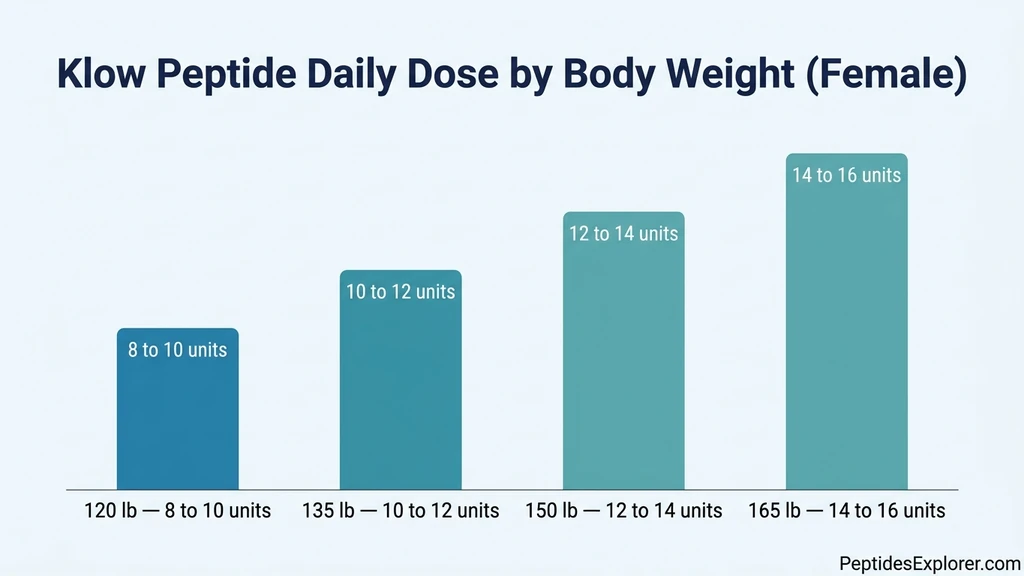
Your compounding pharmacy shipped a vial labeled "Klow" with a handwritten note that says "start low." The protocol card references doses in milligrams, the blend sheet lists three ingredients, and nothing tells you what a 135-pound woman should actually inject on day one. For most female patients at 120 to 160 pounds, the typical Klow daily dose is 200 to 500 mcg of the KPV component, 100 to 250 mcg of the AOD-9604 or tesofensine appetite component, and a 0.25 to 0.5 mg lipolytic fraction where present. That translates to roughly 10 to 15 units on a standard 1 mL U-100 insulin syringe of a reconstituted Klow-80 blend, taken once daily in the morning, 5 days on and 2 days off. Exact volumes depend on how your pharmacy reconstituted the vial, which is why the calculator matters more than any chart.
| Klow Daily Dose by Body Weight (Female) | 120 lb | 135 lb | 150 lb | 165 lb |
|---|---|---|---|---|
| KPV fraction (anti-inflammatory) | 200 mcg | 250 mcg | 300 mcg | 400 mcg |
| AOD-9604 or tesofensine fraction | 100 mcg | 150 mcg | 200 mcg | 250 mcg |
| Lipolytic fraction (if present) | 0.25 mg | 0.3 mg | 0.4 mg | 0.5 mg |
| Typical syringe units (U-100, 1 mL) | 8-10 | 10-12 | 12-14 | 14-16 |
| Days per week | 5 on / 2 off | 5 on / 2 off | 5 on / 2 off | 5 on / 2 off |
Klow is a compounded peptide blend and is not FDA-approved. Formulations vary by pharmacy, and "Klow" is not a standardized drug. Some pharmacies sell Klow-80 (KPV plus AOD-9604 plus a slimfit fraction), others use KPV plus tesofensine, and a few use LL-37 plus a GLP-1 analogue. Always confirm the exact ingredients on your vial before dosing. For reconstitution math, use the peptide reconstitution calculator.
This is educational content. Consult a healthcare provider before starting any peptide. Klow is compounded only, is not FDA-approved, and carries unknown long-term safety data in women.
Get your custom peptide protocol:
- Tailored to your body and goals
- Precise dosing and cycle length
- Safe stacking combinations
- Backed by peer-reviewed studies
- Ready in under 2 minutes
What Is Klow and Why Is It Marketed to Women?
Klow is a compounded peptide blend marketed primarily to female patients for weight loss, appetite control, and skin quality. The name is not a chemical designation. It is a brand label used by a handful of specialty compounding pharmacies to package two to four peptides into a single vial. The most common formulations include a KPV fraction, a weight-loss component (AOD-9604 or tesofensine), and sometimes a third lipolytic or anti-inflammatory ingredient.
The marketing targets women because the dose ranges, the timing, and the expected outcomes (appetite suppression plus gut-level inflammation reduction plus modest fat loss) map onto concerns that show up more often in female patients asking about peptides. The actual pharmacology is not sex-specific. KPV, an alpha-MSH-derived tripeptide, blocks NF-kB and MAP kinase signaling at nanomolar concentrations via PepT1-mediated uptake into intestinal epithelial and immune cells (Dalmasso et al., 2008). AOD-9604 (the hGH 177-191 fragment) mimics the lipolytic activity of growth hormone without the diabetogenic effects (Heffernan et al., 2001), and tesofensine inhibits reuptake of dopamine, noradrenaline, and serotonin (Astrup et al., 2008). All three work the same way in male and female tissue. The "female" framing in Klow is a dosing convention, not a biological requirement.
The most common Klow variant, Klow-80, contains KPV plus AOD-9604 plus a proprietary "slimfit" fraction that most pharmacies describe as a short chain lipolytic peptide. Some pharmacies substitute tesofensine for AOD-9604 in patients who need stronger appetite control. A few variants add LL-37 for mast cell stabilization. You will not find two Klow vials with the same ingredient ratios across pharmacies, which is why a universal dose chart does not exist.
Klow is not FDA-approved. The individual peptides inside Klow are not FDA-approved for weight loss either. Compounded peptide blends fall under state pharmacy regulations, which means quality, sterility, and potency vary widely. For the legal framework around compounded peptides, see are peptides legal and the compounded tirzepatide safety analysis.
Typical Daily Dose Range for Female Patients (120 to 160 lb)
The dosing conventions below are drawn from protocols published by specialty compounding pharmacies that sell Klow blends. They are not clinical guidelines. No published randomized trial of Klow exists.
KPV fraction (anti-inflammatory, appetite regulation): - Starting dose: 200 mcg once daily - Target dose: 250 to 400 mcg once daily - Upper range: 500 mcg daily, split morning and evening if oral - Route: typically subcutaneous in the Klow blend, sometimes oral as a separate component
AOD-9604 fraction (lipolysis, fat oxidation): - Starting dose: 100 mcg once daily - Target dose: 200 to 300 mcg once daily - Route: subcutaneous, morning on empty stomach for best lipolytic effect
Tesofensine fraction (appetite suppression, dopamine noradrenaline reuptake inhibitor): - Starting dose: 100 mcg daily (oral drops or subcutaneous depending on compound) - Target dose: 250 to 500 mcg daily (the 0.5 mg dose produced 9.2% mean weight loss at 24 weeks vs 2.0% on placebo in the phase 2 trial; (Astrup et al., 2008)) - Upper range: 750 mcg; above this most women report insomnia, elevated heart rate, and anxiety
Lipolytic or "slimfit" fraction (varies by pharmacy): - Typical dose: 0.25 to 0.5 mg daily - Usually a proprietary blend; ask for ingredient disclosure
For most 130 to 145-pound women starting Klow for weight loss, a reasonable first-month protocol is 250 mcg KPV plus 150 mcg AOD-9604 daily, 5 days on and 2 days off, titrating up after 4 weeks if tolerated. See the KPV peptide dosage guide for the KPV-specific ramp schedule and the glow peptide dosage guide for a comparable female-focused blend.
Klow-80 Dosage Chart by Pharmacy Formulation
The "80" in Klow-80 usually refers to the combined peptide concentration per milliliter after reconstitution (roughly 8 mg/mL total), not a standardized recipe. Common published ratios from compounding pharmacies:
| Klow-80 Variant | KPV | AOD-9604 | Slimfit / Lipolytic | Typical Daily Volume |
|---|---|---|---|---|
| Formula A (standard) | 5 mg | 2 mg | 1 mg | 10-12 units |
| Formula B (high KPV) | 6 mg | 1.5 mg | 0.5 mg | 8-10 units |
| Formula C (tesofensine substitute) | 4 mg | 0 mg (tesofensine 0.5 mg) | 0.5 mg | 6-8 units |
| Formula D (LL-37 variant) | 3 mg | 2 mg | LL-37 1 mg | 10-12 units |
Reconstitution matters more than the chart. A 10 mg total peptide vial reconstituted in 2 mL of bacteriostatic water gives a different concentration than the same vial in 1 mL. One unit on a U-100 insulin syringe equals 0.01 mL. If your pharmacy reconstituted a Klow-80 vial with 2 mL, then 10 units delivers approximately 400 mcg of total peptide blend.
Standard reconstitution math for Klow-80 (10 mg total peptide): - 1 mL bacteriostatic water: 10 units = 1,000 mcg total blend - 2 mL bacteriostatic water: 10 units = 500 mcg total blend - 3 mL bacteriostatic water: 10 units = 333 mcg total blend
Never guess. Use the peptide reconstitution calculator with your vial's actual mg and reconstitution volume before your first injection. For injection technique, site rotation, and needle selection, see how to inject peptides.
Timing, Food, and the Injection Routine
Morning is the default window for Klow. The AOD-9604 fraction works best on an empty stomach because post-meal insulin blunts lipolysis. The tesofensine fraction (where present) acts as a stimulant; evening dosing causes insomnia in most users. KPV has no timing preference from a systemic standpoint but pairs well with morning dosing when blended with the other two.
The standard Klow protocol for female weight loss: - 6:30 to 7:30 AM: inject Klow subcutaneously in the lower abdomen or upper thigh - 7:30 to 8:30 AM: light breakfast with protein (25 to 30 g) - Do not inject within 30 minutes of coffee or a high-sugar meal - Rotate injection sites every day to avoid lipohypertrophy
Why 5 days on, 2 days off: most compounding pharmacies recommend weekday dosing with a weekend washout. The rationale is to prevent receptor downregulation on the melanocortin pathway (KPV) and the adrenergic pathway (tesofensine). Clinical evidence for this schedule is thin, but anecdotal reports from practitioners suggest fewer side effects and cleaner appetite signaling with the 5-on, 2-off pattern.
Food interactions: avoid grapefruit, high-acid beverages, and heavy carbohydrate meals within 60 minutes of the injection. Grapefruit inhibits CYP3A4 and may prolong tesofensine half-life. High-acid drinks can destabilize the KPV tripeptide bond. Heavy carb meals blunt AOD-9604 lipolysis. For broader peptide timing principles, see our KPV peptide morning or night guide.
Do not inject Klow within 30 minutes of a hot shower, sauna, or intense cardio. Vasodilation speeds distribution and can produce flushing, dizziness, or a brief heart rate spike.
Titration Schedule: Weeks 1 Through 12
Klow tolerance varies. Some women feel appetite suppression on day three; others need the full 4-week ramp. The protocol below is a conservative starting schedule for a 130 to 150-pound female patient using a Klow-80 Formula A blend.
Weeks 1 to 2 (assessment phase): - Dose: 150 mcg total peptide blend daily (roughly 3 to 4 units at 2 mL reconstitution) - Goal: confirm tolerance. Watch for injection site reactions, nausea, elevated heart rate, sleep disruption - Do not increase if you notice any side effect; hold at the starting dose
Weeks 3 to 4 (titration): - Dose: 250 mcg total peptide blend daily (roughly 5 to 6 units) - Goal: appetite suppression should appear by day 10 to 14. Mild weight loss (1 to 2 pounds per week) is normal
Weeks 5 to 8 (target phase): - Dose: 400 mcg total peptide blend daily (roughly 8 to 10 units) - Goal: consistent appetite control, steady fat loss at 0.5 to 1 percent body weight per week - Track: waist circumference, resting heart rate, sleep quality, and menstrual cycle regularity
Weeks 9 to 12 (plateau or maintenance): - Dose: hold at 400 mcg or titrate to 500 mcg if tolerated - Goal: maintain weight loss trajectory or transition to maintenance dosing - Consider a 4-week break after week 12 to reset receptor sensitivity
Women with lower body weight (under 120 pounds) should start at 100 mcg total blend and titrate slower. Women over 170 pounds may need the upper range (600 to 800 mcg total blend) but should first rule out whether a single-agent GLP-1 analogue would be more appropriate. For structural stacking principles, see our peptide stacking guide and the wolverine peptide stack for a contrast with male-focused blends.
Side Effects and Red Flags Specific to Women
Most Klow side effects come from the tesofensine or AOD-9604 fractions, not the KPV component. KPV itself has a clean safety profile at these doses. The appetite suppressant and lipolytic fractions carry the real watch list.
Common and usually self-limiting: - Injection site redness or mild bruising (rotate sites) - Dry mouth, especially with tesofensine - Mild nausea in week 1 (usually resolves by day 10) - Transient fatigue 2 to 4 hours after injection - Minor menstrual cycle shifts (one to three days later, rarely earlier)
Call your prescriber (not 911) if you notice: - Resting heart rate persistently above 95 bpm - Sleep onset delayed by more than 90 minutes three nights running - Anxiety or panic attacks (more common with tesofensine) - Severe appetite suppression leading to intake below 1,200 calories daily - Persistent dizziness on standing - Amenorrhea lasting more than one cycle
Stop immediately and call a doctor if: - Chest pain or palpitations lasting more than 10 minutes - Fainting or near-fainting episodes - Severe abdominal pain - Signs of allergic reaction (hives, swelling, difficulty breathing) - Unexpected pregnancy (Klow has unknown effects on fetal development; no safety data exists)
Red flags for female-specific concerns: - Do not use Klow during pregnancy or while trying to conceive. None of the peptides in Klow have reproductive safety data in humans. - Do not use Klow while breastfeeding. Peptide excretion into breast milk is not characterized. - If you have a history of eating disorders, the appetite suppression from Klow can trigger a relapse. Talk to a provider before starting. - If you have a history of cardiac arrhythmia, avoid tesofensine-containing Klow variants.
For a broader safety framework when choosing peptides, see peptides for women over 40 and the general peptide dosage chart.
How Klow Compares to Glow, Wolverine, and Single-Agent Protocols
Klow is one of several branded peptide blends marketed through compounding pharmacies. The closest alternatives differ in their target outcomes and their peptide ratios.
Klow vs Glow: Glow is the skin-and-repair blend (GHK-Cu plus BPC-157 plus TB-500 in most formulations). Klow is the weight-loss-plus-gut blend (KPV plus AOD-9604 or tesofensine). They are complementary, not competitive. Many female patients run Klow in the morning and Glow in the evening. For Glow specifics, see the glow peptide dosage guide.
Klow vs Wolverine: Wolverine is the male-focused recovery stack (BPC-157 plus TB-500 plus GHK-Cu, sometimes with IGF-1 LR3). Klow's female orientation is about weight and appetite rather than muscle recovery. Dose ranges are lower in Klow because the target tissues are different. See the wolverine peptide stack for comparison.
Klow vs single-agent KPV: if you only want anti-inflammatory and gut benefits, single-agent KPV at 250 to 500 mcg daily is cheaper, better studied, and avoids the stimulant fraction. Klow makes sense when you want appetite suppression plus anti-inflammation in one injection. Read the KPV peptide dosage guide before deciding.
Klow vs GLP-1 (semaglutide, tirzepatide): for weight loss targets above 20 pounds, a GLP-1 receptor agonist has orders of magnitude more clinical evidence. Klow is a lighter intervention suited to patients who want 5 to 15 pounds of loss plus gut and skin benefits. For heavier weight loss, the GLP-1 path is more appropriate; see our compounded tirzepatide safety analysis.
Use the peptide stack calculator to check interactions before combining Klow with any other peptide or GLP-1.
Frequently Asked Questions
What is the typical Klow peptide dose per day for a female?
For most 120 to 160-pound women, the typical daily Klow dose is 200 to 500 mcg total peptide blend, injected subcutaneously in the morning, 5 days on and 2 days off. Exact volumes depend on reconstitution. Use the peptide reconstitution calculator with your vial's specifics before your first injection.
How do I calculate Klow-80 units on an insulin syringe?
One unit on a U-100 syringe equals 0.01 mL. A 10 mg Klow-80 vial reconstituted in 2 mL delivers roughly 50 mcg per unit, so 8 units equals 400 mcg. The math changes with your reconstitution volume, so confirm every time. See our peptide reconstitution calculator for the exact calculation.
Should I take Klow in the morning or at night?
Morning. The AOD-9604 and tesofensine fractions both work best before food, and tesofensine is stimulating, so evening dosing often causes insomnia. KPV has no strong timing preference but pairs cleanly with morning dosing in the blend. For peptide timing principles in general, see KPV peptide morning or night.
Is Klow peptide FDA-approved?
No. Klow is a compounded peptide blend sold through specialty pharmacies. None of its component peptides (KPV, AOD-9604, tesofensine) are FDA-approved for weight loss in the United States. Compounded peptides fall under state pharmacy rules, and quality varies. Read our are peptides legal guide before ordering.
How long does it take for Klow to work for weight loss?
Most female patients notice appetite suppression by day 10 to 14 and visible weight loss (1 to 2 pounds per week) starting in week 3. Expect 4 to 8 weeks to hit a steady fat loss trajectory. Klow is not a rapid-loss drug; for 20-plus pound goals, a GLP-1 is better studied. See our peptide dosage chart for comparison.
Can I stack Klow with Glow peptide?
Yes, and it is a common female-focused stack. Klow targets weight and gut inflammation in the morning. Glow targets skin and tissue repair in the evening. The peptides do not share receptors, so interaction risk is low. Verify compatibility on the peptide stack calculator and review the glow peptide dosage guide for evening timing.
What if I miss a dose of Klow?
Skip the missed dose and resume your normal schedule the next morning. Do not double up. Klow has a mixed half-life (KPV short, AOD-9604 moderate, tesofensine long), so a single missed dose has minimal impact. If you miss three or more days, drop back to your starting dose for a week before titrating again. See our KPV peptide dosage guide for missed-dose logic.
Is Klow safe during pregnancy or breastfeeding?
No. Klow is not studied in pregnancy or lactation, and none of its component peptides have reproductive safety data. Stop Klow immediately if you become pregnant or are trying to conceive. Talk to your obstetric provider before considering any peptide. For a broader female safety framework, see peptides for women over 40.
The Bottom Line
The honest answer to "what is the Klow peptide dose per day for a female" is that it depends on three things: your body weight, your pharmacy's exact formulation, and the reconstitution volume used when the vial was mixed. The 200 to 500 mcg daily total blend range covers most 120 to 160-pound women on a standard Klow-80 Formula A blend, dosed in the morning, 5 days on and 2 days off, titrated over 4 weeks from a starting dose of 150 mcg.
The biggest mistake women make with Klow is skipping the titration. Starting at the target dose on day one produces the side effects (nausea, insomnia, heart rate bumps) that would have been avoided with a 2-week ramp. The second biggest mistake is not running the reconstitution math, which leads to accidental overdosing by a factor of two or three when the vial volume is different from the assumed 2 mL.
Klow is not FDA-approved. Its component peptides are not FDA-approved for weight loss. Clinical evidence in women is thin, and long-term safety data does not exist. Use Klow with a prescribing clinician who can monitor heart rate, menstrual cycle, and metabolic markers through the 12-week protocol. Do not use it during pregnancy or breastfeeding.
For the tools and companion guides you will need alongside a Klow protocol, start with the peptide reconstitution calculator, the peptide stack calculator, the KPV peptide dosage guide, and how to inject peptides.
Related Articles: - KPV Peptide Dosage: All Routes - Glow Peptide Dosage Guide - Peptide Stacking Guide - Peptides for Women Over 40 - How to Inject Peptides
For what each of the four components does, how the copper load adds up, and how KLOW differs from GLOW, see KLOW peptide benefits.
Related Articles
HGH Fragment 176-191 Dosage: What Research Supports
HGH Fragment 176-191 dosage: 250-500 mcg/day subcutaneous, fasted, 8-12 week cycles. Unit math for 2 mg and 5 mg vials, rodent vs human evidence, safety.
KPV Peptide Dosage Chart by Condition
KPV peptide dosage chart by condition: gut/IBD, skin, and inflammation doses with oral vs subcutaneous routes, reconstitution math, and common mistakes.
MOTS-c Dosage: Protocols & Timing
Complete MOTS-c dosage guide: 5-10mg/week protocols, reconstitution steps, week-by-week results timeline, side effects, and stacking options backed by research.
KPV Peptide Dosage Chart by Route
KPV peptide dosage is 200-500 mcg/day. Full chart for oral (gut/IBD), injectable, topical, and nasal routes, plus the KPV + BPC-157 gut stack. PubMed-cited.