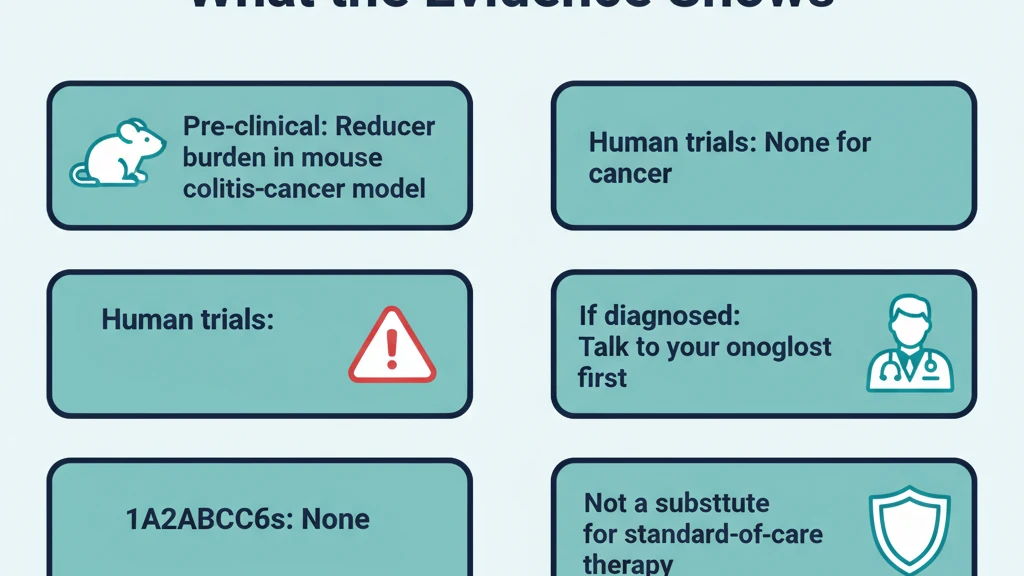
You searched "KPV peptide cancer" and you probably came here for one of two reasons. Either you are worried that KPV might cause cancer, or you have read about its anti-inflammatory effects and you are wondering whether it might help treat a cancer you or someone you love is facing. The honest answer to both questions: there are no human cancer trials of KPV. Period. The available evidence is animal data showing that the tripeptide KPV reduces colitis-associated colon cancer in mice when delivered orally through the PepT1 transporter (Viennois et al., 2016; Dalmasso et al., 2008). There is no evidence that KPV causes cancer at therapeutic doses in animal studies. There is also no evidence that KPV treats any human cancer. If you have a cancer diagnosis, do not substitute KPV for evidence-based oncology care. Talk to your oncologist before adding KPV to anything.
| Quick Reference | Detail |
|---|---|
| Does KPV cause cancer? | No evidence in animal models at therapeutic doses |
| Does KPV treat cancer? | No human trial evidence; preclinical mouse data only |
| Strongest preclinical signal | Reduced tumor burden in azoxymethane/DSS colitis-associated cancer model |
| Mechanism studied | Anti-inflammatory via NF-kB suppression, M2 macrophage shift, PepT1 transport |
| Human evidence base | Zero clinical trials in any cancer indication |
| Regulatory status | Not approved for any indication, anywhere |
| Safe to take during chemotherapy? | Unknown; potential immune modulation interactions |
| Patient takeaway | Talk to your oncologist before considering KPV |
This is one of those questions where the honest answer is more useful than the comforting one. KPV's anti-inflammatory profile is real and consistent across animal studies. The leap from "anti-inflammatory in mice" to "treats cancer in humans" is a leap that the actual data does not support. Most cancer treatments that worked beautifully in mice failed in humans. Anti-inflammatory drugs have a particularly mixed record in oncology.
This article is educational content, not medical advice. Cancer is a YMYL (your money or your life) topic. If you have a cancer diagnosis or a cancer risk factor, the only safe path is to discuss any peptide use with your oncologist before starting. Do not replace standard-of-care therapy with KPV or any research peptide. The remainder of this article walks through what the actual research shows so you can have an informed conversation with your medical team.
For broader context on KPV's mechanism and uses, see KPV peptide morning or night and KPV dosage. For the regulatory landscape, see are peptides legal and our peptide safety guide.
Get your custom peptide protocol:
- Tailored to your body and goals
- Precise dosing and cycle length
- Safe stacking combinations
- Backed by peer-reviewed studies
- Ready in under 2 minutes
What KPV Is and Why It Got Connected to Cancer in the First Place
KPV is a three-amino-acid peptide: lysine-proline-valine. It is the C-terminal fragment of alpha-melanocyte-stimulating hormone (alpha-MSH), the hormone better known for skin pigmentation but with a wider role in immune regulation (Brzoska et al., 2008). Most of alpha-MSH's anti-inflammatory activity sits in the KPV tail.
Researchers became interested in KPV specifically because alpha-MSH itself is bound up with melanocortin receptor signaling, which means it affects pigmentation, sexual function, and appetite. KPV strips those effects away. It keeps the anti-inflammatory signaling and loses the rest. That makes it a cleaner tool for studying inflammation in animal models of inflammatory bowel disease, contact dermatitis, and other immune-driven conditions.
The cancer connection started with inflammatory bowel disease research. Patients with long-standing ulcerative colitis or Crohn's disease have a meaningfully elevated risk of colorectal cancer. The leading explanation: chronic inflammation drives DNA damage in colonic epithelial cells, which over decades produces the conditions for malignant transformation. If you can dampen the inflammation, you might lower the cancer risk that flows from it.
That hypothesis is what put KPV in the mouse models. The work by Dalmasso and colleagues established that KPV is absorbed through PepT1, a peptide transporter that is upregulated in inflamed colonic tissue (Dalmasso et al., 2008). PepT1 carries di- and tri-peptides into intestinal epithelial cells. In healthy small intestine, PepT1 is doing routine nutrition work. In inflamed colon, it shows up where it normally would not, and it picks up KPV along with normal dietary peptides. Once inside the cell, KPV blocks NF-kB signaling, suppresses pro-inflammatory cytokines like IL-6 and TNF-alpha, and shifts macrophages from the M1 (inflammatory) to the M2 (reparative) phenotype.
That mechanism is interesting because chronic NF-kB activation, IL-6, and M1 macrophages are exactly the inflammatory features that link colitis to colorectal cancer. So researchers asked the obvious next question: if KPV blocks the inflammation that drives colitis-associated cancer, does it actually reduce tumor formation?
For the broader KPV mechanism, see KPV peptide morning or night, KPV dosage, and peptides for gut health.
What the Animal Data Actually Shows (And What It Does Not)
The most directly relevant study on KPV and cancer is from Viennois and colleagues, published in *Cellular and Molecular Gastroenterology and Hepatology* in 2016 (Viennois et al., 2016). The full title says it cleanly: "Critical role of PepT1 in promoting colitis-associated cancer and therapeutic benefits of the anti-inflammatory PepT1-mediated tripeptide KPV in a murine model."
Here is what the researchers actually did:
- 1.They used the azoxymethane (AOM) plus dextran sodium sulfate (DSS) mouse model. AOM is a chemical carcinogen. DSS damages the colonic epithelium and induces colitis. The combination is a standard model of colitis-associated cancer (CAC) and reliably produces colon tumors over several weeks.
- 1.They ran the experiment in three mouse genotypes: wild-type mice, mice with intestinal-epithelial-specific overexpression of human PepT1 (TG mice), and mice with PepT1 knocked out (KO mice).
- 1.They administered KPV orally to subgroups of each genotype and measured tumor number, tumor size, and intestinal inflammation.
What they found:
- TG mice (PepT1 overexpressing) developed larger tumors and more inflammation than wild-type. This established that PepT1 expression promotes colitis-associated tumorigenesis in this model.
- KO mice (no PepT1) developed fewer and smaller tumors than wild-type, and oral KPV had no effect on them. This confirmed that KPV requires PepT1 to do its anti-inflammatory work in the colon.
- In wild-type mice, oral KPV reduced tumor number and tumor size, and reduced inflammatory markers in the colon.
This is genuinely interesting preclinical data. It supports a coherent mechanistic story: KPV reduces inflammation in inflamed colon via PepT1, and the reduced inflammation translates into reduced tumor burden in a well-established mouse model of colitis-associated cancer.
What this study does not show:
- It does not show that KPV reduces tumor burden in any other cancer model. Sporadic colorectal cancer (the much larger category, not driven by colitis) was not tested. Other GI cancers were not tested. Non-GI cancers were not tested.
- It does not show any effect in humans. A mouse model is a model; the gap to a human cancer patient is enormous.
- It does not test whether KPV affects existing tumors that have already formed independent of inflammation. The model is a tumor-prevention study in an inflammation-driven cancer setting.
- It does not establish a safe human dose for cancer prevention or treatment.
- It does not address chemotherapy interactions, immunotherapy interactions, or any combination care concern.
The earlier Dalmasso work (Dalmasso et al., 2008) established the PepT1-mediated transport and anti-inflammatory mechanism in colitis models without measuring tumor outcomes. Together, these studies form a coherent preclinical case for KPV in colitis-associated colorectal cancer prevention research. They do not form a clinical case for using KPV to treat cancer.
For context on KPV's broader anti-inflammatory pharmacology, the Brzoska et al. review in *Endocrine Reviews* is the standard reference (Brzoska et al., 2008). For broader peptide research caveats, see our peptide safety guide.
Why Anti-Inflammatory Does Not Equal Anti-Cancer in Humans
The intuitive leap from "anti-inflammatory in mice" to "anti-cancer in humans" feels obvious. Inflammation is bad. Cancer is bad. Things that reduce inflammation should reduce cancer. The actual clinical record is more complicated than the intuition allows.
Aspirin is the cleanest example. Long-term low-dose aspirin reduces colorectal cancer incidence in some populations, with effect sizes around 20 to 40% over 10+ years of daily use. That benefit took decades of large randomized trials and observational studies to establish. The benefit is real but small in absolute terms, requires long exposure, and comes with a bleeding risk that is not trivial. Aspirin is one of the best-validated anti-inflammatory cancer-prevention agents in modern medicine, and even it does not work as a treatment for established cancer.
COX-2 inhibitors had a similar story. Celecoxib and rofecoxib were studied for colon cancer prevention in patients with familial adenomatous polyposis. The signal was real. The cardiovascular risks were also real, and rofecoxib was withdrawn from the market. The remaining COX-2 inhibitors are used cautiously, not as first-line cancer prevention.
TNF-alpha inhibitors (the same cytokine KPV suppresses) are interesting in a different way. Drugs like infliximab and adalimumab block TNF-alpha and are used to treat inflammatory bowel disease. They reduce IBD-related colon cancer risk in long-term users (likely by controlling the underlying inflammation). They also carry a black-box warning about increased risk of certain lymphomas and skin cancers, because TNF-alpha is part of normal immune surveillance against malignancy. The same anti-inflammatory mechanism that helps prevent one cancer can theoretically allow another.
The pattern that emerges from these examples: anti-inflammatory drugs have a complex relationship with cancer. They can lower the risk of inflammation-driven cancers. They can occasionally raise the risk of cancers that depend on immune surveillance to be controlled. The effects show up over years, not weeks, and often require very large studies to detect.
KPV has none of those long-term human studies. We do not know how it affects cancer surveillance in humans. We do not know whether the dose, route, or duration tested in mice translates to a meaningful human effect. We do not know if it interacts safely with chemotherapy or immunotherapy. The honest position is that the mechanism is interesting and the preclinical data is positive, but the gap to clinical use is enormous and unbridged.
For broader peptide research limitations, see are peptides legal, peptide safety guide, and BPC-157 long-term safety.
What This Means If You Have an IBD Diagnosis and Cancer Risk
If you have ulcerative colitis or Crohn's disease, your colorectal cancer risk is elevated relative to the general population. The magnitude depends on duration of disease, extent of colonic involvement, severity of inflammation, and family history. Most modern guidelines recommend surveillance colonoscopy starting 8 to 10 years after IBD diagnosis if extensive colitis is present, with intervals tailored to risk.
The standard-of-care strategies for reducing IBD-related cancer risk are:
- 1.Achieve and maintain mucosal healing. Active inflammation drives the cancer risk. Sustained remission lowers it. Whatever combination of mesalamine, immunomodulators, biologics, or JAK inhibitors gets you to mucosal healing is the core of cancer prevention in IBD.
- 1.Colonoscopy with chromoendoscopy or high-definition white light at recommended intervals. Surveillance does not reduce cancer formation; it catches dysplasia and early cancer when intervention is most effective.
- 1.Address modifiable risk factors. Smoking, low-fiber diet, vitamin D deficiency, and obesity all contribute. These have evidence behind them in IBD-CAC prevention.
- 1.Screen for and treat primary sclerosing cholangitis (PSC) when relevant. PSC plus IBD dramatically raises colorectal cancer risk and changes surveillance protocols.
KPV is not in this list. It might one day be, if human clinical trials show it adds something to standard care. Right now, no such trials exist. Adding KPV to your regimen does not substitute for any of the four standard-of-care items. If you are using KPV alongside standard IBD care under medical supervision because the anti-inflammatory effect helps your symptom control, that is a different conversation than "I am taking KPV to prevent cancer."
The conversation to have with your gastroenterologist:
- "My disease activity is at level X. Is mucosal healing achieved?"
- "When is my next surveillance colonoscopy?"
- "Are there modifiable risks (smoking, BMI, vitamin D, alcohol) I should address?"
- "I have read about KPV in animal models of colitis-associated cancer. Is there any reason I should not add it to my current regimen?"
The answer to that last question may be "no reason" or "let me think about it" or "I would advise against it pending more data." Whichever it is, that is a real medical decision based on your specific case. It is not a decision a research peptide vendor or an article on the internet can make for you.
For broader gut peptide context, see peptides for gut health, BPC-157 for gut health, and LL-37 peptide benefits.
Does KPV Cause Cancer? What the Animal Safety Data Shows
The other half of the "KPV peptide cancer" search is the worry that KPV might itself cause cancer. The short answer: there is no evidence in available animal studies that KPV at the doses studied causes tumor formation. The longer answer requires honesty about what we do and do not know.
What animal studies show on KPV safety:
The studies that have administered KPV to mice and rats over weeks, both orally and parenterally, at doses comparable to or exceeding what humans use, have not reported tumor induction as a finding. Across the colitis models, dermatitis models, and immune-modulation studies, KPV's safety profile in animals is benign. The Brzoska review of alpha-MSH-derived peptides (Brzoska et al., 2008) does not flag tumor induction as an observed concern across the broader class.
What we do not know:
- Long-term (multi-year) carcinogenicity studies in animals have not been done at the level required for FDA drug approval.
- Pharmacokinetics of repeated KPV exposure in humans are not well characterized.
- Effects on immune surveillance against pre-existing micro-tumors in humans are unknown.
- Interactions with other medications (chemotherapy, immunosuppressants) on cancer risk are unknown.
Mechanistic plausibility for cancer concern:
KPV's anti-inflammatory mechanism (NF-kB suppression, M2 macrophage shift, IL-6 reduction) is similar in concept to other anti-inflammatory drugs that have shown mixed cancer profiles in humans. The TNF-alpha-suppressing biologics carry a black-box warning for certain malignancies, as discussed in the previous section. Whether KPV's specific mechanism produces a similar concern is unknown because no human surveillance data exists.
The reasonable position:
KPV does not appear to cause cancer based on the animal evidence available. KPV has not been studied long enough or broadly enough in humans to rule out a cancer-related effect. People with active cancer, a strong cancer history, or significant cancer risk factors should treat KPV with extra caution and discuss it with their oncologist or primary care provider before using it.
People without those concerns who are using KPV for short-term gut inflammation, post-injury healing, or skin barrier support face an unknown but probably small theoretical risk based on the available data. The known benefits are also small and short-term. Whether that ratio is acceptable to you is a personal decision informed by a medical conversation, not an internet article.
For broader peptide safety considerations, see our peptide safety guide and are peptides legal.
If You Have Cancer: How to Have the KPV Conversation With Your Oncologist
If you are facing a cancer diagnosis and you have read about KPV (or any peptide) and wondered if it might help, the right move is the same as for any complementary therapy: bring it to your oncologist. The wrong move is to start it without telling them, or worse, to substitute it for the treatment they recommended.
What to bring to the conversation:
- 1.The specific peptide you are considering (KPV, in this case).
- 2.The reason you are interested (anti-inflammatory effects, animal data on colitis-associated cancer, recommendation from a peptide-prescribing clinic).
- 3.Any product information you have (vendor, concentration, planned dose, route of administration).
- 4.The published references this article has cited so your oncologist can see the actual data: Viennois et al., 2016, Dalmasso et al., 2008, and Brzoska et al., 2008.
What to ask:
- "Are there any reasons KPV would interact badly with my current treatment plan?"
- "Are there any cancer types where anti-inflammatory peptides like KPV are specifically contraindicated?"
- "If I want to try KPV, when in my treatment course would be the safest window?"
- "What signs would tell us KPV is causing a problem so I can stop it immediately?"
What you should not do:
- Start KPV without telling your oncologist. Their treatment plan and side effect interpretation depend on knowing everything you are taking.
- Replace any standard-of-care therapy with KPV. The mouse data on colitis-associated cancer prevention is not a basis for skipping chemotherapy, immunotherapy, surgery, or radiation.
- Buy KPV from an unregulated vendor and inject it during active cancer treatment. Sterility, identity, and quality cannot be guaranteed from research-grade peptide vendors. Contamination during chemotherapy-induced neutropenia is dangerous.
- Trust marketing claims that KPV "fights cancer" or "shrinks tumors" or "boosts immunity against cancer" in humans. None of these claims are supported by published clinical data.
The realistic outcome of the conversation:
Your oncologist will probably do one of three things. They may say no for a specific clinical reason (active immunotherapy where immune modulation is unwanted, hematologic malignancy where anti-inflammatory effects could complicate response monitoring, or specific drug interactions). They may say "I do not see a clear contraindication, but the evidence is not strong enough for me to recommend it; if you want to use it, here are the things we should monitor." Or they may refer you to an integrative oncologist who specializes in evaluating these questions.
Any of these answers is information you can act on. Skipping the conversation is the only response that reliably leads to bad outcomes.
For broader cancer-adjacent peptide considerations, see our peptide safety guide, BPC-157 side effects, and are peptides legal. For KPV's general use cases, see KPV peptide morning or night and KPV dosage.
Where the KPV Cancer Research May Go Next
The realistic path from the current preclinical evidence to clinical use, if it ever happens, looks something like this:
Phase 0 (current state): Mouse model evidence in colitis-associated colorectal cancer. Mechanistic studies in cell culture and isolated tissue. No human clinical trials.
Phase 1 trials (not yet initiated): Small, short studies in healthy volunteers and possibly in IBD patients to establish safety, pharmacokinetics, and dosing. These trials would test whether oral KPV achieves therapeutic concentrations in humans, whether it modulates inflammatory markers, and whether short-term safety holds up.
Phase 2 trials (not yet conceived in published protocols): If Phase 1 succeeded, small efficacy trials in defined patient populations. The most likely first target would be patients with active IBD or with high-risk IBD for cancer prevention rather than active cancer treatment.
Phase 3 trials: Large randomized trials comparing KPV plus standard care to standard care alone for some defined endpoint (mucosal healing, colonoscopy findings, cancer incidence over many years).
Approval: Only after Phase 3 success would KPV be considered for prescription use in any specific cancer-adjacent indication.
We are nowhere near Phase 1 trials of KPV for cancer in humans. The molecule has not attracted the kind of pharmaceutical investment that drives a peptide through that pipeline, partly because tripeptides are difficult to patent and partly because KPV's small molecular size limits the kind of intellectual property protection drug developers want.
This means the mouse data is likely to remain mouse data for the foreseeable future. Patient-funded research, academic interest, and small biotech experiments may move things forward incrementally. None of that creates the evidence base needed to recommend KPV for cancer treatment in humans today.
The other plausible path is that KPV gets studied not as a standalone agent but as a delivery vehicle or combination therapy. If a future trial enrolls patients with high-risk IBD into a chemoprevention study with KPV plus a standard agent, the data picture could shift quickly. Until that happens, the responsible position is the one this article has taken throughout: animal data is suggestive, human data is absent, and clinical decisions should not run ahead of the evidence.
For related peptide research updates, see peptide safety guide, BPC-157 long-term safety, and LL-37 peptide benefits.
Frequently Asked Questions
Does KPV peptide cause cancer?
There is no evidence in animal studies that KPV at therapeutic doses causes cancer. Long-term human carcinogenicity studies have not been done. The mechanism (anti-inflammatory NF-kB suppression) is similar to other anti-inflammatory drugs that have mixed long-term cancer profiles in humans. People with active cancer or strong cancer risk should discuss KPV with their oncologist before using it. See KPV peptide morning or night for KPV's general profile.
Can KPV peptide treat cancer?
There are no human clinical trials of KPV for any cancer. The strongest data is a 2016 mouse study showing reduced tumor burden in a colitis-associated colorectal cancer model (Viennois et al., 2016). Anti-inflammatory effects in mice do not reliably translate to cancer treatment in humans. Do not substitute KPV for standard oncology care. Talk to your oncologist before adding KPV to any cancer treatment plan. See our peptide safety guide.
Is KPV safe to take during chemotherapy?
Unknown. KPV's interactions with chemotherapy, immunotherapy, and other cancer treatments have not been studied. Sterility of research-grade peptides is also a concern during chemotherapy-induced neutropenia. The only safe approach is to discuss KPV with your treating oncologist before considering it during active cancer treatment. They may say no, suggest a window, or refer you to an integrative oncologist. See are peptides legal and KPV dosage.
Does KPV reduce colorectal cancer risk in inflammatory bowel disease patients?
Not proven in humans. Mouse data shows that oral KPV reduces tumor burden in a colitis-associated cancer model via the PepT1 transporter (Viennois et al., 2016; Dalmasso et al., 2008). Translating this to human IBD patients requires clinical trials that have not been done. Standard IBD cancer prevention (mucosal healing, surveillance colonoscopy) remains the only evidence-based approach. See peptides for gut health.
What does the KPV alpha-MSH connection mean for cancer?
KPV is the C-terminal tripeptide fragment of alpha-MSH and retains alpha-MSH's anti-inflammatory effects without the pigmentation and melanocortin receptor activity (Brzoska et al., 2008). This makes KPV a cleaner research tool for studying inflammation. The alpha-MSH lineage has been studied broadly for inflammatory conditions but does not carry an established cancer-treatment role in humans. See KPV peptide morning or night.
How does PepT1 connect KPV to colorectal cancer?
PepT1 is a peptide transporter normally expressed in the small intestine. It becomes upregulated in inflamed colonic tissue and in colorectal cancer cells. Mouse studies show PepT1 overexpression worsens colitis-associated tumorigenesis, while PepT1 knockout reduces it (Viennois et al., 2016). KPV is transported via PepT1 and exerts its anti-inflammatory effect inside the same cells. This is the mechanistic basis for the colitis-associated cancer research signal. See KPV dosage.
Should I take KPV if I have a family history of colon cancer?
Family history of colon cancer is a reason to follow standard surveillance (earlier and more frequent colonoscopy, possibly genetic counseling for syndromes like Lynch syndrome or familial adenomatous polyposis). It is not by itself a reason to start KPV, because no human evidence supports KPV for cancer prevention. Discuss any peptide use with your gastroenterologist or primary care provider in the context of your specific risk. See our peptide safety guide.
What should I tell my oncologist if I am already taking KPV?
Tell them everything. The product (vendor, concentration, dose, route), how long you have been on it, and why you started. Bring the published references (Viennois 2016, Dalmasso 2008, Brzoska 2008). Your oncologist needs this information to interpret your symptoms, monitor for interactions, and decide whether KPV should continue, pause, or stop during your treatment. Hiding it from them is the most dangerous option. See are peptides legal and peptide safety guide.
The Bottom Line
KPV peptide and cancer is a question that gets a clear answer from the actual research, even if the answer is not the dramatic one the search query usually wants. KPV reduces colitis-associated colorectal cancer in a mouse model when delivered orally through the PepT1 transporter (Viennois et al., 2016; Dalmasso et al., 2008). KPV does not appear to cause cancer in any animal study at therapeutic doses. KPV has never been studied in any human cancer trial, for prevention or treatment.
That gap between "promising mouse data" and "human clinical use" is enormous. Most anti-inflammatory drugs that worked in animal cancer models have not turned into useful human cancer drugs. The few that did (aspirin for colorectal cancer prevention, TNF-alpha inhibitors for IBD-related risk reduction) required decades of large clinical trials to establish their actual effect size and risk profile. KPV is nowhere near that evidence base. The honest position is that the molecular biology is interesting and the mouse data is positive, and neither of those things justifies a clinical recommendation today.
If you have a cancer diagnosis or a significant cancer risk: do not substitute KPV for evidence-based oncology care, and do not start KPV during active treatment without your oncologist's input. The molecule is not validated for human cancer use, the product quality of research-grade peptides is variable, and the interactions with chemotherapy and immunotherapy are unstudied. Talk to your medical team. If they say no, the answer is no. If they say yes with monitoring, the answer is yes with monitoring. Either is information you can act on. Skipping the conversation is the only response that reliably ends badly.
For KPV's general use in inflammation and gut health (the contexts where the evidence base is at least non-zero), see KPV peptide morning or night and KPV dosage. For broader peptide considerations, see peptides for gut health, BPC-157 for gut health, LL-37 peptide benefits, our peptide safety guide, and are peptides legal.
This article is educational content based on published research as of 2026. It is not a substitute for personalized medical advice. If you are facing a cancer diagnosis, your oncologist is the only person who can advise you on your specific case.
Related Articles: - KPV Peptide Morning or Night - KPV Dosage - Peptides for Gut Health - BPC-157 for Gut Health - LL-37 Peptide Benefits - Peptide Safety Guide - Are Peptides Legal
Related Articles
Best Peptides for Men Over 40: Ranked Guide (2026)
Top 10 peptides for men over 40: CJC-1295, BPC-157, PT-141, Tesamorelin ranked by evidence. Stacking protocols, dosing, and safety monitoring guide.
Best Peptides for Men Over 50: Protocols
Top 8 peptides for men over 50 ranked by safety. Sermorelin, BPC-157, Tesamorelin protocols with adjusted dosing and blood work requirements.
Best Peptides for Women Over 40: Guide
Top 8 peptides for women over 40: GHK-Cu, collagen peptides, BPC-157, PT-141. Perimenopause vs menopause protocols, dosing, and safety guide.
PT-141 for Men: Dosage, Results & How It Works
PT-141 (bremelanotide) for men: 34% success in Viagra non-responders. Dosage, mechanism, clinical trial data, side effects, and comparison to PDE5 inhibitors.