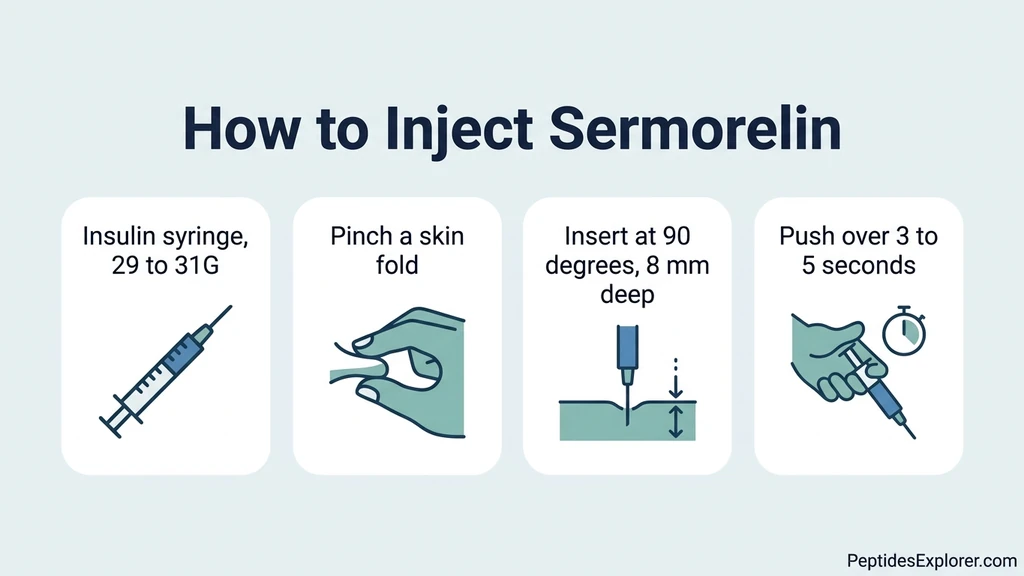
The vial is mixed, the syringe is in your hand, and the stopper is swabbed. Here is the answer: inject sermorelin subcutaneously with a 29 to 31 gauge insulin syringe, draw the number of units that matches your protocol's micrograms at your vial's concentration, pinch a fold of skin, enter at 45 degrees with a 1/2 inch needle or 90 degrees with a 5/16 inch needle, push the plunger over 3 to 5 seconds, hold for 5 seconds, and withdraw. Do it at bedtime on an empty stomach, and never reuse the needle.
| Question | Short answer |
|---|---|
| Syringe | U-100 insulin syringe, 0.3 or 0.5 mL, 29 to 31 gauge |
| Needle length | 5/16 inch (8 mm) at 90 degrees, or 1/2 inch (12.7 mm) at 45 degrees into a pinch |
| Depth | Subcutaneous fat only, never muscle |
| Speed | Plunger down over 3 to 5 seconds, hold 5 seconds |
| Timing | 30 to 60 minutes before sleep, 2 hours after the last food |
| Rotation | At least 1 cm from the last puncture, same spot no more than once a week |
| Disposal | Sharps container, never the kitchen bin |
This page is technique only. The ranked list of body sites lives in where to inject sermorelin, the micrograms to draw in the sermorelin dosage chart, and the water-to-powder ratio in the peptide reconstitution calculator. Sermorelin was FDA-approved as Geref for growth hormone deficiency in children; that product was discontinued, and the compound has no FDA approval for adult use.
Get your custom peptide protocol:
- Tailored to your body and goals
- Precise dosing and cycle length
- Safe stacking combinations
- Backed by peer-reviewed studies
- Ready in under 2 minutes
Supplies: Syringe, Needle Size, and What Else Goes on the Table
Lay everything out before you uncap anything. The injection takes 20 seconds; hunting for a swab with a loaded syringe in your hand is how needles get set down on counters.
- U-100 insulin syringes with a fixed needle, 29 to 31 gauge, 0.3 mL or 0.5 mL barrel
- The reconstituted sermorelin vial, out of the refrigerator 10 to 15 minutes before
- Two alcohol swabs, one for the stopper and one for the skin
- A sharps container, or a hard plastic bottle with a screw cap until you have one
- An injection log: date, site, units
Gauge is the needle's thickness, and a higher number is thinner. A 31 gauge needle is 0.25 mm wide, a 29 gauge is 0.33 mm. Both are fine; the 31 gauge stings less, the 29 gauge draws faster and bends less when it meets the stopper.
Length is the number that decides whether the dose lands in fat or muscle. Skin is only about 2 mm thick at every common injection site regardless of body weight, and the fat layer under it ranges from a few millimeters on a lean thigh to several centimeters on an abdomen (Gibney et al., Curr Med Res Opin, 2010, PMID 20429833). The 2016 international injection-technique recommendations concluded that 4 mm pen needles and 6 mm syringe needles reach subcutaneous fat in all adults, and that longer needles need a lifted skin fold or a 45 degree entry to stay out of muscle (Frid et al., Mayo Clin Proc, 2016, PMID 27594187).
| Needle | Length | Angle | Pinch needed? |
|---|---|---|---|
| 6 mm (15/64 inch) | Shortest insulin syringe needle | 90 degrees | Only on a very lean site |
| 8 mm (5/16 inch) | The common short needle | 90 degrees, or 45 on a lean site | Yes on thigh and arm, optional on abdomen |
| 12.7 mm (1/2 inch) | The common long needle | 45 degrees | Always |
If the box in your drawer says 1/2 inch, you are fine. Pinch and go in at 45 degrees. The same gauge and length logic runs through every subcutaneous peptide, and the generic walkthrough in how to inject peptides covers the syringe anatomy in more detail.
Units vs Micrograms: Drawing the Right Volume
Think of a measuring cup and a bag of sugar. The cup measures volume, the bag is sold by weight, and how much sugar one cupful holds depends on how packed it is. An insulin syringe measures volume in units. Your protocol is written in micrograms. The concentration of your vial is what connects them.
Literally stated: on a U-100 syringe, 1 unit is 0.01 mL. The micrograms in that unit equal the concentration in mcg/mL divided by 100. Nothing on the syringe tells you how much sermorelin is in it; only your vial label does.
Worked once. A 5 mg vial mixed with 2 mL of bacteriostatic water is 2.5 mg/mL, which is 2,500 mcg/mL. One unit therefore carries 25 mcg. A protocol calling for 200 mcg is 200 divided by 25, or 8 units. A protocol calling for 300 mcg is 12 units. Run your own vial through the peptide unit converter and write the result on the vial with a marker.
| Vial and water | Concentration | mcg per unit | 100 mcg | 200 mcg | 300 mcg |
|---|---|---|---|---|---|
| 5 mg + 1 mL | 5 mg/mL | 50 | 2 units | 4 units | 6 units |
| 5 mg + 2 mL | 2.5 mg/mL | 25 | 4 units | 8 units | 12 units |
| 5 mg + 2.5 mL | 2 mg/mL | 20 | 5 units | 10 units | 15 units |
| 2 mg + 1 mL | 2 mg/mL | 20 | 5 units | 10 units | 15 units |
| 2 mg + 2 mL | 1 mg/mL | 10 | 10 units | 20 units | 30 units |
The rows are a conversion table, not a dose recommendation; which microgram figure applies to you is a protocol question that belongs to the dosage chart linked in the introduction. The pattern to notice is that more water makes the draw larger and easier to read: a 4 unit draw on a 0.5 mL syringe puts one tick of misreading at 25% of the dose, while a 10 or 12 unit draw brings that error under 10%. When you mix the next vial, check the ratio in the peptide reconstitution calculator and the water itself in where to buy bacteriostatic water.
How to Inject Sermorelin, Step by Step
Twelve steps, one action each. The first six happen at the table, the last six at the skin.
- 1.Warm the vial. Take it out of the refrigerator 10 to 15 minutes early. Cold solution stings and is harder to draw through a 31 gauge needle.
- 2.Wash your hands. Soap, 20 seconds, dry on a clean towel.
- 3.Swab the stopper. One alcohol swab, then let it dry for 10 seconds. Wet alcohol dragged into the vial is the one thing a swab can do wrong.
- 4.Draw air to your unit mark. If your draw is 8 units, pull the plunger to 8. This air replaces the liquid you are about to remove.
- 5.Push the air into the vial. Needle straight through the center of the stopper, plunger down. Without this step the vial develops a vacuum and the plunger fights you.
- 6.Invert and draw. Turn the vial upside down with the needle tip under the liquid, pull the plunger slowly past your mark, then push back to the exact line. Read the leading edge of the black plunger tip at eye level.
- 7.Clear bubbles. Tap the barrel with a fingernail until the bubble rises, push it back into the vial, and re-draw to the line.
- 8.Swab the skin. Fresh swab, center outward, air-dry 10 to 15 seconds.
- 9.Pinch. Lift a fold of skin and fat between thumb and two fingers. You are lifting the fat away from the muscle, so the grip is firm but not a squeeze.
- 10.Insert. 45 degrees with a 1/2 inch needle, 90 degrees with a 5/16 inch needle, one smooth motion to the hub. Bevel up. Hesitating hurts more than committing.
- 11.Inject slowly and hold. Plunger down over 3 to 5 seconds, then count to 5 with the needle still in place so the liquid disperses instead of tracking back out the puncture.
- 12.Withdraw and dispose. Release the pinch, pull the needle out along the angle it went in, press a dry gauze pad for 10 seconds without rubbing, and drop the syringe into the sharps container uncapped.
A bead of fluid on the skin after withdrawal is a few hundredths of a milliliter, well under a unit. Do not re-inject. Note the site and units in your log; the entry takes 5 seconds and makes the rotation section below possible.
45 or 90 Degrees, the Pinch, and How Deep the Needle Goes
The target is the subcutaneous fat layer, a few millimeters below the surface, where the peptide absorbs through capillaries at a predictable pace. Above it is skin, below it is muscle, and both change the result.
Angle and length are one decision, not two. A 12.7 mm needle at 90 degrees reaches 12.7 mm deep, which on a thigh with 8 mm of fat is muscle. The same needle at 45 degrees reaches about 9 mm deep, and inside a pinched fold that is raised a further centimeter off the muscle, it stays in fat. An 8 mm needle at 90 degrees does the same job without the geometry. Ultrasound measurements of the distance from skin to muscle at the four standard sites found that long needles pushed in straight carry a real risk of intramuscular injection, especially at the thigh and in lean adults, which is the published rationale for shorter needles (Hirsch et al., Diabetes Technol Ther, 2014, PMID 25329935).
| Your needle | Lean site (thigh, arm, lean abdomen) | Abdomen with a full pinch |
|---|---|---|
| 6 mm | 90 degrees, light pinch | 90 degrees, no pinch |
| 8 mm (5/16 inch) | 45 degrees into a pinch | 90 degrees into a pinch |
| 12.7 mm (1/2 inch) | 45 degrees into a firm pinch | 45 degrees into a pinch |
The pinch is the insurance policy. Lift the fold before the needle touches skin, hold it through the injection, and release it only after the 5 second hold. Releasing early lets the tissue relax around a needle that is still in place, which drags fat downward toward the needle tip.
Resistance on entry means scar tissue or a firm lump. Pull out, move at least 2 cm, and start again with a new syringe. The same needle-length logic governs the weekly GLP-1 pens, and the tirzepatide injection guide shows it from the pen side.
Why Bedtime on an Empty Stomach
Sermorelin is the first 29 amino acids of growth hormone-releasing hormone. It binds the GHRH receptor on the pituitary and triggers a pulse of your own growth hormone, with the body's feedback loops still in control of the size of that pulse (Walker, Clin Interv Aging, 2006, PMID 18046908). It clears from the blood within minutes; the review of its clinical program puts the half-life on the order of 10 to 20 minutes (Prakash et al., BioDrugs, 1999, PMID 18031173).
That short window is why the clock matters. The largest natural growth hormone pulse of the day arrives shortly after sleep onset, during slow-wave sleep, and in men that single pulse carries most of the 24-hour output (Van Cauter et al., Growth Horm IGF Res, 2000, PMID 10984255). An injection 30 to 60 minutes before sleep lands the sermorelin pulse on top of the one your pituitary was about to produce anyway.
Food works against it. Elevated insulin after a meal reduces the growth hormone response to GHRH; the effect was measured directly in a study of obese adults where high insulin levels explained part of their blunted response (Lanzi et al., Metabolism, 1999, PMID 10484056). Two hours between the last carbohydrate and the injection is the practical rule. Water, black coffee earlier in the evening, and plain protein are the exceptions people tolerate.
How quickly that nightly pulse turns into something you notice is covered in how long sermorelin takes to work, and the hormone it does and does not move in does sermorelin increase testosterone.
Rotation Within Your Site
A nightly injection means roughly 30 punctures a month. Put them in the same square inch and the fat there thickens into a rubbery lump called lipohypertrophy, which absorbs peptide erratically.
The numbers come from insulin, the best-studied daily subcutaneous injection. In a study of 430 insulin-injecting patients, lipohypertrophy was present in 64.4%, and nearly every patient who had it either did not rotate sites or rotated incorrectly; reusing needles was an independent risk factor (Blanco et al., Diabetes Metab, 2013, PMID 23886784). The international recommendations that followed set the rule at injections spaced at least 1 cm apart, with the same spot left alone for a week or more (Frid et al., Mayo Clin Proc, 2016, PMID 27594187).
Make it mechanical. Take the site you chose, divide it into a grid in your head, and move one finger-width clockwise each night. Your log entry closes the loop: if tonight's site matches an entry from the last 7 days, move.
Before each injection, run a hand over the area. A firm, slightly raised patch that does not hurt is lipohypertrophy. Skip it for a month. The same rotation discipline carries across every daily peptide, including the BPC-157 injection routine.
Four Common Mistakes, Quantified
Injecting into muscle. A 1/2 inch needle, straight in, no pinch, lean thigh. The dose lands in muscle, where blood flow is higher and absorption faster. The signs are a sharper sting, a bruise the next day, and a flushed face within minutes, since the whole dose hits at once instead of over 20 to 30 minutes. Fix: pinch, 45 degrees, or switch to a 5/16 inch needle at 90 degrees.
Reusing needles. A 31 gauge tip is sharpened and silicone-coated for one pass. After one puncture the point is blunted and the coating is gone, so the second pass tears instead of parting tissue, and the needle carries skin bacteria into a vial you will draw from for another three weeks. Needle reuse was an independent predictor of lipohypertrophy in the 430-patient study above (Blanco et al., Diabetes Metab, 2013, PMID 23886784). Fix: one syringe per injection. At $0.15 to $0.30 each, a month of fresh syringes costs less than one vial.
Injecting cold peptide. Straight from the refrigerator at 4 degrees C, the solution stings on entry and the stinging makes you inject faster, which is the next mistake. Fix: 10 to 15 minutes on the counter, never the microwave, never warm water, and never more than an hour. Storage limits for the mixed vial are in how long reconstituted peptides last.
Ignoring air bubbles. A bubble the size of a unit mark in a 10 unit draw means you deliver 9 units and 10% of the dose stays as air. Over a month that is three missed nights. A subcutaneous air bubble that size is harmless; the lost dose is the problem. Fix: tap, expel into the vial, re-draw. If the bubble keeps coming back, the stopper has been cored by a steep needle angle and the vial is drawing air around the puncture; use a fresh entry point on the stopper.
Site Reactions, Troubleshooting, and Disposal
Local reactions were the most frequently reported adverse event in sermorelin's clinical program: pain, swelling, or redness at the puncture (Prakash et al., BioDrugs, 1999, PMID 18031173). Most of them are a few millimeters wide and gone by morning. Flushing and a brief headache in the first week are also reported and fade as the body adapts.
| What you see | Likely cause | What to do |
|---|---|---|
| Pink spot under 1 cm, gone in 24 hours | Normal needle trauma | Nothing |
| Sting on entry | Cold solution or wet alcohol | Warm the vial, let the swab dry |
| Small bruise | Needle nicked a capillary | Rotate away, press longer next time |
| Flushed face within minutes | Fast absorption, possibly intramuscular | Pinch, 45 degrees, shorter needle |
| Firm painless lump, weeks old | Lipohypertrophy | Rest the site 4 weeks, rotate wider |
| Red, hot, spreading, or pus after 48 hours | Infection | Medical attention the same day |
| Hives, wheezing, swelling away from the site | Allergic reaction | Stop and seek emergency care |
Redness that grows after 48 hours, warmth you can feel with the back of your hand, or a streak running away from the site is an infection until proven otherwise. The pattern of a reaction that fades versus one that spreads is the same as for any subcutaneous peptide, and the tirzepatide injection site reaction guide walks through it with photographs.
Disposal. The syringe goes into a sharps container uncapped the moment it leaves your skin. Recapping is where fingers get stuck. A rigid, puncture-proof, screw-top plastic bottle works until you buy a proper container; most pharmacies sell one for a few dollars and many accept full ones back. Never put loose syringes in household trash. The broader handling rules, including what to do with a vial that turns cloudy, are in how to store peptides and the peptide safety guide.
Frequently Asked Questions
What needle size do you use to inject sermorelin?
A 29 to 31 gauge U-100 insulin syringe. For length, 5/16 inch (8 mm) at 90 degrees into a pinch, or 1/2 inch (12.7 mm) at 45 degrees into a pinch. Skin is about 2 mm thick at every site (PMID 20429833), so both reach fat; the long one reaches muscle if pushed straight in. The peptide injection walkthrough covers syringe anatomy.
How many units of sermorelin do you draw?
It depends entirely on your vial concentration. At 2.5 mg/mL (a 5 mg vial plus 2 mL of water) each unit holds 25 mcg, so 200 mcg is 8 units and 300 mcg is 12 units. At 5 mg/mL those draws halve to 4 and 6 units. Convert your own vial with the peptide unit converter, and check the mixing ratio first in the reconstitution calculator.
Do you inject sermorelin at 45 or 90 degrees?
Match the angle to the needle. A 1/2 inch (12.7 mm) needle goes in at 45 degrees into a pinched fold; a 5/16 inch (8 mm) needle goes in at 90 degrees. Ultrasound measurements show long needles pushed straight in can reach muscle on the thigh and in lean adults (PMID 25329935). The same rule runs through the peptide injection walkthrough.
How do you inject sermorelin in the stomach?
Pinch a fold of abdominal fat at least 5 cm from the navel, swab, insert the needle at 45 degrees (1/2 inch) or 90 degrees (5/16 inch), push the plunger over 3 to 5 seconds, hold 5 seconds, withdraw, and press with dry gauze for 10 seconds. Move at least 1 cm each night. Storage limits are in how long reconstituted peptides last.
Why do you inject sermorelin before bed on an empty stomach?
The largest natural growth hormone pulse of the day arrives shortly after sleep onset during slow-wave sleep (PMID 10984255), and sermorelin clears within minutes, so a shot 30 to 60 minutes before sleep stacks the two. Post-meal insulin blunts the GH response to GHRH (PMID 10484056); leave 2 hours after food. The sermorelin profile covers the pharmacology.
Is it normal for the sermorelin injection site to be red?
A pink spot under 1 cm that fades within 24 hours is normal needle trauma. Local reactions were the most common adverse event in the clinical program (PMID 18031173). Redness that spreads after 48 hours, feels hot, or shows pus is an infection and needs a clinician. The injection site reaction guide shows the difference.
Can you reuse a needle for sermorelin injections?
No. After one puncture the 31 gauge tip is blunted and its silicone coating is gone, so the next pass tears tissue, and the needle carries skin bacteria into a multi-dose vial. Needle reuse was an independent risk factor for lipohypertrophy in a 430-patient study (PMID 23886784). Water and vial hygiene are in where to buy bacteriostatic water.
Is there a video showing how to inject sermorelin?
The 12-step procedure above is the same sequence any pharmacist demonstration follows: draw air, inject it into the vial, invert and draw to the unit line, clear bubbles, swab, pinch, insert, inject over 3 to 5 seconds, hold 5 seconds, withdraw, dispose. If you want to watch it done on a comparable daily peptide first, the BPC-157 injection guide walks the identical motions.
The Bottom Line
Inject sermorelin subcutaneously with a 29 to 31 gauge insulin syringe: draw the units that match your protocol's micrograms at your vial's concentration, pinch, enter at 45 degrees with a 1/2 inch needle or 90 degrees with a 5/16 inch needle, push over 3 to 5 seconds, hold 5, withdraw, and drop the syringe in a sharps container. Bedtime, 2 hours after food, a new spot every night.
The principle: the vial label sets the units, the needle length sets the angle, and the clock sets whether the pulse lands where your pituitary was already heading. Every mistake on this page is one of those three ignored.
Sermorelin is not FDA-approved for adult use and this content is educational, not medical advice. Convert your vial with the peptide unit converter, check the next mix in the peptide reconstitution calculator, and find the rest of the sermorelin cluster at PeptidesExplorer.
Related Articles
What Size Needle for Peptide Injections? Gauge
What size needle for peptide injections: 29 to 31 gauge, 5/16 inch (8 mm), U-100 insulin syringe. Gauge chart, length by body fat, draw vs inject needles.
Where to Inject KPV: Best Sites and Technique
Where to inject KPV: belly fat, outer thigh, arm or flank with a 29 to 31G insulin needle. Why the site barely matters, rotation grid and step-by-step.
How to Reconstitute Tesamorelin: Water Volumes & Units
How to reconstitute tesamorelin: bacteriostatic water volumes for 2, 5, 10 and 20 mg vials, U-100 unit math, mixing steps, storage window, and bad-vial signs.
Ipamorelin vs Sermorelin: Mechanism, Safety, Cost
Ipamorelin vs sermorelin: ghrelin-receptor agonist vs GHRH analog, 2-hour vs 4-minute half-life, cortisol selectivity, FDA history, cost, and who picks which.