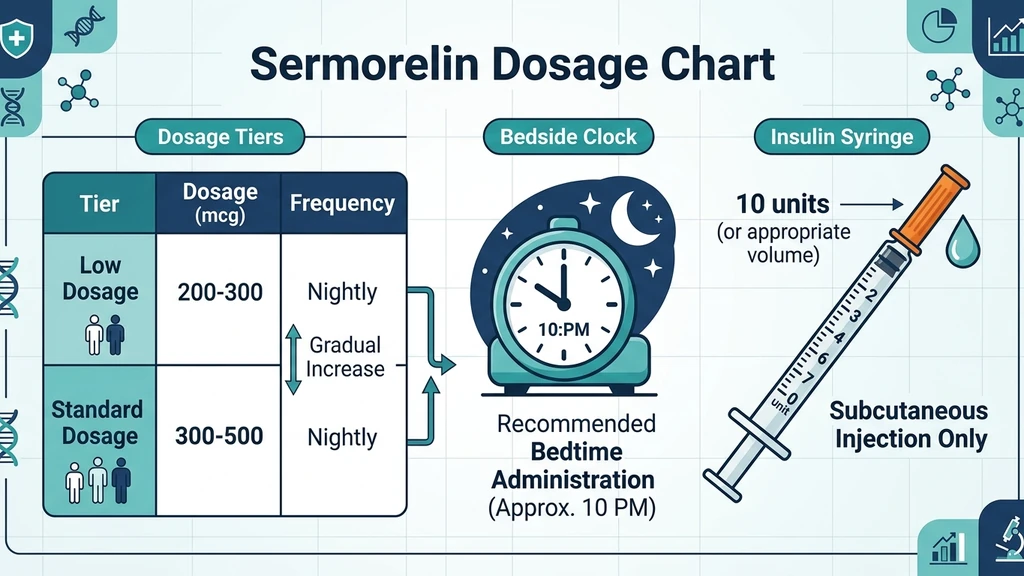
The vial is reconstituted, the insulin syringe is in your hand, and the label tells you nothing about how much to draw. Here is the answer: the standard sermorelin dose is 200 to 500 mcg, injected subcutaneously once per night, 30 to 60 minutes before bed, on an empty stomach. Most adults start at 200 to 300 mcg and adjust after IGF-1 blood work at 6 to 8 weeks.
The chart below covers the common starting points by profile.
| Profile | Starting Dose | Typical Range | Timing | Schedule |
|---|---|---|---|---|
| Men under 50 | 200-300 mcg | 300-500 mcg | 30-60 min before bed | 5 days on, 2 off |
| Men over 50 | 100-200 mcg | 200-400 mcg | 30-60 min before bed | 5 days on, 2 off |
| Women under 50 | 100-200 mcg | 200-300 mcg | 30-60 min before bed | 5 days on, 2 off |
| Women over 50 | 100 mcg | 100-200 mcg | 30-60 min before bed | 5 days on, 2 off |
| Fat loss focus | 200-300 mcg | 300-500 mcg | 30-60 min before bed | Daily or 5/2 |
| Sermorelin + ipamorelin stack | 100-200 mcg each | 200-300 mcg each | 30-60 min before bed | 5 days on, 2 off |
Sermorelin is prescribed through compounding pharmacies and studied in research settings; it is not FDA-approved for anti-aging. Verify your math with the peptide reconstitution calculator before the first draw, and keep the peptide dosage chart bookmarked for every other compound you run.
Get your custom peptide protocol:
- Tailored to your body and goals
- Precise dosing and cycle length
- Safe stacking combinations
- Backed by peer-reviewed studies
- Ready in under 2 minutes
How Sermorelin Dosing Works: Timing a Push on a Swing
Sermorelin is a synthetic copy of the first 29 amino acids of growth hormone-releasing hormone (GHRH), the fragment that carries the full signaling power of the parent molecule. The vial holds zero growth hormone: the peptide works by signaling your pituitary to release its own.
Think of your natural GH rhythm as a child on a swing. The swing already moves on its own, rising highest during deep sleep. Sermorelin is a push delivered at the top of the arc: timed right, a small push makes the swing go much higher. Timed wrong, the same push does almost nothing. Literally stated: sermorelin amplifies the GH pulse your pituitary was already going to release during slow-wave sleep, which is why a 200 mcg dose at bedtime outperforms the same dose at breakfast.
The pulse mechanism also builds in a safety ceiling. Somatostatin, the hormone that brakes GH release, still operates when you inject sermorelin, so your pituitary cannot be pushed into the runaway output that direct HGH injections can produce (Walker, Clin Interv Aging, 2006, PMID 18046908). Pharmacologically, sermorelin belongs with the secretagogues rather than the hormone replacements, and it is not a steroid.
The clinical evidence for restoring output is old and solid. GHRH(1-29) given twice daily reversed the age-related decline in both GH and IGF-1 in men aged 60 to 78 (Corpas et al., J Clin Endocrinol Metab, 1992, PMID 1379256). Modern protocols consolidate that stimulation into one nightly injection.
Sermorelin Dosage Chart by Goal and Body Weight
Clinics prescribe flat doses, but the underlying research dosed by body weight at roughly 1 to 2 mcg per kg. An 80 kg (176 lb) man at 2 mcg/kg lands at 160 mcg, which is why smaller adults respond well at 100 to 200 mcg while heavier adults often need 300 mcg or more to move IGF-1.
| Goal | Under 68 kg (150 lb) | 68-90 kg (150-200 lb) | Over 90 kg (200 lb) | Schedule |
|---|---|---|---|---|
| Anti-aging, general wellness | 100-200 mcg | 200-300 mcg | 200-300 mcg | 5 on, 2 off |
| Fat loss | 200-300 mcg | 300-400 mcg | 300-500 mcg | Daily or 5/2 |
| Sleep and recovery | 100-200 mcg | 200-300 mcg | 200-300 mcg | 5 on, 2 off |
| Muscle support (stacked with ipamorelin) | 100-200 mcg each | 200-300 mcg each | 200-300 mcg each | 5 on, 2 off |
Doses above 500 mcg rarely buy anything. The pituitary releases its full pulse and further GHRH signal hits a ceiling, so the extra 200 mcg is wasted product with more flushing. Fat loss protocols sit at the high end because GH mobilizes fatty acids during the overnight fast; the sermorelin for fat loss guide covers that protocol in detail.
Stacking changes the math. Ipamorelin fires GH through the ghrelin receptor, a separate pathway, so 200 mcg of each outperforms a larger dose of either alone; the CJC-1295/ipamorelin benefits guide covers the synergy data, and the tesamorelin vs sermorelin vs ipamorelin comparison maps the choice between analogs.
These ranges produce measurable change. In men treated with GH secretagogue regimens that included sermorelin, serum IGF-1 rose from a mean of 159.5 to 239.0 ng/mL over roughly 4.5 months (Sigalos et al., Am J Mens Health, 2017, PMID 28830317). That is a 50% increase inside the standard dosing window.
Reconstitution Math: Turning Micrograms Into Syringe Units
Sermorelin ships as freeze-dried powder, and your dose in micrograms means nothing until you know the concentration you created. The math takes 30 seconds and prevents the most expensive mistakes on this page.
Walk through a 6 mg vial. Add 2 mL of bacteriostatic water and you create 3 mg/mL, which is 3,000 mcg/mL. A U-100 insulin syringe holds 100 units per mL, so each unit contains 30 mcg. A 300 mcg dose is 10 units on the syringe. That is the entire calculation: concentration per mL, divided by 100, gives mcg per unit.
| Vial Size | Bacteriostatic Water | Concentration | 200 mcg | 300 mcg | 500 mcg |
|---|---|---|---|---|---|
| 2 mg | 1 mL | 2,000 mcg/mL | 10 units | 15 units | 25 units |
| 5 mg | 2 mL | 2,500 mcg/mL | 8 units | 12 units | 20 units |
| 6 mg | 2 mL | 3,000 mcg/mL | 7 units | 10 units | 17 units |
| 9 mg | 3 mL | 3,000 mcg/mL | 7 units | 10 units | 17 units |
Use bacteriostatic water, not sterile water, because the vial will be punctured nightly for weeks; the bacteriostatic vs sterile water guide explains why. Full technique, including how to aim the stream down the glass wall, is in the reconstitution walkthrough, and the peptide unit converter double-checks any dose against any concentration.
After mixing, refrigerate at 2-8 degrees C (36-46 degrees F) and plan to use the vial within 4 to 6 weeks. Potency decays from the moment water hits powder; the reconstituted peptide shelf-life guide and storage guide cover the timelines.
Timing: Why Bedtime and an Empty Stomach Decide the Result
Sermorelin peaks in blood within 5 to 20 minutes of a subcutaneous injection and clears in about 30. That narrow window has to overlap the large GH pulse your pituitary fires during the first 90 minutes of slow-wave sleep. Inject 30 to 60 minutes before you actually fall asleep, and the amplified pulse lands exactly where your body scheduled it.
Nightly bedtime dosing is the pattern the clinical literature tested directly: single injections of GHRH(1-29) given each night at bedtime raised GH secretion in healthy elderly men over six weeks (Vittone et al., Metabolism, 1997, PMID 9005976). Morning injections fight cortisol, which peaks at 6 to 8 AM and suppresses GH release.
The empty stomach rule exists because insulin is the other GH suppressor. A carbohydrate-heavy dinner keeps insulin elevated for 90 to 120 minutes, and injecting inside that window can blunt the GH pulse by 30 to 50%. Stop eating 90 minutes before the injection; if you must eat, keep it to protein.
Inject into the fat of the abdomen, 5 cm (2 inches) from the navel, with a 29 to 31 gauge insulin syringe, and rotate sides nightly. The where to inject sermorelin guide maps every approved site, and the peptide injection walkthrough covers the pinch, angle, and plunger technique step by step.
Cycle Length and Titration: The 12-Week Arc
Sermorelin is not a set-and-forget compound. The standard protocol runs in a 12-week arc with one blood test in the middle, and most prescribers layer a 5-days-on, 2-days-off weekly rhythm underneath it to keep GHRH receptors sensitive.
The titration schedule: 1. Weeks 1-2: Start at 200 mcg nightly (100-150 mcg for smaller adults and most women). Expect mild flushing or injection-site redness; both fade within 2 weeks. 2. Weeks 3-6: Hold the dose. Sleep depth and recovery usually shift first; body composition lags. The results timeline guide sets realistic checkpoints. 3. Weeks 6-8: Draw fasting IGF-1. If it sits below the age-adjusted target, raise the dose by 50-100 mcg. If it overshoots, drop 50 mcg or add a third rest day. 4. Weeks 9-12: Hold the adjusted dose, then retest. Two consecutive in-range results mean the dose is set.
Cycles typically run 3 to 6 months, followed by a 4-week break to preserve long-term pituitary responsiveness. The longest controlled GHRH(1-29) analog data covers 16 weeks of continuous daily dosing in older men and women with sustained endocrine effects and no serious adverse events (Khorram et al., J Clin Endocrinol Metab, 1997, PMID 9141536); beyond that, break periods are convention rather than trial-tested rule.
Side effects at standard doses are mild: transient flushing, headache, and injection-site redness lead the list. Joint aches and fluid retention signal chronic overshoot and resolve with a dose cut. The sermorelin safety guide covers contraindications, and the sermorelin and testosterone article covers what GH pulses change downstream.
Common Mistakes: Where the Numbers Go Wrong
Every mistake below produces a wrong dose while the syringe reads exactly what you expected. The units are only as good as the concentration behind them.
Mistake 1: Wrong water volume at reconstitution. You add 1 mL to a 9 mg vial instead of 3 mL, creating 9,000 mcg/mL instead of 3,000. Tonight's "10 units" delivers 900 mcg, triple the intended 300 mcg dose. The feedback loop prevents an emergency, but you get pounding flushing and a headache, and the vial that should last a month empties in 10 days. Write the concentration on the vial label the moment you mix.
Mistake 2: Carrying units between vial sizes. Your last vial was 6 mg in 2 mL, where 10 units meant 300 mcg. The new vial is 2 mg in 1 mL, where 10 units means 200 mcg. Same syringe reading, 33% less peptide, and six weeks later your IGF-1 result looks like the protocol failed. Recompute with the peptide reconstitution calculator every time the vial changes.
Mistake 3: Injecting after dinner. A 9 PM meal followed by a 9:30 PM injection puts the dose inside the postprandial insulin wave, cutting the GH pulse by 30 to 50%. The trap compounds: labs come back flat, the dose gets raised, and the real problem was timing all along. Move dinner earlier or the injection later; the fix costs nothing.
Mistake 4: Dosing an unverified product. A vial that is underfilled or degraded turns every calculation above into fiction. Third-party testing with certificates of analysis is the floor; the where to buy sermorelin guide lists what to check before money moves, and the CJC-1295 vs sermorelin comparison helps if you are still choosing your GHRH analog.
Frequently Asked Questions
How much sermorelin should I take per day?
The standard dose is 200 to 500 mcg once nightly, injected subcutaneously 30 to 60 minutes before bed. Most adults start at 200 to 300 mcg and adjust after IGF-1 blood work at 6 to 8 weeks. The peptide dosage chart puts these numbers alongside every other common peptide.
How many units is 300 mcg of sermorelin?
At 3,000 mcg/mL (a 6 mg vial mixed with 2 mL of bacteriostatic water), 300 mcg is 10 units on a U-100 insulin syringe. At 2,000 mcg/mL it is 15 units. The concentration decides everything, so confirm yours with the peptide unit converter before drawing.
When is the best time to inject sermorelin?
30 to 60 minutes before sleep, on a stomach that has been empty for at least 90 minutes. This times the peptide to the large natural GH pulse of early deep sleep. Inject into abdominal fat and rotate sides nightly; the where to inject sermorelin guide shows each site.
Can I take sermorelin in the morning instead?
Morning dosing sacrifices most of the effect. Cortisol peaks at 6 to 8 AM and suppresses GH release, and the injection misses the slow-wave sleep pulse the peptide is built to amplify. If your evenings make bedtime dosing impossible, review the sermorelin safety guide with your prescriber before improvising.
How long should a sermorelin cycle last?
Standard cycles run 3 to 6 months on a 5-days-on, 2-days-off weekly rhythm, followed by a 4-week break. Subjective changes appear within 2 to 4 weeks and IGF-1 shifts by week 6 to 8; the results timeline guide breaks down what to expect at each checkpoint.
What happens if I take too much sermorelin?
Your pituitary feedback loop caps GH output, so a single overdose causes flushing and headache rather than danger. Chronic dosing above 500 mcg nightly can add joint aches and fluid retention that reverse with a dose cut. The sermorelin safety article covers the full side effect profile.
Is sermorelin dosed differently for fat loss?
Yes, fat loss protocols sit at the high end, 300 to 500 mcg nightly, often 7 nights per week instead of 5, because GH mobilizes fatty acids during the overnight fast. Diet still does most of the work. The sermorelin for fat loss guide details the full protocol.
Do I use less sermorelin when stacking with ipamorelin?
Yes. Ipamorelin fires GH through the ghrelin receptor, a second pathway, so 100 to 200 mcg of each peptide can outperform 400 mcg of sermorelin alone. Both go in the same bedtime injection. Model the combined protocol with the CJC-1295/ipamorelin dosage calculator.
The Bottom Line
The chart compresses to one sentence: 200 to 500 mcg of sermorelin, injected subcutaneously once per night, 30 to 60 minutes before bed, on an empty stomach, 5 nights per week, adjusted 50 to 100 mcg at a time against IGF-1 labs at 6 to 8 weeks. Dose sets the ceiling; timing decides how much of that ceiling you reach.
Get the concentration right before anything else. Every dosing error above traces back to a syringe reading trusted without knowing the mcg behind each unit, so run your vial through the peptide reconstitution calculator and label it.
Sermorelin remains a compounded, research-context peptide rather than an approved anti-aging therapy, and a qualified prescriber should anchor any protocol. For dosage charts, calculators, and evidence-graded guides across the whole peptide landscape, start at PeptidesExplorer.com.
Helpful Tools
Related Articles
Ipamorelin Dosage: Solo Protocols, Timing & Unit Math
Ipamorelin dosage: 200-300 mcg subcutaneous, 1-3x daily, bedtime fasted. Charts by goal and weight, saturation dose, reconstitution units, safety data.
CJC-1295 Dosage: Complete Protocol Guide
CJC-1295 dosage guide: DAC and no-DAC protocols. Dosing by goal (anti-aging, fat loss, muscle, sleep), ipamorelin stacking, and injection timing.
Tesamorelin Dosage for Fat Loss
Tesamorelin dosage guide for fat loss. FDA-approved 2 mg/day protocol, visceral fat reduction data, cycling strategies, and GH peptide comparisons.
Ipamorelin vs Sermorelin: Mechanism, Safety, Cost
Ipamorelin vs sermorelin: ghrelin-receptor agonist vs GHRH analog, 2-hour vs 4-minute half-life, cortisol selectivity, FDA history, cost, and who picks which.