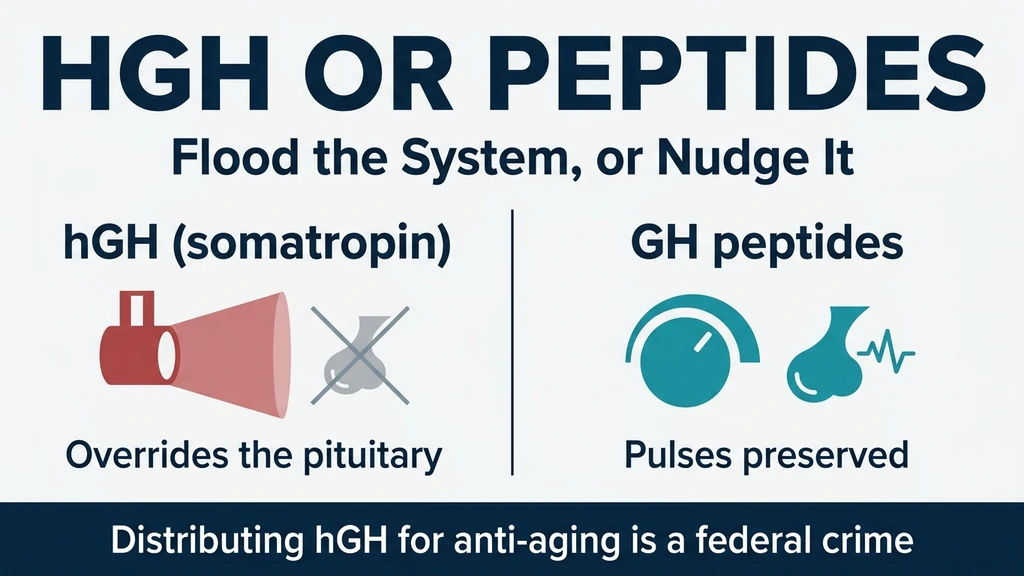
A clinic quoted you two paths at very different prices: nightly somatropin injections, or a vial of sermorelin. Here is the answer. Recombinant hGH puts growth hormone directly into your blood and overrides the pituitary. GH-releasing peptides ask the pituitary to release its own, so the output stays bounded by your body's own brake.
| Question | hGH (somatropin) | GH-releasing peptides |
|---|---|---|
| What it is | The hormone itself, made recombinantly | Signals that trigger GH release |
| Where it acts | GH receptors throughout the body | Pituitary and hypothalamus |
| Pulsatility | Abolished; a flat pharmacologic level | Preserved; GH still comes in bursts |
| Own production | Suppressed by negative feedback | Maintained, sometimes amplified |
| Ceiling | Whatever dose you inject | Capped by somatostatin feedback |
| FDA-approved | Yes, for specific indications only | Only tesamorelin, for HIV lipodystrophy |
| US legality outside approved use | Federal felony to distribute | Unapproved, not criminalized by that statute |
| Effect size | Larger | Smaller |
That last row is the trade the entire debate turns on. Only tesamorelin among the GH peptides holds an FDA approval, and only for HIV-associated lipodystrophy. Everything else on the peptide side is unapproved, which is a different legal category from criminal.
Get your custom peptide protocol:
- Tailored to your body and goals
- Precise dosing and cycle length
- Safe stacking combinations
- Backed by peer-reviewed studies
- Ready in under 2 minutes
The Dimmer Switch and the Floodlight
Picture a room with a dimmer switch wired to a light sensor. Turn the dimmer up and the lamps brighten, but once the room hits a certain brightness the sensor pulls the current back. You can push the dimmer to its stop and the room still will not exceed what the sensor allows. Now picture a floodlight bolted to the ceiling and wired straight to the mains, past the sensor. It goes exactly as bright as the switch you installed, and the sensor never sees the circuit.
GH-releasing peptides are the dimmer. Injected hGH is the floodlight.
The literal mechanism: growth hormone leaves the pituitary in pulses, roughly ten per 24 hours, with the largest amplitude during slow-wave sleep. Each pulse raises IGF-1, and IGF-1 feeds back on the hypothalamus to increase somatostatin release, which shuts the somatotrophs off until the next window. GH-releasing peptides act upstream of that loop and remain subject to it, which is why their GH output has a ceiling no dose escalation clears.
Somatropin bypasses the loop entirely. It is growth hormone, arriving in the blood without a pituitary signal. Serum GH follows the injection curve, not a physiologic rhythm, and the resulting IGF-1 rise raises somatostatin tone and suppresses whatever endogenous pulses you were still making.
Neither category is an anabolic steroid. Both work through the GH/IGF-1 axis rather than the androgen receptor, a distinction covered in peptides vs steroids.
The Two Peptide Classes Everyone Confuses
"GH peptides" covers two drug classes acting on two different receptors. Mixing them up produces most of the bad protocols circulating online.
GHRH analogues bind the GHRH receptor on pituitary somatotrophs, the same receptor the hypothalamus uses. Sermorelin is the natural GHRH 1-29 fragment. Mod GRF 1-29 is a stabilized version of it. CJC-1295 with DAC adds an albumin-binding tether that extends the half-life to 5.8 to 8.1 days and raises mean plasma GH 2- to 10-fold for six days or more after a single dose (Teichman et al., J Clin Endocrinol Metab, 2006, PMID 16352683). Tesamorelin is a stabilized GHRH analogue as well. The CJC-1295 DAC vs no DAC split is a half-life question, not a receptor question.
Ghrelin-receptor agonists, also called GH secretagogues, bind GHS-R1a. That receptor was cloned in 1996 and shown to mediate GH release in pituitary and hypothalamus (Howard et al., Science, 1996, PMID 8688086). Ipamorelin, GHRP-2, GHRP-6, and hexarelin all live here. They differ in selectivity: ipamorelin released GH without raising ACTH or cortisol above the levels seen with GHRH itself, while the older GHRPs do not share that clean profile (Raun et al., Eur J Endocrinol, 1998, PMID 9849822). Hexarelin's GH response attenuates with repeated dosing, which is why hexarelin protocols are kept short.
MK-677 (ibutamoren) also hits GHS-R1a, and it is not a peptide. It is an orally active non-peptide spiropiperidine small molecule. Vendors shelve it next to injectable peptides and buyers assume it belongs there. It does not, which is the first thing to understand in MK-677 vs ipamorelin.
The two classes are synergistic because they pull different levers. A GHRH analogue raises the amplitude of the pulse; a ghrelin agonist adds a secretory stimulus and blunts somatostatin. Combining them produces a larger pulse than either alone, and it still ends when somatostatin says it ends.
The Legal Position on hGH Is Not the Same as the Legal Position on Peptides
This is where most comparison articles go quietly vague, so here is the statute.
Under 21 U.S.C. § 333(e)(1), "whoever knowingly distributes, or possesses with intent to distribute, human growth hormone for any use in humans other than the treatment of a disease or other recognized medical condition, where such use has been authorized by the Secretary of Health and Human Services under section 355 of this title and pursuant to the order of a physician, is guilty of an offense punishable by not more than 5 years in prison." The enhanced penalty runs to 10 years where the offense involves someone under 18. The statute defines human growth hormone as somatrem, somatropin, or an analogue of either.
Read the conjunction carefully. A physician's order alone does not satisfy it. The indication must also be one FDA has authorized under section 355. Prescribing somatropin for anti-aging, athletic performance, or body composition in a healthy adult therefore falls inside the prohibition, well outside the ordinary latitude physicians hold for off-label use. hGH is close to unique in US drug law for that reason.
The GH-releasing peptides sit in a different bucket. They are unapproved drugs, which exposes sellers to FDA enforcement, but § 333(e) does not reach them because they are not somatrem, somatropin, or analogues of either. Unapproved is not the same as felonious. FDA placed CJC-1295, ipamorelin acetate, and several other peptides in Category 2 of the interim 503A bulks list in September 2023. CJC-1295 and ipamorelin acetate came off Category 2 on 27 September 2024, after their nominators withdrew the nominations. A separate action on 16 April 2026 removed twelve further peptides. Removal from Category 2 is not authorization to compound. The Pharmacy Compounding Advisory Committee meets on 23 and 24 July 2026 to consider whether BPC-157, KPV, TB-500, MOTS-c, DSIP, Semax and Epitalon belong on the 503A bulks list at all. See are peptides legal for the current enforcement picture.
Tesamorelin is the exception on the peptide side, approved as Egrifta for HIV-associated lipodystrophy and nothing else, a status detailed in is tesamorelin FDA approved. Sermorelin held FDA approval as Geref, initially in 1990, until EMD Serono discontinued it for commercial reasons in 2008; the approval was formally withdrawn in 2009. Every vial of sermorelin dispensed today is compounded, not FDA-approved.
Two Ways This Decision Goes Wrong
Scenario 1: 2 IU of somatropin nightly for "anti-aging." You buy hGH at roughly 0.67 mg per day, inject before bed, and feel the tissue changes within weeks. Rudman's original trial in men over 60 found lean body mass up 8.8%, adipose mass down 14.4%, and skin thickness up 7.1% over six months (Rudman et al., N Engl J Med, 1990, PMID 2355952). Real effects, and the reason the market exists.
Now the other side of the ledger. A meta-analysis of GH in healthy elderly adults found fat mass down 2.1 kg and lean mass up 2.1 kg with no net weight change, alongside significantly increased rates of soft tissue edema, arthralgia, carpal tunnel syndrome, gynecomastia, and new-onset diabetes or impaired fasting glucose. The authors concluded GH cannot be recommended as an antiaging therapy (Liu et al., Ann Intern Med, 2007, PMID 17227934). Meanwhile the exogenous GH has raised your IGF-1, IGF-1 has raised hypothalamic somatostatin, and your own nocturnal pulses have gone quiet. Stop the injections and there is a recovery gap while the axis restarts. And the clinician who sold it to you is exposed to a federal felony carrying up to 5 years. The fix: if the indication is not FDA-authorized, somatropin is not on the table, and no dose adjustment changes that.
Scenario 2: chasing hGH numbers with a secretagogue. You start ipamorelin at 200 mcg, see a modest IGF-1 bump, and reason that tripling the dose will triple the result. It will not, because somatostatin rises with each pulse and GHS-R1a downregulates. Look at the numbers. Oral MK-677 at 25 mg daily roughly doubled 24-hour GH output and raised IGF-1 from 141 to 265 µg/L over four weeks (Chapman et al., J Clin Endocrinol Metab, 1996, PMID 8954023). Over a full 12 months at the same dose, fat-free mass rose 1.1 kg versus a 0.5 kg loss on placebo, a net 1.6 kg, while body weight climbed 2.7 kg and fasting glucose rose 0.3 mmol/L, about 5.4 mg/dL (Nass et al., Ann Intern Med, 2008, PMID 18981485).
Set that against Rudman's 8.8% lean gain in six months. For a man carrying 55 kg of lean mass, hGH produced roughly 4.8 kg in half the time that a maximal secretagogue dose produced 1.6 kg. A GH secretagogue delivers something on the order of a third of the lean-mass effect in twice the time. Doubling the dose to close that gap buys you the water retention, the appetite, and the glucose drift without the GH, and with GHRP-6 or hexarelin it also buys cortisol and prolactin elevation. The fix: pick the compound for the ceiling you actually want, and titrate against IGF-1 rather than against a number you read on a forum. Start with the documented CJC-1295 and ipamorelin side effects before escalating anything.
How to Read an IGF-1 Result (and Why GH Levels Tell You Almost Nothing)
Nobody explains this, and it is the single most useful skill on either side of the comparison.
A random serum GH draw is close to worthless. GH is pulsatile. Between pulses, serum GH in a person with a completely normal axis falls to the assay floor, often under 0.1 ng/mL. Draw at 2 pm and you have sampled a trough; draw during a pulse and you have sampled a peak that says nothing about 24-hour output. Interpreting GH properly requires serial sampling every 10 to 20 minutes across a full day, which no outpatient lab is doing for you.
IGF-1 is the readable endpoint. The liver produces it in response to GH, and it circulates bound in a ternary complex with IGFBP-3 and the acid-labile subunit, which extends its half-life to roughly 12 to 15 hours. A single draw integrates GH exposure over the preceding days.
Read it as an age-adjusted Z-score, not as raw ng/mL. An IGF-1 of 240 ng/mL is unremarkable in a 22-year-old and high in a 62-year-old. If your lab reports only the raw value, ask for the standard deviation score against the age reference range.
Draw a baseline before the first injection. Without a pre-treatment value you have no way to distinguish a response from your own normal.
Retest at 6 to 8 weeks, at the same time of day, at the same lab, on the same assay platform. IGF-1 immunoassays are not interchangeable between platforms, and a 30 ng/mL swing can be the analyzer rather than the drug.
Target the middle of the age-adjusted range, not the top of it. No trial has established an optimal IGF-1 target for healthy adults on secretagogues; the reasonable goal is moving off the bottom quartile. Above the age-adjusted upper limit is where the acromegaly-adjacent signals appear: rings and shoes tightening, morning hand numbness, jaw changes, rising fasting glucose.
Two practical notes. Malnutrition, poorly controlled diabetes, hepatic impairment, and hypothyroidism all suppress IGF-1 independent of GH, so a flat result can be a nutrition problem rather than a dosing problem. And a GHRH analogue with a long half-life shifts the picture: with CJC-1295 DAC, IGF-1 stays elevated for days after the injection, so a trough draw is not a trough. Timing conventions are covered in the CJC-1295 dosage guide.
Complete Reference Table: Every Compound in the Comparison
One row per compound, with the receptor it actually binds.
| Compound | Class | Receptor | Route | FDA status | Typical use |
|---|---|---|---|---|---|
| Somatropin (hGH) | Recombinant hormone | GH receptor (JAK2/STAT5) | Subcutaneous | Approved, specific indications only | GH deficiency, Turner syndrome, HIV wasting, short bowel |
| Sermorelin | GHRH analogue (GHRH 1-29) | GHRH receptor | Subcutaneous | Approval withdrawn 2009; compounded only | Adult GH optimization, off-label |
| Mod GRF 1-29 (CJC-1295 no DAC) | GHRH analogue, stabilized | GHRH receptor | Subcutaneous | Not approved | Research; short-acting GHRH pulse |
| CJC-1295 with DAC | GHRH analogue + albumin tether | GHRH receptor | Subcutaneous | Not approved | Research; 5.8-8.1 day half-life |
| Tesamorelin | GHRH analogue, stabilized | GHRH receptor | Subcutaneous | Approved (Egrifta), HIV lipodystrophy only | Visceral adipose reduction |
| Ipamorelin | Ghrelin agonist (pentapeptide) | GHS-R1a | Subcutaneous | Not approved | Research; selective, no cortisol rise |
| GHRP-2 | Ghrelin agonist | GHS-R1a | Subcutaneous | Not approved | Research; modest prolactin/cortisol rise |
| GHRP-6 | Ghrelin agonist | GHS-R1a | Subcutaneous | Not approved | Research; strong hunger stimulus |
| Hexarelin | Ghrelin agonist | GHS-R1a | Subcutaneous | Not approved | Research; desensitizes with repeat dosing |
| MK-677 (ibutamoren) | Non-peptide small molecule | GHS-R1a | Oral | Not approved | Research; 24-hour IGF-1 elevation |
| HGH Fragment 176-191 | GH C-terminal fragment | No GH receptor activity | Subcutaneous | Not approved | Marketed for fat loss; releases no GH |
HGH Fragment 176-191 sits at the bottom because it is the compound most often filed under "HGH peptides" while doing none of the things on this page. It is a fragment of the growth hormone molecule with no GH-releasing action and no GH receptor agonism, marketed on lipolysis claims. Dose it with the HGH fragment dosage calculator if you use it, and do not expect an IGF-1 response.
Common Mistakes
Mistake 1: Treating "peptides" as a single alternative to hGH. A GHRH analogue and a ghrelin agonist have different receptors, different side-effect profiles, and different ceilings. Stacking two GHRH analogues does nothing that one does, since they compete for the same receptor. The fix: know which class each vial belongs to. Tesamorelin vs ipamorelin and CJC-1295 vs sermorelin both come down to this distinction.
Mistake 2: Expecting hGH-scale results from a secretagogue. The published gap is roughly 4.8 kg of lean mass in six months on hGH versus 1.6 kg in twelve months on maximal-dose MK-677. Escalating the peptide dose does not close it, because somatostatin caps the pulse. The fix: choose the compound whose ceiling matches the goal, and accept the ceiling.
Mistake 3: Assuming a prescription makes hGH legal. Section 333(e) requires both a physician's order and an FDA-authorized indication. A telehealth script for "anti-aging" satisfies one of two conditions. The fix: ask which approved indication you are being treated for. If nobody can name one, walk.
Mistake 4: Monitoring with GH levels instead of IGF-1. A random GH draw samples a pulse or a trough at random and answers nothing. The fix: baseline IGF-1, retest at 6 to 8 weeks, same lab, same platform, interpreted against the age reference. Read sermorelin for fat loss for what the fat-loss claims actually rest on.
Frequently Asked Questions
Is HGH or peptides better for building muscle?
hGH produces the larger effect. Rudman's trial showed 8.8% lean mass gain in six months, while 25 mg daily MK-677 produced a net 1.6 kg fat-free mass gain over twelve months. hGH also carries federal criminal exposure outside FDA-approved indications, which removes it from consideration for most people. See peptides for muscle growth.
Are HGH peptides the same as HGH?
No. hGH (somatropin) is the hormone itself, injected directly. GH peptides are signals that ask your pituitary to release its own growth hormone, which keeps secretion pulsatile and bounded by somatostatin feedback. Only tesamorelin holds FDA approval among them, and only for HIV lipodystrophy. See tesamorelin peptide.
Is it legal to take HGH in the US?
21 U.S.C. § 333(e)(1) makes it a felony, punishable by up to 5 years in prison, to knowingly distribute or possess with intent to distribute hGH for any use other than an FDA-authorized indication under a physician's order. Prescribing somatropin for anti-aging or performance falls inside that prohibition. GH peptides sit in the separate category of unapproved drugs, which § 333(e) does not reach. See the FDA peptide crackdown for how enforcement is evolving.
Do GH peptides suppress your natural growth hormone?
GHRH analogues and ghrelin agonists work upstream of the pituitary and remain subject to somatostatin negative feedback, so endogenous pulsatile secretion is preserved. Exogenous somatropin does the opposite: it raises IGF-1, IGF-1 raises hypothalamic somatostatin, and your own nocturnal GH pulses go quiet. See is sermorelin safe.
Is MK-677 a peptide?
No. MK-677 (ibutamoren) is an orally active non-peptide small molecule that binds the same GHS-R1a ghrelin receptor as ipamorelin and the GHRPs. At 25 mg daily it raised IGF-1 from 141 to 265 µg/L over four weeks. Being oral is its defining practical difference. See MK-677 vs ipamorelin.
How much sermorelin do I need to match HGH?
No sermorelin dose matches somatropin, because somatostatin caps the pulse regardless of how much GHRH signal arrives. Sermorelin raises GH within physiologic bounds; hGH sets serum GH by the syringe. Titrate sermorelin against age-adjusted IGF-1 rather than against an hGH-equivalent target. See how much sermorelin per day.
Should I stack a GHRH analogue with a ghrelin agonist?
The two classes hit different receptors, so CJC-1295 plus ipamorelin produces a larger GH pulse than either alone while remaining under somatostatin control. Stacking two GHRH analogues achieves nothing, since they compete for the same receptor. Dose with the CJC-1295 and ipamorelin calculator.
Do GH peptides raise testosterone?
GH peptides act on the GH/IGF-1 axis, not the hypothalamic-pituitary-gonadal axis, so they do not directly raise testosterone the way gonadorelin or hCG would. Any indirect effect runs through body composition and sleep quality rather than through the androgen pathway. See does sermorelin increase testosterone.
The Bottom Line
hGH is growth hormone, injected past the pituitary, with no ceiling other than the dose in the syringe and no legal path in the US outside a short list of FDA-approved indications. GH-releasing peptides work upstream, keep secretion pulsatile, and stay capped by somatostatin feedback, which is simultaneously their safety argument and the reason their effect size is smaller.
The principle underneath the whole comparison: a system with an intact brake behaves differently from one with the brake removed, and the smaller effect is the price of keeping the brake. Tesamorelin proved a GHRH analogue can reduce visceral fat by 15.2% at 2 mg daily over 26 weeks in a real trial (Falutz et al., N Engl J Med, 2007, PMID 18057338). Everything else in the peptide column is unapproved and monitored on IGF-1, which is the only endpoint worth drawing.
Run your protocol through the CJC-1295 and ipamorelin dosage calculator, look hard at tesamorelin if visceral fat is the goal, and work with a clinician who can name the indication being treated. More at peptidesexplorer.com.
Related Articles
Tesamorelin vs Ipamorelin: Key Differences
Tesamorelin vs ipamorelin: GHRH analog vs ghrelin mimetic. Fat loss data, dosing, side effects, cost, and stacking protocols. PubMed-cited guide.
Ipamorelin vs Sermorelin: Mechanism, Safety, Cost
Ipamorelin vs sermorelin: ghrelin-receptor agonist vs GHRH analog, 2-hour vs 4-minute half-life, cortisol selectivity, FDA history, cost, and who picks which.
CJC-1295 vs Sermorelin: Half-Life and Dosing
CJC-1295 vs sermorelin: half-life 6-8 days vs 10-20 min, GH output 2-10x vs physiologic pulse, cost, FDA status, and who picks which.
CJC-1295 DAC vs No DAC: How to Choose
CJC-1295 DAC (6-8 day half-life, weekly injection) vs no DAC/Mod GRF 1-29 (30-min half-life, 2-3x daily). Compare dosing, GH patterns, and cost.