You are choosing between a pill and a syringe. MK-677 (ibutamoren) is an oral, non-peptide ghrelin mimetic with a 24-hour half-life. Ipamorelin is an injectable pentapeptide with a 2-hour half-life. Both raise growth hormone, but ipamorelin does so without affecting cortisol, prolactin, or fasting glucose, while MK-677 raises fasting glucose by 25-27% within 2-4 weeks and one clinical trial was stopped early for congestive heart failure concerns (Nass et al., J Clin Endocrinol Metab, 2008; Raun et al., Endocrinology, 1998). MK-677's key advantage is oral dosing; ipamorelin's key advantage is safety.
| Quick Reference | MK-677 (Ibutamoren) | Ipamorelin |
|---|---|---|
| Administration | Oral (capsule/liquid) | Subcutaneous injection |
| Half-life | ~24 hours | ~2 hours |
| Receptor target | Ghrelin receptor (full agonist) | Ghrelin receptor (selective agonist) |
| Cortisol effect | None documented | None (even at 200x dose) |
| Prolactin effect | None documented | None |
| Insulin resistance | Significant (25-27% glucose increase) | None at therapeutic doses |
| Appetite increase | Significant, persistent | Mild |
| Water retention | 40% of subjects in trials | 15-25% |
| Monthly cost | $30-80 (research-grade) | $150-300 (compounded) |
| FDA status | Not approved | Not approved |
For ipamorelin dosing protocols, use our CJC-1295/ipamorelin dosage calculator.
Neither compound is FDA-approved for human therapeutic use. Consult a healthcare provider before use. Do not use MK-677 if you have prediabetes, diabetes, or insulin resistance.
Get your custom peptide protocol:
- Tailored to your body and goals
- Precise dosing and cycle length
- Safe stacking combinations
- Backed by peer-reviewed studies
- Ready in under 2 minutes
What Is MK-677 (Ibutamoren)?
MK-677 is a non-peptide, orally active ghrelin mimetic originally developed by Merck. It binds the ghrelin receptor (GHS-R1a) and stimulates growth hormone release from the pituitary gland. A single 25 mg oral dose sustains elevated GH and IGF-1 for a full 24 hours.
It is not a peptide. It is not a SARM, despite frequent mislabeling on supplement websites. MK-677 is a small molecule with oral bioavailability above 60% (Murphy et al., J Clin Endocrinol Metab, 1998).
In healthy elderly subjects, 25 mg/day for 4 weeks restored IGF-1 levels to the range of young adults, a 40-60% increase from baseline (Chapman et al., J Clin Endocrinol Metab, 1996). A 12-month randomized controlled trial confirmed sustained fat-free mass increases but documented insulin resistance as the primary safety concern (Nass et al., 2008).
What Is Ipamorelin?
Ipamorelin is a synthetic pentapeptide (Aib-His-D-2-Nal-D-Phe-Lys-NH2) that earned the title "first selective growth hormone secretagogue" in the landmark Raun et al. study. It stimulates GH release through the ghrelin receptor, but with a selectivity profile unlike any other compound in its class.
At doses up to 200 times the effective threshold, ipamorelin does not elevate cortisol, ACTH, prolactin, FSH, LH, or TSH (Raun et al., Endocrinology, 1998). No other GH secretagogue achieves this level of selectivity. This is not marketing language; it is the defining result of a preclinical study that distinguished ipamorelin from every compound that came before it.
Its half-life is approximately 2 hours, with a GH peak at about 40 minutes post-injection and dose-proportional pharmacokinetics (Johansen et al., Eur J Clin Pharmacol, 1999). Standard dosing is 100-300 mcg subcutaneously, typically paired with CJC-1295 for synergistic GHRH-GHRP activation.
How Do Their Mechanisms Differ?
Both compounds target the ghrelin receptor on the pituitary gland. The difference lies in activation pattern, duration, and downstream effects.
MK-677: Full Ghrelin Receptor Agonist
MK-677 acts as a full agonist at GHS-R1a, the same receptor that endogenous ghrelin uses. Because ghrelin is the hunger hormone, MK-677 activates the appetite signaling cascade alongside GH release. The 24-hour half-life means this activation persists around the clock.
Think of it like leaving a faucet on all day. GH flows steadily, but so does the hunger signal and the metabolic strain. Ghrelin receptor activation for 24 continuous hours is a fundamentally different stimulus than the body's natural pulsatile GH secretion pattern, which releases GH in discrete pulses with near-zero baseline between them.
Ipamorelin: Selective GH Release Only
Ipamorelin binds the same receptor but triggers a narrower downstream cascade. GH is released. Cortisol, ACTH, and prolactin are not affected. Appetite stimulation is minimal compared to MK-677 or GHRP-6.
The 2-hour half-life produces a discrete GH pulse that clears quickly, mimicking the body's natural secretory rhythm. This pulsatile pattern is closer to physiological GH release than MK-677's sustained elevation. When paired with CJC-1295 (a GHRH analog), ipamorelin activates two complementary pathways for synergistic GH output. For the full stack analysis, see CJC-1295/ipamorelin benefits.
GH and IGF-1 Output Compared
Both compounds raise GH and IGF-1 meaningfully. The pattern and duration differ.
MK-677 at 25 mg/day restored IGF-1 in elderly subjects to levels matching young adults (40-60% increase from baseline) within 2 weeks. After 12 months of continuous use, IGF-1 remained elevated and fat-free mass increased significantly by DXA scan (Nass et al., 2008). In obese subjects, 2 months of MK-677 increased fat-free mass and basal energy expenditure (Murphy et al., 1998).
Ipamorelin produces dose-proportional GH peaks at approximately 40 minutes post-injection. The GH pulse is sharp and resolves within 4-6 hours. Direct body composition studies for ipamorelin alone are limited; most clinical data uses ipamorelin combined with CJC-1295.
| Parameter | MK-677 | Ipamorelin |
|---|---|---|
| IGF-1 elevation | 40-60% increase, sustained 24h | Pulsatile, returns to baseline within hours |
| GH peak timing | Gradual rise over 2-6 hours | Sharp peak at ~40 minutes |
| GH duration | 24 hours (continuous) | 4-6 hours (pulsatile) |
| Body composition data | 12-month RCT (DXA confirmed) | Limited standalone data |
| GH pattern | Sustained elevation | Pulsatile (more physiological) |
Side Effects Compared: The Critical Difference
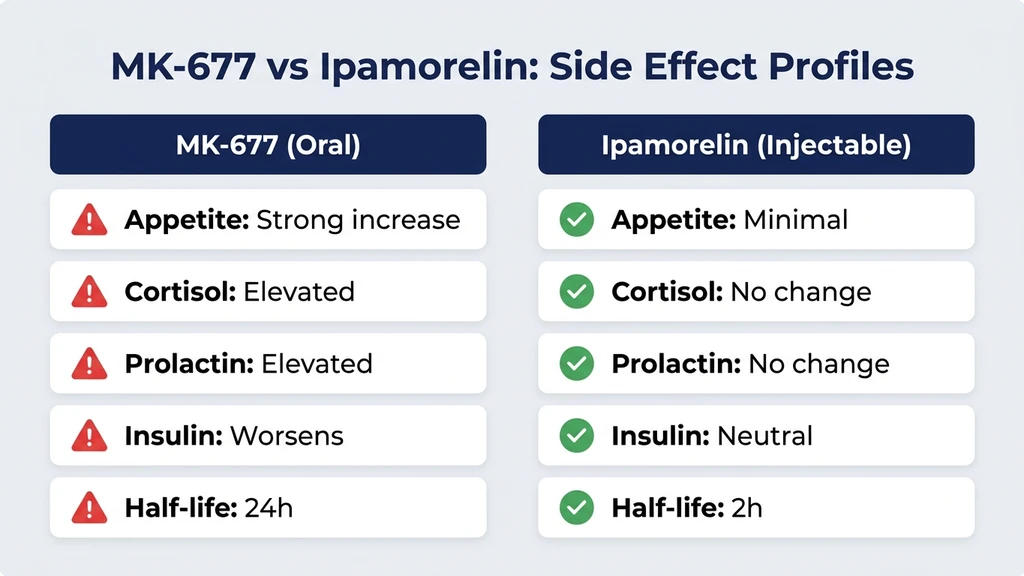
This is where the two compounds diverge most sharply. MK-677 carries metabolic risks that ipamorelin does not.
MK-677 Side Effects: Insulin Resistance Is the Headline
The Nass 2008 randomized controlled trial documented fasting glucose increases of 25-27% within 2-4 weeks of MK-677 use. In 6% of subjects, fasting glucose exceeded 140 mg/dL. HbA1c rose by 0.3% on average over 12 months. One clinical trial in elderly patients recovering from hip fractures was stopped early due to congestive heart failure concerns in the MK-677 group (Nass et al., 2008).
Water retention affected 40% of subjects. Arthralgias (joint pain) appeared in 20%. Carpal tunnel symptoms developed in 10%. Appetite increase is significant and typically persists for the duration of use.
| MK-677 Side Effect | Frequency | Severity |
|---|---|---|
| Insulin resistance/glucose increase | Very common (25-27% rise) | Moderate-Severe |
| Increased appetite | Very common | Moderate, persistent |
| Water retention/edema | 40% | Mild-Moderate |
| Arthralgias | 20% | Mild-Moderate |
| Carpal tunnel symptoms | 10% | Mild-Moderate |
| Lethargy | Common | Mild |
These are not theoretical risks from animal models. The glucose and insulin data come from multiple randomized controlled trials with up to 12-month follow-up.
Ipamorelin Side Effects: Minimal and Transient
Ipamorelin's side effect profile at therapeutic doses consists of injection site reactions, transient flushing, and occasional light-headedness. No cortisol elevation has been detected even at doses 200 times the effective threshold (Raun et al., 1998).
No significant appetite spike. No insulin resistance at standard doses. No edema at the rates seen with MK-677. The trade-off: you need a syringe, bacteriostatic water, and injection supplies. For complete side effect management, see our CJC-1295/ipamorelin side effects guide.
| Ipamorelin Side Effect | Frequency | Severity |
|---|---|---|
| Injection site reactions | 20-30% | Mild |
| Facial flushing | 15-20% | Mild, transient |
| Light-headedness | 5-10% | Mild |
| Cortisol increase | None (at any dose) | N/A |
| Appetite increase | Minimal | Mild |
| Insulin resistance | None at therapeutic doses | N/A |
Quantified Risk Scenarios
Scenario 1: You take MK-677 at 25 mg/day without glucose monitoring. After 3 weeks, your fasting glucose rises from 90 mg/dL to 115 mg/dL. That is the prediabetic range. If your baseline was already 100 mg/dL, MK-677 could push you to 125-127 mg/dL, past the diabetic diagnostic threshold.
Scenario 2: You inject ipamorelin at 200 mcg before bed. GH peaks during your deep sleep cycle. Your fasting glucose the next morning is unchanged from baseline. No appetite disruption affects your diet. The full cost of this safety advantage: one subcutaneous injection with a 30-gauge needle, 30 seconds, every day.
The safety gap between these compounds is not subtle. For comprehensive comparison of GH peptide risks, see our peptide safety guide.
Sleep Quality: MK-677 Has Dedicated Clinical Data
Both compounds are commonly used for sleep improvement. MK-677 has a specific advantage here.
Copinschi et al. (1997) administered MK-677 to young men and documented a 50% increase in Stage IV (deep) sleep duration and a 20% increase in REM sleep. Total sleep time did not change, but the quality shifted toward more restorative stages (Copinschi et al., Neuroendocrinology, 1997).
Ipamorelin lacks a dedicated sleep study. Users commonly report improved sleep quality, deeper rest, and vivid dreams, consistent with GH-mediated sleep enhancement. The mechanism is sound: GH secretion naturally peaks during deep sleep, and ipamorelin before bed amplifies this pulse.
| Sleep Parameter | MK-677 | Ipamorelin |
|---|---|---|
| Stage IV sleep | +50% (RCT data) | Improved (clinical reports) |
| REM sleep | +20% (RCT data) | Improved (clinical reports) |
| Evidence level | PubMed RCT | User reports + GH physiology |
| Timing | Once daily oral | Before bed subcutaneous |
For documented sleep enhancement, MK-677 has stronger published evidence. For sleep improvement without metabolic risk, ipamorelin before bed is the conservative choice. For a broader review of sleep-targeting peptides, see our peptides for sleep guide.
Body Composition Effects Compared
MK-677 has the most direct body composition evidence among non-prescription GH secretagogues.
The Nass 2008 twelve-month study used DXA in healthy elderly subjects. MK-677 at 25 mg/day produced statistically significant increases in fat-free mass. Limb fat also increased. Total body weight rose, partly from water retention and lean tissue. Grip strength and physical function did not improve despite the body composition changes.
In obese subjects, Murphy et al. (1998) documented increased fat-free mass and basal metabolic rate after 2 months. Higher lean mass combined with higher energy expenditure is favorable for recomposition, though insulin resistance complicates long-term use.
Ipamorelin standalone body composition data is limited. The CJC-1295/ipamorelin combination is the standard clinical protocol, and practitioners report improvements in fat loss, recovery, and lean tissue over 8-12 week cycles. For a broader comparison including FDA-approved options for fat loss, see best peptides for weight loss.
| Outcome | MK-677 (12 months) | Ipamorelin (standalone) |
|---|---|---|
| Fat-free mass | Increased (DXA confirmed) | Limited standalone data |
| Strength | No improvement | No direct data |
| Energy expenditure | Increased (obese subjects) | No direct data |
| Body composition format | MK-677 alone | Best data is with CJC-1295 |
Cost and Accessibility Compared
MK-677 is cheaper and more convenient. This explains its popularity despite the metabolic risks.
| Factor | MK-677 | Ipamorelin |
|---|---|---|
| Monthly cost | $30-80 (research-grade) | $150-300 (compounded) |
| Administration | Oral capsule or liquid | Subcutaneous injection |
| Supplies needed | None | Syringes, bacteriostatic water, alcohol swabs |
| Storage | Room temperature (capsules) | Refrigerated after reconstitution |
| Preparation time | Seconds (swallow capsule) | 5-10 minutes (reconstitute, draw, inject) |
MK-677 requires zero injection supplies and no reconstitution. For people with needle aversion, this is a decisive advantage. Ipamorelin requires purchasing bacteriostatic water, insulin syringes, and the peptide vial, then reconstituting and injecting subcutaneously 1-3 times daily. Use our peptide reconstitution calculator for guidance on ipamorelin preparation.
Both compounds are research chemicals without FDA approval. MK-677 is sometimes mislabeled and sold as a dietary supplement. The FDA has issued warnings against such products. Ipamorelin is available through compounding pharmacies with a valid prescription.
Who Should Choose Which?
The decision framework is clear once you weigh metabolic risk against convenience.
Choose MK-677 If:
You are needle-averse and oral dosing is essential. Sleep improvement is your primary goal and you want the compound with clinical sleep data (Copinschi 1997). Your fasting glucose is below 90 mg/dL, HbA1c is under 5.4%, and you have no family history of type 2 diabetes. You plan short-term use (8-12 weeks maximum) with glucose monitoring at baseline and week 4. Budget is a meaningful constraint.
Choose Ipamorelin If:
Selectivity and safety are your priorities. You have any insulin resistance risk factors: fasting glucose above 95 mg/dL, HbA1c above 5.5%, family history of diabetes, BMI above 30, or existing cardiovascular risk. You want to stack with CJC-1295 for synergistic GHRH-GHRP activation. You prefer pulsatile, physiological GH release. You plan long-term cycling over multiple months.
For the three-way comparison including tesamorelin and sermorelin, see our tesamorelin vs sermorelin vs ipamorelin guide. For bodybuilding context, see peptides for bodybuilding.
Can You Stack MK-677 and Ipamorelin?
Stacking MK-677 with ipamorelin is not recommended. Both target the ghrelin receptor, creating pharmacological redundancy rather than synergy. You double the ghrelin pathway stimulation without adding a complementary mechanism.
Additive appetite stimulation and water retention would be pronounced. Insulin resistance risk from MK-677 would persist regardless of stacking.
Better stacks activate two distinct receptor pathways. Ipamorelin pairs with CJC-1295 (a GHRH analog that activates the GHRH receptor) for genuine synergy: the GHRH analog tells the pituitary to produce GH, while ipamorelin tells it to release GH. MK-677 is best used alone. For comprehensive stacking guidance, see our peptide stacking guide.
Blood Work and Monitoring
Both compounds require monitoring, but MK-677 demands more frequent glucose checks.
| Timing | MK-677 Labs | Ipamorelin Labs |
|---|---|---|
| Baseline | Fasting glucose, HbA1c, IGF-1, fasting insulin | IGF-1, fasting glucose, CMP |
| Week 4 | Fasting glucose, fasting insulin (critical) | IGF-1 (optional) |
| Week 8-12 | Full panel: glucose, HbA1c, IGF-1, CMP | IGF-1, fasting glucose |
| Post-cycle (4 weeks off) | Fasting glucose, IGF-1 | IGF-1 |
Stop MK-677 immediately if: fasting glucose exceeds 126 mg/dL on two consecutive readings, fasting insulin doubles from baseline, or lower extremity edema develops and does not resolve with hydration and sodium reduction.
Stop ipamorelin if: severe persistent headaches develop, joint pain limits daily function, or IGF-1 exceeds the upper reference range for your age. For comprehensive safety protocols, see our peptide safety guide.
Important Safety Warnings
Neither MK-677 nor ipamorelin is FDA-approved for any indication. All human data comes from Phase I/II clinical trials and observational reports.
MK-677 carries specific risks that cannot be understated. A randomized trial in elderly hip fracture patients was stopped early because MK-677 subjects showed signs of congestive heart failure. The glucose and insulin sensitivity effects are documented across multiple studies and are not theoretical.
Do not use MK-677 if you have type 2 diabetes, prediabetes, or poorly controlled fasting glucose. Do not use either compound if you have active cancer or a history of hormone-sensitive cancers without oncologist clearance. IGF-1 elevation may theoretically promote tumor growth.
For recovery-focused peptide comparisons, see our peptides for recovery guide. For muscle growth context, see peptides for muscle growth.
Frequently Asked Questions
Is MK-677 stronger than ipamorelin?
MK-677 produces more sustained GH and IGF-1 elevation over 24 hours. Ipamorelin produces sharper, shorter GH pulses. In total daily GH output, MK-677 at 25 mg/day likely exceeds ipamorelin at 200-300 mcg. But the sustained elevation comes with documented insulin resistance (25-27% glucose increase) and one halted trial. Ipamorelin paired with CJC-1295 produces synergistic output without those metabolic risks.
Does MK-677 cause diabetes?
MK-677 does not directly cause diabetes, but it raises fasting glucose by 25-27% within 2-4 weeks. In the Nass 2008 study, 6% of subjects exceeded 140 mg/dL fasting glucose. If your baseline is already elevated (above 95 mg/dL), MK-677 can push you into prediabetic or diabetic range. Monitor glucose at baseline and week 4. Do not use MK-677 if you have prediabetes.
Can you take MK-677 orally?
Yes. MK-677 is one of very few GH-stimulating compounds with oral bioavailability above 60%. It is taken as a capsule or liquid once daily. This is its primary practical advantage over injectable peptides like ipamorelin, which require subcutaneous injection, reconstitution, and injection supplies. The oral route does not reduce the metabolic side effect risk.
Does ipamorelin increase appetite?
Ipamorelin causes minimal appetite stimulation compared to MK-677 or GHRP-6. While it acts on the ghrelin receptor, its selective activation profile spares the aggressive hunger signaling seen with full ghrelin mimetics. Most users report little to no appetite change at 200-300 mcg doses, in contrast to MK-677's significant and persistent appetite increase. See the ipamorelin profile for mechanism details.
MK-677 vs ipamorelin for sleep: which is better?
MK-677 has clinical evidence for sleep improvement: Copinschi et al. (1997) documented a 50% increase in Stage IV deep sleep and 20% increase in REM sleep. Ipamorelin improves sleep through GH-mediated mechanisms but lacks a dedicated sleep study. For documented sleep enhancement, MK-677 has stronger evidence. For sleep improvement without metabolic risk, ipamorelin before bed is safer. See our peptides for sleep guide for full context.
Which is safer, MK-677 or ipamorelin?
Ipamorelin is safer by every available metric. It does not raise cortisol, prolactin, or glucose at any tested dose. MK-677 raises fasting glucose by 25-27%, causes edema in 40% of users, and one trial was halted for heart failure concerns. The trade-off: ipamorelin requires injection, while MK-677 is oral. See our peptide safety guide for comprehensive risk assessment.
Can you stack MK-677 with ipamorelin?
Not recommended. Both target the ghrelin receptor, making the combination pharmacologically redundant. The additive appetite stimulation and water retention outweigh any theoretical GH benefit. Ipamorelin pairs better with CJC-1295 (a GHRH analog), which activates the complementary GHRH receptor pathway for true synergy. See our peptide stacking guide for productive GH secretagogue stack protocols.
Is MK-677 a SARM?
No. MK-677 is frequently mislabeled as a SARM on supplement websites, but it is a non-peptide ghrelin receptor agonist. It does not bind androgen receptors and has no direct anabolic effect on muscle tissue. Its body composition effects come entirely through GH and IGF-1 elevation, not androgen signaling. The mislabeling is a marketing practice with no pharmacological basis.
The Bottom Line
MK-677 offers oral convenience, clinical sleep data, and documented body composition effects over 12 months. Ipamorelin offers the cleanest GH release profile ever documented: no cortisol, no prolactin, no glucose disruption at any tested dose. The safety gap between them is substantial and quantified in clinical literature.
If you have no insulin sensitivity risk factors, need oral dosing, and plan short-term use with careful glucose monitoring, MK-677 is a reasonable choice. If you want the safest long-term GH secretagogue protocol with the cleanest side effect profile, ipamorelin paired with CJC-1295 is the standard.
Use our CJC-1295/ipamorelin dosage calculator to build your protocol. For reconstitution help, see our peptide reconstitution calculator. For the broader GH peptide landscape, see our tesamorelin vs sermorelin vs ipamorelin three-way comparison.
Related Articles
Tesamorelin vs Sermorelin vs Ipamorelin
Tesamorelin vs sermorelin vs ipamorelin compared: mechanism, dose, cost, side effects, and which growth hormone peptide fits your goal.
Tesamorelin vs CJC-1295: FDA GHRH vs Research
Tesamorelin vs CJC-1295: FDA GHRH (-18% visceral fat, Phase III) vs research peptide (2-10x GH, Phase I). Cost, dosing, and who picks which.
GHRP-2 vs GHRP-6: Potency vs Hunger Compared
GHRP-2 vs GHRP-6: GH release potency, hunger effects, cortisol and prolactin impact, 100-300 mcg dosing, and which peptide fits each research goal.
CJC-1295 & Ipamorelin Benefits Explained
CJC-1295 and ipamorelin benefits: fat loss, muscle recovery, sleep, anti-aging, bone density, cognition, and immune support. PubMed-cited guide.