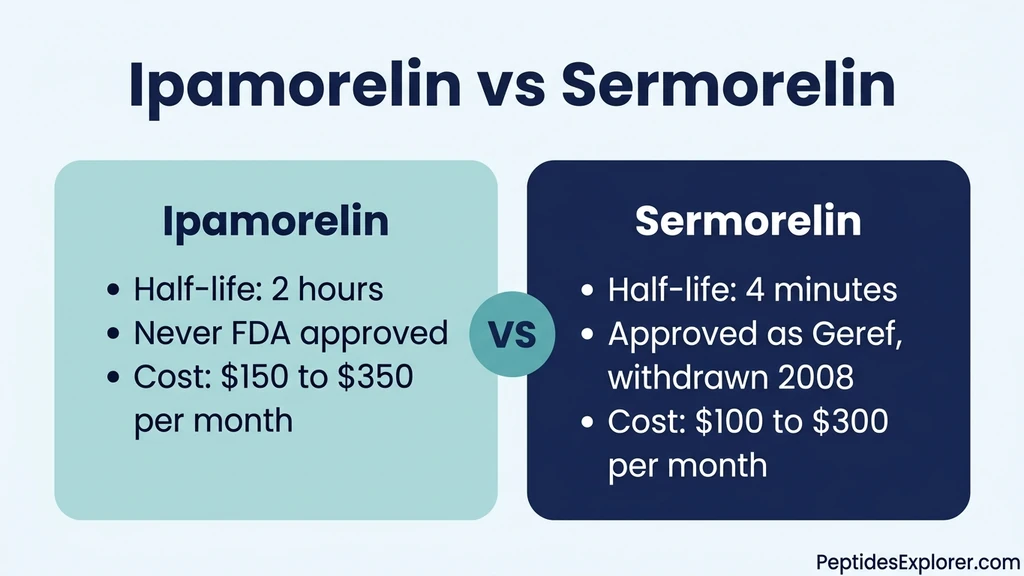
Two clinic quotes sit in your inbox, one for ipamorelin and one for sermorelin, and both promise "natural growth hormone support." Here is the difference: ipamorelin is a ghrelin-receptor agonist with a 2-hour half-life that triggers one GH pulse without raising cortisol or prolactin; sermorelin is a GHRH analog that clears in minutes and was once an FDA-approved drug. They enter the pituitary through different doors, which is why they stack well and why neither replaces the other.
| Feature | Ipamorelin | Sermorelin |
|---|---|---|
| Drug class | Growth hormone releasing peptide (GHRP) | GHRH analog, GHRH(1-29) |
| Receptor | GHS-R1a (ghrelin receptor) | GHRH receptor |
| Measured half-life | ~2 hours (terminal, IV) | ~4 minutes (IV disappearance) |
| GH pulse | Single pulse, peak at ~40 minutes | Short physiological pulse |
| Cortisol / prolactin | No rise, even at 200x the GH dose | No rise (GHRH is GH-specific) |
| FDA history | Never approved; phase 2 only | Approved as Geref, withdrawn 2008 (non-safety) |
| Monthly cost, compounded (Sept 2026) | ~$150 to $350 | ~$100 to $300 |
| Best for | Clean GH pulse, stacking | Bedtime pulse, regulatory paper trail, beginners |
Amounts, timing, and reconstitution live on their own pages: the ipamorelin dosage guide, the sermorelin dosage chart, and the CJC-1295 dosage guide for the usual stacking partner.
Get your custom peptide protocol:
- Tailored to your body and goals
- Precise dosing and cycle length
- Safe stacking combinations
- Backed by peer-reviewed studies
- Ready in under 2 minutes
Two Different Doors Into the Same Pituitary
Picture the pituitary somatotroph as a house with two doorbells. Sermorelin rings the front bell, the GHRH receptor, the same one your hypothalamus rings every few hours. Ipamorelin rings the side bell, the ghrelin receptor, which the stomach hormone ghrelin presses when you are hungry.
Literally stated: sermorelin is the first 29 amino acids of human GHRH, the shortest fragment that keeps GHRH's full biological activity, and it stimulates GH release specifically from the anterior pituitary (Prakash & Goa, BioDrugs, 1999, PMID 18031173). Ipamorelin is a five-amino-acid peptide that releases GH through the GHRP receptor rather than the GHRH receptor, confirmed with receptor antagonists in the original Novo Nordisk pharmacology paper (Raun et al., Eur J Endocrinol, 1998, PMID 9849822).
That GHRP receptor is the ghrelin receptor. Ghrelin, a 28-amino-acid stomach hormone, is its natural ligand and drives both GH release and appetite (Kojima & Kangawa, Physiol Rev, 2005, PMID 15788704). Ipamorelin borrows the GH half of that job.
Two doorbells matter because they add up. In seven healthy men, GHRH(1-29) alone produced a peak GH of 26.7 mcg/L, ghrelin alone 92.1 mcg/L, and the two together 133.6 mcg/L, a true synergistic effect (Arvat et al., J Clin Endocrinol Metab, 2001, PMID 11238504). That study used ghrelin itself rather than ipamorelin, and it remains the mechanistic basis for every GHRH-plus-GHRP stack on the market.
Selectivity: What Else Each Peptide Releases
The word "selective" in ipamorelin's marketing has a specific origin. Older GHRPs are messy. In the swine model, both GHRP-6 and GHRP-2 raised ACTH and cortisol alongside GH. Ipamorelin did not: its ACTH and cortisol readings matched those seen after plain GHRH, and that held at doses more than 200-fold above the ED50 for GH release (Raun et al., Eur J Endocrinol, 1998, PMID 9849822). None of the compounds moved FSH, LH, prolactin, or TSH.
Ghrelin itself is less clean. In humans, ghrelin and hexarelin both raised prolactin, ACTH, and cortisol, with ghrelin's responses exceeding hexarelin's (Arvat et al., J Clin Endocrinol Metab, 2001, PMID 11238504). Ipamorelin is the exception in its own family, which is why it displaced GHRP-6 as the default stacking partner.
Sermorelin never needed the qualifier. GHRH acts on the GHRH receptor alone, so GH specificity is built in (Prakash & Goa, BioDrugs, 1999, PMID 18031173). On cortisol and prolactin the two peptides tie; ipamorelin earned the label by comparison with its siblings, sermorelin inherited it from its parent hormone. Whether either touches androgens is covered in does sermorelin increase testosterone.
Half-Life and Pulse Shape
The numbers below come from human infusion studies, not vendor pages.
| Parameter | Ipamorelin | Sermorelin / GHRH(1-29) |
|---|---|---|
| Terminal half-life | 2 hours (IV, dose-proportional) | 4.3 minutes disappearance half-time (IV) |
| Clearance | 0.078 L/h/kg | 39.7 mL/kg per minute |
| GH response shape | One pulse, peak at 0.67 h, then exponential decline | One pulse, tracks the injection closely |
| Study population | 8 healthy men per dose, 5 dose levels | 10 healthy men |
Ipamorelin was infused over 15 minutes at five escalating rates in healthy men. Pharmacokinetics were dose-proportional, the terminal half-life was 2 hours, and GH rose in a single episode that peaked at 0.67 hours before declining to negligible levels at every dose (Gobburu et al., Pharm Res, 1999, PMID 10496658). More ipamorelin did not create a second wave; it made the one wave taller.
Native GHRH(1-29) is far shorter-lived. Infused intravenously in 10 normal men, its disappearance half-time was 4.3 minutes with a clearance of 39.7 mL/kg per minute (Soule et al., J Clin Endocrinol Metab, 1994, PMID 7962295). Clinic literature usually quotes 10 to 20 minutes for subcutaneous sermorelin because skin-depot absorption stretches the window, but the molecule itself is gone within minutes.
Sermorelin therefore delivers a brief nudge timed to the injection, ideally to the bedtime pulse. Ipamorelin stays long enough to produce a fuller, later-peaking pulse. The longer-acting GHRH options that fix sermorelin's brevity are compared in CJC-1295 vs sermorelin.
Evidence Quality: What Humans Have Actually Received
This is where the two compounds split hardest, and where most comparison pages go quiet.
Sermorelin has a regulatory file. It was approved as Geref, used as a diagnostic test and as a once-daily bedtime treatment for children with idiopathic GH deficiency. Height velocity rose significantly and stayed elevated over 12 months, with catch-up growth in the majority of children; the most common adverse events were transient facial flushing and injection-site pain (Prakash & Goa, BioDrugs, 1999, PMID 18031173). Geref left the US market in 2008, and the FDA later determined the withdrawal was not for reasons of safety or effectiveness. Compounding pharmacies fill the gap today with a prescription.
For adults, the case rests on physiology more than trials. Walker argued that sermorelin suits adult-onset GH insufficiency better than recombinant HGH because it works through the pituitary's own feedback loops (Walker, Clin Interv Aging, 2006, PMID 18046908). That is an editorial position; the HGH vs peptides comparison lays out what each side can and cannot claim.
Ipamorelin has a pharmacology file and one phase 2 trial. The largest human study gave 114 bowel-resection patients intravenous ipamorelin or placebo twice daily for up to 7 days for postoperative ileus. It was well tolerated, with treatment-emergent adverse events in 87.5% of the ipamorelin group versus 94.8% on placebo, but it missed its endpoint: median time to a first tolerated meal was 25.3 hours versus 32.6 hours, p = 0.15 (Beck et al., Int J Colorectal Dis, 2014, PMID 25331030). No ipamorelin trial has measured fat loss, sleep, or recovery in adults; those uses are extrapolated from GH physiology and the wider secretagogue literature (Sinha et al., Transl Androl Urol, 2020, PMID 32257855).
Neither compound is FDA-approved for anti-aging, fat loss, sleep, or recovery. Sermorelin's approval was pediatric and has lapsed; ipamorelin's never existed. Current safety context for the better-studied of the two sits in is sermorelin safe.
Side-Effect Profiles Compared
Both peptides produce GH-class effects rather than compound-specific toxicity. The differences trace back to receptor and half-life.
| Side effect | Ipamorelin | Sermorelin |
|---|---|---|
| Injection-site pain or redness | Reported | Most common trial adverse event |
| Facial flushing | Occasional | Most common trial adverse event, transient |
| Cortisol or ACTH rise | None at 200x the GH-releasing dose | None |
| Prolactin rise | None | None |
| Appetite change | Possible mild increase (ghrelin receptor) | Not expected |
| Water retention, tingling | GH-class, milder with short pulses | GH-class, mild |
| Trial safety population | 114 surgical patients, 7 days IV | Pediatric cohorts, 12 to 36 months |
Scenario one: the wrong GHRP. You read that ipamorelin is "a GHRP" and buy GHRP-6 because it is cheaper. GHRP-6 raised ACTH and cortisol in the same model where ipamorelin did not, and it works the appetite arm of the ghrelin receptor hard enough that ravenous hunger is its signature complaint (Raun et al., Eur J Endocrinol, 1998, PMID 9849822). You get a stress-hormone bump and a food bill instead of a clean pulse. Fix: the name on the vial is the selectivity; GHRP-2 and GHRP-6 are not substitutes.
Scenario two: two GHRH analogs, one receptor. You run sermorelin alongside CJC-1295 with DAC because a forum said "more GHRH, more GH." Both ring the same doorbell, and the DAC version already holds it down for days: a single dose raised GH 2 to 10-fold for 6 days or more (Teichman et al., J Clin Endocrinol Metab, 2006, PMID 16352683). Sermorelin adds injections and flushing, and no second pathway. Fix: pair a GHRH analog with a ghrelin-receptor agonist, never with another GHRH analog.
For managing the GH-class effects, the CJC-1295 and ipamorelin side effects guide covers water retention, tingling, and blood sugar.
Cost per Month
Prices below are observed compounded-pharmacy and telehealth ranges as of September 2026, before syringes, bacteriostatic water, and consult fees.
| Route | Ipamorelin | Sermorelin |
|---|---|---|
| Compounded, prescription, monthly | ~$150 to $350 | ~$100 to $300 |
| Often sold as | CJC-1295/ipamorelin blend | Standalone vial |
| Regulatory paper trail | None | Former approved drug; easier to prescribe |
Sermorelin tends to be cheaper because more clinics stock it and its former approval makes prescribers comfortable. Ipamorelin is usually bundled with a GHRH partner, so its sticker price covers two peptides, and a cost-only comparison pits one compound against a stack. Run your actual vial size and schedule through the peptide cost calculator before calling either the "cheap" option.
Who Picks Which
The choice follows the goal, the risk tolerance, and whether you are building a stack.
Choose sermorelin if
You want the pulse that most closely copies your own GHRH, timed to the bedtime GH surge; the peptides for sleep guide ranks it among the gentlest options for that job. You value a regulatory record: sermorelin was an approved drug with pediatric safety data spanning up to 36 months of daily use. You are new to secretagogues and want the mildest entry point, with flushing and injection-site soreness as the worst likely outcomes.
You are patient. Effects build over weeks, and how long sermorelin takes to work sets realistic checkpoints. Read sermorelin for fat loss before buying for body composition, because that claim is the weakest link in its evidence.
Choose ipamorelin if
You want GH release through the ghrelin receptor without the cortisol, prolactin, or hunger that older GHRPs bring, and a fuller pulse than a 4-minute molecule can give. You plan to stack: ipamorelin is the standard ghrelin-side partner for any GHRH analog, and CJC-1295 and ipamorelin benefits explains why that pairing dominates clinic protocols. You are weighing injectable against oral; MK-677 vs ipamorelin covers that fork, where MK-677's appetite and blood-sugar effects push many users back toward ipamorelin.
Accept the trade: ipamorelin has zero approved indications and one failed phase 2 trial in an unrelated condition. Its safety record there was reassuring and its human PK is well characterized, but every wellness claim is extrapolation.
Does Stacking Ipamorelin and Sermorelin Make Sense?
Yes, mechanistically. They hit different receptors, and in humans a GHRH analog plus a ghrelin-receptor agonist produced synergistic GH release, 133.6 mcg/L combined versus 26.7 mcg/L for GHRH(1-29) alone (Arvat et al., J Clin Endocrinol Metab, 2001, PMID 11238504). Sermorelin plus ipamorelin is a legitimate GHRH-plus-GHRP stack.
The practical objection is timing. Sermorelin is gone in minutes while ipamorelin lingers for hours, so the overlap window is narrow. That mismatch is why most protocols swap sermorelin for a modified GHRH(1-29) with a longer half-life; the CJC-1295 no-DAC guide explains that molecule, and CJC-1295 in its DAC form supplies the multi-day version.
| Stack | Receptors | Verdict |
|---|---|---|
| Sermorelin + ipamorelin | GHRH + ghrelin | Valid; short overlap window |
| CJC-1295 no DAC + ipamorelin | GHRH + ghrelin | The default clinic stack |
| CJC-1295 DAC + ipamorelin | GHRH + ghrelin | Weekly base plus daily pulse |
| Sermorelin + CJC-1295 | GHRH + GHRH | Redundant; same receptor |
| Ipamorelin + GHRP-6 | Ghrelin + ghrelin | Redundant; adds cortisol and hunger |
Adding tesamorelin, the third GHRH analog, changes the calculus again; the tesamorelin vs sermorelin vs ipamorelin comparison covers it, and the peptide stacking guide sets out the rule against doubling a pathway. Plan any two-compound protocol with the CJC-1295/ipamorelin dosage calculator and check overlaps with the peptide stack calculator.
Frequently Asked Questions
What is the difference between ipamorelin and sermorelin?
Receptor and half-life. Ipamorelin is a ghrelin-receptor agonist with a 2-hour terminal half-life; sermorelin is a GHRH(1-29) analog whose measured IV half-time is 4.3 minutes. Both release GH without raising cortisol or prolactin. The ipamorelin profile and sermorelin profile cover each compound in full.
Is ipamorelin or sermorelin better for sleep?
Sermorelin is usually chosen for sleep because its minutes-long action delivers one brief GHRH-type pulse that can be timed to the bedtime GH surge. Ipamorelin produces a single pulse peaking around 40 minutes after dosing and also fits an evening schedule. The peptides for sleep guide compares the options.
Does ipamorelin raise cortisol like other GHRPs?
No. In the original pharmacology study, GHRP-6 and GHRP-2 raised ACTH and cortisol, while ipamorelin did not, even at doses more than 200-fold above its ED50 for GH release (PMID 9849822). That selectivity is why it replaced GHRP-6 in stacks such as those in CJC-1295 and ipamorelin benefits.
Is sermorelin FDA approved?
It was. Sermorelin was marketed as Geref for diagnosing and treating pediatric GH deficiency, then withdrawn in 2008 for reasons the FDA later classified as unrelated to safety or effectiveness. Ipamorelin has never been approved for any indication. Current safety context is in is sermorelin safe.
Can you take ipamorelin and sermorelin together?
Yes. They act on two different receptors, and GHRH plus a ghrelin-receptor agonist produced synergistic GH release in humans, 133.6 versus 26.7 mcg/L for GHRH alone (PMID 11238504). Most protocols substitute a longer-acting GHRH analog; see CJC-1295 vs sermorelin for that comparison.
Which has more human evidence, ipamorelin or sermorelin?
Sermorelin, by a wide margin: pediatric trials of 12 to 36 months and a former FDA approval. Ipamorelin has healthy-volunteer pharmacokinetics and one 114-patient phase 2 trial for postoperative ileus that was well tolerated but missed its endpoint (PMID 25331030). The HGH vs peptides comparison puts both in context.
Which is cheaper per month, ipamorelin or sermorelin?
As of September 2026, compounded sermorelin runs roughly $100 to $300 per month and ipamorelin $150 to $350, though ipamorelin is often priced as part of a CJC-1295 blend. Consult fees and supplies add to both. Model your own vial size with the peptide cost calculator.
The Bottom Line
Ipamorelin rings the ghrelin receptor for about 2 hours and leaves cortisol, prolactin, and, mostly, appetite alone. Sermorelin rings the GHRH receptor for a few minutes and carries a pediatric approval history no other secretagogue can match.
The principle: they are partners rather than rivals. A GHRH analog and a ghrelin-receptor agonist multiply each other; two of the same class only add injections.
Plan a stack with the CJC-1295/ipamorelin dosage calculator, and explore the full library of profiles and tools at PeptidesExplorer. Neither ipamorelin nor sermorelin is FDA-approved for anti-aging, sleep, recovery, or fat loss; this content is educational, not medical advice.
Related Articles
CJC-1295 vs Sermorelin: Half-Life and Dosing
CJC-1295 vs sermorelin: half-life 6-8 days vs 10-20 min, GH output 2-10x vs physiologic pulse, cost, FDA status, and who picks which.
Tesamorelin vs Ipamorelin: Key Differences
Tesamorelin vs ipamorelin: GHRH analog vs ghrelin mimetic. Fat loss data, dosing, side effects, cost, and stacking protocols. PubMed-cited guide.
HGH or Peptides: Key Differences and Risks
HGH or peptides? Somatropin floods growth hormone directly; GH peptides work upstream and preserve pulsatility. Mechanisms, FDA status, US law, and IGF-1.
Peptides vs Steroids: Key Differences Explained
Peptides vs steroids compared: mechanism, side effects, legal status, muscle building, fat loss, and recovery. A clear, research-backed guide for newcomers.