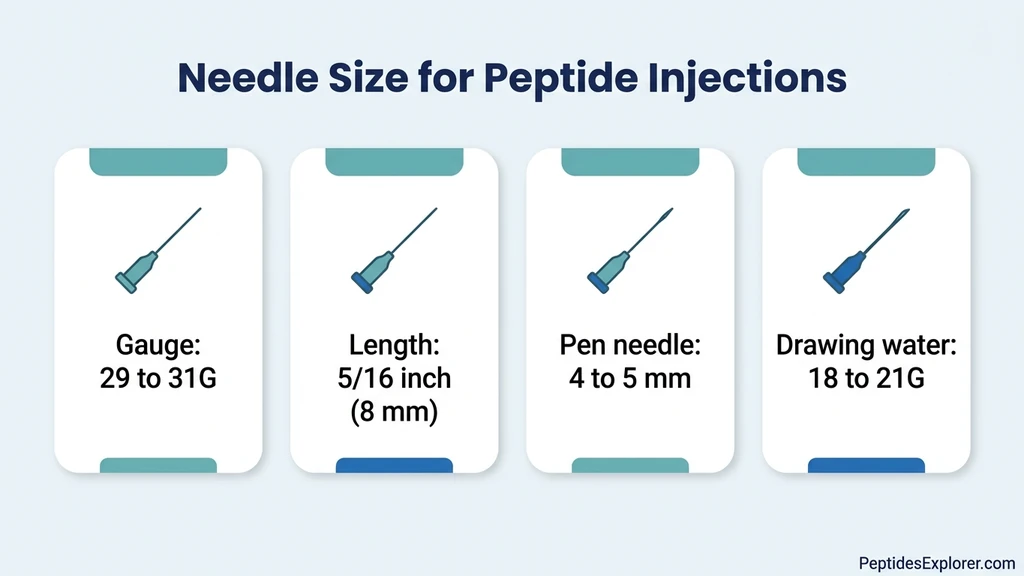
You are at the pharmacy counter, or on a supply site, staring at a wall of boxes: 29G, 31G, 5/16 inch, 1/2 inch, 0.3 mL, 1 mL. Here is the answer: for subcutaneous peptide injections, use a U-100 insulin syringe with a fixed 29 to 31 gauge needle, 5/16 inch (8 mm) long, in the 0.3 mL or 0.5 mL size. That one box covers BPC-157, tirzepatide, growth hormone secretagogues and nearly every other research peptide injected under the skin.
| Peptide type | Syringe | Gauge | Needle length |
|---|---|---|---|
| Daily low-volume subcutaneous (BPC-157, TB-500, ipamorelin) | 0.3 or 0.5 mL U-100 insulin | 29 to 31G | 5/16 inch (8 mm) |
| Weekly GLP-1 from a vial (tirzepatide, semaglutide, retatrutide) | 0.5 mL U-100 insulin | 29 to 31G | 5/16 inch (8 mm) |
| Brand GLP-1 pen | Pen needle | 31 to 32G | 4 to 5 mm |
| Very lean limbs | 0.3 mL U-100 insulin | 31G | 6 mm, or a 4 mm pen needle |
| Drawing bacteriostatic water for reconstitution | 3 mL luer-lock | 18 to 21G | 1 to 1.5 inch |
| Intramuscular (rare for peptides) | 1 to 3 mL luer-lock | 22 to 25G | 1 to 1.5 inch |
This page covers the hardware only: gauge, length, syringe size, drawing versus injecting, and disposal. Where on the body to inject is in the peptide injection sites guide, the needle-to-skin technique in how to inject peptides, and mixing the powder in how to reconstitute a peptide.
Get your custom peptide protocol:
- Tailored to your body and goals
- Precise dosing and cycle length
- Safe stacking combinations
- Backed by peer-reviewed studies
- Ready in under 2 minutes
What the Gauge Number Means: Higher Is Thinner
Gauge works like shotgun bore: the number counts how many of something fit into a fixed space, so a bigger number means a smaller item. A 31G needle is thinner than a 29G, and an 18G drawing needle is a drinking straw next to either.
Literally stated: gauge is the outer diameter of the needle tube, and the scale runs backwards. Between 29G and 31G the difference is 0.08 mm, a quarter of the width of a human hair.
| Gauge | Outer diameter | Typical use |
|---|---|---|
| 18G | 1.27 mm | Drawing bacteriostatic water into a 3 mL syringe |
| 21G | 0.82 mm | Drawing water or a large reconstituted volume |
| 25G | 0.51 mm | Intramuscular injection in a lean limb |
| 27G | 0.41 mm | Intramuscular injection, small volumes |
| 29G | 0.34 mm | Subcutaneous; easiest insulin syringe to draw with |
| 30G | 0.31 mm | Subcutaneous; the standard choice |
| 31G | 0.26 mm | Subcutaneous; least pain, slowest draw |
| 32G | 0.23 mm | Pen needles only |
Thinner hurts less, and the effect has been measured. In a controlled insertion study, 63% of 23G insertions caused pain, 53% of 27G insertions, and 31% with a 32G needle; insertions that bled were about 1.3 times more painful (Arendt-Nielsen et al., Somatosens Mot Res, 2006, PMID 16846958).
The cost of thin is draw speed and fragility. A 31G needle pulls a 0.3 mL dose in a few seconds, bends if you lever it against the stopper, and dulls after one puncture. For the watery solutions peptides make, 30G is the usual compromise; 29G if you fight stiff stoppers, 31G if pain is the problem.
Needle Length: Why 5/16 Inch Beats 1/2 Inch for Almost Everyone
Skin is thinner than most people picture. Ultrasound of 388 adults put mean skin thickness at 1.9 mm on the thigh, 2.2 mm on the abdomen and arm, and 2.4 mm on the buttocks, with the fat layer underneath averaging 10.4 mm on the thigh and 13.9 mm on the abdomen (Gibney et al., Curr Med Res Opin, 2010, PMID 20429833). A needle only has to clear 2 mm of skin to reach fat.
Longer needles reach muscle, which is the thing to avoid. With an 8 mm needle inserted straight in without a pinch, the estimated risk of an intramuscular injection is 25% at the thigh and 9.7% at the abdomen; with a 4 mm needle those risks fall to 1.6% and 0.1% (Hirsch et al., Diabetes Technol Ther, 2014, PMID 25329935). In the leanest adults the skin-to-muscle distance at the thigh was under 3 mm.
Shorter also works just as well. In 274 obese adults with a mean BMI of 37, a 4 mm × 32G pen needle delivered the same glycemic control as 8 mm and 12.7 mm needles, hurt less, and leaked no more (Bergenstal et al., Mayo Clin Proc, 2015, PMID 25662503). The international FITTER recommendations name the shortest needles, 4 mm for pens and 6 mm for syringes, as the first-line choice in every patient category (Frid et al., Mayo Clin Proc, 2016, PMID 27594187).
| Needle length | Inches | Found on | Angle and pinch |
|---|---|---|---|
| 4 mm | 5/32 | Pen needles | 90 degrees, no pinch |
| 5 to 6 mm | about 1/4 | Pen needles, some insulin syringes | 90 degrees, no pinch |
| 8 mm | 5/16 | Short insulin syringes | 90 degrees in a pinched fold, or 45 degrees |
| 12.7 mm | 1/2 | Standard insulin syringes | 45 degrees in a pinched fold only |
| 25 to 38 mm | 1 to 1.5 | Luer-lock needles | Intramuscular only |
For a peptide user drawing from a vial, the practical answer is the 5/16 inch (8 mm) insulin syringe. The 1/2 inch version needs a firm pinch and a 45 degree angle every time, which is why the tirzepatide injection walkthrough specifies the short needle.
Insulin Syringes: 0.3, 0.5 and 1 mL, and What U-100 Means
U-100 means 100 units per millilitre, so 1 unit is 0.01 mL. The unit is a volume mark on the barrel and nothing more; it does not know whether the syringe holds insulin, semaglutide or BPC-157. How many micrograms a unit carries depends on the concentration you mixed, which is the job of the peptide unit converter.
| Syringe | Capacity | Mark spacing | Best for draws of |
|---|---|---|---|
| 0.3 mL | 30 units | every 0.5 unit (some every 1 unit) | 2 to 25 units |
| 0.5 mL | 50 units | every 1 unit | 10 to 45 units |
| 1 mL | 100 units | every 2 units | 40 to 100 units |
Worked once: 5 mg of BPC-157 in 2 mL of water is 2.5 mg/mL, or 2,500 mcg/mL. A 250 mcg dose is 0.1 mL, which is 10 units, and it belongs on a 0.3 mL syringe where the half-unit marks make 10 easy to hit. A 2.5 mg tirzepatide dose at 10 mg/mL is 25 units, worked through in how many units is 2.5 mg of tirzepatide; 7.5 mg at the same concentration is 75 units and needs the 1 mL barrel, per how many units is 7.5 mg of tirzepatide.
Two labels to check before buying. "U-100" must be on the box; a U-40 syringe puts you off by 2.5x. And "fixed needle" means the needle is bonded to the barrel with almost no dead space, so the dose you see is the dose you inject. A detachable luer-slip needle traps a few hundredths of a millilitre in the hub, which on a 10-unit draw is a 20 to 50% loss.
Draw With a Big Needle, Inject With a Small One
An insulin syringe is built to do both jobs with one fixed needle, and for a dose under 1 mL that is what you should do: swab, draw, inject. The two-needle method belongs to a narrower set of situations.
Use a separate drawing needle when you pull more than 1 mL at a time, which mostly means bacteriostatic water for reconstitution. Pulling 2 mL through a 31G takes a minute of plunger strain and bends the tip; an 18 to 21G needle on a 3 mL luer-lock syringe does it in seconds. The procedure is in how to reconstitute tesamorelin, and the water itself in where to buy bacteriostatic water.
Some people draw a dose with a wide needle and swap to a fine one for the injection, because every pass through rubber dulls the tip. The swap needs a detachable-needle syringe, which brings back the dead-space loss above; a fixed 31G after one stopper pass is sharp enough.
- 1.Match the syringe to the volume. Under 1 mL: insulin syringe, fixed needle, no swap. Over 1 mL: 3 mL luer-lock with an 18 to 21G drawing needle.
- 2.Never inject with the drawing needle. 18G is 1.27 mm wide, five times a 31G. It bleeds, bruises and hurts.
- 3.If you swap needles, swap before expelling air. Attach the injection needle, then push the plunger to the dose line so the hub fills.
- 4.Enter the stopper at 45 degrees, bevel up, then straighten. A wide needle pushed straight down cores the rubber and drops flecks into the vial.
- 5.One needle, one puncture, one injection. A used needle goes into the sharps container, never back into the vial.
Subcutaneous vs Intramuscular: Length by Body Fat and Site
Almost every research peptide, from TB-500 to retatrutide, is injected subcutaneously, into the fat under the skin. A 29 to 31G, 8 mm insulin needle does that on the abdomen, thigh, upper buttock and back of the arm, with pinch and angle adjusted to the site as mapped in the GLP-1 injection sites guide.
Body fat changes the margin, not the needle. Each 10 kg/m² of BMI adds about 4 mm of subcutaneous fat, and women carry about 5 mm more than men at the same site (Gibney et al., Curr Med Res Opin, 2010, PMID 20429833). A heavier user has room for 8 mm at 90 degrees; a lean man injecting a thigh has the least, and should pinch and angle, or drop to a 6 mm or 4 mm needle.
Intramuscular injection is a different tool: a 22 to 25G needle 1 to 1.5 inches long on a luer-lock syringe. It has to actually reach muscle, and a systematic review of deltoid ultrasound studies found that in every BMI category except underweight, some adults need a needle longer than 25 mm to clear the fat (Kearns et al., BMJ Open, 2023, PMID 36669836). Few peptide protocols call for it, and a subcutaneous dose that lands in muscle by accident is a dosing error: intramuscular insulin absorbs fast enough to cause hypoglycemia, which is why injection-technique guidelines say to avoid it (Frid et al., Mayo Clin Proc, 2016, PMID 27594187). Site-specific questions, such as injecting near an injury, belong to how to inject BPC-157.
Less Pain, Single Use, and Where the Needle Goes Afterward
Most injection pain comes from four controllable things: needle width, a dulled tip, cold liquid, and alcohol that has not dried. Use 30 or 31G, a fresh needle every time, 10 minutes at room temperature after the fridge, and 10 seconds after the swab.
Reuse is the habit that undoes the rest. A meta-analysis of 51 studies found that reusing needles raised the odds of lipohypertrophy, the rubbery fat lumps that distort absorption, by 3.2 times, second only to failing to rotate sites at 8.85 times (Mader et al., J Diabetes Sci Technol, 2026, PMID 40109173). A 31G tip that has been through a stopper and skin once is already blunted; a second pass tears tissue instead of parting it. Insulin syringes cost cents each. Buy a box of 100.
Every used syringe goes into a sharps container: an FDA-cleared red bin from the pharmacy, or a heavy plastic bottle with a screw cap, labelled, never a glass jar or a bag. When it is three-quarters full, seal it and follow your local rule, which in most of the US means a pharmacy drop-off, a hazardous-waste day, or a mail-back kit. Keeping the vial itself between draws is covered in how to store peptides.
Where to buy syringes depends on where you live. In the United States, insulin syringes are sold over the counter at most pharmacies, but the rules vary by state: some sell any quantity without a prescription, some cap the number per purchase, some ask for ID, and a few require a prescription. Online medical-supply retailers ship boxes of 100 to most states. Ask for "U-100 insulin syringes, 31 gauge, 5/16 inch, 0.3 mL" and you get the right box; the rest of the kit is in the peptide safety guide.
Three Quantified Mistakes
A 1/2 inch needle straight into a lean thigh. Median skin-to-muscle distance at the thigh is 10.9 mm and the minimum is under 3 mm (Hirsch et al., Diabetes Technol Ther, 2014, PMID 25329935). A 12.7 mm needle at 90 degrees with no pinch ends in muscle in a large share of lean users, where the dose absorbs faster and bruises more. Fix: 5/16 inch in a pinched fold, 45 degrees, or a 6 mm needle.
A 1 mL syringe for a 5-unit draw. The 1 mL barrel marks every 2 units, so a half-tick misread is 1 unit, a 20% error on a 5-unit dose of ipamorelin. The same misread on a 0.3 mL syringe with half-unit marks is 0.25 units, or 5%. Fix: small doses on the 0.3 mL syringe, and the arithmetic through the peptide reconstitution calculator.
One syringe, three days. Reused needles triple the odds of lipohypertrophy, and a dose injected into a lump absorbs erratically (Mader et al., J Diabetes Sci Technol, 2026, PMID 40109173). The saving is a few cents. Fix: one syringe per injection, and rotate sites the way the tirzepatide injection site reaction guide describes.
Frequently Asked Questions
What size needle do you use for peptide injections?
A 29 to 31 gauge needle, 5/16 inch (8 mm) long, on a U-100 insulin syringe. That size clears the 2 mm of skin, stays in the fat layer with a pinch, and draws water-thin peptide solutions without strain. The technique that goes with it is in how to inject peptides.
Is a 29, 30 or 31 gauge needle better for peptides?
All three work subcutaneously. 31G (0.26 mm) hurts least but draws slowest and bends most easily; 29G (0.34 mm) draws fastest from stiff stoppers; 30G splits the difference and is the common default. Pain frequency rises with width: 53% of 27G insertions hurt versus 31% of 32G (PMID 16846958). Dose math for any of them runs through the peptide unit converter.
Can you use an insulin syringe for peptides?
Yes, and it is the standard tool. A U-100 insulin syringe marks 100 units per mL, so 1 unit is 0.01 mL, and the fixed 29 to 31G needle wastes almost nothing. Choose 0.3 mL for draws under 25 units and 0.5 mL up to 50 units. A worked tirzepatide example is in how many units is 2.5 mg of tirzepatide.
Should I use a 5/16 inch or 1/2 inch needle for subcutaneous injections?
5/16 inch (8 mm). Skin averages about 2 mm thick and the fat beneath it 10 to 14 mm, so 8 mm reaches fat with margin, while an 8 mm needle straight in already carries a 25% intramuscular risk at the thigh and a 12.7 mm needle more (PMID 25329935). Site-by-site angles are in the GLP-1 injection sites guide.
What needle do you use to draw bacteriostatic water?
An 18 to 21 gauge needle, 1 to 1.5 inches, on a 3 mL luer-lock syringe. It moves 2 mL in seconds where a 31G insulin needle would take a minute and bend. Enter the stopper at 45 degrees, bevel up, to avoid coring. Never inject with it. The full mixing procedure is in how to reconstitute tirzepatide.
Can you reuse a needle for peptide injections?
No. A 31G tip is blunted after a single pass through rubber and skin, and reuse raised the odds of lipohypertrophy 3.2 times across 51 studies (PMID 40109173). Lumps of lipohypertrophy absorb drug unpredictably. Insulin syringes cost cents; use one per injection and dispose of it in a sharps container, as the peptide safety guide describes.
Do you need a prescription to buy insulin syringes for peptides?
In most US states, no: pharmacies sell U-100 insulin syringes over the counter, though some states cap the quantity, ask for ID, or require a prescription, and online medical-supply retailers ship boxes of 100 to most addresses. Ask for 31 gauge, 5/16 inch, 0.3 mL. What to mix in them is in bacteriostatic water vs sterile water.
The Bottom Line
For subcutaneous peptide injections, buy U-100 insulin syringes with a fixed 29 to 31 gauge needle, 5/16 inch (8 mm) long, in the 0.3 mL size for draws under 25 units and 0.5 mL above that. Draw water for reconstitution with an 18 to 21G needle on a 3 mL syringe, and never inject with it.
The principle: skin is 2 mm thick and fat sits under it, so the needle only has to be long enough to clear the skin and thin enough to forget; every millimetre beyond 8 mm buys intramuscular risk, and every reuse buys a lump.
Research peptides such as BPC-157 and TB-500 are not FDA-approved for any use, and this content is educational, not medical advice. Convert your dose to units with the peptide unit converter, and find the rest of the injection cluster at PeptidesExplorer.
Related Articles
How to Inject Sermorelin: Step-by-Step Guide
How to inject sermorelin step by step: 29 to 31G insulin syringe, units vs mcg math, the pinch, 45 vs 90 degrees, bedtime on an empty stomach, common mistakes.
Where to Inject KPV: Best Sites and Technique
Where to inject KPV: belly fat, outer thigh, arm or flank with a 29 to 31G insulin needle. Why the site barely matters, rotation grid and step-by-step.
Best Time to Take MOTS-c: Morning, Fasted or Night?
Best time to take MOTS-c: morning, fasted, 30 to 60 minutes before cardio. The eating window after the shot, daily vs 3x a week, night dosing, missed doses.
How Long Does KPV Take to Work? Timeline
How long does KPV take to work: gut symptoms in 1 to 2 weeks, skin in 2 to 4, systemic inflammation in 2 to 6. Half-life, onset by route, and when to stop.